1

Athletic Trainer Internship Jobs (NOW HIRING)

Supervise athletic training interns/students (must serve as Preceptor to athletic training students as assigned) Assist / Manage treatment scheduling, oversee medical records, maintain/update ...

Supervise athletic training interns/students (must serve as Preceptor to athletic training students as assigned) Assist / Manage treatment scheduling, oversee medical records, maintain/update ...

Supervise athletic training interns/students (must serve as Preceptor to athletic training students as assigned)Assist / Manage treatment scheduling, oversee medical records, maintain/update ...

Supervise athletic training interns/students (must serve as Preceptor to athletic training students as assigned)Assist / Manage treatment scheduling, oversee medical records, maintain/update ...

Athletic Trainer

Oklahoma City, OK ยท On-site

$50K - $55K/yr

Athletic Trainer Job no: 492812 Work type: Regular Full-Time Staff Location: Main Campus, Oklahoma ... Experience in higher education is preferred, however, previous student employment and/or internship ...

Athletic Trainer

Campus, IL

$22 - $30/hr

Athletic Trainer Apply now Job no: 492812 Work type: Regular Full-Time Staff Location: Main Campus ... Experience in higher education is preferred, however, previous student employment and/or internship ...

next page

Showing results 1-20

Athletic Trainer Internship information

See salary details

$12

$26

$38

How much do athletic trainer internship jobs pay per hour?

As of Jul 4, 2026, the average hourly pay for athletic trainer internship in the United States is $26.18, according to ZipRecruiter salary data. Most workers in this role earn between $21.63 and $29.57 per hour, depending on experience, location, and employer.

What are the key skills and qualifications needed to thrive as an Athletic Trainer Intern, and why are they important?

To thrive as an Athletic Trainer Intern, you need foundational knowledge in exercise science, injury prevention, and rehabilitation, usually supported by coursework in athletic training or a related field. Familiarity with taping techniques, first aid/CPR certification, and experience using rehabilitation equipment are typically expected. Strong communication, attention to detail, and teamwork skills help interns effectively support athletes and collaborate with coaches and medical staff. These competencies are vital to ensure athlete safety, promote recovery, and contribute to a positive and efficient sports environment.

What Are the Qualifications to Get an Athletic Trainer Internship?

To obtain an athletic trainer internship, you need to be enrolled in an undergraduate or graduate program focused on sports medicine, physical therapy, or a related field. Having experience as a student-athlete is also very helpful and provides insight into effective training techniques, common sports injuries, and how they can be prevented. You should have strong observational skills and attention to detail because you need to continually assess the performance of the athletes, discuss issues with the coach or other trainers, and be able to determine when an athlete needs further medical assistance. Excellent verbal and written communication skills are also essential. Network with local coaches and sports teams to find athletic trainer internship opportunities.


What is the difference between Athletic Trainer Internship vs Athletic Trainer?

AspectAthletic Trainer InternshipAthletic Trainer
CredentialsTypically requires enrollment in a related degree program; certification not yet obtainedRequires BOC certification and state licensure
Work EnvironmentInternship sites such as sports teams, clinics, or schools, under supervisionFull-time professional setting, including sports teams, clinics, or hospitals
ResponsibilitiesAssisting with injury prevention, basic treatment, and observationPerforming injury assessments, developing treatment plans, and rehabilitation

In summary, an Athletic Trainer Internship is a training period for students gaining practical experience before becoming certified Athletic Trainers. Once certified, Athletic Trainers take on full responsibilities in injury management and prevention in various sports and healthcare settings.

What kinds of hands-on experiences can I expect during an Athletic Trainer Internship?

As an Athletic Trainer Intern, you'll typically gain hands-on experience by assisting with injury prevention, evaluation, and rehabilitation for athletes under the supervision of certified athletic trainers. You'll often be involved in daily activities such as taping, stretching, preparing athletes for practices or games, and documenting injury reports. Interns also observe and participate in emergency response protocols, giving you exposure to real-time decision-making. These practical experiences help you build foundational skills, confidence, and professional relationships within sports medicine teams.

What is an Athletic Trainer Internship?

An Athletic Trainer Internship is a supervised, hands-on learning experience where students or recent graduates work under certified athletic trainers to gain practical skills in injury prevention, assessment, treatment, and rehabilitation of athletes. Interns typically assist with daily operations, learn to apply therapeutic techniques, and observe injury management in real-world settings such as schools, colleges, or sports teams. This internship is a critical step for those pursuing a career in athletic training, as it provides valuable exposure to the demands and responsibilities of the profession.
What cities are hiring for Athletic Trainer Internship jobs? Cities with the most Athletic Trainer Internship job openings:
What are the most commonly searched types of Athletic Trainer jobs? The most popular types of Athletic Trainer jobs are:
What states have the most Athletic Trainer Internship jobs? States with the most job openings for Athletic Trainer Internship jobs include:
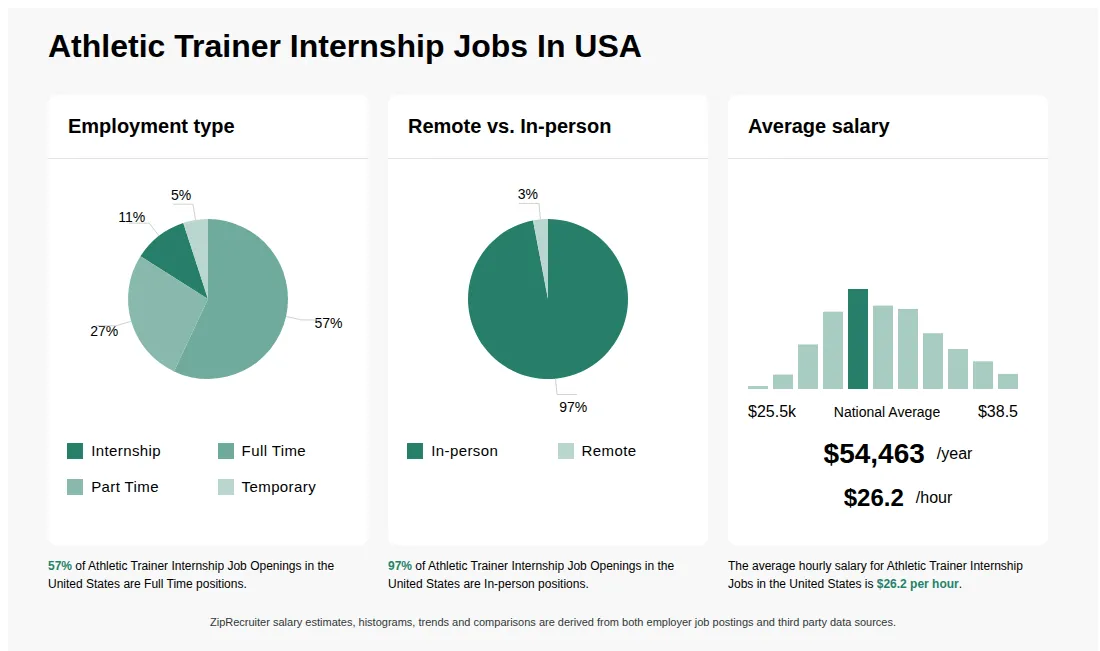
Infographic showing various Athletic Trainer Internship job openings in the United States as of June 2026, with employment types broken down into 4% Internship, 2% As Needed, 65% Full Time, 26% Part Time, 1% Temporary, and 2% Contract. Highlights an 90% Physical, 1% Hybrid, and 9% Remote job distribution, with an average salary of $54,463 per year, or $26.2 per hour.
Athletic Trainer

$6.2K - $6.6K/mo

Other

This job post hasย expired 1 day ago.ย Applications are no longer accepted.


Job description

Position Information
Job Title Athletic Trainer Position Type Classified Position Code 3CPE04 FTE 1.0 Pay Rate (or Annual Salary) $6,290.17 - $6,612.75/month Job Location Las Positas College, 3000 Campus Hill Dr., Livermore, CA 94551 Department Business, Health, Athletics, Work Experience, and Kinesiology Job Summary
Las Positas College
Las Positas College provides an inclusive, learning-centered, equity-focused environment that offers educational opportunities and support for completion of students' transfer, degree, and career-technical goals while promoting lifelong learning. At Las Positas College we know that equity will be achieved by changing the impacts of structural racism, ableism, homophobia, and systematic poverty on student success and access to higher education, achieved through continuous evaluation and improvement of all services. We believe in a high-quality education focused on learning and an inclusive, culturally-relevant environment that meets the diverse needs of all our students and staff.
Equity is parity in student educational outcomes; it places belonging for students of color and disproportionately impacted students at center focus. Our prized and emerging equity efforts include Puente, Umoja, ConnectUp, Brother 2 Brother, Sister 2 Sister, Black Student Union, Presidential Task Force on Systemic and Institutionalized Racism, the Presidential Speaker Series, Black Education Association, UndocuAlly Taskforce, curriculum reviews and a linguistic justice curriculum.
Located in Livermore, Las Positas College is becoming an institution that reflects the diversity in California. We are a learning-centered institution focused on excellence and student success, and are fully committed to supporting all Tri-Valley residents in their quest for education and advancement.
Joining Our College Community
We seek equity-minded applicants who demonstrate they understand the benefits diversity brings to an educational community. We look for applicants who:
  1. Value and intentionally promote diversity and consciousness of difference
  2. Demonstrate cultural humility and an ongoing desire to improve cultural competence
  3. Are dedicated to addressing issues of social justice
  4. Accept their shared role and responsibility in addressing opportunity and achievement gaps experienced by students
  5. Have experience and success in closing student equity gaps and engaging in equitable practices, or are knowledgeable and enthusiastic about implementing practices that achieve these goals
  6. Actively seek to identify, disrupt, and remove institutional and/or systemic barriers that adversely impact historically marginalized communities
  7. Empower the underrepresented and underserved
  8. Foster students' potential to become global citizens and socially responsible leaders
  9. Believe that all people have the right to an education and work environment free from fear, harassment, or discrimination
The Chabot-Las Positas Community College District is seeking an Athletic Trainer for Las Positas College in Livermore, California.
Under direction, participate in the development, organization, implementation, and supervision of a comprehensive sports medical program for the care, treatment, rehabilitation, and prevention of physical injuries to athletes in the District's intercollegiate athletics programs; attend athletic events and serve as first responder in case of athletic emergencies or injury; and train and supervise assistant/associate athletic trainers, graduate assistant athletic trainers, and student athletic training interns.
This is a grant/categorically funded position. Continuation of this position is contingent upon available funding on a year to year basis.
Representative Duties
The following duties are typical for this classification. Incumbents may not perform all of the listed duties and/or may be required to perform additional or different duties from those set forth below to address business needs and changing business practices.
1. Participate in the development and implementation of sports medical programs including injury prevention programs, injury evaluations, injury management, injury treatment and rehabilitation, educational programs, and counseling for student athletes.
2. Prepare written policies and procedures in collaboration with the team physician regarding emergency management, treatment, and reconditioning of injuries for athletes; participate in annual review and update of established programs as necessary.
3. Oversee, direct, and schedule the day-to-day activities of the athletic training staff including the recruitment, guidance, training, and evaluation of assistant/associate athletic trainers, graduate assistant athletic trainers, and student athletic training interns in the performance of their duties.
4. Schedule and coordinate athletic training staff and students for coverage of all team practices and athletic competitions.
5. Attend athletic practices and events as required; render emergency First Aid treatment; provide preventative and emergency care for visiting teams as necessary.
6. Provide athletic training services to athletic teams at home and during travel; apply preventive and protective taping and padding for athletes; tape ankles, knees, wrists, elbows, shoulders, and ribs of athletes prior to practice or games.
7. Administer first aid and emergency medical care including lifesaving procedures to student athletes; in the absence of the team physician, make decisions concerning the ability of the injured athlete to participate.
8. Coordinate with strength and conditioning staff to ensure safety in the design and implementation of fitness, nutrition, and conditioning programs customized to meet individual student athlete needs.
9. Evaluate athletic injuries; administer conditioning/rehabilitation by use of massage, heat, cold, and vibration of hydro-whirlpool as prescribed by team physician; recommend treatment of athletes.
10. Administer the use of rehabilitation equipment; operate related therapeutic modalities as directed by the team's physician; maintain treatment room equipment in a clean and orderly condition.
11. Refer injured students to the team physician, college health center, or appropriate medical facility as necessary.
12. Coordinate and schedule physical examinations and medical referrals for student-athletes to determine their ability to practice and compete.
13. Assist the college physician and health personnel with athletic health screening examination arrangements.
14. Inspect and evaluate dressing rooms, showers, playing fields, and athletic equipment to reduce hazards.
15. Assist in the development of the sports medical program budget; prepare budget for athletic first aid medical supplies and equipment; assist in the ordering of training room supplies and equipment.
16. Research, evaluate, and recommend new techniques and equipment that would enhance the benefit of the sports medical program.
17. Facilitate communication between athletes, coaches, parents, administration, and community concerning the health and physical status of athletes.
18. With the advice of the insurance agent, review athletic insurance coverage and assist student athletes and staff in the correct submission of insurance claims.
19. Provide information to athletes on the care and prevention of athletic injuries; inform and advise athletes on various health topics including nutrition and diet.
20. Work to assist athletes with various personal, social, and educational problems as well as goals and objectives; provide professional referrals as appropriate.
21. Maintain accurate and detailed injury and treatment reports about student athletes; prepare, maintain, and update a variety of forms, records, and reports including physicals, daily treatment logs, injury evaluation forms, daily coach's report and student trainer hours.
22. Perform related duties as required.
Minimum Education and Experience
Any combination of the following would provide a typical way to obtain the required knowledge and abilities.
Education/Training:
A Bachelor's degree from an accredited college or university with major course work in sports medicine, physiology, anatomy, health education, physical education, or a related field.
Experience:
Two years of responsible experience working as a certified athletic trainer preferably working in an athletic program at the secondary level or higher.
LICENSE OR CERTIFICATE
Certified by the National Athletic Trainers' Association Board of Certification.
Valid First Aid and CPR certificate issued by the American Red Cross.
Valid California driver's license and a safe driving record.
Minimum Qualifications
The following generally describes the knowledge and ability required to enter the job and/or be learned within a short period of time in order to successfully perform the assigned duties.
Knowledge of:
1. Policies, procedures and objectives of an athletic program including health and safety regulations.
2. Athletic sports medicine practices used in the prevention and treatment of sports injuries, including conditioning techniques and practices.
3. Symptoms of various injuries and appropriate first aid treatment.
4. Principles and practices of ImPACT neurocognitive concussion baseline testing and post concussive testing.
5. Principles, methods, equipment, and basic theory of therapeutic and physical rehabilitation.
6. Conditioning and rehabilitation programs relevant to athletic injuries and illnesses.
7. Equipment and devices used to treat and rehabilitate injured athletes.
8. Human anatomy, physiology, kinesiology, and exercise physiology.
9. Common athletic injuries and athletics psychology.
10. OSHA guidelines regarding blood borne pathogens.
11. First aid, CPR, and other emergency medical practices and procedures including taping, wrapping, and bandaging techniques.
12. Rules and regulations of a variety of sports and athletic activities including familiarity with CCCAA and NCAA governing rules.
13. Principles of supervision and training.
14. Office procedures, methods, and equipment including computers.
15. Principles and procedures of record keeping.
16. Interpersonal skills using tact, patience and courtesy.
17. Basic housekeeping methods.
18. Basic mathematical principles.
19. Oral and written communication skills.
Ability to:
1. Administer preventive measures, first aid, CPR, emergency care, and rehabilitative treatments to athletes in various intercollegiate sports.
2. Administer ImPACT neurocognitive concussion baseline testing and post concussive testing.
3. Evaluate the nature and extent of injuries to determine the need for immediate medical attention and the participation status of athletes.
4. Identify symptoms of various injuries and take appropriate action.
5. Evaluate and treat a variety of athletic and physical education injuries accurately.
6. Analyze situations accurately and adopt an effective course of action.
7. Operate a variety of therapeutic equipment and devices used to treat athletic injuries.
8. Tape, wrap, and bandage body joints and apply protective pads and equipment.
9. Understand and follow physicians' prescriptions and technical instructions.
10. Administer preventive measures, first aid, CPR, emergency care, and rehabilitative treatments to athletes in various intercollegiate sports.
11. Maintain current knowledge of treatment modalities and preventive techniques related to sports injuries.
12. Prepare and maintain accurate and timely records related to insurance, injuries, treatment, athletic equipment and supplies, and inventory.
13. Work independently with little direction.
14. Meet schedules and timelines.
15. Supervise, train, and provide work direction to student workers.
16. Understand and follow oral and written directions.
17. Travel to athletic events as requested and work outside normal business hours.
18. Communicate clearly and concisely, both orally and in writing.
19. Establish and maintain effective working relationships with those contacted in the course of work.
20. Work with and exhibit sensitivity to and understanding of the varied racial, ethnic, cultural, sexual orientation, academic, socio-economic, and disabled populations of community college students.
Desirable Qualifications Job Work Schedule
40 hours/week, Monday - Friday, 8:00 a.m. - 5:00 p.m., hours may vary depending on department needs, occasional evening and weekends required as needed, 10 months/year.
Physical Demands and Working Environment
The conditions herein are representative of those that must be met by an employee to successfully perform the essential functions of this job. Reasonable accommodations may be made to enable individuals with disabilities to perform the essential job functions.
Environment:
Work is performed in both indoor and outdoor environments; travel from site to site; frequently works around athletic playing fields; exposure to all types of weather and temperature conditions, blood borne pathogens and bodily fluids. Positions may be required to work evenings, nights, and weekends.
Physical: