1

Art Conservator Jobs (NOW HIRING)

Overview Art House Astoria is a 501(c)(3) nonprofit music and art conservatory dedicated to providing high-quality, affordable arts education to students of all ages and abilities. We offer private ...

New

next page

Showing results 1-20

Art Conservator information

See salary details

$27K

$69.6K

$121.5K

How much do art conservator jobs pay per year?

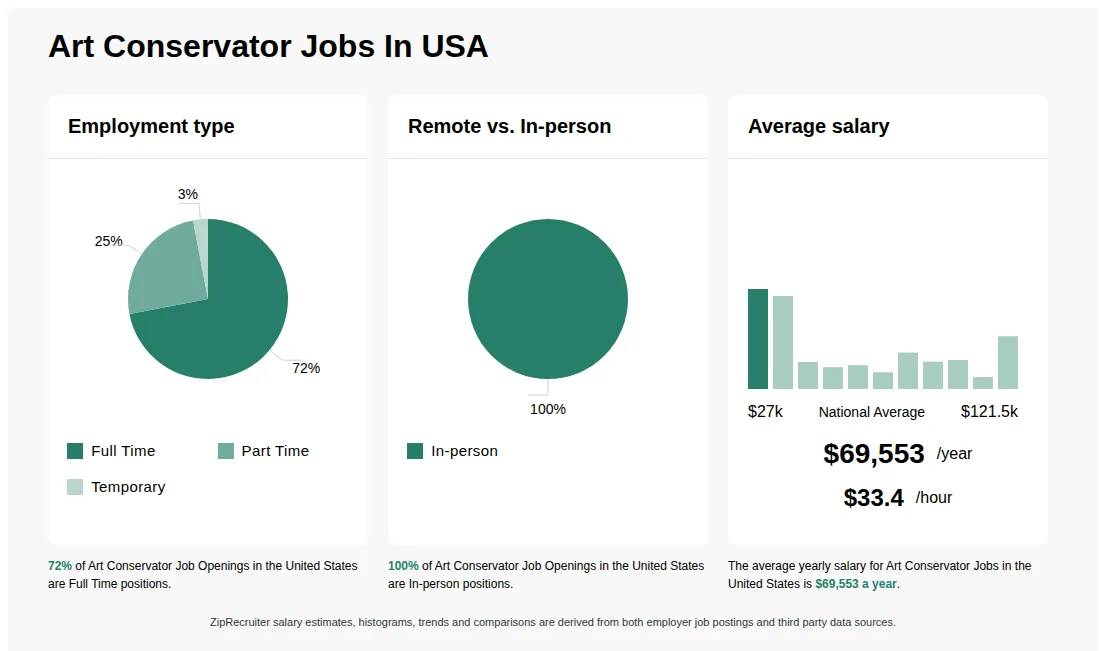
As of Aug 13, 2026, the average yearly pay for art conservator in the United States is $69,553.00, according to ZipRecruiter salary data. Most workers in this role earn between $36,000.00 and $99,500.00 per year, depending on experience, location, and employer.

How much does an art conservator make a year?

The average annual salary for an art conservator in the United States is around $50,000 to $70,000, depending on experience, location, and specialization. Senior conservators or those working in major institutions can earn over $80,000 annually. Many conservators also pursue certifications and advanced training to increase earning potential.

How do you become an art conservator?

To become an art conservator, individuals typically earn a bachelor's degree in art conservation, archaeology, chemistry, or a related field, followed by a master's degree in conservation from an accredited program. Gaining hands-on experience through internships or apprenticeships and obtaining professional certification, such as from the American Institute for Conservation, can enhance job prospects. Strong attention to detail, knowledge of art materials, and skills in scientific analysis are essential for the role.

What is the difference between Art Conservator vs Art Restorer?

AspectArt ConservatorArt Restorer
CredentialsMaster’s degree in conservation or related field, certifications often preferredSimilar credentials, often with specialized training in restoration techniques
Work EnvironmentMuseums, galleries, conservation labs, archivesArt studios, conservation labs, private practices
Primary FocusPreserving and maintaining artworks for long-term stabilityRepairing and restoring artworks to their original appearance
Industry UsageCommonly used in museums, cultural institutions, and conservation organizationsOften used in private restoration projects and art studios

While both Art Conservators and Art Restorers work to preserve artworks, Art Conservators focus on long-term preservation and preventive care, whereas Art Restorers concentrate on repairing and restoring artworks to their original condition. The roles often overlap, but the key difference lies in their primary goals and methods.

Is art conservation a good career?

Art conservators restore and preserve artworks, requiring skills in chemistry, art history, and fine manual work. The profession offers opportunities in museums, galleries, and private collections, but it can be competitive and often requires specialized training and certification. Job stability and salary vary based on experience, location, and employment setting.

What is an art conservator?

Art Conservators are professionals who are trained to preserve, restore, and maintain artworks, historical artifacts, and cultural heritage objects. They use scientific techniques and specialized knowledge to stabilize and repair items, ensuring their longevity and historical integrity. Their work often includes examining objects, assessing damage, performing restoration treatments, and advising on proper storage and display conditions. Art Conservators may specialize in different materials, such as paintings, textiles, sculptures, or paper. Their expertise is crucial for museums, galleries, private collectors, and cultural institutions.

What skills and qualifications are needed to thrive as an art conservator?

To thrive as an Art Conservator, you need expertise in chemistry, fine arts, and art history, often supported by a master's degree in conservation or a related field. Familiarity with scientific analysis tools, conservation lab equipment, and documentation software is typically required. Attention to detail, problem-solving abilities, and strong communication skills distinguish top professionals in this role. These skills and qualities are vital to accurately preserving cultural heritage while safely restoring valuable works of art.

What are some common challenges art conservators face when working on restoration projects?

Art Conservators often encounter challenges such as dealing with deteriorating materials, limited historical documentation, and balancing ethical considerations around preserving original intent versus necessary intervention. Each artwork presents unique problems that require customized treatment plans, careful testing, and sometimes collaboration with historians, scientists, and curators. Additionally, conservators must keep up-to-date with advancements in conservation science to ensure that restoration methods remain effective and reversible, which adds to the complexity and learning involved in the role.
More about Art Conservator jobs
What cities are hiring for Art Conservator jobs? Cities with the most Art Conservator job openings:
Who are the top companies hiring for Art Conservator jobs? The top employers for Art Conservator jobs are:
What states have the most Art Conservator jobs? States with the most job openings for Art Conservator jobs include:
What job categories do people searching Art Conservator jobs look for? The top searched job categories for Art Conservator jobs are:
Infographic showing various Art Conservator job openings in the United States as of August 2026, with employment types broken down into 75% Full Time, and 25% Part Time. Highlights an 98% In-person, and 2% Remote job distribution, with an average salary of $69,553 per year, or $33.4 per hour.

Associate Conservator of Photographic Materials

Philadelphia Museum of Art

Philadelphia, PA • On-site

Full-time

Medical, Dental, Vision, Life, Retirement, PTO

Posted 28 days ago


Job description

We Are Committed to an Inclusive Workplace
At the Philadelphia Museum of Art, we actively seek to employ a diverse group of people who embody our organizational values. We welcome and encourage individuals of all backgrounds to apply, especially those from marginalized and underrepresented groups in the museum field, who are inspired by our shared purpose and enjoy working collaboratively with others.
We are proud to be an equal opportunity employer. All qualified applicants will receive consideration for employment without regard to age, ancestry, citizenship or immigration status, color, disability, ethnicity, familial status, gender identity and/or expression, genetic information, marital status, national origin, race, religion, sex, sexual orientation, veteran status, or any other protected status. 
The Philadelphia Museum of Art welcomes applications for the position of Associate Conservator of Photographic Materials. Working with, and reporting to, the Senior Conservator of Works of Art on Paper, the Conservator will perform conservation examinations and treatments on the museum’s collection of over 35,000 photographic works of art. 
The PMA holds significant works that encompass the history of photography, including: early cased daguerreotypes, ambrotypes, and tintypes, black and white salted paper, albumen, collodion, gelatin silver, and platinum prints, analog color photographs and a growing collection of digitally printed images. The collection also contains matrices such as glass, gelatin, and film negatives.
The Conservator will examine, evaluate, document, conserve, and oversee preventative care for a wide range of photographic materials. In collaboration with other museum staff, the Conservator will conduct historical and scientific research to further understanding of the materials and photographic processes used by the artists represented in the collection. They will serve as an integral member of the museum’s paper conservation lab and will participate in activities relating to exhibitions, installations, loans, preventive care of the permanent collections, and professional and public engagement.
Specifically, you will:
 
  • Examine, document, conduct research, and perform conservation treatment on a broad range of photographic materials.
  • Evaluate and document the condition of photographs requested for loan, exhibition, and acquisition consideration.
  • Collaborate with and advise colleagues across the museum on a range of preservation activities, such as housing, installation, storage, handling, packing, and transport of photographic materials.
  • Collaborate with conservation scientists in chemical and instrumental analysis and characterization of photographic materials.
  • Engage professionally with colleagues and the museum community by publishing and presenting technical and historical research, attending conferences and workshops, and pursuing continuing education opportunities to expand and refine knowledge and skills.
  • Work with contemporary artists and studios to document artistic processes and preservation goals.
  • Serve as an integral member on a team of museum colleagues dedicated to the exhibition and preservation of time-based media in the collection.
  • Mentor and train junior conservation staff, post-graduate fellows, interns, and technicians.
  • Participate as a member of the Conservation Division in a range of institutional initiatives and functions, including professional and public engagement.
  • Examine, document, and conduct minor treatments on prints and drawings as assigned.

Your background and experience include:
  • Graduate degree from a recognized Art Conservation training program, with a specialization in photographic materials and general training in the care and conservation of works of art on paper.
  • A minimum of 5 years professional experience beyond the degree in the study, preservation, and treatment of photographic materials.
  • Proven ability to plan and execute a variety of conservation treatments on photographs and other works of art on paper.
  • Experience collaborating with aligned professionals on the conservation of time-based media.
  • Experience/interest in microfadometry analysis of photographs.
  • Demonstrated visual, manual, and scholarly aptitudes. Strong written and verbal communication skills.
  • Strong organizational skills, attention to detail, and the ability to work both independently and collaboratively.

Position and Compensation Details
  • The salary for this position is $72,000.
  • This position is Full-Time, Exempt, and 35 hours per week.
  • This position is part of the AFSCME Local 397 bargaining unit.
  • This position reports to The Charles K. Williams, II, Senior Conservator of Works of Art on Paper
  • Physical requirements:
    • Able to remain stationary for extended periods of time, to utilize computers and other office equipment required of this job, to perform physically administrative duties in a typical interior office environment, gallery, or exhibit space, and to access most public and staff areas of the museum campus
  • Background check required after a conditional job offer is made. Consideration of the background check will be tailored to the requirements of the job.

Institutional Requirements
 
  • Upholds the professional standards of the field, always acts in a manner that is consistent with the best interests of the museum and protects and enhances its reputation and standing within the community of museums.
  • Adheres to the museum’s code of ethics and Employee Handbook and avoids any real or perceived conflicts of interest.
  • Shows respect for co-workers and visitors and an understanding of and appreciation for the diversity of the museum’s staff, volunteers, and audiences.
  • Maintains confidentiality.
  • Adheres to all museum protocols, procedures, rules, and policies.

Application Timeline
Applications will be reviewed on a rolling basis.  We encourage candidates to apply early as the position will close once we have a robust applicant pool or a candidate has been selected.
What We Offer
Our employees are at the center of the museum. As an employee, you will have access to numerous museum perks including, but not limited to:
 
  • Free general admission to the museum for you and your immediate family
  • Discounted guest tickets for admission
  • Discounts on gift memberships
  • Special staff tours and presentations from our curatorial and conservation teams
  • Discounts at the museum restaurant, museum cafés, and museum retail and online stores

We offer a comprehensive benefits package for employees including:
 
  • Medical, dental, and vision benefits
  • Fully paid short-term disability insurance, long-term disability insurance, and life insurance
  • Health savings or flexible spending account program
  • Retirement savings program with museum match
  • Paid vacation, personal days, sick days, and holidays

*Eligibility for certain benefits is based on a variety of factors including the employee’s regular schedule and tenure.
 

Powered by JazzHR

d6sSbCgW17