SOI Archaeologist
Guaynabo, PR · On-site
The successful candidate will lead archaeological field investigations, prepare and review technical documentation, coordinate with the Puerto Rico State Historic Preservation Office (SHPO) and other ...
Guaynabo, PR · On-site
The successful candidate will lead archaeological field investigations, prepare and review technical documentation, coordinate with the Puerto Rico State Historic Preservation Office (SHPO) and other ...
Guaynabo, PR · On-site
The successful candidate will lead archaeological field investigations, prepare and review technical documentation, coordinate with the Puerto Rico State Historic Preservation Office (SHPO) and other ...
Archaeologist Location: Southwestern Arizona Job Code: Arch_AZ_2026 Job Link: SEARCH Job Postings - Direct Applications Position Information SEARCH has immediate openings for Archaeologists to join ...
Archaeologist Location: Southwestern Arizona Job Code: Arch_AZ_2026 Job Link: SEARCH Job Postings - Direct Applications Position Information SEARCH has immediate openings for Archaeologists to join ...
Archaeologist Location: Southwestern Arizona Job Code: Arch_AZ_2026 Job Link: SEARCH Job Postings - Direct Applications Position Information SEARCH has immediate openings for Archaeologists to join ...
Archaeologist Location: Southwestern Arizona Job Code: Arch_AZ_2026 Job Link: SEARCH Job Postings - Direct Applications Position Information SEARCH has immediate openings for Archaeologists to join ...
Archaeologist Location: Southwestern Texas Job Code: TXMon_2026 Job Link: SEARCH Job Postings - Direct Applications Position Information SEARCH has immediate openings for Archaeologists to join our ...
Archaeologist Location: Southwestern Texas Job Code: TXMon_2026 Job Link: SEARCH Job Postings - Direct Applications Position Information SEARCH has immediate openings for Archaeologists to join our ...
Grants, NM · On-site
$40/hr
Archaeologist ID: NPSELMA-002-002 Location: Grants Program: NPS Wage/Hr: $40.00 Hours/Week: 24 Minimum Age: 55 For over 25 years, National Experienced Workforce Solutions (NEW Solutions) has ...
Quick apply
Grants, NM · On-site
$40/hr
Archaeologist ID: NPSELMA-002-002 Location: Grants Program: NPS Wage/Hr: $40.00 Hours/Week: 24 Minimum Age: 55 For over 25 years, National Experienced Workforce Solutions (NEW Solutions) has ...
Guaynabo, PR · On-site
The successful candidate will lead archaeological field investigations, prepare and review technical documentation, coordinate with the Puerto Rico State Historic Preservation Office (SHPO) and other ...
Guaynabo, PR · On-site
The successful candidate will lead archaeological field investigations, prepare and review technical documentation, coordinate with the Puerto Rico State Historic Preservation Office (SHPO) and other ...
Houston, TX · On-site
$70K - $80K/yr
Responsible for writing all, or portions of, archaeological reports at the direction of the Senior Archaeologist. The qualified candidate for this position will assist JMT Senior Archaeologists ...
Houston, TX · On-site
$70K - $80K/yr
Responsible for writing all, or portions of, archaeological reports at the direction of the Senior Archaeologist. The qualified candidate for this position will assist JMT Senior Archaeologists ...
Knoxville, TN · On-site
Archaeologist (OER) A - Level A Knoxville, TN 6-month Full-Time Contract Expenses Allowed for candidates who meet the requirements and qualifications. This is an entry-level position for an ...
Knoxville, TN · On-site
Archaeologist (OER) A - Level A Knoxville, TN 6-month Full-Time Contract Expenses Allowed for candidates who meet the requirements and qualifications. This is an entry-level position for an ...
Archaeologist Location: Southwestern Arizona Job Code: Arch_AZ_2026 Job Link: SEARCH Job Postings - Direct Applications Position Information SEARCH has immediate openings for Archaeologists to join ...
Quick apply
Archaeologist Location: Southwestern Arizona Job Code: Arch_AZ_2026 Job Link: SEARCH Job Postings - Direct Applications Position Information SEARCH has immediate openings for Archaeologists to join ...
Archaeologist Location: Southwestern Arizona Job Code: Arch_AZ_2026 Job Link: SEARCH Job Postings - Direct Applications Position Information SEARCH has immediate openings for Archaeologists to join ...
Quick apply
Archaeologist Location: Southwestern Arizona Job Code: Arch_AZ_2026 Job Link: SEARCH Job Postings - Direct Applications Position Information SEARCH has immediate openings for Archaeologists to join ...
Albuquerque, NM · On-site
ARCHAEOLOGIST FOR THE AAIHS, OEHE JOB LOCATION: Albuquerque Area Office 4101 Indian School Rd NE Suite 225 Albuquerque, NM 87110 SCHEDULE: TO BE DETERMINED DUTIES: The candidate shall: * Researching ...
Quick apply
Albuquerque, NM · On-site
ARCHAEOLOGIST FOR THE AAIHS, OEHE JOB LOCATION: Albuquerque Area Office 4101 Indian School Rd NE Suite 225 Albuquerque, NM 87110 SCHEDULE: TO BE DETERMINED DUTIES: The candidate shall: * Researching ...
Albuquerque, NM · On-site
ARCHAEOLOGIST FOR THE AAIHS, OEHE JOB LOCATION: Albuquerque Area Office 4101 Indian School Rd NE Suite 225 Albuquerque, NM 87110 SCHEDULE: TO BE DETERMINED DUTIES: The candidate shall: * Researching ...
Albuquerque, NM · On-site
ARCHAEOLOGIST FOR THE AAIHS, OEHE JOB LOCATION: Albuquerque Area Office 4101 Indian School Rd NE Suite 225 Albuquerque, NM 87110 SCHEDULE: TO BE DETERMINED DUTIES: The candidate shall: * Researching ...
$70K - $80K/yr
Responsible for writing all, or portions of, archaeological reports at the direction of the Senior Archaeologist. The qualified candidate for this position will assist JMT Senior Archaeologists ...
$70K - $80K/yr
Responsible for writing all, or portions of, archaeological reports at the direction of the Senior Archaeologist. The qualified candidate for this position will assist JMT Senior Archaeologists ...
Archaeologist Location: Southwestern Arizona Job Code: Arch_AZ_2026 Job Link: SEARCH Job Postings - Direct Applications Position Information SEARCH has immediate openings for Archaeologists to join ...
Quick apply
Archaeologist Location: Southwestern Arizona Job Code: Arch_AZ_2026 Job Link: SEARCH Job Postings - Direct Applications Position Information SEARCH has immediate openings for Archaeologists to join ...
Houston, TX · On-site
About the job Archaeologist - Houston, TX Position Summary: Responsible for scheduling, managing, and conducting Phase I-III fieldwork, lab analysis, and research associated with archaeological ...
Houston, TX · On-site
About the job Archaeologist - Houston, TX Position Summary: Responsible for scheduling, managing, and conducting Phase I-III fieldwork, lab analysis, and research associated with archaeological ...
Asheville, NC · On-site
Job Summary The Archaeologist Writer provides technical expertise in archaeological research, laboratory analysis, cultural resource documentation, and technical report development in support of ...
Asheville, NC · On-site
Job Summary The Archaeologist Writer provides technical expertise in archaeological research, laboratory analysis, cultural resource documentation, and technical report development in support of ...
Archaeologist Location: Southwestern Texas Job Code: TXMon_2026 Job Link: SEARCH Job Postings - Direct Applications Position Information SEARCH has immediate openings for Archaeologists to join our ...
Quick apply
Archaeologist Location: Southwestern Texas Job Code: TXMon_2026 Job Link: SEARCH Job Postings - Direct Applications Position Information SEARCH has immediate openings for Archaeologists to join our ...
Saint Charles, MO · On-site
Overview As an Archaeological Field Supervisor (Project Scientist) for Civil & Environmental Consultants, Inc. (CEC), in our St. Louis, MO, you'll manage project teams to navigate today's complex ...
Saint Charles, MO · On-site
Overview As an Archaeological Field Supervisor (Project Scientist) for Civil & Environmental Consultants, Inc. (CEC), in our St. Louis, MO, you'll manage project teams to navigate today's complex ...
Archaeologist Location: Guam Job Code: SOI-Guam- 26 Job Link: SEARCH Job Postings - Direct Applications Position Information SEARCH has an immediate opening for Full-Time Archaeologists to join our ...
Archaeologist Location: Guam Job Code: SOI-Guam- 26 Job Link: SEARCH Job Postings - Direct Applications Position Information SEARCH has an immediate opening for Full-Time Archaeologists to join our ...
Alpharetta, GA · On-site
The archaeologist will conduct research, field surveys, and data recovery initiatives to assist in the identification and evaluation of archaeological sites and will complete project tasks within ...
Alpharetta, GA · On-site
The archaeologist will conduct research, field surveys, and data recovery initiatives to assist in the identification and evaluation of archaeological sites and will complete project tasks within ...
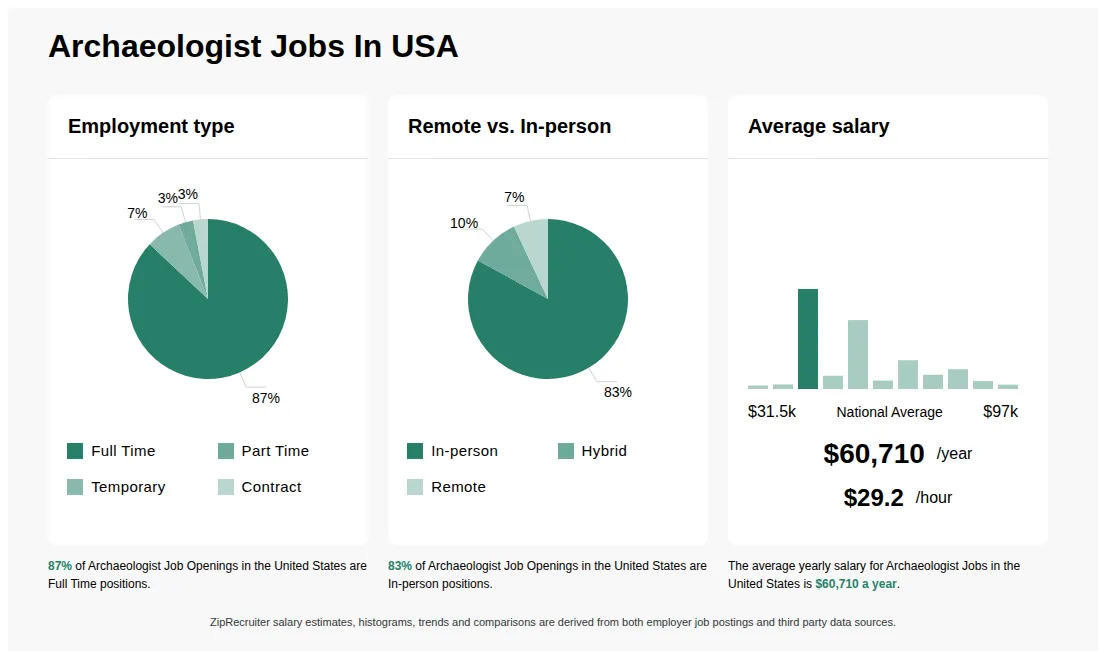
$31.5K - $37.5K
1% of jobs
$37.5K - $43.4K
1% of jobs
$47K is the 25th percentile. Wages below this are outliers.
$43.4K - $49.4K
38% of jobs
$49.4K - $55.3K
4% of jobs
The median wage is $56.6K / yr.
$55.3K - $61.3K
26% of jobs
$61.3K - $67.2K
3% of jobs
$68K is the 75th percentile. Wages above this are outliers.
$67.2K - $73.2K
11% of jobs
$73.2K - $79.1K
5% of jobs
$79.1K - $85.1K
7% of jobs
$85.1K - $91K
2% of jobs
$91K - $97K
1% of jobs
$31.5K
$60.7K
$97K
Archaeologists investigate historic and prehistoric sites and physical remains to understand human links to the past and to preserve past cultures. Archaeologists find clues about the past. They use a variety of extraction or digging techniques. Equipment like trowels, pick-axes, and even bulldozers help archaeologists coordinate and participate in fieldwork to attempt to unearth artifacts, such as pottery, ancient tools, seeds, or animal bones. Archaeologists are also responsible for the conservation of the artifacts they recover. This usually involves bringing the items back to a lab to clean, restore, and stabilize them properly. Data collection is another key duty of the archaeologist. Before, during, and after the dig, the archaeologist records notes, images, soil samples, maps, measurements, and other information about the archaeological site. Archaeologists not only to find information but to use it to educate. Many archaeologists are professors and are involved in publishing and teaching.
| Aspect | Archaeologist | Paleontologist |
|---|---|---|
| Required Credentials | Bachelor's or Master's in Archaeology, Anthropology, or related field | Bachelor's or Master's in Paleontology, Geology, or related field |
| Work Environment | Excavation sites, museums, research labs | Fossil sites, research labs, museums |
| Industry Usage | History, cultural heritage, museums | Natural history, fossil research, museums |
| Common Search/Comparison | Often compared for fieldwork and research focus | Often compared for fossil discovery and study |
Both Archaeologists and Paleontologists work in research environments and require similar academic backgrounds. However, Archaeologists focus on human history and artifacts, while Paleontologists study fossils of ancient plants and animals. Their work settings often overlap, especially in museums and research labs, but their specific expertise and research focus differ significantly.
Cities with the most Archaeologist job openings:
The most popular types of Archaeologist jobs are:
The top employers for Archaeologist jobs are:
States with the most job openings for Archaeologist jobs include:
The top searched job categories for Archaeologist jobs are:
For Archaeologist jobs, the most frequently searched job titles are:

Full-time
This job post has expired 2 days ago. Applications are no longer accepted.
6.4
Based on 42 frontline employees who took The Breakroom Quiz
405th of 453 rated engineering
Get the full story on Breakroom

Sourced by ZipRecruiter
Tetra Tech combines the resources of a global, multibillion-dollar company with local, client-focused delivery in more than 450 locations around the world. Our reputation rests on the technical expertise and dedication of our employees-21,000 associates working together to provide smart, scalable solutions for challenging projects. We are proud to be home to leading technical experts in water, environment, infrastructure, resource management, energy, and international development.
Civil engineering construction and environmental consulting services
10,000+ Employees
Pasadena, CA, US