1

Alligator Jobs (NOW HIRING)

... alligator cameo Adult-focused practice A team that actually supports you instead of piling random work onto your desk Room to scale your income however aggressively you want (this bag is expandable ...

Operate varies pieces of equipment, i.e. alligator shear, tow motor, bobcat skid steer. * Ensures a safe work environment for self and others at all times. * Supplies production facility and/or ...

Non-Ferrous Laborer

Girard, OH · On-site

$13.50 - $17/hr

Operate varies pieces of equipment, i.e. alligator shear, tow motor, bobcat skid steer. * Ensures a safe work environment for self and others at all times. * Supplies production facility and/or ...

Laborer

Poplar Bluff, MO · On-site

$14.75 - $18/hr

Operate small equipment such as a forklift, skid steer, alligator shear and balers. * Identify, separate, and clean up scrap material using various hand tools. * Perform daily inspections on ...

Warren Bridge over Alligator River. As a Construction Inspector with RK&K you will perform complex and routine inspections on materials, processes, safety, and documentation to ensure construction ...

General Laborer

Detroit, MI · On-site

$15 - $18.50/hr

Perform tasks involving physical labor using tools, including but not limited to standard hand tools, torch, bander, chop saw, alligator shear, saw zall, and wire snips. * Identify scrap including ...

General Laborer

Inkster, MI · On-site

$15 - $18.75/hr

Perform tasks involving physical labor using tools, including but not limited to standard hand tools, torch, bander, chop saw, alligator shear, saw zall, and wire snips. * Identify scrap including ...

next page

Showing results 1-20

Alligator information

See salary details

$22

$25

$27

How much do alligator jobs pay per hour?

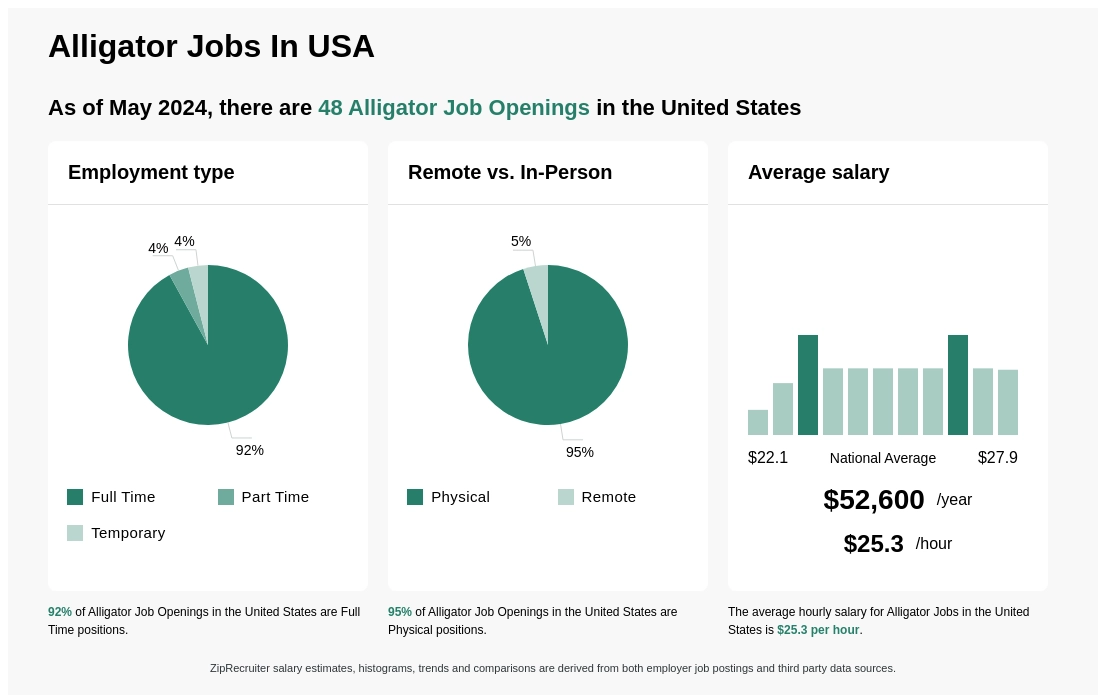
As of Jun 5, 2026, the average hourly pay for alligator in the United States is $25.29, according to ZipRecruiter salary data. Most workers in this role earn between $23.80 and $26.68 per hour, depending on experience, location, and employer.

What are the key skills and qualifications needed to thrive as an Alligator Biologist, and why are they important?

To thrive as an Alligator Biologist, you need a strong background in wildlife biology, ecology, and zoology, often supported by a relevant degree. Familiarity with GPS tracking, wildlife survey methods, and data analysis software is typically required. Exceptional observational skills, problem-solving abilities, and effective communication make someone stand out in this field. These skills ensure accurate research, effective conservation efforts, and safe collaboration with both wildlife and colleagues.

What are the common challenges faced by alligator handlers in a wildlife conservation setting?

Alligator handlers often face unique challenges such as ensuring safety while working closely with these large reptiles, maintaining proper habitats to support their health, and managing stress for both the animals and the handlers during routine checkups or relocations. Teamwork and clear communication are essential, as handlers frequently collaborate with veterinarians, researchers, and other wildlife staff. Staying up to date with best practices in animal care and understanding alligator behavior are also crucial for a safe and effective work environment.

What are alligators in the context of jobs?

In most professional contexts, 'alligator' does not refer to a job title. However, in some industries such as wildlife management, entertainment, or animal care, the term may colloquially describe someone who works closely with alligators, such as an alligator handler, wrangler, or trainer. These professionals are responsible for the care, handling, and sometimes public demonstration of alligators, often working at zoos, wildlife parks, or in environmental conservation. Their duties typically include feeding, habitat maintenance, medical care, and ensuring both animal and public safety during interactions.

What job pays $400,000 a year without a degree?

An alligator trapper or wildlife removal specialist can earn around $400,000 annually by capturing and relocating alligators, often in regions with high demand for safety and pest control. Success in this field depends on experience, skills in handling dangerous animals, and sometimes specialized certifications, with work typically performed outdoors and on a flexible schedule.

What is the difference between Alligator vs Crocodile?

AspectAlligatorCrocodile
Required credentialsWildlife conservation or zoology degree, permits for handlingSimilar credentials, often with additional certifications for handling dangerous animals
Work environmentZoos, wildlife reserves, research facilitiesWild habitats, zoos, research centers
Industry usageWildlife conservation, zoology, educationWildlife management, research, conservation

Alligators and crocodiles share many similarities but differ mainly in habitat, physical features, and behavior. Alligators are typically found in freshwater environments and have broader, U-shaped snouts, while crocodiles prefer saltwater habitats and have pointed, V-shaped snouts. Both roles require similar credentials and are used in wildlife conservation and research settings. Understanding these differences helps in accurate identification and appropriate handling in professional contexts.


What cities are hiring for Alligator jobs? Cities with the most Alligator job openings:
What are the most commonly searched types of Alligator jobs? The most popular types of Alligator jobs are:
What states have the most Alligator jobs? States with the most job openings for Alligator jobs include:
Infographic showing various Alligator job openings in the United States as of May 2026, with employment types broken down into 86% Full Time, and 14% Part Time. Highlights an 100% Physical job distribution, with an average salary of $52,600 per year, or $25.3 per hour.
EKG Tech - Treadmill (Call-In, Varied Shifts)

EKG Tech - Treadmill (Call-In, Varied Shifts)

Diagnostic Laboratory Services, Inc.

Aiea, HI • On-site

Full-time

Posted 8 days ago


Job description

Responsibilities
Effective Date: 02/22
I. JOB SUMMARY/RESPONSIBILITIES:
• Performs EKG tests in patients on a timely basis according to prescribed procedures.
II. TYPICAL PHYSICAL DEMANDS:
• Essential: walking, stooping/bending, seeing, hearing, speaking, lifting patient from sitting to bed with nurse assistance; pushing carts with wheels at less than 50 pounds.
• Continuous: standing, walking, repetitive arm/hand motions, static gripping of an object for prolonged periods; frequent gripping of an object.
• Frequent: sitting, twisting body, finger dexterity, reaching at and below shoulder.
• Occasional: climbing stairs, walking on uneven ground; reaching above shoulders.
• Operates computer, Mac Carts, machine, electrodes, alligator system clips.
III. TYPICAL WORKING CONDITIONS:
• Subjected to both inside and outside environmental conditions.
• Work environment is fast paced and frequently stressful due to volume of workload.
IV. MINIMUM QUALIFICATIONS:
A. EDUCATION/CERTIFICATION AND LICENSURE:
• Academic background necessary to understand basic aseptic and sterile techniques and perform EKG tests.
• Current certification in BLS/HCP.
B. EXPERIENCE:
• Prior experience in patient care and EKG procedures preferred.
• Experience to demonstrate knowledge and ability to operate a computer, including knowledge of Microsoft Office (Word, Outlook and Excel).
Equal Employment Opportunity
Equal Opportunity Employer / Disability / Vet