1

Ai Cancer Research Jobs (NOW HIRING)

AI Architect

Dublin, OH · Remote

$64.50 - $85/hr

AI ArchitectWe are seeking a senior AI Architect to lead the design and development of enterprise AI capabilities across a healthcare and cancer research organization. This role will define the ...

New

AI Architect

Dublin, OH · Remote

$64.50 - $85/hr

AI ArchitectWe are seeking a senior AI Architect to lead the design and development of enterprise AI capabilities across a healthcare and cancer research organization. This role will define the ...

New

Research Scientist

Manhattan, NY · On-site

$120 - $210/hr

Our advisors include AI pioneers such as Yann LeCun and distinguished oncologists from top cancer ... Passion for research, attention to detail and ability to drive tasks to completion. Strong ...

AI Architect

Dublin, OH · Remote

$64.50 - $85/hr

AI ArchitectWe are seeking a senior AI Architect to lead the design and development of enterprise AI capabilities across a healthcare and cancer research organization. This role will define the ...

New

Research Associate

Baltimore, MD · On-site

$90 - $130/hr

... or AI methodologies, with cancer-related applications being especially of interest; 3) clinical ... research would be welcomed and supported as well. In sum, the ideal candidate will have ...

... AI tools to facilitate scientific discovery in domains such as biology, cancer research, neuroscience, social science, etc. • Designing, building, and training machine learning or language models ...

... AI tools to facilitate scientific discovery in domains such as biology, cancer research, neuroscience, social science, etc. • Designing, building, and training machine learning or language models ...

Showing results 21-40

Ai Cancer Research information

See salary details

$111.5K

$206K

How much do ai cancer research jobs pay per year?

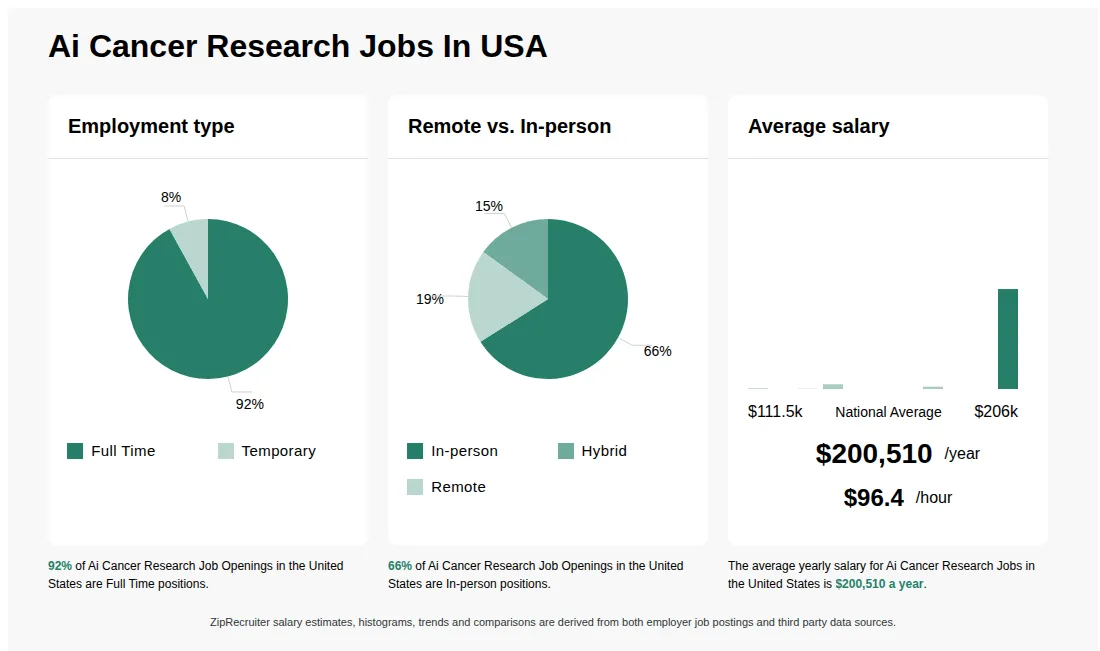
As of Sep 5, 2026, the average yearly pay for ai cancer research in the United States is $200,510.00, according to ZipRecruiter salary data. Most workers in this role earn between $205,000.00 and $205,000.00 per year, depending on experience, location, and employer.

What is AI cancer research?

AI cancer research refers to the use of artificial intelligence technologies, such as machine learning and deep learning algorithms, to improve the detection, diagnosis, treatment, and understanding of cancer. Researchers use AI to analyze large datasets, including medical images and genetic information, to identify patterns and make predictions that can assist doctors and scientists. AI can help in discovering new cancer therapies, personalizing treatment plans, and enhancing early detection, ultimately aiming to improve patient outcomes and advance cancer care.

What are the key skills and qualifications needed to thrive as an AI cancer researcher?

To thrive as an AI Cancer Researcher, you need a strong background in computational biology, machine learning, and oncology, typically supported by an advanced degree in computer science, bioinformatics, or a related field. Proficiency with programming languages (such as Python or R), machine learning frameworks (like TensorFlow or PyTorch), and experience with large-scale biomedical datasets is essential. Critical thinking, problem-solving, and interdisciplinary collaboration are crucial soft skills for driving innovative research and translating findings into clinical impact. These skills and qualifications enable researchers to develop effective AI models that advance cancer diagnosis, treatment, and patient outcomes.

What are the typical challenges faced when integrating AI models into cancer research teams?

Integrating AI models into cancer research often involves navigating challenges such as ensuring high-quality, well-annotated data and fostering effective collaboration between data scientists and clinical researchers. Teams must address the complexity of medical data, maintain patient privacy, and validate AI findings with rigorous scientific standards. Open communication between AI specialists and oncology experts is crucial to develop models that are both accurate and clinically relevant, making interdisciplinary teamwork an essential part of daily responsibilities.

What is the difference between Ai Cancer Research vs Data Scientist in Healthcare?

AspectAi Cancer ResearchData Scientist in Healthcare
Required CredentialsMaster's or PhD in Oncology, Bioinformatics, or related fields; experience with AI and machine learningBachelor's or Master's in Data Science, Computer Science, or related; knowledge of healthcare data
Work EnvironmentResearch labs, hospitals, biotech companiesHospitals, healthcare tech firms, research institutions
Industry UsageFocused on applying AI to cancer diagnosis, treatment, and researchAnalyzing healthcare data for insights, predictive modeling, and decision support

Ai Cancer Research and Data Scientist in Healthcare share skills in data analysis and AI, but Ai Cancer Research specializes in oncology applications, while Data Scientists in Healthcare work across broader medical data domains.

More about Ai Cancer Research jobs

What cities are hiring for Ai Cancer Research jobs?

Cities with the most Ai Cancer Research job openings:

What states have the most Ai Cancer Research jobs?

States with the most job openings for Ai Cancer Research jobs include:

Infographic showing various Ai Cancer Research job openings in the United States as of August 2026, with employment types broken down into 100% Full Time. Highlights an 83% In-person, and 17% Remote job distribution, with an average salary of $200,510 per year, or $96.4 per hour.

AI Architect

DATA INDICATORS LLC

Dublin, OH • Remote

$64.50 - $85/hr

Full-time

Posted 2 days ago

New


Job description

AI ArchitectWe are seeking a senior AI Architect to lead the design and development of enterprise AI capabilities across a healthcare and cancer research organization. This role will define the architecture, standards, and roadmap for Generative AI, machine learning, enterprise search, RAG, AI assistants, and agentic AI.
Key Responsibilities
  • Define enterprise AI architecture, standards, reference designs, and technology roadmap.
  • Architect Generative AI, LLM, RAG, semantic/vector search, AI assistant, and agentic AI solutions.
  • Design secure integrations between AI platforms, enterprise applications, APIs, knowledge repositories, and data platforms.
  • Establish reusable AI services, model-selection patterns, guardrails, evaluation, monitoring, and human-in-the-loop controls.
  • Define standards for MLOps/LLMOps, deployment, model lifecycle management, and monitoring.
  • Partner with data, cloud, security, clinical, research, and application teams to move AI solutions into production.
  • Ensure AI solutions meet requirements for security, privacy, governance, auditability, and responsible AI.
  • Provide technical leadership and communicate architecture, risks, and technology decisions to senior stakeholders.
Required Skills
  • 10+ years in enterprise architecture, solution architecture, data/cloud architecture, software engineering, AI/ML, or related disciplines.
  • Strong enterprise architecture experience with Generative AI and LLM-based platforms.
  • Strong knowledge of:
    • LLMs and Generative AI
    • RAG and enterprise search
    • Embeddings and vector databases
    • AI agents / agentic workflows
    • APIs and enterprise integrations
    • Cloud AI platforms
    • MLOps / LLMOps
  • Strong understanding of modern data architecture, cloud platforms, APIs, containers/Kubernetes, and distributed systems.
  • Experience designing solutions involving sensitive or regulated data.
  • Knowledge of AI security, privacy, governance, model risk, and responsible AI.
  • Strong technical leadership and executive communication skills.
Preferred
  • Experience with Glean or similar enterprise AI search / knowledge-management platforms.
  • Healthcare, life sciences, cancer research, pharmaceutical, or other regulated-industry experience.
  • Familiarity with FHIR, HL7, DICOM, Epic, or clinical/research data environments.
  • Experience with Azure, AWS, or Google Cloud AI platforms.
  • Experience with enterprise RAG platforms, vector databases, knowledge graphs, model gateways, or agent frameworks.
Ideal Candidate
A senior architect who combines enterprise architecture leadership with hands-on technical depth in GenAI, RAG, LLMs, agents, cloud/data architecture, and AI governance.