1

Aaep Jobs (NOW HIRING)

Showing results 21-21

Aaep information

See salary details

$87.5K

$135.3K

$189.5K

How much do aaep jobs pay per year?

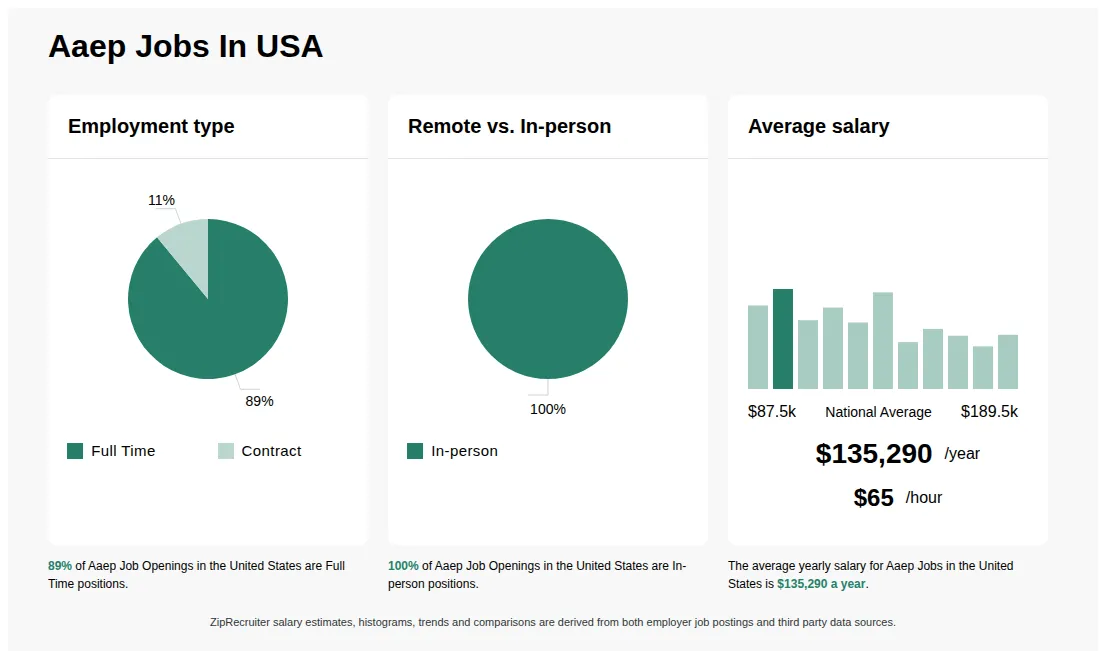
As of Sep 5, 2026, the average yearly pay for aaep in the United States is $135,290.00, according to ZipRecruiter salary data. Most workers in this role earn between $106,000.00 and $160,000.00 per year, depending on experience, location, and employer.

What is an AAEP?

AAEP stands for Auditory Evoked Potentials, which are neurological tests used to measure the brain's response to sound stimuli. In a medical context, professionals who perform AAEPs are often technologists or audiologists specializing in neurodiagnostics. They use specialized equipment to monitor electrical activity in the brain and auditory pathways, which can help diagnose hearing loss, neurological disorders, or monitor nerve function during surgery. These tests are non-invasive and are important tools in both clinical and research settings.

What skills and qualifications are needed to thrive as an AAEP member or education professional?

To thrive as an education professional, you need expertise in curriculum development, classroom management, and subject matter knowledge, usually backed by a teaching degree and state certification. Familiarity with educational technology platforms, student assessment tools, and learning management systems is common in the field. Strong communication, patience, and adaptability are crucial soft skills for engaging students and collaborating with colleagues. These skills ensure effective teaching, positive learning environments, and continuous professional growth.

What are common challenges faced by AAEP veterinarians during equine emergency care, and how can they be managed?

AAEP veterinarians often encounter unpredictable and high-pressure situations during equine emergency care, such as managing colic, lameness, or trauma cases. These challenges require quick decision-making, strong communication with horse owners, and the ability to work efficiently under stress. Building strong client relationships, staying current with continuing education, and collaborating with other veterinary professionals are effective strategies for managing these challenges and ensuring the best outcomes for equine patients.

What is the difference between Aaep vs Athletic Trainer?

AspectAaepAthletic Trainer
CredentialsRequires certification through the National Athletic Trainers' Association (NATA) and passing the Board of Certification (BOC) examSame as Aaep, requiring NATA certification and BOC exam
Work EnvironmentTypically works in sports teams, schools, clinics, or hospitalsWorks in similar settings, including schools, sports facilities, and healthcare clinics
Industry UsageCommonly used in sports medicine and athletic healthcareWidely recognized in sports medicine, healthcare, and rehabilitation

Both Aaep and Athletic Trainer are recognized credentials in sports medicine, requiring similar certifications and working in comparable environments. The terms are often used interchangeably, with Aaep being a specific certification for athletic trainers. Understanding this overlap helps in choosing the right career path or job search focus.
More about Aaep jobs
Infographic showing various Aaep job openings in the United States as of August 2026, with employment types broken down into 100% Full Time. Highlights an 100% In-person job distribution, with an average salary of $135,290 per year, or $65 per hour.

Emergency Psychiatrist - Emory University Hospital at Midtown

American Association for Emergency Psychiatry (AAEP)

Atlanta, GA • On-site

$230 - $310/hr

Other

Posted 14 days ago


Key responsibilities

  • Direct the medical and psychiatric care of patients within the BHOS, focusing on rapid stabilization within 24 hours.

  • Respond to urgent psychiatric consults in the general ED, managing complex patients and acute trauma cases.

  • Partner with a multidisciplinary team to create rapid, holistic discharge plans and facilitate community discharges.


Job description

Emergency Psychiatrist - Emory University Hospital at Midtown
Job Type Regular Full-Time
Division School Of Medicine
Department SOM: Psych: Adult
Location US-GA-Atlanta
Location Name: Emory Midtown
Remote Work Classification: No Remote
Health and Safety Information: Position involves clinical patient contact

Discover Your Career at Emory University
Emory University is a leading research university that fosters excellence and attracts world-class talent to innovate today and prepare leaders for the future. We welcome candidates who can contribute to the excellence of our academic community.

Schedule: Monday – Friday, 8:00 AM – 5:00 PM
Setting: General Hospital Emergency Department & Behavioral Health Observation Service

Position Summary

We are seeking a board-certified/board-eligible Emergency Psychiatrist to lead psychiatric care in a General Hospital Emergency Department (ED) and our newly developed Behavioral Health Observation Service (BHOS) following the EmPATH (Emergency Psychiatry Assessment, Treatment, and Healing) model. In this daytime role, you will champion a shift away from traditional ED boarding toward immediate, trauma-informed stabilization. You will split your time between addressing high-acuity crisis consultations in the main ED and managing a collaborative, healing-centered environment in the BHOS. Working in an academic hospital may include supervision of resident physicians and bedside teaching of medical students and other trainees.

Anticipated effort directed towards ED and BHOS for first year is 1.0 FTE. After 1 year, depending on workload, the time commitment for ED/BHOS may reduce to 0.6 FTE with remaining time directed towards other clinical activities as per interest of the faculty member, but could include Telehealth Emergency Psychiatry, consult-liaison, inpatient or outpatient psychiatry.

Core Schedule & Workflow Advantages:
  • Predictable Hours: Fixed Monday through Friday, 8:00 AM to 5:00 PM daytime schedule.
  • Work-Life Balance: No standard evening, night, or weekend shifts required.
  • On-Call: Participate in Faculty call schedule (typically 4-5 weeks per year)
Essential Duties:
  • EmPATH Milieu Leadership: Direct the medical and psychiatric care of patients within the communal, chair-based BHOS, focusing on rapid stabilization within a 24-hour window. Round with team of advanced practice providers twice a day.
  • Main ED Consultations: Respond to urgent psychiatric consults in the general ED, managing medically complex patients, acute trauma, or individuals requiring initial chemical/physical restraint.
  • Trauma-Informed Care: Utilize proactive de-escalation and prompt pharmacological interventions to minimize the use of restraints and seclusion.
  • Throughput Facilitation: Accelerate the transition of behavioral health patients out of standard ED beds and into the BHOS to improve patient flow.
  • Multidisciplinary Team Care: Partner closely with an integrated team of psychiatric nurses, social workers, and peer support specialists to create rapid, holistic discharge plans.
  • Community Disposition: work with team to facilitate discharges to home/community by coordinating robust handoffs with community resources.
Required Qualifications:
  • Education: MD or DO from an accredited school of medicine.
  • Training: Completed residency training in Psychiatry.
  • Licensure: Board Certified or Board Eligible in Psychiatry, with an active, unrestricted state medical license and DEA registration.
  • Philosophy: Strong alignment with recovery-oriented, restraint-reduction, and trauma-informed care models.
Preferred Qualifications
  • Prior clinical experience in an EmPATH unit, Crisis Stabilization Unit (CSU), or dedicated Psychiatric Emergency Service (PES).
    Experience working in high-volume, urban, or safety-net hospital emergency settings.

NOTE: Position tasks are required to be performed in-person at an Emory University location; working remote is not an option. Emory reserves the right to change this status with notice to employee.

Additional Details:
Emory is an equal opportunity employer, and qualified applicants will receive consideration for employment without regard to race, color, religion, sex, national origin, disability, protected veteran status or other characteristics protected by state or federal law. Emory University does not discriminate in admissions, educational programs, or employment, including recruitment, hiring, promotions, transfers, discipline, terminations, wage and salary administration, benefits, and training. Students, faculty, and staff are assured of participation in university programs and in the use of facilities without such discrimination. Emory University complies with Section 503 of the Rehabilitation Act of 1973, the Vietnam Era Veteran's Readjustment Assistance Act, and applicable executive orders, federal and state regulations regarding nondiscrimination, equal opportunity, and affirmative action (for protected veterans and individuals with disabilities). Inquiries regarding this policy should be directed to the Emory University Department of Equity and Civil Rights Compliance, 201 Dowman Drive, Administration Building, Atlanta, GA 30322. Telephone: 404-727-9867 (V) | 404-712-2049 (TDD).

Emory University is committed to ensuring equal access and providing reasonable accommodations to qualified individuals with disabilities upon request. To request this document in an alternate format or to seek a reasonable accommodation, please contact the Department of Accessibility Services at accessibility@emory.edu or call 404-727-9877 (Voice) | 404-712-2049 (TDD). We kindly ask that requests be made at least seven business days in advance to allow adequate time for coordination.

#J-18808-Ljbffr