Visualization Artist - Visual Impact Assessment Focus
The Design Visualization Services (DVS) team at Stantec works on a variety of design projects internationally using cutting-edge technology and is proud to be a leader in the visualization industry. We are passionate about our work and committed to cultivating a dynamic environment for our talented artists that supports them both professionally and personally. We are as dedicated to producing cutting-edge, high-quality work as we are to making work-life balance a priority. Our firm supports career growth and research and development, encouraging individuals to explore new technological innovations and techniques.
We continue to actively build our 3D modeling practice within our design team and are looking for a creative professional who is dedicated to enhancing the quality of life where people live, work, and play.
Your Opportunity
The Design Visualization Services team is actively seeking a full-time, Visualization Artist with a focus on Visual Impact Assessments (VIAs) and before-and-after visual simulations. This role requires a skill set similar to Architectural Visualization (ArchViz), but is not primarily focused on visualizing buildings or architecture.
In this mid-level role, you will contribute to a wide range of Visual Impact Assessment (VIA) projects, including, but not limited to, solar, wind, infrastructure, and transmission line developments. You will be primarily responsible for 3ds Max model production, V-Ray photorealistic rendering, and Photoshop compositing. You will also have the opportunity to manage data collection and CAD imports into 3ds Max to ensure precise spatial accuracy.
Stantec's DVS team is also at the forefront of developing innovative deliverables, including Virtual Reality experiences and 360° imagery. Successful candidates will have the opportunity to contribute to the development of these exciting and evolving processes.
As a mid-level professional, you will work alongside experienced professionals from a variety of disciplines and must be able to thrive in a creative, collaborative, and dynamic team environment. This role offers opportunities to solve complex problems, tell compelling stories, and visually communicate design solutions.
In this position, you will be on the front lines of the innovative work we produce in the fields of virtual, video, and photo simulation. We are seeking applicants with relevant industry qualifications and software expertise who are ready to bring their ideas to the table. If you have demonstrated the ability to create visually compelling 3D content, translate design information into visual reality, and are looking for a meaningful and creative professional experience, this may be the opportunity for you.
Your Key Responsibilities
- Collaborate with multi-disciplinary teams of planners, designers, engineers and specialists on a variety of projects at once.
- Contribute to all phases of projects including analysis, design, client engagement and final production.
- Create drawings and graphics including maps, diagrams, sketches, renderings, 3D models, animations, and videos.
- Open to learn new programs, plug ins, and processes to apply to future projects.
Your Capabilities and Credentials
- Strong 3D Studio Max skills, including modelling, texturing, and basic animation.
- Strong Adobe Photoshop and Illustrator skills
- Strong AutoCAD skills
- Civil3D experience is a plus.
- ArcGIS experience is a plus.
- Unreal engine experience is a plus.
- VRAY experience is a plus.
- ITOO Forest and Rail Clone plugins experience is a plus.
- Photography experience is a plus.
- A design background with portfolio
- Open to learning new programs, plug-ins, and processes to apply to future projects.
- Ability to work on tight project deadlines as both an individual and part of a team.
Education and Experience
- An undergraduate or graduate degree in Computer Graphics, Motion Graphics, Industrial Design, or a related field.
- 3-5 years of relevant experience.
This description is not a comprehensive listing of activities, duties or responsibilities that may be required of the employee and other duties, responsibilities and activities may be assigned or may be changed at any time with or without notice.
Stantec is a place where the best and brightest come to build on each other's talents, do exciting work, and make an impact on the world around us. Join us and redefine your personal best.
Pay Range:
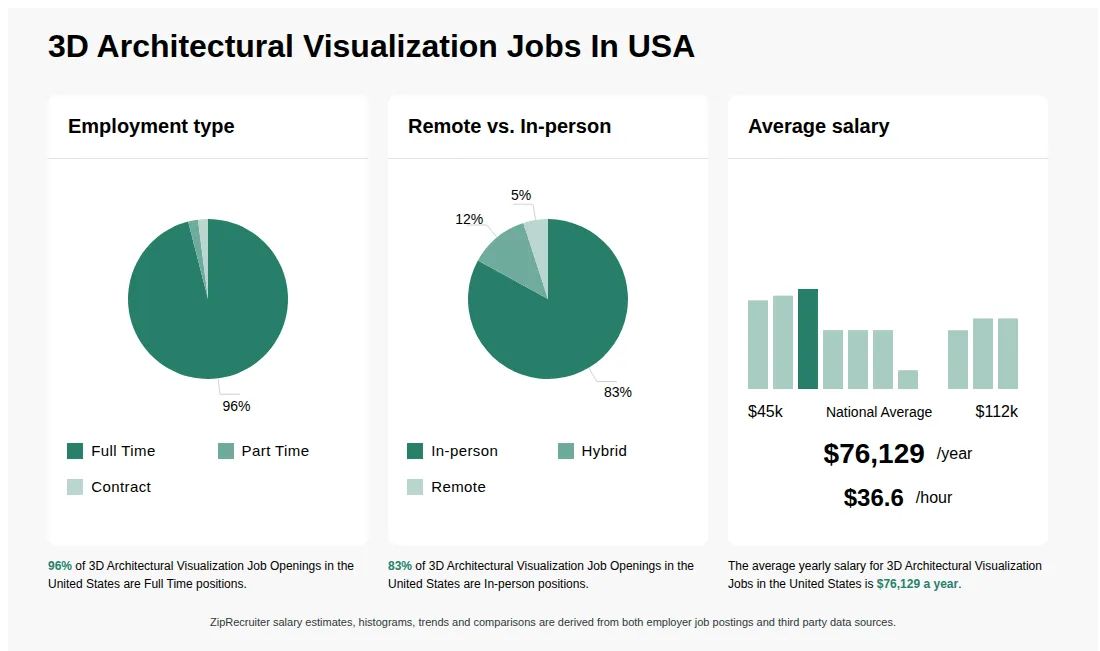
• Locations in WA, DC & Various CA, MA areas-$77,400.00 - $112,200.00 Annually
• Locations in NYC & CA (Bay Area) & NJ (RP)-$82,700.00 - $119,800.00 Annually
Pay Transparency: In compliance with pay transparency laws, pay ranges are provided for positions in locations where required. Please note, the final agreed upon compensation is based on individual education, qualifications, experience, and work location. At Stantec certain roles are bonus eligible. Actual compensation for part-time roles will be pro-rated based on the agreed number of working hours per week.
Benefits Summary: Regular full-time and part-time employees (working at least 20 hours per week) have access to medical, dental, and vision plans, a wellness program, health saving accounts, flexible spending accounts, 401(k) plan, employee stock purchase program, life and accidental death & dismemberment (AD&D) insurance, short-term/long-term disability plans, emergency travel benefits, tuition reimbursement, professional membership fee coverage and paid family leave. Regular full-time and part-time employees will receive ten paid holidays in each calendar year. In addition, employees will be eligible to accrue vacation between 10 and 20 days per year and eligible for paid sick leave (and if more generous, in accordance with state and local law).
Temporary/casual employees have access to 401(k) plans, employee stock purchase program, and paid leave, in accordance with state and local law.
The benefits information listed above may not apply to union positions because benefits for such positions are governed by applicable collective bargaining agreements
Primary Location: United States | MA | Boston
Other Locations: United States | NY | New York
Organization: 2243 Water-US Delivery-Boston MA
Employee Status: Regular
Business Justification: New Position
Travel: No
Schedule: Full time
Job Posting: 25/06/2026 04:06:10
Req ID: 1006443
Stantec provides equal employment opportunities to all qualified employees and applicants for future and current employment and prohibit discrimination on the grounds of race, colour, religion, sex, national origin, age, marital status, genetic information, disability, sexual orientation, gender identity or gender expression. We prohibit discrimination in decisions concerning recruitment, hiring, referral, promotion, compensation, fringe benefits, job training, terminations or any other condition of employment. Stantec is in compliance with laws and regulations and ensures equitable opportunities in all aspects of employment. At Stantec we are committed to ensuring our recruitment process is accessible to all. If you require reasonable adjustments to be made during the recruitment process then please inform a member of our Talent Acquisition team.