1

Cio Jobs Near Me

Extensive knowledge of a CIO's focus areas and an in-depth understanding of the IT industry (including Leadership, IT Operations Management, strategy and trends, use of metrics, etc.) and priorities ...

Extensive knowledge of a CIO's focus areas and an in-depth understanding of the IT industry (including Leadership, IT Operations Management, strategy and trends, use of metrics, etc.) and priorities ...

Serve as a primary point of contact for CFO and CIO-level stakeholders. * Work with large data sets and financial information and translate findings into clear executive-level storytelling.

next page

Showing results 1-20

Cio information

See salary details

$59K

$159.5K

$245.5K

How much do cio jobs pay per year?

As of Aug 21, 2026, the average yearly pay for cio in the United States is $159,468.00, according to ZipRecruiter salary data. Most workers in this role earn between $125,000.00 and $188,500.00 per year, depending on experience, location, and employer.

What cities are hiring for Cio jobs?

Cities with the most Cio job openings:

What states have the most Cio jobs?

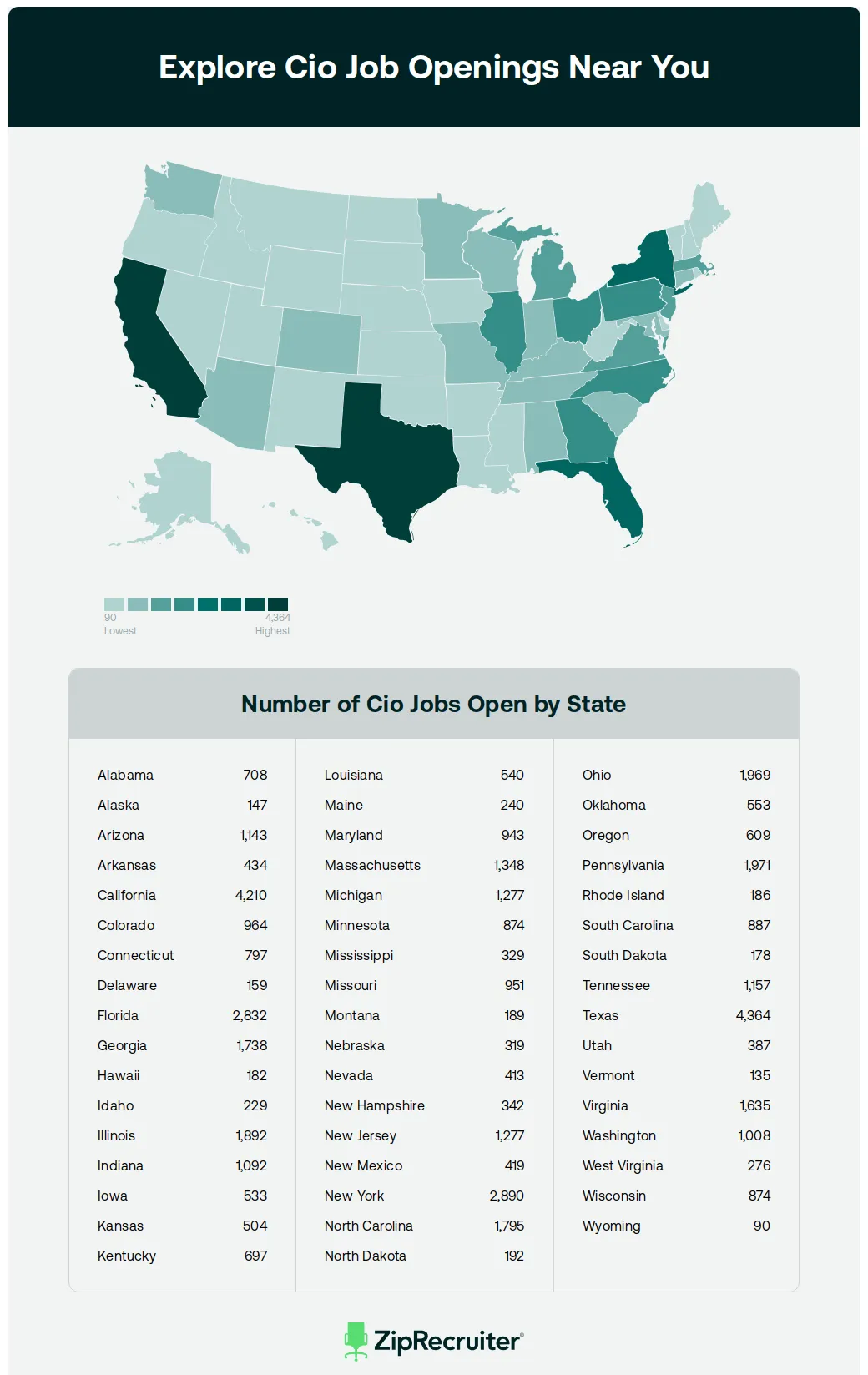
States with the most job openings for Cio jobs include:

What are the most commonly searched types of Cio jobs?

The most popular types of Cio jobs are:

A map of the United States highlighting the number of Cio job openings by state according to ZipRecruiter. The image is accompanied by a detailed chart listing the number of Cio job openings in each state, with California having the most at 2 and Hawaii the least at 0.

Divisional Chief Information Officer - Digital Services

Northwest

Columbus, OH • On-site

$250 - $350/hr

Other

Posted 2 days ago

New


Job description

OH0713 NW Bancshares HQ Job Description The Divisional Chief Information Officer (Divisional CIO) serves as part of the Executive Leadership team aligned to a designated business domain and is accountable for the strategy, delivery, modernization, support, resilience, security, and continuous improvement of technology capabilities supporting that domain. The Divisional CIO partners with business executives to align technology investments with business objectives, drive digital transformation, improve operational efficiency, strengthen customer and employee experiences, and ensure technology capabilities deliver measurable business value. The Divisional CIO leads a portfolio of products, applications, platforms, engineering teams, vendors, and technology initiatives while maintaining alignment with enterprise architecture, cybersecurity, data governance, technology standards, and regulatory requirements. The role reports to the Chief Information Officer and serves as the primary technology relationship manager for assigned business executives and stakeholders.

Domain Scope
  • Online Banking
  • Mobile Banking
  • Digital Account Opening
  • Digital Lending
  • Digital Sales and Servicing
  • Public Website
  • Digital Payments
  • Merchant Services
  • Marketing Technology
  • Customer Communications Platforms
  • External Communications Platforms
Domain-Specific Responsibilities
  • Define and execute digital banking strategy in partnership with business leadership.
  • Deliver seamless omnichannel customer experiences across web, mobile, and emerging channels.
  • Drive digital sales, customer acquisition, and self-service capabilities.
  • Lead modernization of digital platforms and customer-facing technologies.
  • Enhance digital payment capabilities and merchant service offerings.
  • Improve customer engagement through personalization, analytics, and AI-enabled experiences.
  • Partner with Marketing and Communications teams on digital engagement technologies.
  • Monitor customer experience, adoption, and digital channel performance metrics.
Essential FunctionsBusiness Relationship Management
  • Act as the senior technology partner to executive and business leadership.
  • Develop trusted relationships with business stakeholders and provide strategic technology guidance.
  • Translate business priorities into technology roadmaps, investments, and execution plans.
  • Ensure technology initiatives are aligned with enterprise objectives and business outcomes.
Technology Strategy & Planning
  • Develop and maintain multi-year technology roadmaps for assigned domains.
  • Identify opportunities to modernize platforms, reduce technical debt, improve efficiency, and strengthen resiliency.
  • Evaluate emerging technologies, fintech solutions, automation, AI, and digital capabilities.
  • Ensure technology investments support growth, customer experience, operational excellence, and risk management objectives.
Portfolio & Investment Management
  • Manage the domain technology investment portfolio and associated budgets.
  • Prioritize initiatives, enhancements, and operational support activities based on business value and risk.
  • Partner with Enterprise Architecture, EPMO, and executive leadership to govern technology investments.
  • Ensure projects are delivered on time, within budget, and aligned with strategic objectives.
Architecture, Engineering & AI Leadership
  • Lead product, application, engineering, support, and vendor teams supporting the domain.
  • Establish and govern delivery excellence through Agile, DevSecOps, product-oriented operating models, and modern software engineering practices.
  • Develop and maintain domain architecture roadmaps aligned with enterprise architecture standards, business strategies, data strategies, and technology modernization objectives.
  • Partner with Enterprise Architecture to ensure solutions are scalable, resilient, secure, reusable, and aligned to target-state capabilities and platforms.
  • Champion modern engineering practices including cloud-native development, platform engineering, continuous integration and delivery (CI/CD), automated testing, observability, infrastructure as code, API-first design, and engineering automation.
  • Drive adoption of Artificial Intelligence (AI), Generative AI, intelligent automation, and machine learning capabilities to improve customer experiences, employee productivity, operational efficiency, risk management, and business outcomes.
  • Establish governance and standards for responsible AI usage, model lifecycle management, security, compliance, and ethical AI practices.
  • Promote engineering excellence through architecture reviews, technical standards, reusable platforms, innovation programs, and continuous improvement initiatives.
  • Ensure solutions are maintainable, resilient, secure, performant, and support long-term business growth and technology sustainability.
  • Drive continuous improvement in delivery velocity, quality, reliability, customer experience, and engineering maturity.
Operational Excellence
  • Ensure stability, availability, supportability, and performance of domain systems.
  • Monitor service levels, operational metrics, incidents, and problem management activities.
  • Establish recovery, resiliency, and continuity capabilities for critical systems.
  • Drive automation, process optimization, and operational efficiency initiatives.
Risk, Security & Compliance
  • Ensure compliance with banking regulations, audit requirements, internal policies, and industry standards.
  • Partner with Information Security, Risk, Legal, and Compliance teams to manage technology risks.
  • Ensure appropriate cybersecurity controls, resiliency standards, and data protection practices are implemented.
Vendor & Third-Party Management
  • Manage relationships with strategic technology vendors and partners.
  • Negotiate contracts, service levels, and commercial arrangements.
  • Monitor vendor performance, risk, and value realization.
Leadership & Talent Development
  • Recruit, develop, and retain high-performing technology talent.
  • Build succession plans for critical leadership and technical roles.
  • Foster a culture of accountability, innovation, collaboration, and continuous learning.
  • Promote employee engagement and professional development.
Financial Management
  • Develop and manage operating and capital technology budgets.
  • Optimize technology spend and vendor investments.
  • Identify opportunities for cost reduction, consolidation, and rationalization.
Executive Communication & Governance
  • Present technology strategies, portfolio updates, risks, and investment recommendations to executive leadership.
  • Establish meaningful KPIs, operational metrics, and service dashboards.
  • Participate in governance committees and strategic planning activities.
Additional Essential Functions
  • Ensure compliance with Northwest's policies and procedures, and Federal/State regulations.
  • Navigate Microsoft Office Software, computer applications, and software specific to the department in order to maximize technology tools and gain efficiency.
  • Work as part of a team.
  • Work with on-site equipment.
What You Bring to the TeamLeadership Competencies
  • Strategic Thinking
  • Executive Presence
  • Business Acumen
  • Financial Management
  • Relationship Management
  • Organizational Leadership
  • Talent Development
  • Change Leadership
  • Decision Making
  • Communication and Influence
Technical Competencies
  • Technology Strategy and Architecture
  • Product Management
  • Application Engineering
  • Cloud Technologies
  • AI and Automation
  • Cybersecurity and Risk Management
  • Data and Analytics
  • Vendor Management
  • Agile Delivery and DevSecOps
  • IT Governance and Portfolio Management
QUALIFICATIONS

To perform this job successfully, an individual must be able to perform each essential duty satisfactorily. The requirements listed below are representative of the knowledge, skill, and/or ability required. Reasonable accommodations may be made to enable individuals with disabilities to perform the essential functions.

Education

Bachelor's Degree Banking, financial services, consulting, technology or related field

Work Experience

12 - 15 years Progressive technology leadership experience

8 - 12 years Large-scale application, product, engineering, or technology organizational leadership experience

Additional Knowledge, Skills and Abilities
  • Demonstrated experience aligning technology strategy with business objectives.
  • Experience managing complex technology portfolios and budgets.
  • Experience leading enterprise transformation and modernization initiatives.
  • Experience working within highly regulated industries; banking or financial services preferred.
  • Proven success leading technology teams through organizational change and growth.
Licenses and Certifications
  • Certified Information Systems Security Professional Upon Hire
  • PMP Project Management Professional Upon Hire
  • TOGAF Upon Hire
  • Certified Scrum Practitioner SAFe Certification Upon Hire
  • Cloud Platform Certifications (Microsoft Azure, AWS, or Google Cloud) Upon Hire

Northwest is an equal opportunity employer. We are committed to creating an inclusive environment for all employees.

Northwest, we're here for what's next. Whether we're finding opportunities for families, businesses and communities or opening doors for our team, we share a passion for helping the people around us succeed. And we know that in order to provide the highest level of care, we need to understand unique experiences and perspectives. That's why, whether you're interested in a corporate role or something customer-facing, your talent and voice matter. Here, you belong. Working at Northwest, you'll find that we recognize our employees for the important work they do through competitive compensation and benefits, professional development opportunities and by regularly celebrating wins along the way. So, take a look at the opportunities here. And join us as we move into the future making a difference for the people we serve.

#J-18808-Ljbffr