By Jeremy Leader
What comes to mind when you think of a guild? Perhaps a group of metalworkers standardizing their craft’s execution, or maybe (to the more artistically inclined readers) a certain Rembrant flutters across the brainwaves.
At ZipRecruiter we have a number of professional guilds that guide our technical efforts. Their goal is the same as those from the 11th century and those at Spotify circa 2012 (ages ago right?) – to be a forum where skilled people gather to improve and standardize their profession. Most of our guilds oversee how specific programming languages are used, and a few preside over broader technological domains.
There are lots of important benefits to guilds. Here I’d like to highlight how the participation in and support of guilds can contribute to your personal career development.
Let’s take the example of our programming language guilds and explore the what, why and how to make it work, through the prism of the individual.
What are programming language guilds
We currently have five language guilds at ZipRecruiter–Golang, Java Virtual Machine (Java and Scala), Python, Perl, Fullstack Typescript Guild–as well as three broader technical guilds for Data Engineering, Data Science and Applications Security. To rally them all we have the ‘Guild of Guilds.’
After a few years of ‘guilding’ around, in September 2023 we created The Guild Charter which formalized the authority and expectations from our guilds.
Each has a mission statement. For example, the Python guild’s mission statement is: “To guide the development of standards and tools to make Python use at ZipRecruiter more productive.” The Fullstack Typescript Guild are in charge of overseeing “All things fullstack typescript: processes, best practices, setup guides, and more!” And the Guild of Guilds “…is the place where all guilds communicate with each other to allow cross tech/team sync, company-wide.”
In general, we expect language guilds to
- Standardize code styles and best practices to improve code readability and maintainability.
- Identify and address common technical issues within or across languages and propose solutions to enhance the development process.
- Streamline onboarding and training by deciding when to use external norms vs our own.
- Curate and share learning resources to enhance the skills of guild members and the organization’s technical community.
Our Python guild, for example, is standardizing and creating tools that automate the testing sequence and dependency management of Python code, and our Golang guild chose coding conventions that are very similar to the Golang open source world in order to accelerate the onboarding of new team members.
When a guild is productive and trusted across the organization, they’ll also manage to reduce the amount of pointless technical arguments. For example, we have decided to adopt the Golang code formatter open source tool; nobody loves it but no one really needs to argue about it 😜
As you can imagine, Language guilds at ZipRecruiter have notable influence on the way things are done, so being part of a guild can both expose you to a broad range of high-visibility issues and open the door to being part of the solution.
What guilds are not
Before we get to the ‘great things about guilds’ part, it’s good to understand what guilds are not. At ZipRecruiter, although guilds are the foremost authority on their given technical subject, they are not ‘on call’ for code running in production, nor should they overstep into team-level decisions.
A guild may suggest the purchase of a useful commercial tool, but they would still need to submit requests and make the business case for incurring expenses. And finally, guilds require a serious commitment, they are not a place for the occasional contributor. For more general interest we have ‘interest groups’ that come together to learn or create something that isn’t currently mainstream in the organization.
The great thing about guilds
There are many benefits to the guild system.
From the company’s perspective, guilds drastically increase the speed of growth and adaptation to changing circumstances. With more people from the frontlines involved, pressing challenges are exposed faster and practical solutions deployed quicker. A guild structure also fosters a sense of responsibility and involvement in employees. They are guiding the ship.
For the individual, the guild can be a launchpad for career development. In fact, at ZipRecruiter guild participation is taken into consideration for advancement and promotions.
I think it boils down to 3 main aspects.
- Knowledge and Skill – actively participating in a guild is a great place to learn about the bleeding-edge of challenges and technology.
- Impact – Guilds are results oriented. They take on projects to solve technical issues with the widest scope. By being part of this you will be guiding the company’s technological roadmap.
- Visibility – by engaging with your peers and gaining authority you’ll become a visible part of the community, with above average exposure to leadership.
One interesting example is our Perl language guild. We are actually weaning ZipRecruiter off Perl, so their main goal is to improve the velocity and stability of the decommissioning process. It’s a delicate, high visibility task which has resulted in neat projects like building tools to find and remove unreachable or unused code.
Unlocking the guild’s full potential requires authority and action
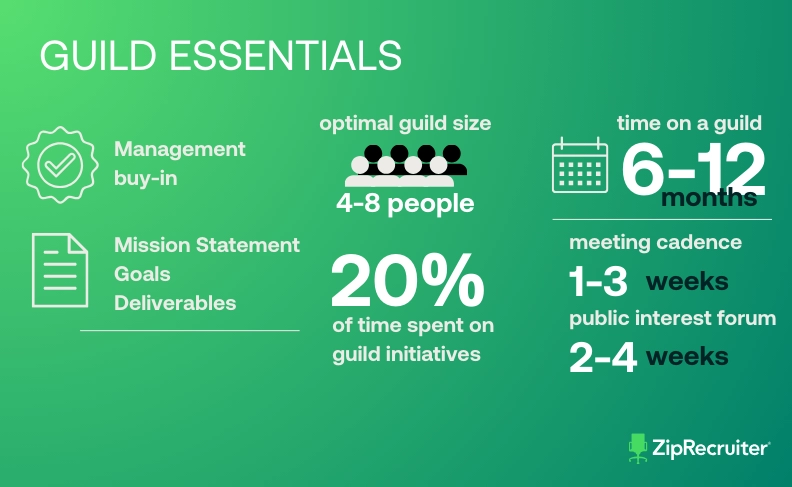
To ensure your time spent for the guild is effective, it is crucial to obtain management and community buy-in. Top leadership must endorse and mandate the guilds formally. This will reduce the friction of explaining why you spent a certain percent of your time on guild work and provide the first level of authority. We expect around 20% of a guild member’s time to be devoted to guild initiatives.
For effective authority, however, the community needs to accept the guilds. This can be achieved in a few ways. First, ensure diverse representation across teams and seniority levels. The added benefit is that you’ll be circulating knowledge from other companies, schools and experiences. In addition, keeping things documented and public is vital. Besides slack channels, newsletters and meeting notes, we frequently run ‘public calls for proposals’ which not only bring in great ideas, they also streamline adoption of the outcomes.
Finally, as mentioned, being active is key. Whether you’re “just” the note taker or doing research for a guild project, find a way to contribute. I’m a senior IC with over 40 years of experience. I’m the note taker for the Guild of Guilds, note taker for the Python guild, and an active member of the Golang guild. We don’t want people to be contributing members in more than one guild (the guild of guilds is an exception, because most of the members are leads of other guilds). This ensures we dive deep and create real impact.
If you’re interested in working on solutions like these, visit our Careers page to see open roles.
* * *
Jeremy Leader is a Senior Software Engineer at ZipRecruiter with decades of experience spanning mainframes, gaming, search engine advertising and more. He loves the challenge of creating tools and infrastructure that allow others to build, deploy, and manage their systems while scaling with Zip’s rapid growth.