As the founding partner of TBN Consulting LLC, a search firm for direct hire, contract and freelance professionals specializing in marketing, marketing research and sales, Tony Nelson reads resumes. Lots of resumes. He reads good resumes. He reads bad resumes.
And he reads resumes that leave him shaking his head in disbelief. In fact, one of Nelson’s recruiting pet peeves is when job seekers send in a resume that reads like a job description, with no quantifiable achievements highlighted.
“The hiring manager is interested in how well you did your job,” says Nelson. “Use your resume to demonstrate where you excelled at your job to set yourself apart from all the other candidates.”
And while that scenario irks recruiters like Nelson, nothing upsets and frustrates recruiters more than when a candidate is lying on a resume. The problem is, it’s not always obvious, especially to new recruiters, managers or small business owners who don’t specialize in hiring and/or reading resumes.
“When reading a resume it can be difficult to know if something is telling the truth or not, but a resume that lacks specifics can be one sign,” says Elizabeth Laukka, a recruiter specializing in placing advertising, public relations and digital talent.
Examples include failure to clarify one’s role, vague dates of employment, or the inability to back up their claims when quizzed an interview – the most common case.
That’s why in some cases the only way to truly judge candidates’ claims is through a conversation. That’s why phone interviews are increasing in popularity as a pre-screening tool and why there can be a lengthy interview process.
“Sometimes, when viewing a resume at first blush, it’s hard to notice false information,” says Laukka.
That’s why Laukka conducts online searches of candidates she is specifically interested in to try and verify information, or to possibly spot inconsistencies. She then will reach out to possible connections within each other’s network to verify information. But that’s down the road, when there is interest.
In an interview situation, Laukka will overlap questions and ask twice during the course of a conversation to probe information that she may find concerning.
For example when inquiring about reasons why a candidate moved on from a job Laukka will ask the question one way, then rephrase later in the interview to confirm. That is an effective way to “catch” any glitches in a candidate’s background.
Taking it a step further, Laukka says when reviewing/discussing locations, dates, number of direct reports and manager’s names, ask the candidate for specifics. Answers such as “The team had a hard time with the company policies” could mean the whole team, or it could mean just them. Dig deeper.
“I will drill down the statement,” says Laukka. “I say ‘tell me more’ and will pause. Silence forces most people to fill in with conversation and more information is shared, which sheds light on truth vs. fiction.”
Just recently Laukka was contacted by a candidate looking to make a move out of a large public relations agency. Laukka and the candidate exchanged several emails, conducted a quick phone call then determined they should meet in person. The candidate cancelled right before the meeting, saying her client had an urgent need. So Laukka rescheduled. For that meeting the candidate sent a text that said she was running late. Then after that, she said she couldn’t make it all because her client scheduled a sudden conference call. Laukka, being a savvy recruiter and sensing something fishy, took it upon herself to investigate.
“I was already at our meeting place feeling very skeptical, so I called her corporation and asked the receptionist for her and they said she no longer worked there and her last day had been a week earlier,” said Laukka. “The whole time we had been in contact she did not have a job but tried to portray that she did have a position.”
What does Laukka do in a situation like this?
“If I do determine a candidate is lying I will no longer consider them for a role, and will tell them that that is the reason they are no longer in the running,” she said.
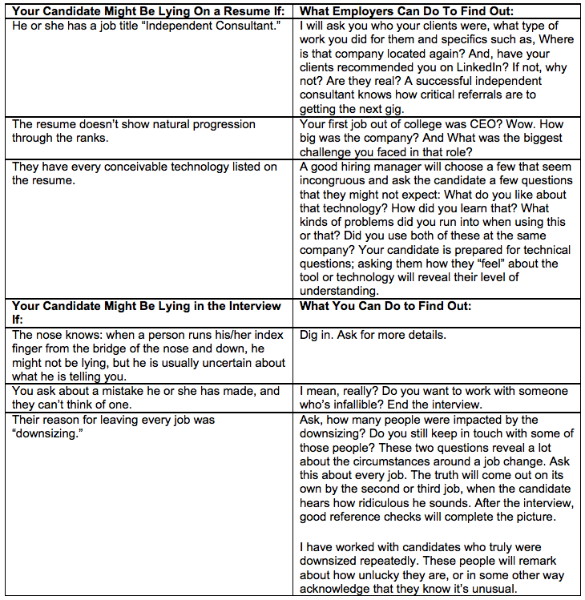
Little details are important when reading a resume. They are just as important when interviewing. In many cases, recruiters, managers, small business owners and others who interview – especially those less experienced, will reference the resume throughout the interview process to foster discussion. How can you catch additional lies or flesh out potential inaccuracies? Julie Desmond, IT and Software Engineering Recruiter with George Konik Associates, Inc., put together this information chart that outlines how to spot potential lies on a resume, how to dig deeper to get the information needed and in some cases, what to do when the job seeker is digging themselves into a deeper hole with potential and obvious lies on a resume: