Have a high capability of welding all types of steel as well as aluminum. Prior experience, strong background/knowledge regarding welding techniques. Must be able to work within precise limits and ...
Have a high capability of welding all types of steel as well as aluminum. Prior experience, strong background/knowledge regarding welding techniques. Must be able to work within precise limits and ...
Have a high capability of welding all types of steel as well as aluminum. Prior experience, strong background/knowledge regarding welding techniques. Must be able to work within precise limits and ...
Have a high capability of welding all types of steel as well as aluminum. Prior experience, strong background/knowledge regarding welding techniques. Must be able to work within precise limits and ...
Have a high capability of welding all types of steel as well as aluminum. Prior experience, strong background/knowledge regarding welding techniques. Must be able to work within precise limits and ...
Have a high capability of welding all types of steel as well as aluminum. Prior experience, strong background/knowledge regarding welding techniques. Must be able to work within precise limits and ...

As a Welding Inspector, you will conduct visual inspections of welds to ensure compliance with specifications and standards. You will review and interpret welding procedures, codes, and standards ...
New
As a Welding Inspector, you will conduct visual inspections of welds to ensure compliance with specifications and standards. You will review and interpret welding procedures, codes, and standards ...
New
As a Welding Inspector, you will conduct visual inspections of welds to ensure compliance with specifications and standards. You will review and interpret welding procedures, codes, and standards ...
New
As a Welding Inspector, you will conduct visual inspections of welds to ensure compliance with specifications and standards. You will review and interpret welding procedures, codes, and standards ...
New
As a Welding Inspector, you will conduct visual inspections of welds to ensure compliance with specifications and standards. You will review and interpret welding procedures, codes, and standards ...
As a Welding Inspector, you will conduct visual inspections of welds to ensure compliance with specifications and standards. You will review and interpret welding procedures, codes, and standards ...
As a Welding Inspector, you will conduct visual inspections of welds to ensure compliance with specifications and standards. You will review and interpret welding procedures, codes, and standards ...
New
As a Welding Inspector, you will conduct visual inspections of welds to ensure compliance with specifications and standards. You will review and interpret welding procedures, codes, and standards ...
New
Welding Inspector
$30 - $45/hr
As a Welding Inspector, you will conduct visual inspections of welds to ensure compliance with specifications and standards. You will review and interpret welding procedures, codes, and standards ...
Welding Inspector
$30 - $45/hr
As a Welding Inspector, you will conduct visual inspections of welds to ensure compliance with specifications and standards. You will review and interpret welding procedures, codes, and standards ...

Research Engineer - Welding
Montpelier, IA · On-site
$36.50 - $50.25/hr
Essential Functions • Lead welding projects, review welding specifications and develop optimal welding practices for commercial and branded steel, and overlay products in accordance with industry ...
Research Engineer - Welding
Montpelier, IA · On-site
$36.50 - $50.25/hr
Essential Functions • Lead welding projects, review welding specifications and develop optimal welding practices for commercial and branded steel, and overlay products in accordance with industry ...

Welding Technician
Corning, IA · On-site
Welding Technician Division: Precision Pulley and Idler (PPI) Location: Corning, IA - On-site Shift : 1st S alary Grade: 1 F LSA: Non - Exempt Physical Grade: 3 Job Status: Full Time Travel Required ...
Quick apply
Welding Technician
Corning, IA · On-site
Welding Technician Division: Precision Pulley and Idler (PPI) Location: Corning, IA - On-site Shift : 1st S alary Grade: 1 F LSA: Non - Exempt Physical Grade: 3 Job Status: Full Time Travel Required ...
Welding Technician
Humboldt, IA · On-site
Welding Technician Division: Precision Pulley & Idler (PPI) Location: Humboldt, IA - On-site Shift: 1st Salary Grade: 1 F LSA: Non - Exempt Physical Grade: 3 Job Status: Full Time Travel Required: 0 ...
Quick apply
Welding Technician
Humboldt, IA · On-site
Welding Technician Division: Precision Pulley & Idler (PPI) Location: Humboldt, IA - On-site Shift: 1st Salary Grade: 1 F LSA: Non - Exempt Physical Grade: 3 Job Status: Full Time Travel Required: 0 ...
Welding Technician
Humboldt, IA · On-site
Welding Technician Division: Precision Pulley & Idler (PPI) Location: Humboldt, IA - On-site Shift: 1st Salary Grade: 1 F LSA: Non - Exempt Physical Grade: 3 Job Status: Full Time Travel Required: 0 ...
Quick apply
Welding Technician
Humboldt, IA · On-site
Welding Technician Division: Precision Pulley & Idler (PPI) Location: Humboldt, IA - On-site Shift: 1st Salary Grade: 1 F LSA: Non - Exempt Physical Grade: 3 Job Status: Full Time Travel Required: 0 ...
Welding Technician
Humboldt, IA · On-site
Welding Technician Division: Precision Pulley & Idler (PPI) Location: Humboldt, IA - On-site Shift: 1st Salary Grade: 1 F LSA: Non - Exempt Physical Grade: 3 Job Status: Full Time Travel Required: 0 ...
Welding Technician
Humboldt, IA · On-site
Welding Technician Division: Precision Pulley & Idler (PPI) Location: Humboldt, IA - On-site Shift: 1st Salary Grade: 1 F LSA: Non - Exempt Physical Grade: 3 Job Status: Full Time Travel Required: 0 ...
Welding Technician
Corning, IA · On-site
Welding Technician Division: Precision Pulley and Idler (PPI) Location: Corning, IA - On-site Shift : 1st S alary Grade: 1 F LSA: Non - Exempt Physical Grade: 3 Job Status: Full Time Travel Required ...
Welding Technician
Corning, IA · On-site
Welding Technician Division: Precision Pulley and Idler (PPI) Location: Corning, IA - On-site Shift : 1st S alary Grade: 1 F LSA: Non - Exempt Physical Grade: 3 Job Status: Full Time Travel Required ...
Welding Technician (Drums)
Pella, IA · On-site
Welding Technician Division: Precision Pulley & Idler (PPI) Location: Pella, IA - On-site Shift: 1st F LSA: Non-Exempt Grade: 1 Job Status: Full Time Travel Required: 0-5% Revision Date: October 2024 ...
Quick apply
Welding Technician (Drums)
Pella, IA · On-site
Welding Technician Division: Precision Pulley & Idler (PPI) Location: Pella, IA - On-site Shift: 1st F LSA: Non-Exempt Grade: 1 Job Status: Full Time Travel Required: 0-5% Revision Date: October 2024 ...
Welding Technician (Wings)
Pella, IA · On-site
Welding Technician Division: Precision Pulley & Idler (PPI) Location: Pella, IA - On-site Shift: 1st F LSA: Non-Exempt Grade: 1 Job Status: Full Time Travel Required: 0-5% Revision Date: October 2024 ...
Welding Technician (Wings)
Pella, IA · On-site
Welding Technician Division: Precision Pulley & Idler (PPI) Location: Pella, IA - On-site Shift: 1st F LSA: Non-Exempt Grade: 1 Job Status: Full Time Travel Required: 0-5% Revision Date: October 2024 ...

CERTIFIED WELDING INSPECTOR
Sioux City, IA · On-site
$28 - $38/hr
Join Our Team as a Certified Welding Inspector! Location: Sioux City, IA Are you a skilled Certified Welding Inspector looking to make an impact in a fast-paced, high-quality environment? We're on ...
Quick apply
CERTIFIED WELDING INSPECTOR
Sioux City, IA · On-site
$28 - $38/hr
Join Our Team as a Certified Welding Inspector! Location: Sioux City, IA Are you a skilled Certified Welding Inspector looking to make an impact in a fast-paced, high-quality environment? We're on ...

Welding Inspectors - Multiple Locations - Contract
Des Moines, IA · On-site
$40 - $45/hr
SGS is currently looking for Welding Inspectors in multiple locations throughout the USA. Work will be assigned on a as needed basis and will be paid for the hours/days and other applicable cost ...
Welding Inspectors - Multiple Locations - Contract
Des Moines, IA · On-site
$40 - $45/hr
SGS is currently looking for Welding Inspectors in multiple locations throughout the USA. Work will be assigned on a as needed basis and will be paid for the hours/days and other applicable cost ...
Welding Technician (Wings)
Pella, IA · On-site
Welding Technician Division: Precision Pulley & Idler (PPI) Location: Pella, IA - On-site Shift: 1st F LSA: Non-Exempt Grade: 1 Job Status: Full Time Travel Required: 0-5% Revision Date: October 2024 ...
Quick apply
Welding Technician (Wings)
Pella, IA · On-site
Welding Technician Division: Precision Pulley & Idler (PPI) Location: Pella, IA - On-site Shift: 1st F LSA: Non-Exempt Grade: 1 Job Status: Full Time Travel Required: 0-5% Revision Date: October 2024 ...
Welding Technician (Drums)
Pella, IA · On-site
Welding Technician Division: Precision Pulley & Idler (PPI) Location: Pella, IA - On-site Shift: 1st F LSA: Non-Exempt Grade: 1 Job Status: Full Time Travel Required: 0-5% Revision Date: October 2024 ...
Welding Technician (Drums)
Pella, IA · On-site
Welding Technician Division: Precision Pulley & Idler (PPI) Location: Pella, IA - On-site Shift: 1st F LSA: Non-Exempt Grade: 1 Job Status: Full Time Travel Required: 0-5% Revision Date: October 2024 ...
Welding information
See Iowa salary details
$14 - $16.61
5% of jobs
$16.61 - $19.21
9% of jobs
$19.21 - $21.82
9% of jobs
$22.18 is the 25th percentile. Wages below this are outliers.
$21.82 - $24.43
19% of jobs
The median wage is $26.32 / hr.
$24.43 - $27.03
12% of jobs
$27.03 - $29.64
12% of jobs
$31.70 is the 75th percentile. Wages above this are outliers.
$29.64 - $32.25
13% of jobs
$32.25 - $34.85
9% of jobs
$34.85 - $37.46
5% of jobs
$37.46 - $40.07
5% of jobs
$40.07 - $42.67
3% of jobs
$13
$27
$42
How much do welding jobs pay per hour?
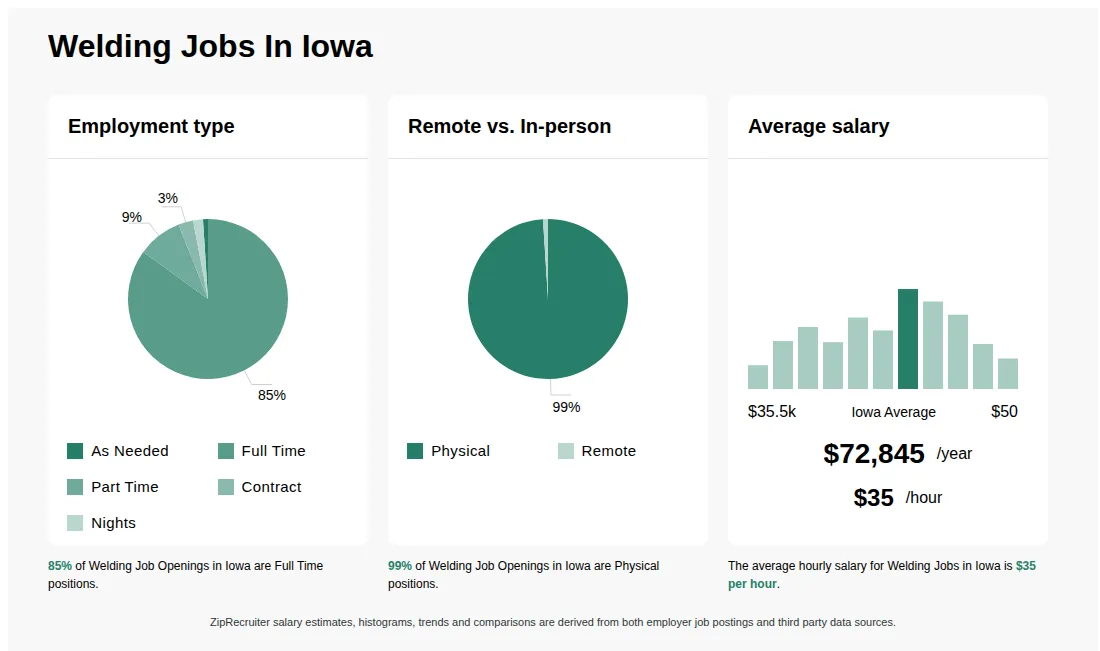
As of Sep 5, 2026, the average hourly pay for welding in Iowa is $27.98, according to ZipRecruiter salary data. Most workers in this role earn between $21.92 and $32.07 per hour, depending on experience, location, and employer.
What is a welding job?
Welding jobs are any jobs that include metal welding as a significant part of the work. There are many different fields that require welders, including manufacturing and construction. As a welder, you are trained to use a number of hand-held and automated tools to complete jobs. You use these tools to cut or fuse together metal parts. Other related positions include cutting, soldering, and brazing jobs. Other fields that have a significant welding component include ironwork and sheet metal work.
What do welders do?
Welders are skilled tradespeople who join metal parts together using high heat and specialized equipment. They work on construction sites, in manufacturing plants, shipyards, and many other settings to build or repair metal structures and products. Welders must be knowledgeable about different welding techniques, safety protocols, and the properties of various metals. Their work is essential in industries like automotive, aerospace, and infrastructure.
What are the key skills and qualifications needed to thrive as a welder, and why are they important?
To thrive as a Welder, you need strong technical skills in metal fabrication, blueprint reading, and welding techniques, typically backed by a welding certification or completion of a technical program. Familiarity with tools like MIG, TIG, and arc welders, as well as safety equipment and quality inspection systems, is essential. Attention to detail, physical stamina, and effective problem-solving are standout soft skills in this role. These abilities ensure precise, safe, and durable work that meets industry standards and project requirements.
What are some common safety challenges welders face on the job, and how are these typically addressed in the workplace?
Welders regularly encounter safety challenges such as exposure to intense heat, ultraviolet light, fumes, and the risk of burns or electrical shock. Most workplaces address these risks by enforcing strict safety protocols, including the use of personal protective equipment (PPE) like helmets, gloves, and flame-resistant clothing. Additionally, employers often provide regular safety training and ensure proper ventilation systems are in place to minimize exposure to hazardous fumes. Team discussions and safety briefings are also common to keep everyone aware of best practices and recent safety updates.
What is the difference between Welding vs Pipefitting?
| Aspect | Welding | Pipefitting |
|---|---|---|
| Certifications | Welding certifications (e.g., AWS) | Pipefitting certifications (e.g., NCCER) |
| Work Environment | Fabrication shops, construction sites, manufacturing | Construction sites, industrial plants, maintenance |
| Job Focus | Joining metal parts through welding | Assembling and installing piping systems |
| Tools & Equipment | Welding machines, torches, safety gear | Pipes, fittings, wrenches, threading tools |
Welding and pipefitting share overlapping skills and certifications, often working together in construction and manufacturing. While welders focus on joining metal components through welding techniques, pipefitters specialize in installing and maintaining piping systems. Both roles require safety training and certifications, but their daily tasks and work environments differ slightly, making each role unique within the industry.
What are some jobs for welding?
Welding jobs include positions such as welder, pipefitter, fabricator, and structural welder, often requiring skills in reading blueprints and operating welding equipment. These roles are found in industries like construction, manufacturing, shipbuilding, and oil and gas, with certifications such as AWS or ASME often preferred. Welders typically work in factories, construction sites, or shipyards and may need to work in various environments and shifts.
More about Welding jobs
What are the most commonly searched types of Welding jobs in Iowa?
The most popular types of Welding jobs in Iowa are:
What are popular job titles related to Welding jobs in Iowa?
For Welding jobs in Iowa, the most frequently searched job titles are:
What job categories do people searching Welding jobs in Iowa look for?
The top searched job categories for Welding jobs in Iowa are:
What cities in Iowa are hiring for Welding jobs?
Cities in Iowa with the most Welding job openings:

Full-time
Posted 11 days ago
Job description
Description
Summary: Weld fabrications or other work as directed by Lead Person or Supervisor. Have a high capability of welding all types of steel as well as aluminum. Prior experience, strong background/knowledge regarding welding techniques. Must be able to work within precise limits and have experience in bench and MIG welding (aluminum, steel, stainless steel). Department specific skills may include chassis prep, crane assembly, hook lift assembly, installation mechanic, rebuild and repair assembly, truck assembly and fuel tank assembly.
Essential Duties and Responsibilities include the following:
- Weld aluminum, steel, and stainless-steel components (bench, MIG).
- Be capable of performing all aspects of welding area.
- Grind welds.
- Working with other employees as part of a team as well as individually.
- Willingness to take direction from area supervision and follow that direction.
- Required to attend/successfully complete company sponsored weld-training program.
- Be capable of reading blueprints/work order, other technical documents required by the job of a welder.
- Have the ability and desire to become efficient with welding, learn all aspects of job as required.
- Set up and assemble various components/machines for welding.
- Continually demonstrates a productive, non-disruptive work ethic.
- Works in a way to create no/limited scrap or rework, works to continually improve quality level.
- Follows all company safety rules as laid out in company safety manual and all other company policies.
- Maintain company equipment/work areas in a clean, orderly manner.
- Be able to safely us the proper tooling and other equipment as specified to fulfill basic job requirements.
- Continually strive to improve in all aspects of job requirements.
- Perform other duties as assigned.
Qualifications:
- Able to commit to welding training provided to by the Company.
- Willing to cross train SOP as required by supervisor/manager.
- Successfully complete weld test prior to job offers.
- Able to follow work orders precisely with little to no error.
- Read work orders and tape measure/measuring equipment.
- Have mechanical skills, some computer skills.
- 6 months similar experience or Weld Program Certification from an accredited Trade School or Vocational Program preferred.
- Must be authorized to work in the US.
Physical Requirements:
- Position will require standing on concrete floor during majority of shift, not including break times.
- Candidate must be able to lift 50lbs and/or push up to 200lbs. All welding bays have hoists that are required to be used for any pieces exceeding that weight.
- Most objects being lift will be lifted approximately from floor to waist. (38")
- Candidate must be able to reach/grab parts up to 10lbs.
- Some functions may include climbing ladders. Appx 5'.
- Some functions will require crouching, squatting, and kneeling.
- Good hand dexterity and balance is required to operate all equipment necessary.
- Job duties may require a minimum amount of crawling.
- Daily use of 5 senses to maintain safety for the team and self.
Requirements
Manufacturing & Operations, Weld