1

Veterinary Behaviorist Jobs (NOW HIRING)

Be Seen First

Veterinary Technician/ Assistant

Monroe Township, NJ · On-site

$15.75 - $20/hr

Holds and restrains animals during veterinary procedures. * Cleans and maintains kennels, animal ... Examines animals to detect behavioral changes or clinical symptoms that could indicate illness or ...

Be Seen First

Veterinary Technician/ Assistant

Monroe Township, NJ · On-site

$15.75 - $20/hr

Holds and restrains animals during veterinary procedures. * Cleans and maintains kennels, animal ... Examines animals to detect behavioral changes or clinical symptoms that could indicate illness or ...

$16 - $18/hr

If you're passionate about animal care, eager to support patients and veterinarians, enthusiastic ... Strong commitment to patient care and an understanding of animal behavior. * Ability to work ...

Veterinarian

Canton, GA · On-site

$110K - $130K/yr

Expand or tailor your interests in surgery, dentistry, companion animal medicine, veterinary behavior, and alternative services. * Strong community reputation. Join a growing hospital with a trusted ...

Perform initial evaluation of pet's condition, collect information from client, observe pet's behavior, and checks vital statistics * Complete preparatory procedures and assist the Veterinarian ...

Veterinarian

Canton, GA · On-site

$110K - $130K/yr

Expand or tailor your interests in surgery, dentistry, companion animal medicine, veterinary behavior, and alternative services. * Strong community reputation. Join a growing hospital with a trusted ...

Showing results 41-60

Veterinary Behaviorist information

See salary details

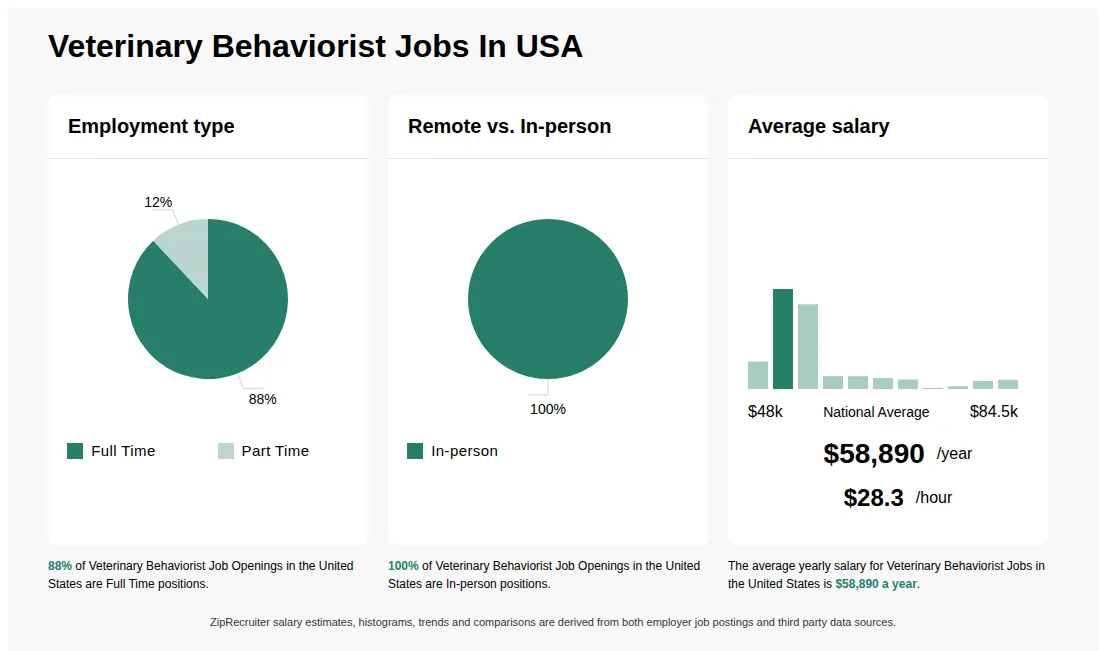
$48K

$58.9K

$84.5K

How much do veterinary behaviorist jobs pay per year?

As of Sep 5, 2026, the average yearly pay for veterinary behaviorist in the United States is $58,890.00, according to ZipRecruiter salary data. Most workers in this role earn between $52,500.00 and $60,000.00 per year, depending on experience, location, and employer.

What is a veterinary behaviorist?

Veterinary behaviorists are licensed veterinarians who specialize in animal behavior, particularly diagnosing and treating behavioral problems in pets. They have advanced training in both veterinary medicine and animal psychology, often completing residencies and earning board certification from organizations like the American College of Veterinary Behaviorists. These professionals use a combination of medical, behavioral, and environmental interventions to help pets with issues such as anxiety, aggression, and compulsive behaviors. Veterinary behaviorists work closely with pet owners to develop personalized treatment plans and may collaborate with other veterinarians or animal trainers. Their expertise helps improve the quality of life for both animals and their owners.

What are the key skills and qualifications needed to thrive as a veterinary behaviorist?

To excel as a Veterinary Behaviorist, you need a Doctor of Veterinary Medicine (DVM) degree, completion of a residency in animal behavior, and board certification (DACVB). Familiarity with behavior assessment tools, diagnostic software, and up-to-date research literature is crucial. Outstanding interpersonal skills, patience, and the ability to educate and empathize with pet owners are essential soft skills. These qualifications and abilities enable effective diagnosis and treatment of animal behavioral issues, ultimately promoting animal welfare and client satisfaction.

What are some common challenges veterinary behaviorists face when working with clients and their pets?

Veterinary Behaviorists often encounter challenges such as managing clients' expectations regarding the timeline for behavioral improvement, ensuring consistent follow-through with treatment plans at home, and addressing cases with complex medical or psychological factors. Building trust with both pets and their owners is crucial, as is effective communication to help clients understand the underlying causes of behavioral issues. Additionally, collaboration with primary care veterinarians and other specialists is often necessary to provide comprehensive care.

How much do veterinary behaviorists make?

Veterinary behaviorists typically earn between $70,000 and $150,000 annually, depending on experience, location, and work setting. Advanced training, board certification, and a private practice or specialty hospital environment can influence salary levels.
More about Veterinary Behaviorist jobs
Infographic showing various Veterinary Behaviorist job openings in the United States as of August 2026, with employment types broken down into 1% Locum Tenens, 1% As Needed, 76% Full Time, 21% Part Time, and 1% Contract. Highlights an 98% Physical, and 2% Remote job distribution, with an average salary of $58,890 per year, or $28.3 per hour.

Veterinary Technician/ Assistant

Jamesburg Veterinary Hospital

Monroe Township, NJ • On-site

$15.75 - $20/hr

Full-time

Re-posted 3 days ago

Be Seen First

After you apply to this job, you can share why you’re interested to jump to the top of the candidate list.


Job description

General Accountabilities

  • Holds and restrains animals during veterinary procedures.
  • Cleans and maintains kennels, animal holding areas, examination or operating rooms, or animal loading or unloading facilities to control the spread of disease.
  • Fills medication prescriptions.
  • Assists veterinarians in examining animals to determine the nature of illnesses or injuries.
  • Monitors animals recovering from surgery and notify veterinarians of any unusual changes or symptoms.
  • Cleans, maintains, and sterilizes instruments or equipment.
  • Examines animals to detect behavioral changes or clinical symptoms that could indicate illness or injury.
  • Educates or advises clients on animal health care, nutrition, or behavior problems.
  • Administers medication, immunizations, or blood plasma to animals as prescribed by veterinarians.
  • Collects laboratory specimens, such as blood, urine, or feces for testing.
  • Provides emergency first aid to sick or injured animals.
  • Performs routine laboratory tests or diagnostic tests, such as taking or developing x-rays.
  • Exercises animals or provides them with companionship.
  • Performs office reception duties, such as scheduling appointments or helping customers.
  • Performs hygiene-related duties, such as clipping animals' claws or cleaning and polishing teeth.
  • *We are WILLING to train the RIGHT PERSON !!!
  • *The company reserves the right to add or change duties at any time.

If interested please reach out in person at 3 Stockton Ave, Jamesburg, NJ 08831 (732-656-0039).