1

Verification Validation Engineer Jobs in California

next page

Showing results 1-20

Verification Validation Engineer information

What are some common challenges faced by Verification Validation Engineers during the product development lifecycle?

Verification Validation Engineers often encounter challenges such as tight project deadlines, evolving product requirements, and coordinating across multidisciplinary teams. They must ensure that both hardware and software components meet stringent quality and regulatory standards, which can require extensive test planning and documentation. Additionally, balancing thorough testing with the need to deliver products to market quickly demands strong organizational and communication skills, as well as adaptability to shifting priorities.

What is the difference between Verification Validation Engineer vs Quality Assurance Engineer?

AspectVerification Validation EngineerQuality Assurance Engineer
CertificationsISO, Six Sigma, ISTQBISO, Six Sigma, ISTQB
Work EnvironmentProduct development, testing labs, manufacturingProcess improvement, audits, compliance
Industry UsageElectronics, software, manufacturingElectronics, software, manufacturing

The Verification Validation Engineer focuses on testing and validating products to ensure they meet specifications, while the Quality Assurance Engineer emphasizes process quality and compliance. Both roles often collaborate but serve distinct functions in product development and quality management.


What are the key skills and qualifications needed to thrive as a Verification Validation Engineer, and why are they important?

To excel as a Verification Validation Engineer, you need a strong background in engineering principles, testing methodologies, and a degree in electrical, computer, or software engineering. Familiarity with verification tools like MATLAB, Simulink, test automation frameworks, and knowledge of industry standards (such as ISO or DO-178C) are often required. Attention to detail, analytical thinking, and effective problem-solving and communication skills are essential soft skills for this role. These qualifications ensure accurate system validation, compliance with regulatory requirements, and the delivery of reliable products.

What are Verification Validation Engineers?

Verification Validation Engineers are professionals responsible for ensuring that products, systems, or software meet specified requirements and function as intended. They design and execute tests to verify that the product works according to its design specifications (verification) and validate that it fulfills the intended use and user needs (validation). Their work helps identify defects, ensure quality, and minimize risks before a product is released. These engineers collaborate closely with design, development, and quality teams throughout the product lifecycle. Their role is essential in industries such as aerospace, automotive, medical devices, and software development.
What are popular job titles related to Verification Validation Engineer jobs in California? For Verification Validation Engineer jobs in California, the most frequently searched job titles are:
What job categories do people searching Verification Validation Engineer jobs in California look for? The top searched job categories for Verification Validation Engineer jobs in California are:
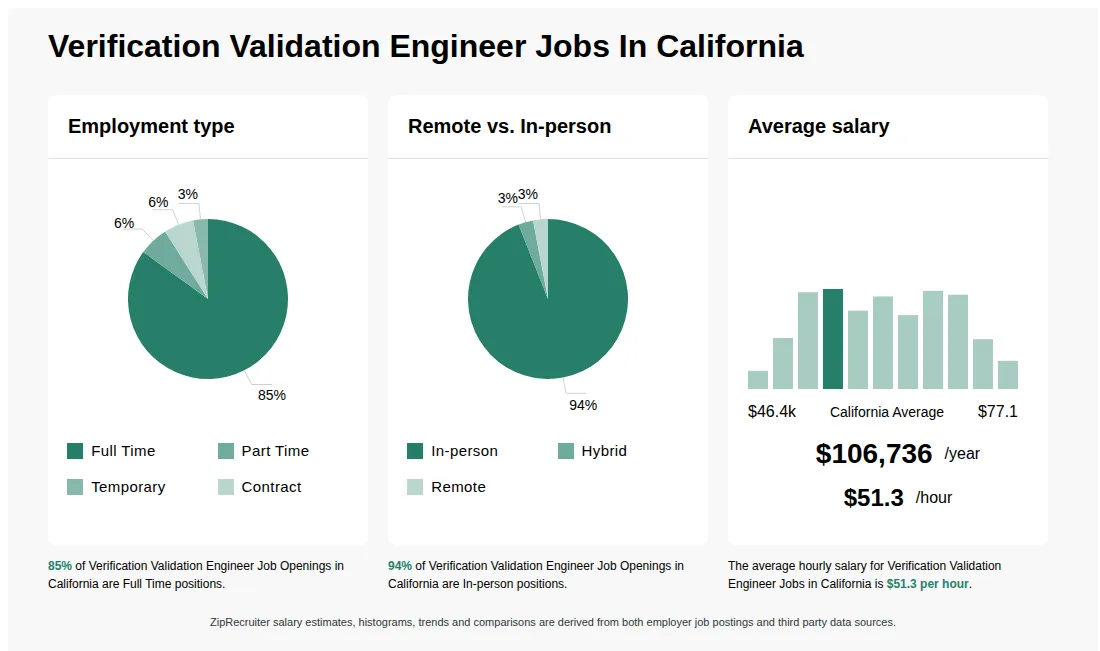
Infographic showing various Verification Validation Engineer job openings in California as of July 2026, with employment types broken down into 93% Full Time, 4% Part Time, and 3% Contract. Highlights an 89% Physical, 4% Hybrid, and 7% Remote job distribution.
Lead Verification & Validation Engineer

Lead Verification & Validation Engineer

ALTEN Technology USA

Palo Alto, CA โ€ข On-site

$140K - $175K/yr

Other

Posted 10 days ago


Job description

We are looking for a Lead Verification & Validation Engineer to join our team. You will be responsible for designing, developing, and executing V&V activities to ensure that our software meets the highest standards of safety and performance. In this role, you will play a critical role in ensuring the quality and reliability of our automotive systems - and serve as a technical lead across the V&V organization, guiding junior engineers and shaping validation strategy at the program level.

What you'll do:

  • Lead V&V strategy definition and own the end-to-end validation plan from concept through production release, setting direction for the broader team
  • Mentor and provide technical guidance to validation engineers, reviewing test plans, debug approaches, and automation frameworks
  • Serve as the primary technical escalation point for complex system-level failures, driving root cause analysis and cross-functional resolution
  • Design, build, and maintain complex automotive system-level test benches to validate automotive systems with a focus on automation
  • Develop comprehensive verification and validation plans for automotive software systems and features
  • Design and execute test cases and test scripts to verify system functionality, performance, and safety
  • Develop and implement automation scripts and tools to enhance testing efficiency and accuracy
  • Integrate hardware and software components to create reliable and scalable test environments
  • Lead debug of issues encountered, working with cross-functional teams across the organization on identifying root cause, confirming fixes, and providing guidance on protecting against future regressions
  • Collaborate with cross-functional teams - including software developers, controls engineers, and systems engineers - to define and implement V&V strategies
  • Continuously improve testing processes and tools to enhance efficiency and effectiveness
  • Prepare and present detailed reports on verification activities and results to stakeholders

You'll have:

  • Bachelor's degree in Electrical Engineering, Mechanical Engineering, or equivalent combination of relevant education and experience
  • 5+ years of experience in the automotive or relevant industry
  • Strong understanding of automotive systems, embedded software, and control systems
  • Demonstrated experience with automotive testing instrumentation and tools
  • Proficiency in automotive communication protocols such as CAN, LIN, Ethernet, and FlexRay
  • Working knowledge of IDLs such as DBC, LDF, ARXML, and work with internal IDLs and frameworks
  • Experience with automotive or aerospace HIL test benches, particularly with dSPACE, Vector VT, or similar platforms
  • Experience writing and executing automated and manual tests
  • Deep expertise in the EE architecture and integration of complex automotive systems, including interactions across multiple domains (e.g., body, powertrain, chassis, ADAS) and ECUs
  • Proven track record of collaborating with large, cross-functional teams across hardware, software, and systems engineering
  • Deep understanding of software development lifecycle and automotive testing methodologies
  • Experience in system-level debugging and root-cause analysis across software and hardware boundaries
  • Proficiency in understanding wiring and logical schematics, network diagrams, and harness drawings
  • Ability to define and drive system validation plan from concept to production

Even better, you may have:

  • Familiarity with safety-critical software development and industry standards like ISO 26262
  • Proficiency in programming languages such as C/C++, Python, or MATLAB
  • Experience testing fully electric vehicles

Salary Range: $140,000-$175,000/K

The actual salary offered is dependent on various factors including, but not limited to, location, the candidate's combination of job-related knowledge, qualifications, skills, education, training, and experience ย