1

Stage Lighting Designer Jobs (NOW HIRING)

Theatre Technician

Glendale, CA · On-site

$5.4K - $5.9K/mo

Read and interpret designs, blueprints, renderings, and other drawings execute scenery, lighting, video, and audio designs. * Assists in the construction and oversight of stage sets and set-up of ...

Stagehand

Atlanta, GA

$16.75 - $22.25/hr

Experience in stage lighting, pro audio systems and basic video systems * Ability to handle ... It is not designed to contain or be interpreted as a comprehensive inventory of all duties ...

Stagehand - Van Buren

Phoenix, AZ

$17.50 - $23/hr

Experience in stage lighting, pro audio systems and basic video systems * Ability to handle ... It is not designed to contain or be interpreted as a comprehensive inventory of all duties ...

Stagehand

Atlanta, GA · On-site

$16.75 - $22.25/hr

Experience in stage lighting, pro audio systems and basic video systems * Ability to handle ... It is not designed to contain or be interpreted as a comprehensive inventory of all duties ...

next page

Showing results 1-20

Stage Lighting Designer information

See salary details

$19.5K

$60.2K

$113K

How much do stage lighting designer jobs pay per year?

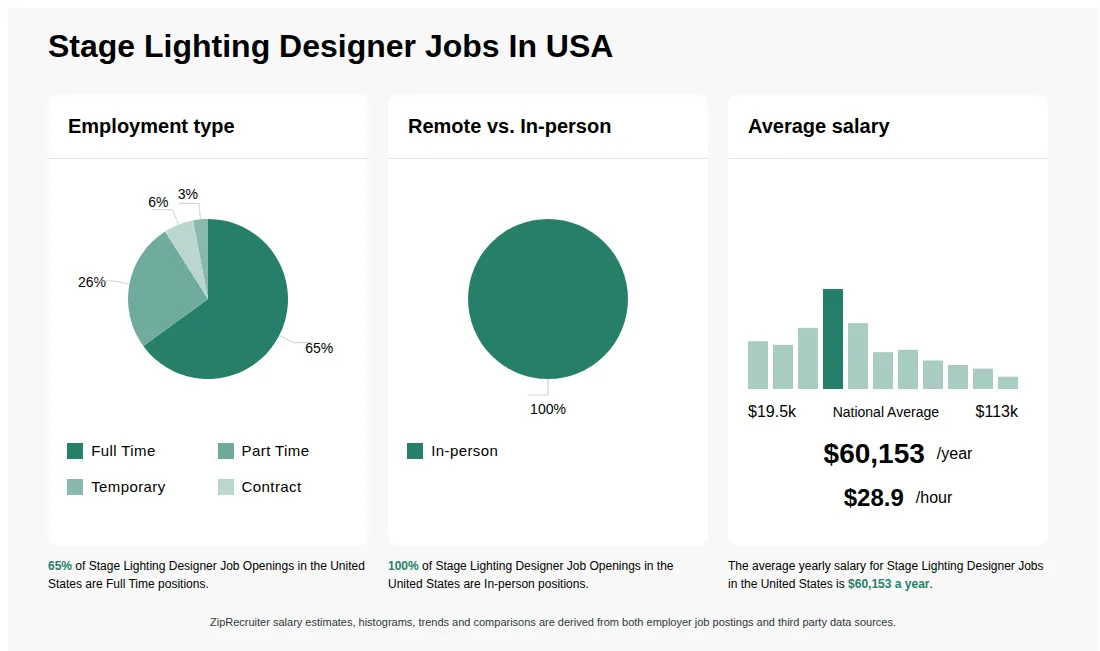
As of Jul 22, 2026, the average yearly pay for stage lighting designer in the United States is $60,153.00, according to ZipRecruiter salary data. Most workers in this role earn between $40,500.00 and $75,000.00 per year, depending on experience, location, and employer.

What does a Stage Lighting Designer do?

A Stage Lighting Designer is responsible for creating the lighting plan and effects for live performances such as theater, concerts, or events. They work closely with directors, set designers, and technicians to ensure that lighting enhances the mood, visibility, and overall impact of a production. Their work involves choosing lighting equipment, programming lighting cues, and overseeing installation and operation during rehearsals and performances. The designer also addresses any technical or creative challenges that arise to achieve the desired artistic vision.

What are the key skills and qualifications needed to thrive as a Stage Lighting Designer, and why are they important?

To thrive as a Stage Lighting Designer, you need a solid understanding of lighting theory, color, stagecraft, and often a degree in theater production or a related field. Familiarity with lighting consoles (such as ETC or GrandMA), CAD software, and lighting design programs like Vectorworks Spotlight is typically required. Creativity, strong collaboration, and problem-solving skills help designers work effectively with directors and production crews. These abilities ensure that lighting enhances the mood, visibility, and overall impact of stage performances.

What are some common challenges faced by stage lighting designers when collaborating with directors and other production team members?

Stage lighting designers often navigate the challenge of aligning their creative vision with the director's concept and the overall production design. Effective communication is crucial, as lighting must complement set, costume, and sound design, often requiring compromises and adjustments during rehearsals. Managing technical limitations, such as venue equipment or budget constraints, is also common. Successful designers remain flexible, proactive in problem-solving, and responsive to feedback from the broader production team.

What is the difference between Stage Lighting Designer vs Lighting Technician?

AspectStage Lighting DesignerLighting Technician
CredentialsLighting design degree or equivalent, certifications in lighting softwareTechnical training, certifications in lighting equipment operation
Work EnvironmentDesign studios, theaters, concert venuesOn-site at venues, event setups, live productions
Employer & IndustryTheater companies, production houses, concert organizersEvent companies, theaters, touring productions

While both roles work with lighting, the Stage Lighting Designer focuses on creating the overall lighting concept and design, whereas the Lighting Technician handles the technical setup, operation, and maintenance of lighting equipment during productions.

More about Stage Lighting Designer jobs
What cities are hiring for Stage Lighting Designer jobs? Cities with the most Stage Lighting Designer job openings:
What states have the most Stage Lighting Designer jobs? States with the most job openings for Stage Lighting Designer jobs include:
Infographic showing various Stage Lighting Designer job openings in the United States as of July 2026, with employment types broken down into 1% Locum Tenens, 87% Full Time, 7% Part Time, 1% Temporary, and 4% Contract. Highlights an 88% Physical, 6% Hybrid, and 6% Remote job distribution, with an average salary of $60,153 per year, or $28.9 per hour.
Theatre Technician

$5.4K - $5.9K/mo

Other

Posted 14 days ago


Job description

Description Definition Under direction, performs technical theatrical duties to support a wide variety of music, dance, theater productions, and other special events; reviews scenic plans, lighting, video and audio plots; reviews and completes work requests for stage productions; installs and maintains theatrical control systems; attends and assists with technical and dress rehearsals; and performs other duties as assigned. Supervision Works under the direct supervision of the department manager. Does not directly or indirectly supervise other employees but may provide work direction to lower-level employees, temporary employees, and/or student workers.

Work Schedule 40 hours per week, 12 months per year, some evenings and weekends will be required. Examples of Duties ESSENTIAL DUTIES AND RESPONSIBILITIES: The following duties and responsibilities are typical of those performed in this classification. Performs technical theatrical duties to support a wide variety of music, dance, theater productions, and other special events (e.g., graduation ceremony, guest speakers, etc.)

Reviews scenic plans, lighting, video and audio plots; works from blueprints, drawings, layouts, and other renderings to design and construct stage sets; prepares cost estimates and orders needed supplies, equipment, material, and rentals for productions, confers with designers and directors on budget and time considerations and restraints. Reviews and completes work requests for stage productions; utilizes tools and equipment to inspect, repair, fabricate and install a variety of requested performing arts construction and stage designs; orders, rents, or otherwise acquires props and set pieces per production designer's specifications; works with the department manager and technical staff to ensure that construction, painting, rigging, and set-up of stage settings and other assigned events are set up in a proper, safe, and timely manner. Installs, and maintains theatrical control systems; operates video, sound and/or lighting consoles during performances and special events; reinforces sound for live music performances; designs, implements, programs, and maintains computerized playback systems to produce audio, visual and special effects during productions.

Attends and assists with technical and dress rehearsals to ensure the proper execution of scene, lighting, and audio shifts, properties placement, and shifting, and costume changes; confers with the department manager to make sure productions will run smoothly. Provides technical expertise and assistance to faculty and students in stagecraft, lighting, and audio courses and labs. Collaborates with staff, vendors, and contractors to guide, oversee and inspect job specifications and completed work.

Schedules and ensures the striking of sets following closing performances. Creates and maintains a variety of office records and reports. May provide work direction to lower-level employees, temporary employees, and/or student workers.

Performs other related duties as assigned. Minimum Qualifications MINIMUM QUALIFICATIONS: The education, training, and experience qualifications are considered likely to provide the required knowledge and abilities to perform the above essential duties. Education and Experience: One year of college course work (30 semester units or equivalent quarter) from an accredited college or university in theatre arts, technical theatrics, multimedia productions, or a closely related field.

Four years of technical theater/dramatic production work experience in one or more of the following areas: set construction, stage rigging, stage lighting, stage audio, or stage video, including experience using computerized theatrical control systems. Licenses/Certifications/Other Requirements: None. Knowledge of: Principles, methods, materials, and terminology used in theatrical set design, construction, lighting, rigging, video, and audio design and set-up.

Computerized theatrical control systems. Safety measures and hazards for theater productions. Basic electrical theory and principles as it pertains to stage equipment.

Network theory. Light design. Theatrical production and construction blueprints.

Laws, regulations, standards, and/or requirements applicable to areas of assignment. Standard office practices or procedures. Standard office software and modern office equipment.

Standard formats for business correspondence and other communications. Methods of filing information using alpha, numeric, and alphanumeric systems. Correct use of the English language, including spelling, punctuation, and grammar.

Principles and practices of customer service. Ability to: Arrange the technical aspects of theatrical productions, including set construction, stage rigging, lighting, audio, and video. Operate and configure computerized theatrical control systems.

Read and interpret designs, blueprints, renderings, and other drawings execute scenery, lighting, video, and audio designs. Assists in the construction and oversight of stage sets and set-up of lighting, video, and audio equipment. Operates hand tools and construction equipment.

Explain and apply general safety procedures applicable to the areas of assignment. Research, apply, and explain the laws, regulations, policies and/or procedures applicable to areas of assignment. Operate a variety of office equipment including computers and printers/copiers.

Utilize standard office software (e.g., email, word processing, and spreadsheet software). Maintain confidentiality of sensitive and/or protected information. Prepare reports, correspondence, and other documents using multiple business formats

Maintain hard copy and electronic files and records. Prioritize work and complete assignments accurately and within established deadlines. Provide and obtain detailed information to/from others.

Provide customer service with a high level of sensitivity, tact and patience. Exercise reasonable judgment in performing job duties. Work and perform duties independently.

Perform and prioritize multiple tasks. Communicate effectively, both orally and in writing. Establish and maintain cooperative and effective working relationships with all staff and others encountered in the course of work.

Demonstrate a sensitivity to, and understanding of, the diverse academic, socioeconomic, cultural, disability, gender identity, sexual orientation, and ethnic backgrounds of community college students. PHYSICAL AND MENTAL STANDARDS: The following physical and mental standards are identified as necessary to perform the essential duties and responsibilities. However, reasonable accommodation may be made to enable individuals with disabilities to perform the essential functions of the position.

Mobility: walking or standing for extended periods of time; dexterity of hands and fingers to operate a computer keyboard, lighting devices, soundboards, and related performing arts equipment; bending at the waist, kneeling, and crouching to retrieve tools, equipment, and materials; climbing ladders and scaffolding. Dexterity: manual dexterity and hand-eye coordination to reach overhead, above the shoulders, and horizontally. Lifting: lifting, carrying, pushing, and pulling heavy objects weighing 50lbs.or less as assigned by the position

Visual Requirements: seeing to read a variety of materials; visual acuity to see close, distant, and peripheral objects; adjust focus as necessary; and perceive depth and colors. Hearing/Talking: hearing and speaking to exchange information in person and on the telephone. Emotional/Psychological Factors: working under pressure; working at considerable heights above performing arts stages.

ENVIRONMENTAL CONDITIONS: Work is primarily performed inside, in a performing arts theatre or classroom. Work involves changing lighting conditions, smoke conditions, and exposure to loud noises. Additional Information Salary The Theatre Technician classification salary range is R-34.

Starting salary: Step 1 $5,421.58 to Step 3 $5,977.29 per month, based on training and experience. Salary range: Step 1 $5,421.58 to Step 6 $6,919.46 per month (plus longevity where applicable) Application Process This position requires the following documents to be attached to your online application in order to be considered: Current resume Transcripts showing required degree and coursework must be submitted. Unofficial transcripts will be accepted only during the application process

Official transcripts are required upon offer of employment. Foreign transcripts and degrees require official certification of equivalency to U.S. transcripts and degrees by a certified U.S

review service at the time of application. Please note: All required documentation must be attached to the online application by the applicant. Additional documents not requested in the announcement will not be reviewed.

Applications will be accepted until the position is filled. First review: August 7, 2026. Applications with incomplete information (i.e

statements such as "see resume") or missing documents will not be reviewed. Position Funding The district reserves the right to extend, withdraw, and/or reopen this position at any time. Commitment to Diversity and Equal Employment Opportunity Employer GCCD is committed to employing administrators, faculty, and staff members who are dedicated to student success.

GCCD recognizes that diversity in the academic environment fosters cultural awareness, promotes mutual understanding and respect, and provides suitable role models for all students. GCCD is committed to hiring processes that support equal opportunity, diversity, and provide equitable consideration for all candidates as required in federal and state law. To find out more about GCCD, please visit our website at glendale.edu

Accommodations If accommodations are needed for the application process in compliance with the Americans with Disabilities Act, please contact the Office of Human Resources. Thank you for your interest in employment opportunities with Glendale Community College