$87 - $113/hr
Candidates with expertise in sports medicine and/or rehabilitation psychology will also be ... D. preferred, in Kinesiology, Exercise Science, Psychology, or a closely related field with an ...
$87 - $113/hr
Candidates with expertise in sports medicine and/or rehabilitation psychology will also be ... D. preferred, in Kinesiology, Exercise Science, Psychology, or a closely related field with an ...
$87 - $113/hr
Candidates with expertise in sports medicine and/or rehabilitation psychology will also be ... D. preferred, in Kinesiology, Exercise Science, Psychology, or a closely related field with an ...
Edinburg, TX · On-site
$60 - $80/hr
Assistant Professor (Exercise Science) - Health & Human Performance CoHP Tenure-Track Faculty 2027 ... College of Sports Medicine. * Research interests in diabetes, obesity, bone health, or ...
Edinburg, TX · On-site
$60 - $80/hr
Assistant Professor (Exercise Science) - Health & Human Performance CoHP Tenure-Track Faculty 2027 ... College of Sports Medicine. * Research interests in diabetes, obesity, bone health, or ...
Buffalo, NY · On-site
$23.50 - $28/hr
... Sports Medicine, Exercise Science or Human Biomechanics degree. Benefits: * Part-time roll (with potential for full time) with a minimum of 15 hours per week. Must be over 3 days per week and ...
Quick apply
Buffalo, NY · On-site
$23.50 - $28/hr
... Sports Medicine, Exercise Science or Human Biomechanics degree. Benefits: * Part-time roll (with potential for full time) with a minimum of 15 hours per week. Must be over 3 days per week and ...
A terminal degree in Exercise Science, Sport Management, or closely related degree is required for the rank of assistant professor and tenure. The ideal candidate will have teaching experience at the ...
Quick apply
A terminal degree in Exercise Science, Sport Management, or closely related degree is required for the rank of assistant professor and tenure. The ideal candidate will have teaching experience at the ...
A terminal degree in Exercise Science, Sport Management, or closely related degree is required for the rank of assistant professor and tenure. The ideal candidate will have teaching experience at the ...
A terminal degree in Exercise Science, Sport Management, or closely related degree is required for the rank of assistant professor and tenure. The ideal candidate will have teaching experience at the ...
A terminal degree in Exercise Science, Sport Management, or closely related degree is required for the rank of assistant professor and tenure. The ideal candidate will have teaching experience at the ...
A terminal degree in Exercise Science, Sport Management, or closely related degree is required for the rank of assistant professor and tenure. The ideal candidate will have teaching experience at the ...
Minneapolis, MN · On-site
$87 - $113/hr
Candidates with expertise in sports medicine and/or rehabilitation psychology will also be ... D. preferred, in Kinesiology, Exercise Science, Psychology, or a closely related field with an ...
Minneapolis, MN · On-site
$87 - $113/hr
Candidates with expertise in sports medicine and/or rehabilitation psychology will also be ... D. preferred, in Kinesiology, Exercise Science, Psychology, or a closely related field with an ...
We are recruiting instructors for the following programs: - Athletic Training - Exercise Science - Health Education - Physical Education Teacher Education - Sport Administration Please reference the ...
We are recruiting instructors for the following programs: - Athletic Training - Exercise Science - Health Education - Physical Education Teacher Education - Sport Administration Please reference the ...
Adjunct Lecturer - Sport and Exercise Science Benedictine University is an inclusive academic community, inspired by theCatholic intellectual tradition and Benedictine values. We seek employees ...
Adjunct Lecturer - Sport and Exercise Science Benedictine University is an inclusive academic community, inspired by theCatholic intellectual tradition and Benedictine values. We seek employees ...
$87 - $113/hr
Candidates with expertise in sports medicine and/or rehabilitation psychology will also be ... D. preferred, in Kinesiology, Exercise Science, Psychology, or a closely related field with an ...
$87 - $113/hr
Candidates with expertise in sports medicine and/or rehabilitation psychology will also be ... D. preferred, in Kinesiology, Exercise Science, Psychology, or a closely related field with an ...
Minneapolis, MN · On-site
$87 - $113/hr
Candidates with expertise in sports medicine and/or rehabilitation psychology will also be ... D. preferred, in Kinesiology, Exercise Science, Psychology, or a closely related field with an ...
Minneapolis, MN · On-site
$87 - $113/hr
Candidates with expertise in sports medicine and/or rehabilitation psychology will also be ... D. preferred, in Kinesiology, Exercise Science, Psychology, or a closely related field with an ...
We are recruiting instructors for the following programs: - Athletic Training - Exercise Science - Health Education - Physical Education Teacher Education - Sport Administration Please reference the ...
We are recruiting instructors for the following programs: - Athletic Training - Exercise Science - Health Education - Physical Education Teacher Education - Sport Administration Please reference the ...
Visiting Faculty, Exercise Science Department: Kinesiology FLSA Status: Exempt Reports To: Dean or ... Applicants with experience in sports science, sports data analytics, or biomechanics are preferred.
Visiting Faculty, Exercise Science Department: Kinesiology FLSA Status: Exempt Reports To: Dean or ... Applicants with experience in sports science, sports data analytics, or biomechanics are preferred.
Anniston, AL · On-site
Provides sports training, and human adaptability to acute and chronic exercise. Responsible for ... Graduate of an exercise physiology/exercise science program. Must have BLS/CPR by the American ...
Anniston, AL · On-site
Provides sports training, and human adaptability to acute and chronic exercise. Responsible for ... Graduate of an exercise physiology/exercise science program. Must have BLS/CPR by the American ...
Anniston, AL · On-site
Provides sports training, and human adaptability to acute and chronic exercise. Responsible for ... Graduate of an exercise physiology/exercise science program. Must have BLS/CPR by the American ...
Anniston, AL · On-site
Provides sports training, and human adaptability to acute and chronic exercise. Responsible for ... Graduate of an exercise physiology/exercise science program. Must have BLS/CPR by the American ...
Visiting Faculty, Exercise Science Department: Kinesiology FLSA Status: Exempt Reports To: Dean or ... Applicants with experience in sports science, sports data analytics, or biomechanics are preferred.
Visiting Faculty, Exercise Science Department: Kinesiology FLSA Status: Exempt Reports To: Dean or ... Applicants with experience in sports science, sports data analytics, or biomechanics are preferred.
The undergraduate lab assistant will assist Exercise & Sport Science faculty with laboratory supervision, fitness assessment, and research. *Bob Jones University students only* PRINCIPAL DUTIES AND ...
The undergraduate lab assistant will assist Exercise & Sport Science faculty with laboratory supervision, fitness assessment, and research. *Bob Jones University students only* PRINCIPAL DUTIES AND ...
Lisle, IL · On-site
Business, Public Health, Nursing, Nutrition & Dietetics, Math, Computer Sciences, Biology, Sports & Exercise Science, Physics, Astronomy, Engineering, Chemistry & Biochemistry, Communications ...
Lisle, IL · On-site
Business, Public Health, Nursing, Nutrition & Dietetics, Math, Computer Sciences, Biology, Sports & Exercise Science, Physics, Astronomy, Engineering, Chemistry & Biochemistry, Communications ...
Elkhorn, NE · On-site
$13 - $25/hr
Massage or Neuromuscular Therapists, Yoga, Pilates, Personal Trainer, Physical Therapy Aide, NASM, ACE, Kinesiology, or Sports and Exercise Science Degree. * Experience working in a fitness/health ...
Quick apply
Elkhorn, NE · On-site
$13 - $25/hr
Massage or Neuromuscular Therapists, Yoga, Pilates, Personal Trainer, Physical Therapy Aide, NASM, ACE, Kinesiology, or Sports and Exercise Science Degree. * Experience working in a fitness/health ...
The undergraduate lab assistant will assist Exercise & Sport Science faculty with laboratory supervision, fitness assessment, and research. *Bob Jones University students only* PRINCIPAL DUTIES AND ...
The undergraduate lab assistant will assist Exercise & Sport Science faculty with laboratory supervision, fitness assessment, and research. *Bob Jones University students only* PRINCIPAL DUTIES AND ...
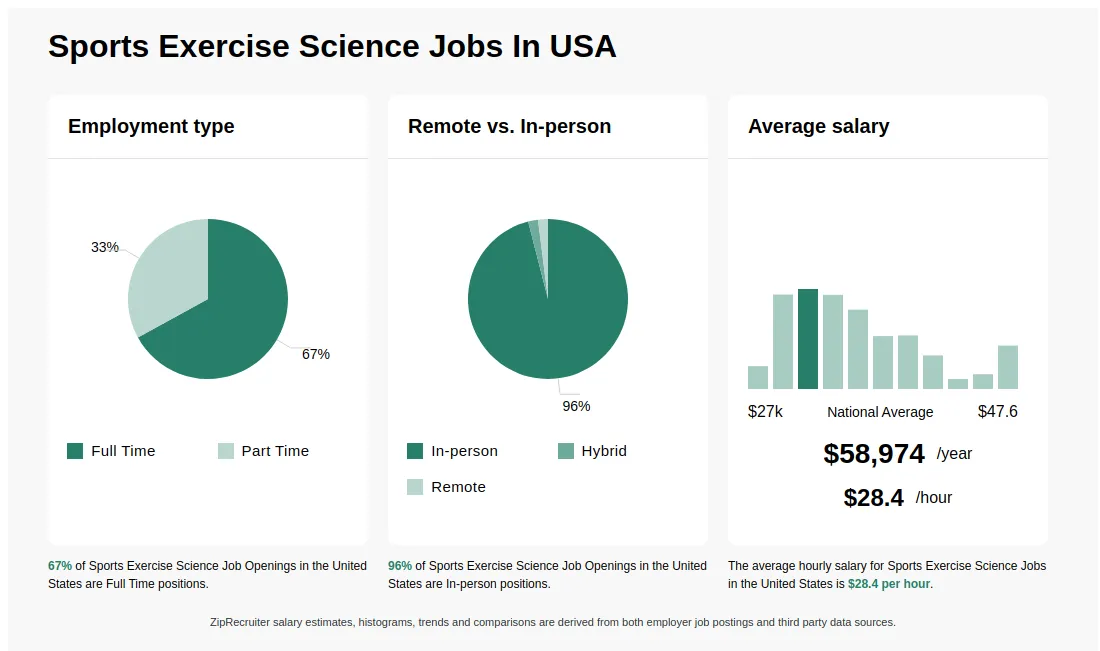
$12.98 - $16.13
3% of jobs
$16.13 - $19.27
16% of jobs
$20.31 is the 25th percentile. Wages below this are outliers.
$19.27 - $22.42
17% of jobs
The median wage is $25.04 / hr.
$22.42 - $25.57
16% of jobs
$25.57 - $28.72
14% of jobs
$31.76 is the 75th percentile. Wages above this are outliers.
$28.72 - $31.86
9% of jobs
$31.86 - $35.01
9% of jobs
$35.01 - $38.16
5% of jobs
$38.16 - $41.30
1% of jobs
$41.30 - $44.45
2% of jobs
$44.45 - $47.60
8% of jobs
$12
$28
$47
| Aspect | Sports Exercise Science | Sports Performance Coach |
|---|---|---|
| Credentials | Degree in Exercise Science, certifications like NSCA or ACSM | Certifications in coaching, strength and conditioning, sport-specific training |
| Work Environment | Clinics, universities, research labs, sports teams | Training facilities, sports teams, gyms |
| Industry Usage | Academic, research, health, and sports settings | Coaching athletes, improving performance |
Sports Exercise Science focuses on understanding human physiology, biomechanics, and health to improve athletic performance and recovery through research and clinical applications. In contrast, a Sports Performance Coach applies training techniques directly to athletes, emphasizing skill development and performance enhancement. While both roles require knowledge of exercise principles, Sports Exercise Science is more research and health-oriented, whereas Sports Performance Coaching is more hands-on and sport-specific.
Cities with the most Sports Exercise Science job openings:
States with the most job openings for Sports Exercise Science jobs include:
$87 - $113/hr
Other
Medical, Dental, Life, Retirement
Posted 4 days ago
The School of Kinesiology in the College of Education and Human Development at the University of Minnesota seeks to fill a tenure-tenure track Assistant / Associate Professor position in sport and exercise psychology. The successful candidate will have education, expertise, and research accomplishments in sport and/or exercise psychology. Candidates with expertise in sports medicine and/or rehabilitation psychology will also be considered. The candidate will join an interdisciplinary department committed to excellence in faculty development and mentoring in research, teaching, and service. Successful candidates will demonstrate alignment and ability to build interdisciplinary collaborations across the School of Kinesiology’s core areas and research centers and across the University of Minnesota. Candidates will also identify opportunities for alignment with robust resources available within the College of Education and Human Development and across the University of Minnesota that support excellence across research, teaching, and service (e.g., Research Methodology Consulting Center, Center for Educational Innovation, Office for Public Engagement). The candidate would have evidence of commitment to mentoring and training graduate students from diverse backgrounds. This is a 9-month, full-time appointment located on the Minneapolis campus with a target start date of August 30, 2027.
The budgeted salary range for this position is $87,000 - $97,000 for the rank of Assistant Professor and $103,000 - $113,000 for the rank of Associate Professor. Final salary offers are dependent on the candidate's experience, skills, and internal equity within the department.
ResponsibilitiesThe School of Kinesiology at the University of Minnesota-Twin Cities has a rich tradition of research and scholarship, combined with excellence in teaching and service. The mission of the School is to enrich the quality of human life by expanding, applying, and disseminating the body of knowledge germane to human movement, physical activity, and their applied systems. The School’s core values of excellence and belonging guide our research, learning, and internal culture to create a positive space for our faculty, staff, and students. Complete information on the School can be found on the website, http://www.cehd.umn.edu/kin.
About The CollegeThe College of Education and Human Development (CEHD), the third largest college at the University, contributes to a just and sustainable future through engagement with the local and global communities to enhance human learning and development at all stages of the life span. We know diversity is necessary to do our best work and foster our humanity. That’s why the CEHD community is collectively dedicated to cultivating an inclusive and equitable environment, embracing and celebrating all identities of our students, staff, and faculty. These values are also a moral imperative requiring continuous proactive measures and a firm stance against prejudice, discrimination, and systemic injustice. https://www.cehd.umn.edu/
Pay And BenefitsPay Range: $87,000 - $97,000 for the rank of Assistant Professor and $103,000 - $113,000 for the rank of Associate Professor ; depending on education/qualifications/experience
Time Appointment: 100% Appointment
Position Type: Faculty and P&A Staff
Please visit the Office of Human Resources website for more information regarding benefit eligibility.
The University Offers a Comprehensive Benefits Package That IncludesWhile our salary ranges provide a framework, it is important to note that most of thetime, the initial pay may not reach the maximum of the range. This approach ensuresthat compensation reflects the value and unique contributions of each candidate whilemaintaining equity within our organization. As part of our commitment to fair andequitable compensation, please be aware that the salary offered to incoming candidateswill be based on their individual credentials and experience.
InquiriesAddress questions about the position to Dr. Emily Kringle, ekringle@umn.edu (Search Committee Chair). For general questions about the application process, contact Debbie Janis, djanis@umn.edu. To request an accommodation during the application process, please e-mail employ@umn.edu or call (612)-624-UOHR (8687).
DiversityThe University recognizes and values the importance of diversity and inclusion in enriching the employment experience of its employees and in supporting the academic mission. The University is committed to attracting and retaining employees with varying identities and backgrounds.
The University of Minnesota provides equal access to and opportunity in its programs, facilities, and employment without regard to race, color, creed, religion, national origin, gender, age, marital status, disability, public assistance status, veteran status, sexual orientation, gender identity, or gender expression. To learn more about diversity at the U: http://diversity.umn.edu
Employment RequirementsAny offer of employment is contingent upon the successful completion of a background check. Our presumption is that prospective employees are eligible to work here. Criminal convictions do not automatically disqualify finalists from employment. This position is not eligible for visa sponsorship.
About University Of MinnesotaAt the University of Minnesota, we are proud to be recognized by Forbes as a Best Employer for Company Culture (2026), Best Employer for Women (2023, 2025, 2026), and Best Employer by State (2022-2026). In 2026, we also received Culture Excellence & Industry Awards recognition for employee appreciation and work-life flexibility.
The University of Minnesota, Twin Cities (UMTC)The University of Minnesota, Twin Cities (UMTC), is among the largest public research universities in the country, offering undergraduate, graduate, and professional students a multitude of opportunities for study and research. Located at the heart of one of the nation's most vibrant, diverse metropolitan communities, students on the campuses in Minneapolis and St. Paul benefit from extensive partnerships with world-renowned health centers, international corporations, government agencies, and arts, nonprofit, and public service organizations.