HES Adjunct Pool includes core curriculum and electives for Exercise & Sport Science (ESS) and Clinical Exercise Science (CES). Part-time, August to May 2022-2023 academic year. Duties and ...
HES Adjunct Pool includes core curriculum and electives for Exercise & Sport Science (ESS) and Clinical Exercise Science (CES). Part-time, August to May 2022-2023 academic year. Duties and ...
HES Adjunct Pool includes core curriculum and electives for Exercise & Sport Science (ESS) and Clinical Exercise Science (CES). Part-time, August to May 2022-2023 academic year. Duties and ...
HES Adjunct Pool includes core curriculum and electives for Exercise & Sport Science (ESS) and Clinical Exercise Science (CES). Part-time, August to May 2022-2023 academic year. Duties and ...

Adjunct Instructor for Sport and Exercise Psychology
Springfield, MA · On-site
$2.8K/wk
Exercise Science Opening Date: 07/22/2026 Description Springfield College invites applications for ... This position would support the on-line master's program in Sport and Exercise Psychology.
Adjunct Instructor for Sport and Exercise Psychology
Springfield, MA · On-site
$2.8K/wk
Exercise Science Opening Date: 07/22/2026 Description Springfield College invites applications for ... This position would support the on-line master's program in Sport and Exercise Psychology.

Adjunct Instructor Exercise Science & Wellness
New York, NY · On-site
$1.0K - $1.3K/wk
Sports Nutrition * Kinesiology * Strength and Conditioning * Wellness and Fitness Assessment ... Master's degree in Exercise Science, Kinesiology, Sports Medicine, or a related field required
Adjunct Instructor Exercise Science & Wellness
New York, NY · On-site
$1.0K - $1.3K/wk
Sports Nutrition * Kinesiology * Strength and Conditioning * Wellness and Fitness Assessment ... Master's degree in Exercise Science, Kinesiology, Sports Medicine, or a related field required

SE - CASA, Student Tutor - Sports Exercise Sciences and Kinesiology (SES 320 and SES 361)
Miami Shores, FL · On-site
Summary The student tutor conducts one-on-one or small group tutorial sessions in the content area of sports exercise sciences and kinesiology, specifically for SES 320 and SES 361 courses. The ...
SE - CASA, Student Tutor - Sports Exercise Sciences and Kinesiology (SES 320 and SES 361)
Miami Shores, FL · On-site
Summary The student tutor conducts one-on-one or small group tutorial sessions in the content area of sports exercise sciences and kinesiology, specifically for SES 320 and SES 361 courses. The ...

Exercise Science / Kinesiology Graduate - Flexologist
Eagle, ID · On-site
$20 - $25/hr
Flexible schedule Put your Exercise Science or Kinesiology degree to work in a hands-on career helping people move better StretchLab is seeking Kinesiology, Exercise Science, Sports Medicine, and ...
Exercise Science / Kinesiology Graduate - Flexologist
Eagle, ID · On-site
$20 - $25/hr
Flexible schedule Put your Exercise Science or Kinesiology degree to work in a hands-on career helping people move better StretchLab is seeking Kinesiology, Exercise Science, Sports Medicine, and ...

Assistant Professor of Exercise Science
Saint George, UT · On-site
$61K - $66K/yr
College of Health Sciences Department: Health & Human Performance Opening Date: 08/10/2026 Closing ... Candidates with a specialization in Sport and Exercise Psychology, Motor Development, and Exercise ...
Assistant Professor of Exercise Science
Saint George, UT · On-site
$61K - $66K/yr
College of Health Sciences Department: Health & Human Performance Opening Date: 08/10/2026 Closing ... Candidates with a specialization in Sport and Exercise Psychology, Motor Development, and Exercise ...
Exercise Science and Sports Medicine
Mount Kisco, NY · On-site
$26 - $30/hr
Corrective Exercise Specialist, Kinesiology and Sports Medicine * Physical Therapist (and Aides who are conducting hands on therapy assists) * Chiropractors (and those in training) * Licensed Massage ...
Quick apply
Exercise Science and Sports Medicine
Mount Kisco, NY · On-site
$26 - $30/hr
Corrective Exercise Specialist, Kinesiology and Sports Medicine * Physical Therapist (and Aides who are conducting hands on therapy assists) * Chiropractors (and those in training) * Licensed Massage ...

Our department offers classes in the Biological Sciences, as well as Sport and Exercise Science. Immediate needs in Mesa for fall are for courses in our Coaching minor, which includes courses in ...
Our department offers classes in the Biological Sciences, as well as Sport and Exercise Science. Immediate needs in Mesa for fall are for courses in our Coaching minor, which includes courses in ...

Assistant Professor of Exercise Science
Saint George, VT · On-site
$61 - $66/hr
Candidates with a specialization in Sport and Exercise Psychology, Motor Development, and Exercise ... Doctorate degree in Kinesiology, Exercise Science, or a related field required. ABD candidates will ...
Assistant Professor of Exercise Science
Saint George, VT · On-site
$61 - $66/hr
Candidates with a specialization in Sport and Exercise Psychology, Motor Development, and Exercise ... Doctorate degree in Kinesiology, Exercise Science, or a related field required. ABD candidates will ...

Department Human Performance & Sports By applying to this posting, you are entering an applicant ... Our Sport Management program is accredited by COSMA, and our Exercise Science program is accredited ...
Department Human Performance & Sports By applying to this posting, you are entering an applicant ... Our Sport Management program is accredited by COSMA, and our Exercise Science program is accredited ...
DepartmentHuman Performance & Sports By applying to this posting, you are entering an applicant ... Our Sport Management program is accredited by COSMA, and our Exercise Science program is accredited ...
DepartmentHuman Performance & Sports By applying to this posting, you are entering an applicant ... Our Sport Management program is accredited by COSMA, and our Exercise Science program is accredited ...

... Sport Sciences invites qualified applicants for an Adjunct faculty position in exercise science ... The position would involve teaching courses in the exercise science field. DUTIES The Adjunct ...
... Sport Sciences invites qualified applicants for an Adjunct faculty position in exercise science ... The position would involve teaching courses in the exercise science field. DUTIES The Adjunct ...
Master's Degree in Exercise/Sports Science
Master's Degree in Exercise/Sports Science
... Exercise ... Sports Science
Quick apply
... Exercise ... Sports Science

Sport & Exercise Psychology Assistant/Associate Professor - Kinesiology
Minneapolis, MN · On-site
$87K - $97K/mo
Candidates with expertise in sports medicine and/or rehabilitation psychology will also be ... D. preferred, in Kinesiology, Exercise Science, Psychology, or a closely related field with an ...
Sport & Exercise Psychology Assistant/Associate Professor - Kinesiology
Minneapolis, MN · On-site
$87K - $97K/mo
Candidates with expertise in sports medicine and/or rehabilitation psychology will also be ... D. preferred, in Kinesiology, Exercise Science, Psychology, or a closely related field with an ...
... Sport Sciences invites qualified applicants for an Adjunct faculty position in exercise science ... The position would involve teaching courses in the exercise science field. DUTIES The Adjunct ...
... Sport Sciences invites qualified applicants for an Adjunct faculty position in exercise science ... The position would involve teaching courses in the exercise science field. DUTIES The Adjunct ...
Assisted Stretch Therapist/Exercise Science
Buffalo, NY · On-site
$23.50 - $28/hr
... Sports Medicine, Exercise Science or Human Biomechanics degree. Benefits: * Part-time roll (with potential for full time) with a minimum of 15 hours per week. Must be over 3 days per week and ...
Assisted Stretch Therapist/Exercise Science
Buffalo, NY · On-site
$23.50 - $28/hr
... Sports Medicine, Exercise Science or Human Biomechanics degree. Benefits: * Part-time roll (with potential for full time) with a minimum of 15 hours per week. Must be over 3 days per week and ...
Exercise Science and Sports Medicine
NY · On-site
$26 - $30/hr
Corrective Exercise Specialist, Kinesiology and Sports Medicine * Physical Therapist (and Aides who are conducting hands on therapy assists) * Chiropractors (and those in training) * Licensed Massage ...
Exercise Science and Sports Medicine
NY · On-site
$26 - $30/hr
Corrective Exercise Specialist, Kinesiology and Sports Medicine * Physical Therapist (and Aides who are conducting hands on therapy assists) * Chiropractors (and those in training) * Licensed Massage ...

Master's Degree in Exercise/Sports Science
Master's Degree in Exercise/Sports Science
Sports Exercise Science information
See salary details
$12.98 - $16.13
3% of jobs
$16.13 - $19.27
16% of jobs
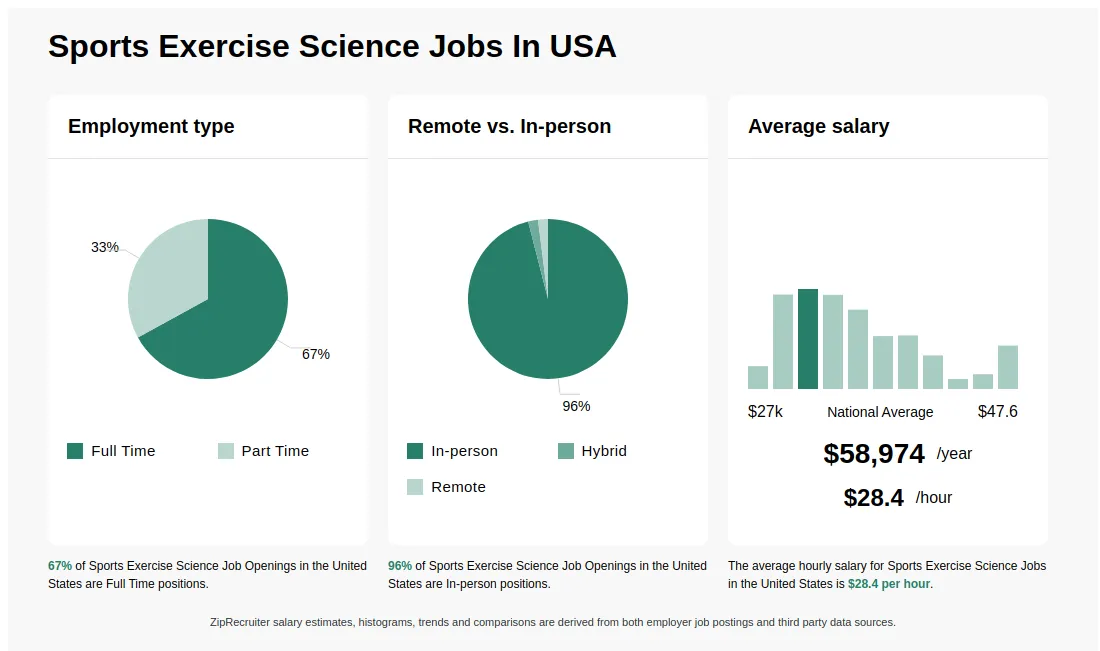
$20.31 is the 25th percentile. Wages below this are outliers.
$19.27 - $22.42
17% of jobs
The median wage is $25.04 / hr.
$22.42 - $25.57
16% of jobs
$25.57 - $28.72
14% of jobs
$31.76 is the 75th percentile. Wages above this are outliers.
$28.72 - $31.86
9% of jobs
$31.86 - $35.01
9% of jobs
$35.01 - $38.16
5% of jobs
$38.16 - $41.30
1% of jobs
$41.30 - $44.45
2% of jobs
$44.45 - $47.60
8% of jobs
$12
$28
$47
How much do sports exercise science jobs pay per hour?
As of Sep 6, 2026, the average hourly pay for sports exercise science in the United States is $28.35, according to ZipRecruiter salary data. Most workers in this role earn between $20.67 and $33.89 per hour, depending on experience, location, and employer.
What is sports exercise science?
Sports exercise science is the study of how physical activity, exercise, and sport affect the human body and mind. It combines knowledge from physiology, biomechanics, psychology, and nutrition to improve athletic performance, promote health, and prevent injuries. Professionals in this field may work with athletes, design fitness programs, or conduct research to understand how exercise influences physical and mental well-being. Sports exercise science plays a crucial role in optimizing training methods and supporting overall health.
What are some typical career paths and advancement opportunities in sports exercise science?
Professionals in sports exercise science often begin their careers in roles such as fitness trainers, strength and conditioning coaches, or exercise physiologists. With experience and further education, many advance to positions in sports management, athletic program direction, or specialized research roles. Opportunities also exist in clinical settings, working alongside physical therapists or sports medicine teams. The field encourages ongoing professional development, and certifications or advanced degrees can open doors to higher-level or more specialized positions.
What are the key skills and qualifications needed to thrive as a sports exercise scientist, and why are they important?
To thrive as a Sports Exercise Scientist, you need a solid background in human physiology, biomechanics, and exercise prescription, typically supported by a degree in sports science or a related field. Familiarity with laboratory testing equipment, data analysis software, and certifications such as ACSM or NSCA are often required. Strong communication, analytical thinking, and the ability to motivate and educate clients or athletes are vital soft skills. These competencies ensure evidence-based program design, accurate performance assessments, and effective support for clients' health and athletic goals.
What is the difference between Sports Exercise Science vs Sports Performance Coach?
| Aspect | Sports Exercise Science | Sports Performance Coach |
|---|---|---|
| Credentials | Degree in Exercise Science, certifications like NSCA or ACSM | Certifications in coaching, strength and conditioning, sport-specific training |
| Work Environment | Clinics, universities, research labs, sports teams | Training facilities, sports teams, gyms |
| Industry Usage | Academic, research, health, and sports settings | Coaching athletes, improving performance |
Sports Exercise Science focuses on understanding human physiology, biomechanics, and health to improve athletic performance and recovery through research and clinical applications. In contrast, a Sports Performance Coach applies training techniques directly to athletes, emphasizing skill development and performance enhancement. While both roles require knowledge of exercise principles, Sports Exercise Science is more research and health-oriented, whereas Sports Performance Coaching is more hands-on and sport-specific.
How much do sports exercise scientists make?
Sports exercise scientists typically earn a median annual salary of around $50,000 to $70,000, depending on experience, education, and location. Advanced roles or those in research and management can pay higher, especially with specialized certifications and skills in biomechanics or sports performance analysis.
What can I do with a sports exercise science degree?
A sports exercise science degree prepares individuals for careers such as sports scientist, exercise physiologist, athletic trainer, fitness instructor, or strength and conditioning coach. These roles often involve working in gyms, sports teams, rehabilitation centers, or research settings, and may require certifications like ACSM or NSCA. The degree provides knowledge of human physiology, biomechanics, and exercise programming essential for these professions.
What careers can you get with a degree in sports exercise science?
A degree in sports exercise science can lead to careers such as sports scientist, exercise physiologist, athletic trainer, fitness instructor, or strength and conditioning coach. These roles often require knowledge of human anatomy, physiology, and fitness assessment, and may involve working in gyms, sports teams, clinics, or research settings.
More about Sports Exercise Science jobs
What cities are hiring for Sports Exercise Science jobs?
Cities with the most Sports Exercise Science job openings:
What states have the most Sports Exercise Science jobs?
States with the most job openings for Sports Exercise Science jobs include:

Part-time
Medical, Dental, Vision, Retirement
Re-posted 22 days ago
Job description
Purpose:
To support the overall mission and vision of Pfeiffer University through excellence in teaching and mentoring students in Health and Exercise Science (HES), Department of Health and Natural Sciences. A commitment to the principles of servant leadership, working with Undergraduate students, and involvement in university and community service is required. Ability to contribute to department, HES programming, and/or scholarship activities preferred. HES Adjunct Pool includes core curriculum and electives for Exercise & Sport Science (ESS) and Clinical Exercise Science (CES). Part-time, August to May 2022-2023 academic year.
Duties and Responsibilities:
Adjunct instructors may teach a variety of in-person, hybrid, and/or online courses in HES, ESS and CES degree tracts. Courses include Intro to HES, Anatomy & Physiology (w/ lab), Exercise Behavior, Nutrition, Exercise Physiology (w/ lab), Exercise Testing & Prescription (w/ lab), Professional Certification, Strength & Conditioning (w/ lab), Exercise & Sport Nutrition, Biomechanics (w/ lab), Exercise & Sport Psychology, Internship/Externship, and HES Special Topics. Instructor responsibilities may include lab coordination/supervision, facilitating student research or projects, collaborating with an interdisciplinary team, and contributing to university and community service.
Supervision of laboratory spaces, research students, and/or student workers.
Pfeiffer University is a private, Liberal Arts University, affiliated with the United Methodist Church, whose mission is to prepare servant leaders for life-long learning. The main campus is located in Misenheimer, approximately 40 miles northeast of Charlotte, NC, with additional locations in Albemarle, Charlotte, and the Raleigh area. Benefits include medical, dental and vision insurance, a 403b retirement account, and tuition benefits at Pfeiffer and other member institutions. Compensation is based upon education and experience.
- MS required; PhD preferred in Exercise Science, Physiology, and/or related Biological Sciences.
- Ability to contribute to lecture/lab courses, HES programming, and department activities.
- Preference to candidates with demonstrated experience, expertise, and/or scholarship in Exercise Physiology, Biomechanics/Kinesiology, or Health Sciences.
- Ability to integrate practical and/or research experience to the classroom setting.
- Strong commitment to service, collaboration, and leadership desired.

About Pfeiffer University
Sourced by ZipRecruiter
Industry
Colleges, universities, and professional schools
Company size
201 - 500 Employees
Headquarters location
Misenheimer, NC, US
Year founded
1885