1

Spacecraft Engineer Jobs (NOW HIRING)

Spacecraft System Engineer

Albuquerque, NM ยท On-site

$100K - $125K/yr

Spacecraft System Engineer:Qualified candidates are knowledgeable Spacecraft Systems Engineers, preferably with experience working on classified programs. Roles and Responsibilities:Leads system ...

We have multiple openings for Spacecraft Systems Engineers to provide spacecraft subject matter expertise as part of a multi-disciplinary team performing concept development, requirements generation ...

Spacecraft System Engineer

Albuquerque, NM ยท On-site

$100K - $125K/yr

Spacecraft System Engineer: Qualified candidates are knowledgeable Spacecraft Systems Engineers, preferably with experience working on classified programs. Roles and Responsibilities : Leads system ...

Spacecraft Systems Engineer

El Segundo, CA ยท On-site

$75 - $115/hr

What You'll Do You'll provide end-to-end systems engineering support across the full spacecraft lifecycle -- from early design through integration, test, and deployment. That means leading or ...

We have multiple openings for Spacecraft Systems Engineers to providespacecraft subject matter expertise as part of a multi-disciplinary team performing conceptdevelopment, requirements generation ...

$90 - $150/hr

The Spacecraft Systems Engineer team supports programs for civil, commercial, and defense customers. Systems engineers are responsible for the development and maintenance of technical budgets ...

New

Spacecraft Systems Engineer

Chantilly, VA ยท On-site

$160K - $200K/yr

The Spacecraft Systems Engineer will support a program office for a Major System Acquisition who requires a mid-career engineer with technical expertise in systems engineering who is anxious to grow ...

Showing results 41-60

Spacecraft Engineer information

See salary details

$42K

$108.6K

$165K

How much do spacecraft engineer jobs pay per year?

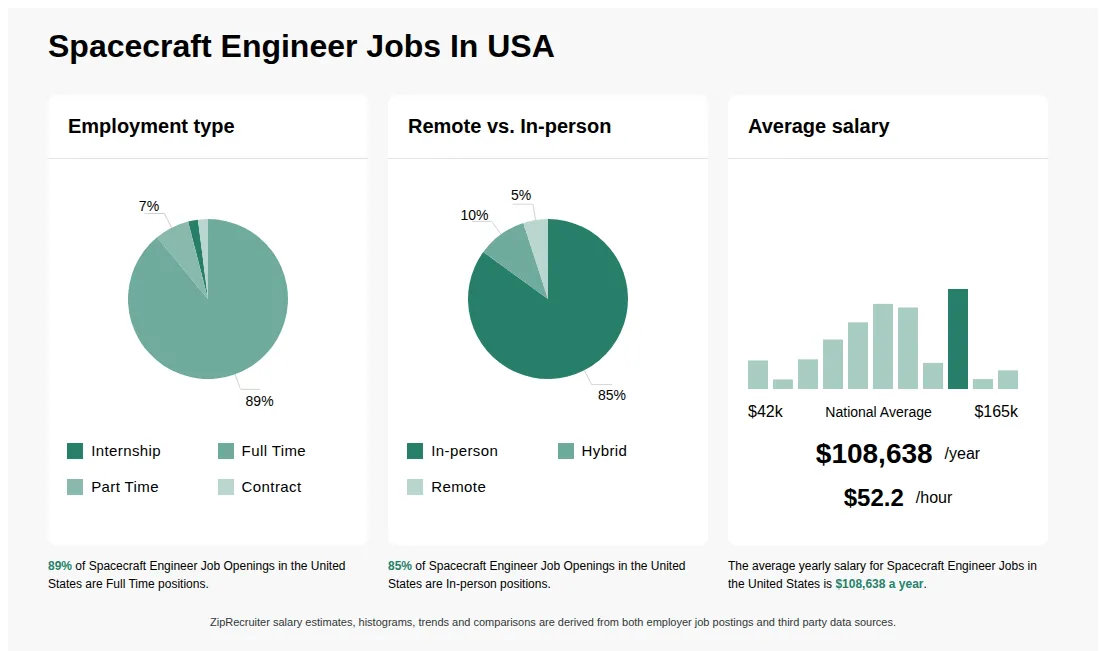
As of Sep 3, 2026, the average yearly pay for spacecraft engineer in the United States is $108,638.00, according to ZipRecruiter salary data. Most workers in this role earn between $88,500.00 and $132,500.00 per year, depending on experience, location, and employer.

What does a spacecraft engineer do?

A Spacecraft Engineer designs, develops, tests, and maintains spacecraft and related systems for missions in space. Their work involves integrating complex technologies, such as propulsion, navigation, communication, and life support systems, to ensure the spacecraft can operate safely and effectively. Spacecraft Engineers collaborate with scientists and other engineers to meet mission objectives and solve unique challenges encountered in the harsh environment of space.

What are the key skills and qualifications needed to thrive as a spacecraft engineer?

To thrive as a Spacecraft Engineer, you need a solid background in aerospace engineering, physics, and mathematics, typically supported by a bachelor's or master's degree in a related field. Familiarity with CAD software, simulation tools like MATLAB, and knowledge of industry standards or certifications such as ITAR compliance are commonly required. Strong problem-solving abilities, attention to detail, and effective teamwork and communication skills set top candidates apart. These skills ensure the successful design, analysis, and operation of spacecraft systems in a highly collaborative and safety-critical environment.

What are some common challenges faced by spacecraft engineers during a typical project lifecycle?

Spacecraft Engineers often encounter challenges such as coordinating across multidisciplinary teams, managing strict project timelines, and addressing unexpected technical issues during design, testing, and launch phases. Balancing innovation with reliability is essential, as even minor errors can have significant consequences in space missions. Additionally, adapting to evolving client requirements and integrating new technologies while ensuring compliance with rigorous safety standards are ongoing aspects of the role.

What is the difference between Spacecraft Engineer vs Satellite Engineer?

AspectSpacecraft EngineerSatellite Engineer
Required CredentialsBachelor's or higher in aerospace, mechanical, or electrical engineering; certifications in aerospace systemsBachelor's or higher in electrical, aerospace, or systems engineering; certifications in satellite systems
Work EnvironmentDesign, develop, and test spacecraft in labs and cleanrooms; work with aerospace companies and agenciesDesign, maintain, and troubleshoot satellites; often in labs, ground stations, or field sites
Employer & Industry UsagePrimarily aerospace firms, government space agencies, defense contractorsSatellite manufacturing companies, telecom firms, government agencies

Both roles require strong engineering backgrounds and work within the aerospace industry. Spacecraft Engineers focus on entire spacecraft systems, while Satellite Engineers specialize in satellite-specific technology. Both careers involve designing, testing, and maintaining space-related hardware, but their specific applications and environments differ slightly.

More about Spacecraft Engineer jobs

What cities are hiring for Spacecraft Engineer jobs?

Cities with the most Spacecraft Engineer job openings:

What states have the most Spacecraft Engineer jobs?

States with the most job openings for Spacecraft Engineer jobs include:

Infographic showing various Spacecraft Engineer job openings in the United States as of August 2026, with employment types broken down into 94% Full Time, 2% Part Time, and 4% Contract. Highlights an 85% Physical, 6% Hybrid, and 9% Remote job distribution, with an average salary of $108,638 per year, or $52.2 per hour.

Senior Mechanical Engineer, Spacecraft

True Anomaly

Denver, CO โ€ข On-site

$107K - $142K/yr

Full-time

Medical, Dental, Vision, Retirement, PTO

Posted 16 days ago


Job description

Space is a warfighting domain. True Anomaly seeks those with the talent and ambition to build the technology that secures it.
OUR MISSION
True Anomaly delivers decisive capabilities for space superiority. We build autonomous spacecraft, advanced payloads, mission software, and space-based interceptors - enabling the U.S. and its Allies to secure the space environment and counter threats from the ultimate high ground.
OUR VALUES
  • Be the offset. We create asymmetric advantages with creativity and ingenuity.
  • What would it take? We challenge assumptions to deliver ambitious results.
  • It's the people. Our team is our competitive advantage and we are better together.

YOUR MISSION
As a Mechanical Engineer at True Anomaly, you will be at the forefront of designing and developing the next generation of spacecraft that define the future of space security and sustainability. From LEO/GEO satellites to small sat platforms and on-orbit servicing vehicles, you will own the mechanical design of flight systems that operate in some of the most demanding environments known to engineering. This is a rare opportunity to shape vehicle architecture from the ground up - translating mission requirements into flight-ready hardware that safeguards access to space for the U.S. and its allies.
RESPONSIBILITIES
  • Lead the design, analysis, and optimization of mechanical structures, mechanisms, and assemblies for LEO/GEO satellites, small sat platforms, and on-orbit servicing vehicles, ensuring designs meet performance, mass, and reliability requirements across the full hardware lifecycle.
  • Own end-to-end development of spacecraft structural systems and mechanisms - from concept and trade studies through prototyping, qualification, and flight hardware delivery.
  • Design and develop primary and secondary structures sized for launch load environments, including sine burst, random vibration, and shock, in compliance with launch vehicle ICD requirements.
  • Lead the design of spacecraft mechanisms and deployment systems, including hinges, hold-down and release mechanisms, solar array drives, antenna pointing systems, and other precision moving assemblies for on-orbit operation.
  • Package and integrate electronics assemblies and avionics hardware within the spacecraft structure, accounting for thermal interface requirements, EMI shielding, harness routing, and accessibility for integration and test.
  • Support propulsion system integration, including structural mounting, propellant line routing, thruster bracket design, and compliance with propulsion subsystem interface requirements.
  • Develop and manage detailed 3D CAD models and drawings for spacecraft components, subsystems, and assemblies using NX (Siemens) and/or SolidWorks, maintaining configuration integrity throughout the program.
  • Define and enforce GD&T standards on piece part and assembly drawings, and review supplier and team deliverables for compliance.
  • Lead and present at spacecraft design reviews (PDR, CDR, TRR) and drive resolution of technical risks, open actions, and subsystem interface trades.
  • Serve as a key technical interface with structures, thermal, avionics, mechanisms, and propulsion teams to validate designs and ensure compliance with mission and environmental requirements.
  • Develop and execute test plans to support structural and mechanisms qualification, acceptance testing, and on-orbit deployment verification.
  • Mentor junior engineers and contribute to a culture of technical excellence, continuous improvement, and spacecraft engineering best practices.

QUALIFICATIONS
  • Bachelor's degree in Mechanical Engineering or a related engineering discipline.
  • 6 -14 years of professional experience in mechanical design, with direct experience in spacecraft or satellite hardware development.
  • Demonstrated experience designing structures for launch load environments, including familiarity with launch vehicle user guides, load cycle definition, and structural margin compliance.
  • Hands-on experience with spacecraft mechanisms design, including deployment systems, release mechanisms, or other flight-qualified moving assemblies.
  • Experience packaging electronics and avionics hardware within spacecraft structures, with an understanding of thermal interface management, harness routing, and integration constraints.
  • Familiarity with propulsion system mechanical integration, including thruster and tank mounting, propellant line design, and interface requirements.
  • Strong proficiency in 3D CAD modeling and drawing creation in NX (Siemens) and/or SolidWorks, including complex spacecraft assemblies and configuration management.
  • Deep knowledge of GD&T principles and ability to define, review, and enforce standards across a program.
  • Experience leading or significantly contributing to spacecraft hardware development from concept through delivery.
  • Experience with configuration management, MES, and PLM tools (e.g., Teamcenter, Windchill).
  • Strong written and verbal communication skills, with the ability to present technical content clearly to both engineering and leadership audiences.

PREFERRED SKILLS AND EXPERIENCE
  • Master's degree in Mechanical Engineering or a related discipline.
  • 5+ years of experience specifically in LEO/GEO satellite, small sat, or on-orbit servicing vehicle mechanical design.
  • Experience with smallsat or CubeSat platforms, including mass-constrained design, commercial off-the-shelf (COTS) component integration, and compressed development schedules.
  • Experience with on-orbit servicing or proximity operations vehicles, including docking mechanisms, capture systems, or servicer-to-client structural interfaces.
  • Familiarity with structural analysis methods and FEA tools (e.g., NASTRAN, Ansys) and ability to interpret and apply results to drive design decisions.
  • Experience leading spacecraft design reviews and managing technical risk across a subsystem or full vehicle.
  • Track record of innovative problem-solving under mass, volume, and schedule constraints typical of spacecraft programs.
  • Familiarity with relevant aerospace and spacecraft standards (e.g., NASA-STD-5001, GEVS, MIL-SPEC, AIAA S-110) and their application to design and test.
  • Experience interfacing directly with machine shops, fabrication vendors, and manufacturing teams to support DFM and flight hardware producibility.
  • Experience working in a startup or fast-paced environment with compressed development timelines.
  • Active U.S. security clearance (Secret or above), or ability and willingness to obtain one.

COMPENSATION
  • Base Salary: $135,000-$200,000
  • Equity + Benefits including Health, Dental, Vision, HRA/HSA options, PTO and paid holidays, 401K, Parental Leave

Your actual level and base salary will be determined on a case-by-case basis and may vary based on the following considerations: job-related knowledge and skills, education, location, and experience.
ADDITIONAL REQUIREMENTS
  • Work Location-Successful candidates will be located near Denver or Colorado Springs. While we observe a hybrid work environment, some work must be done on site.
  • Work environment-the work environment; temperature, noise level, inside or outside, or other factors that will affect the person's working conditions while performing the job.
  • Physical demands-the physical demands of the job, including bending, sitting, lifting and driving.

This position will be open until it is successfully filled. To submit your application, please follow the directions below. #LI-Onsite
To conform to U.S. Government space technology export regulations, including the International Traffic in Arms Regulations (ITAR) you must be a U.S. citizen, lawful permanent resident of the U.S., protected individual as defined by 8 U.S.C. 1324b(a)(3), or eligible to obtain the required authorizations from the U.S. Department of State.
True Anomaly is committed to equal employment opportunity on any basis protected by applicable state and federal laws. If you have a disability or additional need that requires accommodation, please do not hesitate to let us.