The Spacecraft Engineer will work daily on-site with the Government to provide advice and guidance on technical and programmatic aspects of a critical space system. Job Responsibilities: * Define ...
The Spacecraft Engineer will work daily on-site with the Government to provide advice and guidance on technical and programmatic aspects of a critical space system. Job Responsibilities: * Define ...

Guidance, Navigation & Control (GNC) Engineer Spacecraft / RPO
Carson, CA · On-site
$220K - $300K/yr
Senior Guidance, Navigation & Control (GNC) Engineer Spacecraft Autonomy Carson, Ca $225,000 $300,000 Build the Brain That Flies the Spacecraft. We re looking for an exceptional GNC Engineer to ...
Guidance, Navigation & Control (GNC) Engineer Spacecraft / RPO
Carson, CA · On-site
$220K - $300K/yr
Senior Guidance, Navigation & Control (GNC) Engineer Spacecraft Autonomy Carson, Ca $225,000 $300,000 Build the Brain That Flies the Spacecraft. We re looking for an exceptional GNC Engineer to ...

External Job Posting Title Spacecraft Aerospace Engineer
Las Cruces, NM · On-site
$51 - $82/hr
The Spacecraft Engineer will join a team of engineers dedicated to maintaining the health and safety of the Tracking and Data Relay Satellite (TDRS) fleet. Peraton is the prime contractor for NASA at ...
New
External Job Posting Title Spacecraft Aerospace Engineer
Las Cruces, NM · On-site
$51 - $82/hr
The Spacecraft Engineer will join a team of engineers dedicated to maintaining the health and safety of the Tracking and Data Relay Satellite (TDRS) fleet. Peraton is the prime contractor for NASA at ...
New
Founding Spacecraft Mechanical Engineer
Los Angeles, CA · On-site
$160K - $190K/yr
Founding Spacecraft Mechanical Engineer Benefits -- Starting Salary targeting $160K-$190K -- Meaningful founding equity stake -- 100% employer-covered medical, dental, and vision insurance ...
Quick apply
Founding Spacecraft Mechanical Engineer
Los Angeles, CA · On-site
$160K - $190K/yr
Founding Spacecraft Mechanical Engineer Benefits -- Starting Salary targeting $160K-$190K -- Meaningful founding equity stake -- 100% employer-covered medical, dental, and vision insurance ...

Spacecraft Contamination Control Engineer Onsite Kennedy Space Center / Florida - No Hybrid or remote is available. NASA or AEROSPACE Exp US Citizens or Perm Residents Only These are immediate ...
Quick apply
Spacecraft Contamination Control Engineer Onsite Kennedy Space Center / Florida - No Hybrid or remote is available. NASA or AEROSPACE Exp US Citizens or Perm Residents Only These are immediate ...

Spacecraft Systems Engineer
Rockville, MD · On-site
In this role, you will lead spacecraft-level systems engineering activities, driving requirements development, interface management, design integration, and verification across propulsion, structures ...
Spacecraft Systems Engineer
Rockville, MD · On-site
In this role, you will lead spacecraft-level systems engineering activities, driving requirements development, interface management, design integration, and verification across propulsion, structures ...
Spacecraft Contamination Control Engineer Onsite Kennedy Space Center /Florida - No Hybrid or remote is available. NASA or AEROSPACE Exp US Citizens or Perm Residents Only These are immediate ...
Spacecraft Contamination Control Engineer Onsite Kennedy Space Center /Florida - No Hybrid or remote is available. NASA or AEROSPACE Exp US Citizens or Perm Residents Only These are immediate ...

Aerospace Engineer
Welcome, MD · On-site
$80K - $144K/yr
The spacecraft engineer will monitor health status and provide support for spacecraft in operation, including recovery and spacecraft anomalies. Support spacecraft operations and configuration ...
Quick apply
Aerospace Engineer
Welcome, MD · On-site
$80K - $144K/yr
The spacecraft engineer will monitor health status and provide support for spacecraft in operation, including recovery and spacecraft anomalies. Support spacecraft operations and configuration ...
Aerospace Engineer
Welcome, MD · On-site
$80K - $144K/yr
The spacecraft engineer will monitor health status and provide support for spacecraft in operation, including recovery and spacecraft anomalies. Support spacecraft operations and configuration ...
Quick apply
Aerospace Engineer
Welcome, MD · On-site
$80K - $144K/yr
The spacecraft engineer will monitor health status and provide support for spacecraft in operation, including recovery and spacecraft anomalies. Support spacecraft operations and configuration ...
Aerospace Engineer
Welcome, MD · On-site
$80K - $144K/yr
The spacecraft engineer will monitor health status and provide support for spacecraft in operation, including recovery and spacecraft anomalies. Support spacecraft operations and configuration ...
Quick apply
Aerospace Engineer
Welcome, MD · On-site
$80K - $144K/yr
The spacecraft engineer will monitor health status and provide support for spacecraft in operation, including recovery and spacecraft anomalies. Support spacecraft operations and configuration ...

Spacecraft Systems Engineer
Irvine, CA · On-site
The Spacecraft Systems Engineer will use their technical expertise to define and manage subsystem specifications, interface control documents, the concept of operations, and system performance ...
Spacecraft Systems Engineer
Irvine, CA · On-site
The Spacecraft Systems Engineer will use their technical expertise to define and manage subsystem specifications, interface control documents, the concept of operations, and system performance ...

Spacecraft Engineering Lead
Seattle, WA · On-site
$169.62 - $237.47/hr
## Spacecraft Engineering LeadApplylocations: Greater Seattle Area: Denver, COtime type: Full timeposted on: Posted Todayjob requisition id: R64159Application close date:Applications will be accepted on ...
Spacecraft Engineering Lead
Seattle, WA · On-site
$169.62 - $237.47/hr
## Spacecraft Engineering LeadApplylocations: Greater Seattle Area: Denver, COtime type: Full timeposted on: Posted Todayjob requisition id: R64159Application close date:Applications will be accepted on ...
Spacecraft Engineering Lead
$160K - $224K/yr
With support from spacecraft subsystem, systems, and integration engineers from the Spacecraft Development organization, you will be responsible for delivering a mission specific Blue Ring spacecraft.
Spacecraft Engineering Lead
$160K - $224K/yr
With support from spacecraft subsystem, systems, and integration engineers from the Spacecraft Development organization, you will be responsible for delivering a mission specific Blue Ring spacecraft.
Spacecraft Systems Engineer
Irvine, CA · On-site
$100 - $140/hr
Spacecraft Systems Engineer Terran Orbital is seeking an experienced Spacecraft Systems Engineer to join our dynamic team. Reporting to the Sr. Systems Engineering Manager, the Spacecraft Systems ...
New
Spacecraft Systems Engineer
Irvine, CA · On-site
$100 - $140/hr
Spacecraft Systems Engineer Terran Orbital is seeking an experienced Spacecraft Systems Engineer to join our dynamic team. Reporting to the Sr. Systems Engineering Manager, the Spacecraft Systems ...
New
Spacecraft Engineering Lead
Seattle, WA · On-site
$160K - $224K/yr
With support from spacecraft subsystem, systems, and integration engineers from the Spacecraft Development organization, you will be responsible for delivering a mission specific Blue Ring spacecraft.
Spacecraft Engineering Lead
Seattle, WA · On-site
$160K - $224K/yr
With support from spacecraft subsystem, systems, and integration engineers from the Spacecraft Development organization, you will be responsible for delivering a mission specific Blue Ring spacecraft.
Spacecraft Engineering Lead
$160K - $224K/yr
With support from spacecraft subsystem, systems, and integration engineers from the Spacecraft Development organization, you will be responsible for delivering a mission specific Blue Ring spacecraft.
Spacecraft Engineering Lead
$160K - $224K/yr
With support from spacecraft subsystem, systems, and integration engineers from the Spacecraft Development organization, you will be responsible for delivering a mission specific Blue Ring spacecraft.

Spacecraft Systems Engineer
Livermore, CA · On-site
$9.7K/wk
We have multiple openings for Spacecraft Systems Engineers to provide spacecraft subject matter expertise as part of a multi-disciplinary team performing concept development, requirements generation ...
Spacecraft Systems Engineer
Livermore, CA · On-site
$9.7K/wk
We have multiple openings for Spacecraft Systems Engineers to provide spacecraft subject matter expertise as part of a multi-disciplinary team performing concept development, requirements generation ...
Spacecraft Systems Engineer
Irvine, CA · On-site
$100K - $140K/yr
The Spacecraft Systems Engineer will use their technical expertise to define and manage subsystem specifications, interface control documents, the concept of operations, and system performance ...
Spacecraft Systems Engineer
Irvine, CA · On-site
$100K - $140K/yr
The Spacecraft Systems Engineer will use their technical expertise to define and manage subsystem specifications, interface control documents, the concept of operations, and system performance ...
Spacecraft Systems Engineer
Irvine, CA · On-site
$100K - $140K/yr
The Spacecraft Systems Engineer will use their technical expertise to define and manage subsystem specifications, interface control documents, the concept of operations, and system performance ...
Quick apply
Spacecraft Systems Engineer
Irvine, CA · On-site
$100K - $140K/yr
The Spacecraft Systems Engineer will use their technical expertise to define and manage subsystem specifications, interface control documents, the concept of operations, and system performance ...

Spacecraft System Engineer: Qualified candidates are knowledgeable Spacecraft Systems Engineers, preferably with experience working on classified programs. Roles and Responsibilities : Leads system ...
Spacecraft System Engineer: Qualified candidates are knowledgeable Spacecraft Systems Engineers, preferably with experience working on classified programs. Roles and Responsibilities : Leads system ...
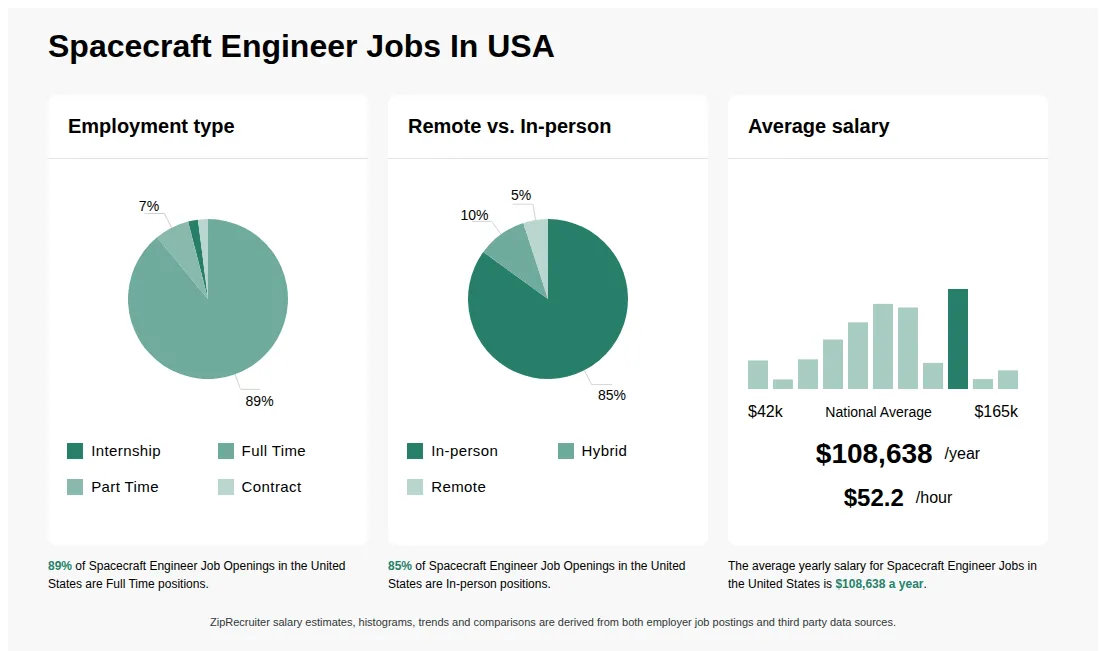
Spacecraft Engineer information
See salary details
$42K - $53.2K
5% of jobs
$53.2K - $64.4K
1% of jobs
$64.4K - $75.5K
5% of jobs
$75.5K - $86.7K
10% of jobs
$89.5K is the 25th percentile. Wages below this are outliers.
$86.7K - $97.9K
14% of jobs
The median wage is $107.3K / yr.
$97.9K - $109.1K
17% of jobs
$109.1K - $120.3K
17% of jobs
$130.9K is the 75th percentile. Wages above this are outliers.
$120.3K - $131.5K
5% of jobs
$131.5K - $142.6K
20% of jobs
$142.6K - $153.8K
1% of jobs
$153.8K - $165K
3% of jobs
$42K
$108.6K
$165K
How much do spacecraft engineer jobs pay per year?
As of Sep 3, 2026, the average yearly pay for spacecraft engineer in the United States is $108,638.00, according to ZipRecruiter salary data. Most workers in this role earn between $88,500.00 and $132,500.00 per year, depending on experience, location, and employer.
What does a spacecraft engineer do?
A Spacecraft Engineer designs, develops, tests, and maintains spacecraft and related systems for missions in space. Their work involves integrating complex technologies, such as propulsion, navigation, communication, and life support systems, to ensure the spacecraft can operate safely and effectively. Spacecraft Engineers collaborate with scientists and other engineers to meet mission objectives and solve unique challenges encountered in the harsh environment of space.
What are the key skills and qualifications needed to thrive as a spacecraft engineer?
To thrive as a Spacecraft Engineer, you need a solid background in aerospace engineering, physics, and mathematics, typically supported by a bachelor's or master's degree in a related field. Familiarity with CAD software, simulation tools like MATLAB, and knowledge of industry standards or certifications such as ITAR compliance are commonly required. Strong problem-solving abilities, attention to detail, and effective teamwork and communication skills set top candidates apart. These skills ensure the successful design, analysis, and operation of spacecraft systems in a highly collaborative and safety-critical environment.
What are some common challenges faced by spacecraft engineers during a typical project lifecycle?
Spacecraft Engineers often encounter challenges such as coordinating across multidisciplinary teams, managing strict project timelines, and addressing unexpected technical issues during design, testing, and launch phases. Balancing innovation with reliability is essential, as even minor errors can have significant consequences in space missions. Additionally, adapting to evolving client requirements and integrating new technologies while ensuring compliance with rigorous safety standards are ongoing aspects of the role.
What is the difference between Spacecraft Engineer vs Satellite Engineer?
| Aspect | Spacecraft Engineer | Satellite Engineer |
|---|---|---|
| Required Credentials | Bachelor's or higher in aerospace, mechanical, or electrical engineering; certifications in aerospace systems | Bachelor's or higher in electrical, aerospace, or systems engineering; certifications in satellite systems |
| Work Environment | Design, develop, and test spacecraft in labs and cleanrooms; work with aerospace companies and agencies | Design, maintain, and troubleshoot satellites; often in labs, ground stations, or field sites |
| Employer & Industry Usage | Primarily aerospace firms, government space agencies, defense contractors | Satellite manufacturing companies, telecom firms, government agencies |
Both roles require strong engineering backgrounds and work within the aerospace industry. Spacecraft Engineers focus on entire spacecraft systems, while Satellite Engineers specialize in satellite-specific technology. Both careers involve designing, testing, and maintaining space-related hardware, but their specific applications and environments differ slightly.
More about Spacecraft Engineer jobs
What cities are hiring for Spacecraft Engineer jobs?
Cities with the most Spacecraft Engineer job openings:
What states have the most Spacecraft Engineer jobs?
States with the most job openings for Spacecraft Engineer jobs include:

Programmatic Spacecraft Systems Engineer
Chantilly, VA • On-site
Full-time
Re-posted 20 days ago
SAIC rating

7.8
Based on 80 frontline employees who took The Breakroom Quiz
88th of 226 rated it services
Job description
Join a mission driven satellite program at the forefront of national defense innovation. Our team is developing cutting edge technologies that directly support critical Department of War priorities, combining both proven and first-of-their-kind capabilities that have never been applied in space. Operating within a fast-paced acquisition environment, we benefit from streamlined authorities and direct access to senior Government decisionmakers, enabling us to move quickly and execute aggressive schedules using the most innovative contracting strategies available.
SAIC is seeking self-directed leaders who skillfully navigate ambiguity, solve complex challenges, and bring diverse expertise to a dynamic environment focused on delivering capability rapidly. Success here requires adaptability, initiative, and a willingness to wear multiple hats in support of a high impact mission. Candidates experienced as USAF/USSF acquisition officers (AFSC: 63A) or developmental engineers (AFSC: 62E) leading satellite programs in the USSF (SSC), NRO, or SDA, applying the full range of the systems engineering discipline (e.g., Requirements Development, Architecture, SE milestones: SRR, PDR, CDR, etc.), and/or DAWIA/PMI Program Management will be especially well-prepared to excel.
Job Description:
This position is for a Programmatic Spacecraft Systems Engineer in Chantilly, VA supporting cutting-edge and innovative space programs. The Spacecraft Engineer will work daily on-site with the Government to provide advice and guidance on technical and programmatic aspects of a critical space system.
Job Responsibilities:
- Define requirements to ensure the spacecraft operates seamlessly, from design through manufacturing, testing, and launch.
- Provide Government with recommended inputs and courses of action for technical and programmatic topics.
- Foster communication and alignment among team members to identify challenges and corresponding solutions.
- Evaluate prime contractor performance at milestone reviews ensuring compliance with technical requirements, and quality of deliverables.
- Support system development from initial requirements verification through mission design, prototype development, and test.
- Serve as the main technical point of contact, leading reviews, and translating customer needs into actionable engineering requirements.
- Participate in studies and system trades for enhanced capabilities.
- Support verification, validation, and test planning.
- Provide technical and programmatic assessments of contractor designs at major milestone reviews to assess progress, risks and issues, and the ability to achieve mission requirements.
- Provide technical support to Government customer activities and programmatic processes.
- Develop documents and briefings to communicate work or study status and brief Government and industry as required.
Qualifications
- TYPICAL EDUCATION AND EXPERIENCE: Bachelors and fourteen (14) years or more experience; Masters and twelve (12) years or more experience; PhD or JD and nine (9) years or more experience
- Bachelors degree is required. Masters degree is preferred.
- Demonstrated strong satellite systems engineering background.
- Major government acquisition program experience.
- Experience with space systems, including development of concept of operations, mission threads, and collaboration with stakeholders on interfaces; ability to conduct trade studies, define interfaces, and work with the developer to mature interface requirements.
- Ability to absorb extensive technical detail and logically formulate solutions for execution on an inflexible schedule, often requiring integration of conflicting and, at times, incomplete data.
- Knowledge and application of Systems Engineering processes and functions.
- Systems engineering and system integration experience.
- Experience with the Intelligence Community or the Department of Defense Satellite Program Office best practices.
- Experience with satellite system requirements development, design, manufacturing, and test.
- Excellent interpersonal, leadership, team building and problem-solving skills with a demonstrated ability to be effective in a government/contractor team environment.
- Ability to facilitate technical discussions with SMEs.
- Ability to communicate with a diverse audience of senior decision makers with varying levels of programmatic and technical expertise.
- Effective communication, coordination, and customer engagement skills.
- Ability to work in a fast paced, dynamic, and team environment with no supervision.
- Active TS/SCI Required.
- Previous SAP experience Preferred.
About Us
SAIC® is a premier mission integrator focused on advancing the power of technology and innovation to serve and protect our world. Our robust portfolio of offerings across the defense, space, intelligence, and civilian markets includes secure high-end solutions in mission IT, enterprise IT, engineering services, and professional services. We integrate emerging technology, rapidly and securely, into mission critical operations that modernize and enable critical national imperatives.
We are approximately 23,000 strong; driven by mission, united by purpose, and inspired by opportunities. SAIC is an Equal Opportunity Employer. Headquartered in Reston, Virginia, SAIC has annual revenues of approximately $7.3 billion. For more information, visit saic.com. For ongoing news, please visit our newsroom.

About Science Applications International
Sourced by ZipRecruiter