Role Summary We are seeking a highly skilled and experienced Sr. Staff Radar DSP Engineer to work alongside an experienced, cross-functional team to help define the signal processing architecture for ...
Role Summary We are seeking a highly skilled and experienced Sr. Staff Radar DSP Engineer to work alongside an experienced, cross-functional team to help define the signal processing architecture for ...

Junior Signal Processing Engineer
La Jolla, CA · On-site
$69K - $125K/yr
Leidos currently has an opening for a Junior Signal Processing Engineer to support EW programs in Arlington, VA or San Diego, CA. As part of our team, you will focus on improving the robustness and ...
Junior Signal Processing Engineer
La Jolla, CA · On-site
$69K - $125K/yr
Leidos currently has an opening for a Junior Signal Processing Engineer to support EW programs in Arlington, VA or San Diego, CA. As part of our team, you will focus on improving the robustness and ...
Junior Signal Processing Engineer
National City, CA · On-site
$69K - $125K/yr
Leidos currently has an opening for a Junior Signal Processing Engineer to support EW programs in Arlington, VA or San Diego, CA. As part of our team, you will focus on improving the robustness and ...
Junior Signal Processing Engineer
National City, CA · On-site
$69K - $125K/yr
Leidos currently has an opening for a Junior Signal Processing Engineer to support EW programs in Arlington, VA or San Diego, CA. As part of our team, you will focus on improving the robustness and ...

The Signal Processing team is seeking Systems Engineer II - Signal Processing engineers to join our PG&C Center in Tucson, AZ. As the Systems Engineer II - Signal Processing , you will collaborate in ...
The Signal Processing team is seeking Systems Engineer II - Signal Processing engineers to join our PG&C Center in Tucson, AZ. As the Systems Engineer II - Signal Processing , you will collaborate in ...
The Signal Processing team is seeking Systems Engineer II - Signal Processing engineers to join our PG&C Center in Tucson, AZ. As the Systems Engineer II - Signal Processing , you will collaborate in ...
The Signal Processing team is seeking Systems Engineer II - Signal Processing engineers to join our PG&C Center in Tucson, AZ. As the Systems Engineer II - Signal Processing , you will collaborate in ...
The Signal Processing team is seeking Systems Engineer II - Signal Processing engineers to join our PG&C Center in Tucson, AZ. As the Systems Engineer II - Signal Processing , you will collaborate in ...
The Signal Processing team is seeking Systems Engineer II - Signal Processing engineers to join our PG&C Center in Tucson, AZ. As the Systems Engineer II - Signal Processing , you will collaborate in ...
The Signal Processing team is seeking Systems Engineer II - Signal Processing engineers to join our PG&C Center in Tucson, AZ. As the Systems Engineer II - Signal Processing , you will collaborate in ...
The Signal Processing team is seeking Systems Engineer II - Signal Processing engineers to join our PG&C Center in Tucson, AZ. As the Systems Engineer II - Signal Processing , you will collaborate in ...
Role Summary We are seeking a highly skilled and experienced Sr. Staff Radar DSP Engineer to work alongside an experienced, cross-functional team to help define the signal processing architecture for ...
Role Summary We are seeking a highly skilled and experienced Sr. Staff Radar DSP Engineer to work alongside an experienced, cross-functional team to help define the signal processing architecture for ...
The Signal Processing team is seeking Systems Engineer II - Signal Processing engineers to join our PG&C Center in Tucson, AZ. As the Systems Engineer II - Signal Processing , you will collaborate in ...
The Signal Processing team is seeking Systems Engineer II - Signal Processing engineers to join our PG&C Center in Tucson, AZ. As the Systems Engineer II - Signal Processing , you will collaborate in ...
The Signal Processing team is seeking Systems Engineer II - Signal Processing engineers to join our PG&C Center in Tucson, AZ. As the Systems Engineer II - Signal Processing , you will collaborate in ...
The Signal Processing team is seeking Systems Engineer II - Signal Processing engineers to join our PG&C Center in Tucson, AZ. As the Systems Engineer II - Signal Processing , you will collaborate in ...
The Signal Processing team is seeking Systems Engineer II - Signal Processing engineers to join our PG&C Center in Tucson, AZ. As the Systems Engineer II - Signal Processing , you will collaborate in ...
The Signal Processing team is seeking Systems Engineer II - Signal Processing engineers to join our PG&C Center in Tucson, AZ. As the Systems Engineer II - Signal Processing , you will collaborate in ...
The Signal Processing team is seeking Systems Engineer II - Signal Processing engineers to join our PG&C Center in Tucson, AZ. As the Systems Engineer II - Signal Processing , you will collaborate in ...
The Signal Processing team is seeking Systems Engineer II - Signal Processing engineers to join our PG&C Center in Tucson, AZ. As the Systems Engineer II - Signal Processing , you will collaborate in ...
The Signal Processing team is seeking Systems Engineer II - Signal Processing engineers to join our PG&C Center in Tucson, AZ. As the Systems Engineer II - Signal Processing , you will collaborate in ...
The Signal Processing team is seeking Systems Engineer II - Signal Processing engineers to join our PG&C Center in Tucson, AZ. As the Systems Engineer II - Signal Processing , you will collaborate in ...
The Signal Processing team is seeking Systems Engineer II - Signal Processing engineers to join our PG&C Center in Tucson, AZ. As the Systems Engineer II - Signal Processing , you will collaborate in ...
The Signal Processing team is seeking Systems Engineer II - Signal Processing engineers to join our PG&C Center in Tucson, AZ. As the Systems Engineer II - Signal Processing , you will collaborate in ...
The Signal Processing team is seeking Systems Engineer II - Signal Processing engineers to join our PG&C Center in Tucson, AZ. As the Systems Engineer II - Signal Processing , you will collaborate in ...
The Signal Processing team is seeking Systems Engineer II - Signal Processing engineers to join our PG&C Center in Tucson, AZ. As the Systems Engineer II - Signal Processing , you will collaborate in ...
The Signal Processing team is seeking Systems Engineer II - Signal Processing engineers to join our PG&C Center in Tucson, AZ. As the Systems Engineer II - Signal Processing , you will collaborate in ...
The Signal Processing team is seeking Systems Engineer II - Signal Processing engineers to join our PG&C Center in Tucson, AZ. As the Systems Engineer II - Signal Processing , you will collaborate in ...
The Signal Processing team is seeking Systems Engineer II - Signal Processing engineers to join our PG&C Center in Tucson, AZ. As the Systems Engineer II - Signal Processing , you will collaborate in ...
The Signal Processing team is seeking Systems Engineer II - Signal Processing engineers to join our PG&C Center in Tucson, AZ. As the Systems Engineer II - Signal Processing , you will collaborate in ...
The Signal Processing team is seeking Systems Engineer II - Signal Processing engineers to join our PG&C Center in Tucson, AZ. As the Systems Engineer II - Signal Processing , you will collaborate in ...
The Signal Processing team is seeking Systems Engineer II - Signal Processing engineers to join our PG&C Center in Tucson, AZ. As the Systems Engineer II - Signal Processing , you will collaborate in ...
The Signal Processing team is seeking Systems Engineer II - Signal Processing engineers to join our PG&C Center in Tucson, AZ. As the Systems Engineer II - Signal Processing , you will collaborate in ...
The Signal Processing team is seeking Systems Engineer II - Signal Processing engineers to join our PG&C Center in Tucson, AZ. As the Systems Engineer II - Signal Processing , you will collaborate in ...
The Signal Processing team is seeking Systems Engineer II - Signal Processing engineers to join our PG&C Center in Tucson, AZ. As the Systems Engineer II - Signal Processing , you will collaborate in ...
The Signal Processing team is seeking Systems Engineer II - Signal Processing engineers to join our PG&C Center in Tucson, AZ. As the Systems Engineer II - Signal Processing , you will collaborate in ...
Signal Processing Engineer information
See California salary details
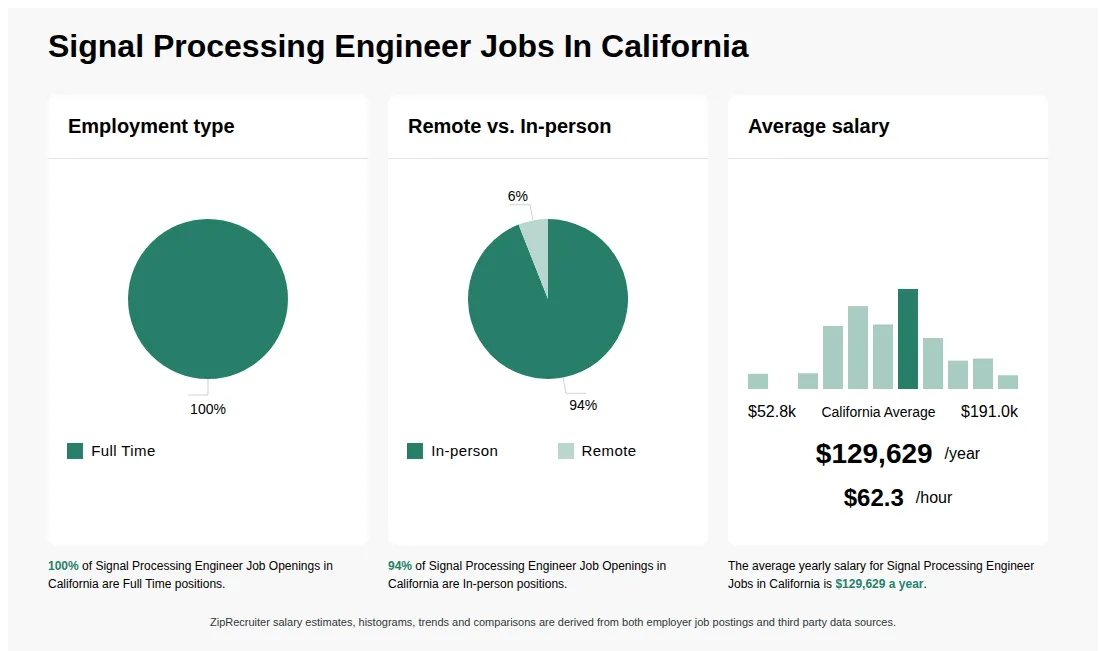
$52.8K - $65.4K
3% of jobs
$65.4K - $77.9K
0% of jobs
$77.9K - $90.5K
3% of jobs
$90.5K - $103K
14% of jobs
$106.4K is the 25th percentile. Wages below this are outliers.
$103K - $115.6K
18% of jobs
The median wage is $126.2K / yr.
$115.6K - $128.2K
14% of jobs
$128.2K - $140.7K
22% of jobs
$141.4K is the 75th percentile. Wages above this are outliers.
$140.7K - $153.3K
11% of jobs
$153.3K - $165.8K
6% of jobs
$165.8K - $178.4K
6% of jobs
$178.4K - $191K
2% of jobs
$52.8K
$129.6K
$191K
How much do signal processing engineer jobs pay per year?
As of Sep 3, 2026, the average yearly pay for signal processing engineer in California is $129,629.00, according to ZipRecruiter salary data. Most workers in this role earn between $107,100.00 and $145,600.00 per year, depending on experience, location, and employer.
What does a signal processing engineer do?
A Signal Processing Engineer designs, develops, and implements algorithms and systems to analyze, modify, and interpret signals such as audio, video, radar, or sensor data. They work with both analog and digital signals to extract meaningful information, improve signal quality, and enable communication between devices. Their work is essential in industries like telecommunications, healthcare (medical imaging), audio engineering, and defense. Signal Processing Engineers often use programming languages like MATLAB or Python, and work closely with hardware and software teams to optimize system performance.
What does a signal processing engineer do?
A signal processing engineer is an information technologies expert that analyzes and alters digital signals to make them more accurate and reliable. As a signal processing engineer, your responsibilities are to develop, manage and update digital signals, creating algorithms to process them more efficiently. Qualifications for a signal processing engineer include a bachelor’s degree in electrical or computer engineering, math, or physics, and skills in various programming languages, like C++. You can find signal processing engineer jobs in a wide variety of industries from security to logistics.
What are the key skills and qualifications needed to thrive as a signal processing engineer, and why are they important?
To thrive as a Signal Processing Engineer, you need a strong background in mathematics, digital signal processing theory, and programming, typically supported by a degree in electrical engineering or a related field. Familiarity with tools such as MATLAB, Python, DSP hardware platforms, and relevant certifications like Certified LabVIEW Developer are highly beneficial. Analytical thinking, problem-solving abilities, and effective communication are crucial soft skills in this role. These skills and qualities ensure accurate analysis, efficient design, and successful implementation of signal processing solutions in diverse technical environments.
What are some typical challenges signal processing engineers face when working on real-time systems?
Signal Processing Engineers working on real-time systems often encounter challenges related to processing speed, latency, and resource constraints. They must design algorithms that efficiently handle large volumes of data without sacrificing accuracy, all while operating within the hardware's computational limits. Collaborating closely with hardware engineers and software developers is common to ensure seamless integration and optimal system performance. Staying updated with the latest advancements in digital signal processing (DSP) tools and techniques also helps address these challenges effectively.
What is the difference between Signal Processing Engineer vs Communications Engineer?
| Aspect | Signal Processing Engineer | Communications Engineer |
|---|---|---|
| Required Credentials | Bachelor's or Master's in Electrical Engineering, Signal Processing, or related fields | Bachelor's or Master's in Electrical Engineering, Communications, or related fields |
| Work Environment | Research labs, tech companies, R&D departments | Telecom companies, network providers, infrastructure firms |
| Industry Usage | Designing algorithms for audio, video, radar, and sensor data | Developing and maintaining communication systems and networks |
| Search & Comparison Intent | Focuses on signal analysis, filtering, and data processing | Focuses on network design, protocols, and transmission systems |
While both roles involve electrical engineering principles, Signal Processing Engineers primarily develop algorithms for analyzing and filtering signals, whereas Communications Engineers focus on designing and maintaining communication systems and networks. The roles often overlap in telecommunications, but their core responsibilities differ based on the specific application and industry focus.
More about Signal Processing Engineer jobs
What are the most commonly searched types of Signal Processing Engineer jobs in California?
The most popular types of Signal Processing Engineer jobs in California are:
What are popular job titles related to Signal Processing Engineer jobs in California?
For Signal Processing Engineer jobs in California, the most frequently searched job titles are:
What job categories do people searching Signal Processing Engineer jobs in California look for?
The top searched job categories for Signal Processing Engineer jobs in California are:
What cities in California are hiring for Signal Processing Engineer jobs?
Cities in California with the most Signal Processing Engineer job openings:
What are popular job titles related to Signal Processing Engineer jobs in CA?
For Signal Processing Engineer jobs in CA, the most frequently searched job titles are:

Full-time
Medical, Dental, Vision, Life, Retirement, PTO
Re-posted 26 days ago
Rivian rating

7.3
Based on 160 frontline employees who took The Breakroom Quiz
18th of 45 rated automakers
Job description
About Rivian
Rivian is on a mission to keep the world adventurous forever. This goes for the emissions-free Electric Adventure Vehicles we build, and the curious, courageous souls we seek to attract.
As a company, we constantly challenge what's possible, never simply accepting what has always been done. We reframe old problems, seek new solutions and operate comfortably in areas that are unknown. Our backgrounds are diverse, but our team shares a love of the outdoors and a desire to protect it for future generations.
Role Summary
We are seeking a highly skilled and experienced Sr. Staff Radar DSP Engineer to work alongside an experienced, cross-functional team to help define the signal processing architecture for our next-generation, high-performance 4D imaging RADAR. This role requires deep, hands-on expertise in radar signal processing theory and practice, and the ability to help design and deliver the algorithms and DSP pipeline that will drive industry-leading detection, resolution, and perception performance. As a senior technical contributor on radar DSP, you will help shape the algorithmic roadmap, drive performance to state-of-the-art KPIs, and partner closely with hardware, firmware, and perception teams to bring the pipeline into production.
Responsibilities
Qualifications
Pay Disclosure
Pay Range: The salary range for this role is $237,000 - $296,000 annually for Bay Area based applicants. This is the lowest to highest salary we in good faith believe we would pay for this role at the time of this posting. An employee's position within the salary range will be based on several factors including, but not limited to, specific competencies, relevant education, qualifications, certifications, experience, skills, geographic location, shift, and organizational needs. The successful candidate may be eligible for annual performance bonus and equity awards.
Benefits: We offer a comprehensive package of benefits for full-time and part-time employees, their spouse or domestic partner, and children up to age 26, including but not limited to paid vacation, paid sick leave, and a competitive portfolio of insurance benefits including life, medical, dental, vision, short-term disability insurance, and long-term disability insurance to eligible employees. You may also have the opportunity to participate in Rivian's 401(k) Plan and Employee Stock Purchase Program if you meet certain eligibility requirements. Full-time employee coverage is effective on their first day of employment. Part-time employee coverage is effective the first of the month following 90 days of employment. More information about benefits is available at rivianbenefits.com.
You can apply for this role through careers.rivian.com (or through internal-careers-rivian.icims.com if you are a current employee). This job is not expected to be closed any sooner than 7/25/2026.
Equal Opportunity
Rivian is an equal opportunity employer and complies with all applicable federal, state, and local fair employment practices laws. All qualified applicants will receive consideration for employment without regard to race, color, religion, national origin, ancestry, sex, sexual orientation, gender, gender expression, gender identity, genetic information or characteristics, physical or mental disability, marital/domestic partner status, age, military/veteran status, medical condition, or any other characteristic protected by law.
Rivian is committed to ensuring that our hiring process is accessible for persons with disabilities. If you have a disability or limitation, such as those covered by the Americans with Disabilities Act, that requires accommodations to assist you in the search and application process, please email us at candidateaccommodations@rivian.com.
Candidate Data Privacy and Technology
Rivian may collect, use and disclose your personal information or personal data (within the meaning of the applicable data protection laws) when you apply for employment and/or participate in our recruitment processes ("Candidate Personal Data"). This data includes contact, demographic, communications, educational, professional, employment, social media/website, network/device, recruiting system usage/interaction, security and preference information. Rivian may use your Candidate Personal Data for the purposes of (i) tracking interactions with our recruiting system; (ii) carrying out, analyzing and improving our application and recruitment process, including assessing you and your application and conducting employment, background and reference checks; (iii) establishing an employment relationship or entering into an employment contract with you; (iv) complying with our legal, regulatory and corporate governance obligations; (v) recordkeeping; (vi) ensuring network and information security and preventing fraud; and (vii) as otherwise required or permitted by applicable law.
Rivian may share your Candidate Personal Data with (i) internal personnel who have a need to know such information in order to perform their duties, including individuals on our People Team, Finance, Legal, and the team(s) with the position(s) for which you are applying; (ii) Rivian affiliates; and (iii) Rivian's service providers, including providers of background checks, staffing services, and cloud services.
Rivian may transfer or store internationally your Candidate Personal Data, including to or in the United States, Canada, the United Kingdom, and the European Union and in the cloud, and this data may be subject to the laws and accessible to the courts, law enforcement and national security authorities of such jurisdictions.
How We Use AI in Our Hiring Process: To ensure transparency, we want candidates to know that Rivian uses iCIMS Talent Cloud Artificial Intelligence (TCAI) and AI-enabled tools to assist with screening, reviewing, organizing and highlighting profiles and applications that match the key requirements for each role.
AI does not make hiring decisions: Qualified candidate applications are reviewed by a member of our team, and all decisions throughout the process are made by humans. We use AI to support efficiency and consistency, not to replace human judgment. We are committed to a fair, thoughtful, and equitable experience for every candidate.
Participation in AI profile matching is entirely voluntary. If you prefer that your profile not be used in this process, you can opt out at any time. Opting out means your profile will be excluded from automated matching and will not be surfaced for additional roles through this system. Your current application remains active and will not be affected in any way.
Please note that we are currently not accepting applications from third party application services.
Rivian is on a mission to keep the world adventurous forever. This goes for the emissions-free Electric Adventure Vehicles we build, and the curious, courageous souls we seek to attract.
As a company, we constantly challenge what's possible, never simply accepting what has always been done. We reframe old problems, seek new solutions and operate comfortably in areas that are unknown. Our backgrounds are diverse, but our team shares a love of the outdoors and a desire to protect it for future generations.
Role Summary
We are seeking a highly skilled and experienced Sr. Staff Radar DSP Engineer to work alongside an experienced, cross-functional team to help define the signal processing architecture for our next-generation, high-performance 4D imaging RADAR. This role requires deep, hands-on expertise in radar signal processing theory and practice, and the ability to help design and deliver the algorithms and DSP pipeline that will drive industry-leading detection, resolution, and perception performance. As a senior technical contributor on radar DSP, you will help shape the algorithmic roadmap, drive performance to state-of-the-art KPIs, and partner closely with hardware, firmware, and perception teams to bring the pipeline into production.
Responsibilities
- Work with an experienced, cross-functional team to design, develop, and optimize the signal processing algorithms and DSP pipeline for a high-performance 4D imaging RADAR, from raw ADC data through detections and point-cloud output.
- Help define and drive the radar processing chain architecture, including waveform design, MIMO/virtual array processing, beamforming, range-Doppler-angle estimation, and super-resolution angle estimation techniques.
- Contribute to the technical roadmap for achieving industry-leading KPIs in range, velocity, and angular resolution, detection probability, false alarm rate, and dynamic range.
- Develop and optimize core algorithms including CFAR detection, clutter and interference mitigation, micro-Doppler processing, tracking, and point-cloud generation for 4D imaging output (range, Doppler, azimuth, elevation).
- Design and implement real-time, compute- and memory-efficient DSP pipelines suitable for deployment on embedded/automotive-grade hardware (DSP cores, FPGA, or custom ASIC/SoC).
- Build high-fidelity simulation, modeling, and algorithm validation frameworks (MATLAB, Python, C++) to characterize algorithm performance ahead of hardware availability.
- Evaluate and integrate state-of-the-art techniques, including MIMO waveform design, digital beamforming, sparse array processing, and interference mitigation for dense multi-radar environments.
- Collaborate with AI/ML teams to develop and deploy deep learning-based radar perception models (e.g., detection, segmentation, classification) operating directly on radar cubes or point clouds.
- Partner closely with RF/hardware, firmware, and systems engineering teams to ensure the DSP pipeline is co-optimized with antenna design, RF front-end, and compute architecture.
- Drive rigorous performance characterization and validation of algorithms against system-level requirements, including field testing and benchmarking against competitive systems.
- Mentor and collaborate with DSP/algorithm engineers across the team, helping establish best practices for algorithm development, code quality, and validation.
- Stay ahead of industry and academic advancements in radar signal processing, automotive/robotics radar, and imaging radar technology, and translate relevant advances into the product roadmap.
- Coordinate with external partners, chipset vendors, and research institutions on next-generation radar processing technologies.
Qualifications
- Master's or PhD in Electrical Engineering, Computer Engineering, Applied Mathematics, or a related field, with a focus on signal processing or radar systems.
- 8+ years of experience developing signal processing algorithms and DSP pipelines for RADAR systems, with demonstrated expertise in imaging or high-resolution automotive/robotics RADAR.
- Deep expertise in radar signal processing fundamentals: waveform design (FMCW/chirp), range-Doppler processing, MIMO virtual array synthesis, digital beamforming, and angle-of-arrival estimation (e.g., FFT-based, MUSIC, ESPRIT, or compressed sensing approaches).
- Strong hands-on experience developing detection and tracking algorithms, including CFAR variants, clutter suppression, and multi-target tracking.
- Proven ability to design DSP pipelines that meet real-time, low-latency constraints on embedded and automotive-grade compute platforms.
- Strong proficiency in MATLAB, Python, and C/C++ for algorithm modeling, simulation, and production implementation.
- Experience with sensor fusion, including fusing RADAR with LiDAR, camera, and IMU data for perception tasks.
- Experience applying deep learning to radar data (raw cube, range-Doppler maps, or point clouds) is highly desirable.
- Familiarity with RF/antenna system design principles and their interplay with DSP algorithm performance.
- Proven track record of technical leadership, including leading algorithm development from concept through production deployment.
- Strong problem-solving skills and the ability to thrive in a fast-paced, innovative environment.
Pay Disclosure
Pay Range: The salary range for this role is $237,000 - $296,000 annually for Bay Area based applicants. This is the lowest to highest salary we in good faith believe we would pay for this role at the time of this posting. An employee's position within the salary range will be based on several factors including, but not limited to, specific competencies, relevant education, qualifications, certifications, experience, skills, geographic location, shift, and organizational needs. The successful candidate may be eligible for annual performance bonus and equity awards.
Benefits: We offer a comprehensive package of benefits for full-time and part-time employees, their spouse or domestic partner, and children up to age 26, including but not limited to paid vacation, paid sick leave, and a competitive portfolio of insurance benefits including life, medical, dental, vision, short-term disability insurance, and long-term disability insurance to eligible employees. You may also have the opportunity to participate in Rivian's 401(k) Plan and Employee Stock Purchase Program if you meet certain eligibility requirements. Full-time employee coverage is effective on their first day of employment. Part-time employee coverage is effective the first of the month following 90 days of employment. More information about benefits is available at rivianbenefits.com.
You can apply for this role through careers.rivian.com (or through internal-careers-rivian.icims.com if you are a current employee). This job is not expected to be closed any sooner than 7/25/2026.
Equal Opportunity
Rivian is an equal opportunity employer and complies with all applicable federal, state, and local fair employment practices laws. All qualified applicants will receive consideration for employment without regard to race, color, religion, national origin, ancestry, sex, sexual orientation, gender, gender expression, gender identity, genetic information or characteristics, physical or mental disability, marital/domestic partner status, age, military/veteran status, medical condition, or any other characteristic protected by law.
Rivian is committed to ensuring that our hiring process is accessible for persons with disabilities. If you have a disability or limitation, such as those covered by the Americans with Disabilities Act, that requires accommodations to assist you in the search and application process, please email us at candidateaccommodations@rivian.com.
Candidate Data Privacy and Technology
Rivian may collect, use and disclose your personal information or personal data (within the meaning of the applicable data protection laws) when you apply for employment and/or participate in our recruitment processes ("Candidate Personal Data"). This data includes contact, demographic, communications, educational, professional, employment, social media/website, network/device, recruiting system usage/interaction, security and preference information. Rivian may use your Candidate Personal Data for the purposes of (i) tracking interactions with our recruiting system; (ii) carrying out, analyzing and improving our application and recruitment process, including assessing you and your application and conducting employment, background and reference checks; (iii) establishing an employment relationship or entering into an employment contract with you; (iv) complying with our legal, regulatory and corporate governance obligations; (v) recordkeeping; (vi) ensuring network and information security and preventing fraud; and (vii) as otherwise required or permitted by applicable law.
Rivian may share your Candidate Personal Data with (i) internal personnel who have a need to know such information in order to perform their duties, including individuals on our People Team, Finance, Legal, and the team(s) with the position(s) for which you are applying; (ii) Rivian affiliates; and (iii) Rivian's service providers, including providers of background checks, staffing services, and cloud services.
Rivian may transfer or store internationally your Candidate Personal Data, including to or in the United States, Canada, the United Kingdom, and the European Union and in the cloud, and this data may be subject to the laws and accessible to the courts, law enforcement and national security authorities of such jurisdictions.
How We Use AI in Our Hiring Process: To ensure transparency, we want candidates to know that Rivian uses iCIMS Talent Cloud Artificial Intelligence (TCAI) and AI-enabled tools to assist with screening, reviewing, organizing and highlighting profiles and applications that match the key requirements for each role.
AI does not make hiring decisions: Qualified candidate applications are reviewed by a member of our team, and all decisions throughout the process are made by humans. We use AI to support efficiency and consistency, not to replace human judgment. We are committed to a fair, thoughtful, and equitable experience for every candidate.
Participation in AI profile matching is entirely voluntary. If you prefer that your profile not be used in this process, you can opt out at any time. Opting out means your profile will be excluded from automated matching and will not be surfaced for additional roles through this system. Your current application remains active and will not be affected in any way.
Please note that we are currently not accepting applications from third party application services.

About Rivian
Sourced by ZipRecruiter
Rivian is a pioneering automotive industry player headquartered in Irvine, California. Established in 2009, the company has made notable advancements in developing sustainable transportation solutions. It is widely recognized for its electric adventure vehicles: the R1T pickup and the R1S SUV. Rivian is dedicated to creating a positive shift in societal mobility and emphasizes sustainability, innovation, and adventure as part of its core values. Their mission is to keep the world adventurous forever - a testament to their commitment in transitioning the world to sustainable transportation. Rivian's achievements are numerous, with one of the most notable being securing a significant multi-billion dollar investment from Amazon for the production of electric delivery vans.
Industry
Automobile dealers
Company size
10,000+ Employees
Headquarters location
Irvine, CA, US
Year founded
2009