1

Reptile Jobs (NOW HIRING)

Desert Dome Reptile Intern FLSA Status: Non-exempt Classification: Seasonal Hours: Up to 24 hours per week for 12 weeks Pay Rate: $15.00/hour This is a seasonal position with a maximum duration of ...

Reptile care and husbandry Research and data entry Prep tasks Meetings and team-building ​Maintaining work area cleanliness For this position, you MUST possess: Working knowledge of reptiles ...

Pangea Reptile - Zeeland, Michigan (On-site) Pay: $16/hr Schedule: Monday - Friday 8a-4p Employment Type: Full-Time About Us: Join our growing team! Pangea Reptile is an online retailer of reptile ...

Pangea Reptile - Zeeland, Michigan (On-site) Pay: $16/hr Schedule: Monday - Friday 8a-4p Employment Type: Full-Time About Us: Join our growing team! Pangea Reptile is an online retailer of reptile ...

next page

Showing results 1-20

Reptile information

See salary details

$13

$22

$37

How much do reptile jobs pay per hour?

As of Jun 20, 2026, the average hourly pay for reptile in the United States is $22.86, according to ZipRecruiter salary data. Most workers in this role earn between $17.31 and $25.72 per hour, depending on experience, location, and employer.

What jobs pay 2000 a day?

High-paying jobs that can pay around $2,000 a day include specialized roles such as surgeons, anesthesiologists, corporate lawyers, and certain high-level consultants or traders. These positions typically require advanced education, certifications, extensive experience, and often involve high-stakes environments or specialized skills.

What profession works with reptiles?

Professionals who work with reptiles include herpetologists, zookeepers, wildlife rehabilitators, and exotic animal veterinarians. These roles involve caring for, studying, or conserving reptile species and often require specialized knowledge, training, and sometimes certifications in animal care or biology.

What are some common challenges faced by reptile keepers in a zoological setting?

Reptile keepers in zoos often encounter challenges such as maintaining precise temperature and humidity levels, managing the specific dietary needs of diverse species, and monitoring for signs of stress or illness that may be subtle. They must also prioritize safety when handling potentially dangerous reptiles and work closely with veterinary and education teams to ensure optimal animal welfare. Staying updated with best husbandry practices is essential for both the caretaker's success and the reptiles' well-being.

What is a Reptile job?

A Reptile job typically involves working with reptiles in various capacities, such as care, research, conservation, or education. Professionals in this field may be herpetologists, zookeepers, wildlife biologists, or veterinary specialists who handle, study, and ensure the well-being of reptiles. Responsibilities can include habitat maintenance, feeding, health monitoring, and assisting with breeding programs. Some roles focus on public education, teaching people about reptile conservation and behavior. Jobs in this field can be found in zoos, research institutions, conservation organizations, and pet trade industries.

What is the difference between Reptile vs Herpetologist?

AspectReptileHerpetologist
Required credentialsBasic knowledge of reptiles, often self-taught or through informal trainingAdvanced degrees in biology or zoology, specialized training in herpetology
Work environmentZoos, pet stores, research labs, outdoor habitatsResearch facilities, fieldwork in natural habitats, universities
Employer and industry usagePet industry, zoos, conservation organizationsAcademic institutions, research organizations, conservation agencies

Reptile refers broadly to any member of the reptile class, often used for pet care or basic education. A herpetologist is a specialized scientist studying reptiles and amphibians, typically with advanced education and research focus. While reptiles are a general category, herpetologists focus on scientific research and conservation of these animals.

What are reptiles?

Reptiles are a class of cold-blooded vertebrate animals that include snakes, lizards, turtles, crocodilians, and tuataras. They are characterized by scaly skin, laying eggs with leathery shells (though some give birth to live young), and breathing air through lungs. Reptiles are found in a variety of habitats worldwide, from deserts to forests and wetlands. They play important roles in ecosystems as predators and prey, and some species are kept as pets or studied for their unique biology.

What jobs pay 10000 a month without a degree?

Reptile-related jobs that can pay around $10,000 a month without a degree include specialized roles such as exotic animal breeders, private reptile trainers, or high-end pet store owners, often requiring expertise, experience, and business skills. These positions typically involve self-employment, entrepreneurship, or niche consulting, and income varies based on demand, reputation, and scale of operations.

What are the key skills and qualifications needed to thrive as a Reptile Keeper, and why are they important?

To thrive as a Reptile Keeper, you need knowledge of reptile biology, husbandry techniques, and animal care, typically supported by experience or a degree in zoology or a related field. Familiarity with environmental control systems, feeding schedules, and animal tracking databases is important. Attention to detail, patience, and strong observational skills are crucial soft skills for monitoring animal health and behavior. These skills ensure the safety, well-being, and proper management of reptiles in captive environments.

Do herpetologists make good money?

Herpetologists, who study reptiles and amphibians, typically earn a median annual salary ranging from $40,000 to $70,000, depending on experience, education, and employer. Salaries can be higher for those with advanced degrees or working in research, conservation, or academia, but overall, the field offers moderate compensation compared to other scientific careers.
More about Reptile jobs
What cities are hiring for Reptile jobs? Cities with the most Reptile job openings:
What are the most commonly searched types of Reptile jobs? The most popular types of Reptile jobs are:
What states have the most Reptile jobs? States with the most job openings for Reptile jobs include:
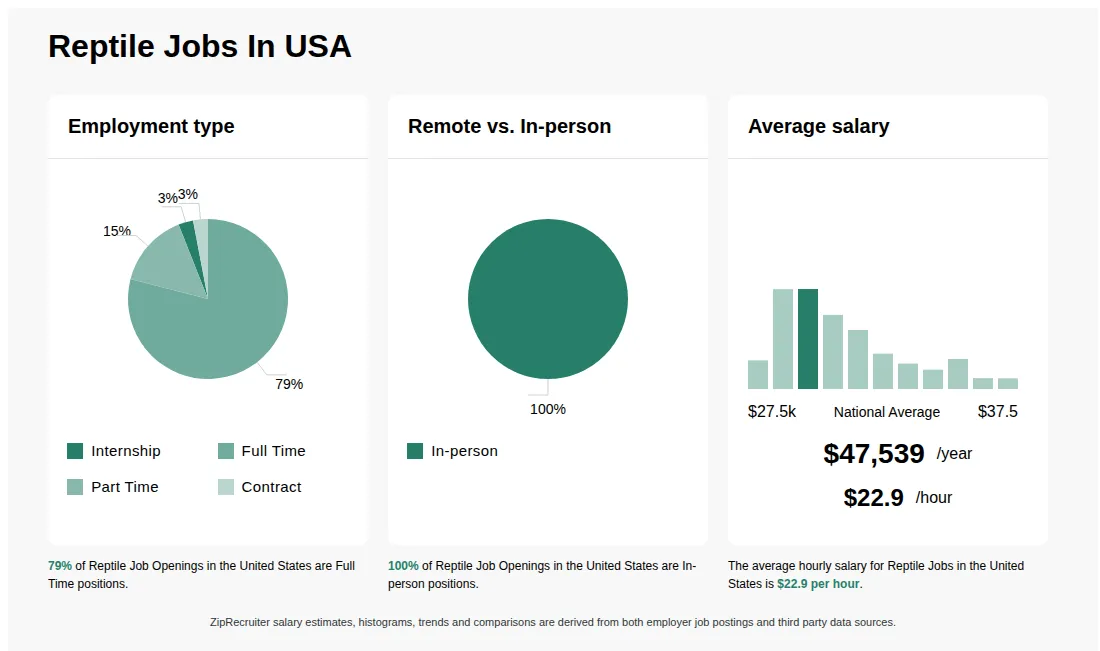
Infographic showing various Reptile job openings in the United States as of June 2026, with employment types broken down into 75% Full Time, 17% Part Time, and 8% Temporary. Highlights an 100% In-person job distribution, with an average salary of $47,539 per year, or $22.9 per hour.
Desert Dome Reptile Intern

$15/hr

Other

Posted 4 days ago


Job description

Job Title: Desert Dome Reptile Intern

FLSA Status: Non-exempt

Classification: Seasonal

Hours: Up to 24 hours per week for 12 weeks

Pay Rate: $15.00/hour

This is a seasonal position with a maximum duration of six months, based on individual performance and business operations. The exact end date will be determined by the official start date. 

SCHEDULE: The fall session runs September 22nd - December 14th, 2026. All interns must be available during this time.

  • Orientation: First day of each semester from 9:00 AM - 4:00 PM. All interns must be available to attend orientation in-person.
  • Weekly Schedule: Must be available to work up to 24 hours per week and attend one weekly afternoon professional development session starting the second week of their internship. Must be willing to work weekends and holidays. Schedules will be determined before internships begin by working with the Intern Coordinator and animal area supervisors.

DESCRIPTION: Omaha’s Henry Doorly Zoo and Aquarium is seeking a Desert Dome Reptile Intern. Under the direction of the Supervisor of Dome-Reptiles & Amphibian Conservation, along with the Curator of Reptile & Amphibians, Reptile interns will assist in the day-to-day husbandry requirements for the animals in the Desert Dome Reptile/Amphibian Collection and will also be expected to help care for animals in the Zoo’s Reptile/Amphibian Collection that are maintained in other departments. The Desert Dome-Reptile/Amphibian Collection is comprised of almost 1000 individual reptile and amphibian specimens. These specimens represent nearly 150 different species and include 20 venomous reptile species and 6 crocodilian species. The collection is featured in the Desert Dome, the world’s largest glazed geodesic dome and in the Kingdoms of the Night which features the world’s largest indoor swamp. Covering ¼ acre and at 160,000 gallons, The Swamp features over 65 individual turtles, a leucistic American Alligator, a small group of adult American Alligators that are involved in an intense training program and includes 5 species of freshwater fishes.  The Desert Dome stands at 13 stories, covers one full acre and features 3 major deserts; Namib of southern Africa, the Red Center of Australia and Sonora of the southwestern United States into Mexico. It is the only exhibit at Henry Doorly to feature venomous reptiles including the Black Mamba, Death Adders, and 7 species of Rattlesnakes some of which are showcased in the world’s largest indoor rattlesnake exhibit.  Desert Dome Reptile Keepers are also responsible for several satellite exhibits which include Gray’s Monitors, White-throated Monitors, and African Spurred Tortoises.  

EDUCATIONAL OPPORTUNITIES AND RESPONSIBILITIES:

  • Develop, work on, and present an internship project aligned with the research needs of the Reptile Department.
  • Attend weekly professional development sessions.
  • Complete learning goals on internship checklist.
  • Participate in and complete a mid-point and final evaluation.
  • Assist in and complete tasks as assigned, including but not limited to:
    • Attends to all aspects of daily animal husbandry, exhibit maintenance, and visitor service for a large and diverse collection of reptiles and amphibians in a major AZA accredited institution.
    • Writes clear, concise reports and maintains accurate records on animals and aquatic systems. Practices good communications skills and has the capacity to work well with others while maintaining the ability to work effectively as an individual.
    • Reports potential issues or concerns promptly to the supervisor or curator including, but not limited to, animal health concerns, exhibit failings, safety issues, facility and maintenance problems, and guest questions, complaints or concerns. Keepers are expected to assist veterinarians and technicians during medical procedures and with administering medical treatments.  Keepers may also be expected to assist other zoo personnel in making minor system/building repairs.
    • Participate in and help develop educational presentations for Zoo visitors.
    • Participates in and supports collaborative efforts pertaining to the Reptile/Amphibian Collection, such as reproduction of selected species, research, enrichment, training and conservation programs.
    • May be required to provide crowd control during peak times and emergency situations.
    • Other duties may be assigned.
  • Must be at least 18 years old.
  • Must follow safety guidelines and always demonstrate safe working practices.
  • Must have effective time management skills for working in a fast-paced and flexible work environment.
  • Must possess strong communication skills; Communicate frequently and in a professional manner with supervisor and team members.
  • Must work well with others and have the ability to work independently.
  • Must be team-oriented and willing to work with other interns, volunteers, and staff members to further not only the goals of the Department but also of the Zoo’s mission statement.
  • Must attend shifts on time and as scheduled.
  • Must have the ability to follow detailed instructions.

Offered candidates are required to pass a pre-employment background check and drug screening.

EXPERIENCE: Previous experience with reptiles and amphibians in an AZA institution is preferred, but not required. General knowledge of aquatic life support systems is preferred. Consideration will be given to an individual’s past direct experience with exotic animals in other zoological, aqua cultural, ecological and biological areas such as in schools, aquariums, nature centers, agricultural operations, animal merchandizing and conservation centers.

EDUCATION: Interns must be currently enrolled in, or have recently graduated from, a college or university. A minimum of one year of coursework in a major field of study to be applied during the internship (e.g. biology, zoology, animal behavior, etc.) is preferred. Knowledge of reptile and amphibian natural history, biology, captive husbandry and conservation issues preferred. Must be motivated to continue expanding knowledge base as it applies to reptiles and amphibians.

PHYSICAL DEMANDS: This position may involve considerable physical exertion, such as climbing of ladders, lifting of heavy objects (50+ pounds), and/or assuming awkward positions. Applicants are strongly encouraged to consider these physical requirements before applying for an internship in this area. Interns that are not able to meet the physical requirements for the position may be reassigned to another department.

WORK ENVIRONMENT: There are routine exposures to heat, cold and moisture. Must be willing to work in confined/uncomfortable spaces and with potentially dangerous animals. The position may involve exposure to chemical substances and physical trauma of a minor nature such as cuts, bruises and minor burns.

PUBLIC CONTACT: Interns will interact with the public frequently throughout their internship and are expected to always exhibit professionalism and exceptional customer service. Interns may be asked to engage in public speaking opportunities, including but not limited to informal educational presentations for the public. 

TO APPLY:

  • Prospective interns can only submit ONE application per person specific to their top their choice but may indicate up to two other areas that interest them on their application.
  • Must submit Cover Letter and Resume to Paycom at the time you apply. Applications without these materials will not be considered. 
    • Your cover letter should include clearly defined career goals including how interning in the area you selected as your top choice will help you achieve your goals.
  • Interns must provide their availability at the time of their interview. Interviews may be conducted over the phone, in person, or over Zoom.

DISCLAIMER

We will do everything possible to accommodate school requirements for those seeking to earn class credit. We do our best to accommodate the schedules of interns with full or part-time job requirements.

Please note this position does not provide any medical coverage.

The information presented indicates the general nature and level of work expected of employees in this classification. It is not designed to contain, nor is it to be interpreted as, a comprehensive inventory of all duties, responsibilities, qualifications, and objectives required of employees assigned to this job.

Omaha’s Henry Doorly Zoo & Aquarium is an Equal Employment Opportunity Employer as defined by the EEOC.