1

Property Preservation Inspector Jobs (NOW HIRING)

Reviewing inspection reports provided by vendors on their designated systems. * Monitor damaged ... Liaise with Property Preservation Vendors, Accounting, Claims and Foreclosure groups. * Review ...

Property Preservation Specialist III

$19.33 - $28.89/hr

  • Medical

  • Dental

  • Vision

  • Life

  • Retirement

  • PTO

... Inspections and Property Preservation upon request • All other duties as assigned Qualifications • High School Diploma or equivalent required • Minimum of 3 years work experience in the real ...

Property Preservation Specialist III

$19.33 - $28.89/hr

  • Medical

  • Dental

  • Vision

  • Life

  • Retirement

  • PTO

... Inspections and Property Preservation upon request • All other duties as assigned Qualifications • High School Diploma or equivalent required • Minimum of 3 years work experience in the real ...

Showing results 41-60

Property Preservation Inspector information

See salary details

$28.5K

$49.7K

$75.5K

How much do property preservation inspector jobs pay per year?

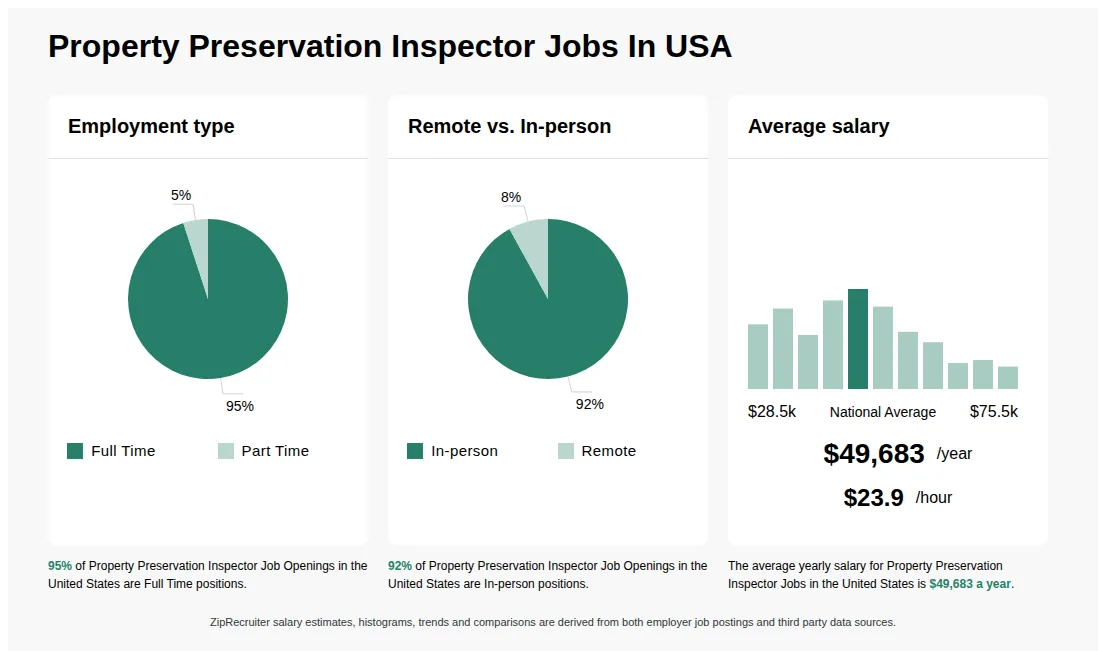
As of Aug 18, 2026, the average yearly pay for property preservation inspector in the United States is $49,683.00, according to ZipRecruiter salary data. Most workers in this role earn between $39,000.00 and $57,500.00 per year, depending on experience, location, and employer.

What does a property preservation inspector do?

A Property Preservation Inspector is responsible for inspecting and documenting the condition of properties, often those in foreclosure or owned by banks or mortgage companies. Their main duties include assessing property damage, ensuring compliance with safety and maintenance standards, and reporting on occupancy status and needed repairs. They help protect and maintain vacant or abandoned properties until they are sold or occupied again. Inspectors may also coordinate minor repairs or maintenance and provide photographic evidence as part of their reports.

What skills and qualifications are needed to be a property preservation inspector?

To thrive as a Property Preservation Inspector, you need a solid understanding of property maintenance standards, inspection procedures, and basic construction knowledge, often supported by a high school diploma or equivalent. Familiarity with inspection software, digital cameras, GPS-enabled devices, and sometimes industry certifications like those from the National Association of Mortgage Field Services (NAMFS) are typically required. Attention to detail, strong organizational skills, and effective communication are crucial soft skills for accurately documenting conditions and coordinating with property owners or contractors. These skills ensure timely, accurate assessments that protect property value and meet regulatory or client requirements.

What challenges do property preservation inspectors face during field inspections?

Property Preservation Inspectors often encounter challenges such as accessing properties in remote or unsafe locations, dealing with inclement weather, and ensuring proper documentation of property conditions. Additionally, inspectors must balance a fast-paced schedule while maintaining attention to detail and compliance with client or regulatory standards. Effective communication with property owners, contractors, and asset managers is essential to overcome these challenges and ensure accurate reporting.

What is the difference between Property Preservation Inspector vs Property Inspector?

AspectProperty Preservation InspectorProperty Inspector
CertificationsTypically requires property preservation certifications, FHA/VA inspectionsMay require general home inspection licenses or certifications
Work EnvironmentPrimarily fieldwork inspecting distressed or foreclosed properties for preservation needsInspecting various residential or commercial properties for condition and compliance
Employer & IndustryLoan servicers, preservation companies, government agenciesReal estate agencies, home inspection companies, private clients

The Property Preservation Inspector focuses on maintaining and securing foreclosed or distressed properties, often working with lenders and preservation companies. In contrast, a Property Inspector conducts general property condition assessments for buyers, sellers, or lenders. While both roles involve property inspections, their specific duties, certifications, and work environments differ significantly.

Is property preservation still profitable?

Property preservation can be profitable for inspectors, especially with experience and proper certifications, as demand for property maintenance and inspections remains steady in the real estate and foreclosure markets. Income depends on the number of properties inspected, geographic location, and the complexity of tasks involved, often requiring tools and knowledge of industry standards.
More about Property Preservation Inspector jobs

What cities are hiring for Property Preservation Inspector jobs?

Cities with the most Property Preservation Inspector job openings:

What states have the most Property Preservation Inspector jobs?

States with the most job openings for Property Preservation Inspector jobs include:

Infographic showing various Property Preservation Inspector job openings in the United States as of August 2026, with employment types broken down into 85% Full Time, 13% Part Time, 1% Temporary, and 1% Contract. Highlights an 93% Physical, 2% Hybrid, and 5% Remote job distribution, with an average salary of $49,683 per year, or $23.9 per hour.

Property preservation

S & A Property Preservation Group L

Pittsburgh, PA • On-site

$200 - $2.0K/day

Full-time

Posted 10 days ago


Job description

Property preservation job duties involve maintaining, securing, and inspecting vacant, foreclosed, or distressed properties
Inspections and Reporting

Occupancy Checks: Verify whether a property is vacant or occupied and document the current condition.
Condition Reporting: Take detailed "before and after" photos and complete digital condition checklists or forms.

Code Compliance Audits: Check properties for municipal or local code violations, damages, and safety hazards.
Property Securing and Maintenance

Securing Assets: Change locks, padlock gates, or board up broken windows and doors to prevent trespassing.

Debris Removal ("Trash-Outs"): Clear out personal property, trash, and abandoned items from the interior and exterior.

Yard Maintenance: Cut grass, trim overgrown shrubs, clear leaves, and perform basic landscaping.

Winterization: Drain plumbing systems and add antifreeze to prevent frozen or burst pipes during cold months. 

Minor Repairs: Fix broken fixtures, patch holes, or repair damaged roofs and flooring