1

Photonics Postdoc Jobs (NOW HIRING)

$126K/yr

QUBT) is an innovative, integrated photonics company that provides accessible and affordable ... Position Description We are seeking a Postdoctoral Researcher in Quantum Optics to join our ...

Showing results 41-60

Photonics Postdoc information

See salary details

$25K

$59K

$83.5K

How much do photonics postdoc jobs pay per year?

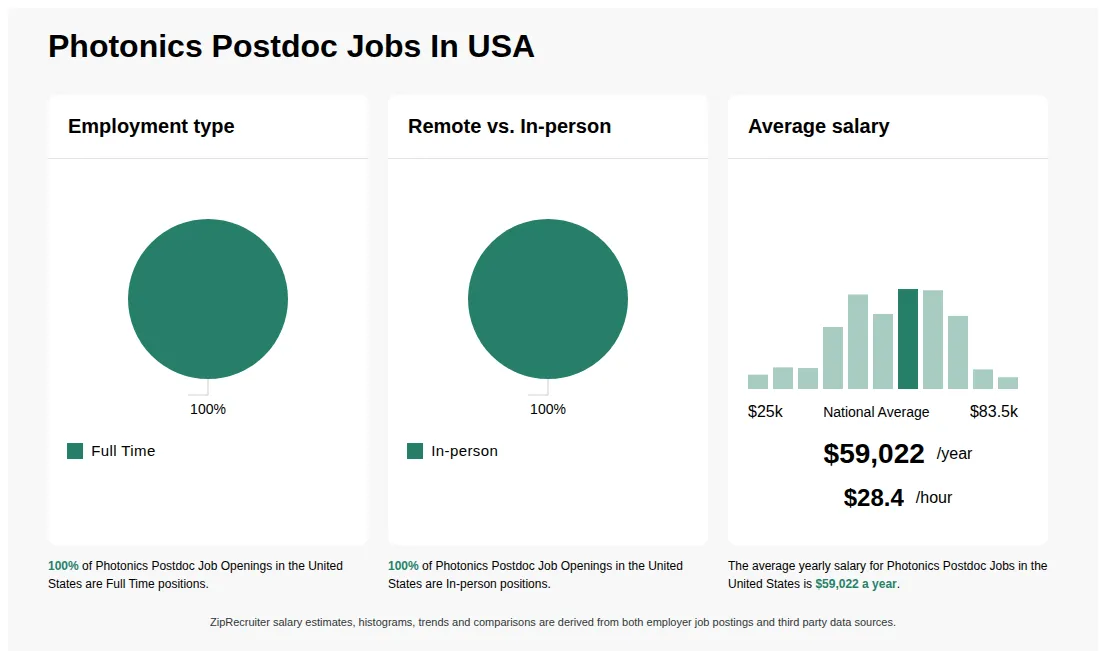
As of Aug 23, 2026, the average yearly pay for photonics postdoc in the United States is $59,022.00, according to ZipRecruiter salary data. Most workers in this role earn between $49,000.00 and $66,500.00 per year, depending on experience, location, and employer.

What is a photonics postdoc?

Photonics Postdocs are researchers who have completed their doctoral studies and are engaged in advanced research in the field of photonics, which involves the study and application of light (photons). They typically work at universities, research institutions, or industry labs to develop new optical technologies, conduct experiments, and publish scientific papers. These positions are often temporary, lasting from one to three years, and are intended to further develop the researcher's expertise and prepare them for permanent academic or industry roles.

What are the key skills and qualifications needed to thrive as a photonics postdoc?

To thrive as a Photonics Postdoc, you need an advanced degree (typically a Ph.D.) in physics, electrical engineering, or a related field, with expertise in optics and photonics principles. Familiarity with optical simulation software, laboratory instrumentation, and data analysis tools is typically required, along with experience in experimental design. Strong problem-solving abilities, collaboration, and clear scientific communication are essential soft skills for success. These competencies enable innovative research, effective teamwork, and dissemination of findings in a highly technical and collaborative academic environment.

What are some common challenges faced by photonics postdocs when transitioning from academic research to industry roles?

Photonics postdocs often find the shift from academia to industry challenging due to differences in project timelines, expectations, and communication styles. In industry, results-driven projects may require faster turnaround and collaboration with multidisciplinary teams, emphasizing practical applications over theoretical exploration. Adjusting to proprietary research, intellectual property policies, and the need for concise reporting are also common hurdles. Developing strong project management and communication skills can help ease this transition and open opportunities for career growth in both research and development settings.
More about Photonics Postdoc jobs

What cities are hiring for Photonics Postdoc jobs?

Cities with the most Photonics Postdoc job openings:

What states have the most Photonics Postdoc jobs?

States with the most job openings for Photonics Postdoc jobs include:

Infographic showing various Photonics Postdoc job openings in the United States as of August 2026, with employment types broken down into 29% Full Time, and 71% Part Time. Highlights an 28% Physical, and 72% Remote job distribution, with an average salary of $59,022 per year, or $28.4 per hour.

Postdoctoral Researcher in Quantum Optics

Quantum Computing Inc.

Hoboken, NJ โ€ข On-site

$126K/yr

Full-time

Re-posted 9 days ago


Job description

Location : Hoboken, NJ
Department : Technology, R&D
Reports to : CTO
About Us
Quantum Computing Inc. (QCi) (Nasdaq: QUBT) is an innovative, integrated photonics company that provides accessible and affordable quantum machines to the world today. QCi products are designed to operate at room temperature and low power at an affordable cost. The Company's portfolio of core technology and products offer unique capabilities in the areas of high-performance computing, artificial intelligence, cyber security as well as remote sensing applications.
Position Description
We are seeking a Postdoctoral Researcher in Quantum Optics to join our research and development team focused on QCi's entropy quantum computing solutions. This position is structured as a one-year contract, with the opportunity for extension based on satisfactory performance and mutual consent by both parties. The role emphasizes theoretical modeling and simulation of quantum photonic devices and systems and requires strong expertise in quantum optics. The successful candidate will collaborate closely with both the high-performance computing application team and the entropy computing hardware team to advance QCi's next-generation computational technologies.
Duties and Responsibilities
- Develop and apply theoretical models of quantum photonic devices and systems relevant to entropy quantum computing.
- Perform simulations of optical components, integrated photonic circuits, and light matter interactions to guide device design.
- Explore new architectures in quantum optics that enhance the efficiency and scalability of entropy-based computing solutions.
- Contribute to algorithm-hardware co-design by identifying opportunities where photonic implementations provide competitive advantages.
- Explore and develop quantum algorithms compatible with entropy computing in collaboration with the scientific computing group at QCi.
- Publish and present research outcomes in journals and conferences.
Required Skills and Experience
- PhD in Physics, Applied Physics, Electrical Engineering, or a closely related field with a focus on theoretical quantum optics .
- Deep expertise in quantum optics, including fields such as quantum coherence, entanglement, cavity/circuit QED, or nonlinear optics.
- Strong background in mathematical modeling and numerical simulation of photonic or quantum systems.
- Proficiency in scientific programming languages such as Python, MATLAB, or C++.
- Demonstrated research record with publications in leading journals.
- Strong communication skills and ability to work collaboratively across interdisciplinary teams.
Preferred Qualifications
- Familiarity with quantum information science, quantum computing, or related computational approaches.
- Experience with integrated photonics, waveguide-based systems, or light-matter interaction models.
- Knowledge of statistical physics approaches to open quantum systems and noise modeling.
- Industry, government, or academic R&D experience in quantum technologies.
- Experience mentoring junior researchers or working in collaborative project teams.
Incumbent(s) in this position may be required to perform other duties and special assignments not specifically stated above. Statements outlined in this section are designated as essential job functions in accordance with the Americans with Disabilities Act of 1990.