Perform ultrafast core-level spectroscopy using a high-harmonic generation source of femtosecond ... The postdoctoral appointee is expected to publish research in peer-reviewed scientific journals ...
Perform ultrafast core-level spectroscopy using a high-harmonic generation source of femtosecond ... The postdoctoral appointee is expected to publish research in peer-reviewed scientific journals ...

Postdoctoral Research Associate in Ultrafast XUV Spectroscopy in High Magnetic Fields (OPS)
Tallahassee, FL · On-site
Postdoctoral applicants must have completed a Ph.D. in a STEM field and demonstrate strong scholarly potential in the ultrafast spectroscopy of condensed matter, chemistry, biochemistry, or related ...
Postdoctoral Research Associate in Ultrafast XUV Spectroscopy in High Magnetic Fields (OPS)
Tallahassee, FL · On-site
Postdoctoral applicants must have completed a Ph.D. in a STEM field and demonstrate strong scholarly potential in the ultrafast spectroscopy of condensed matter, chemistry, biochemistry, or related ...

Postdoctoral Fellow - Harvey Lab
Bloomington, IN · On-site
$50K/yr
The Harvey Lab is seeking a postdoctoral fellow with expertise in ultrafast spectroscopy. Ideal candidates will have completed a Ph.D. in chemistry, physics, chemical engineering, or materials ...
Postdoctoral Fellow - Harvey Lab
Bloomington, IN · On-site
$50K/yr
The Harvey Lab is seeking a postdoctoral fellow with expertise in ultrafast spectroscopy. Ideal candidates will have completed a Ph.D. in chemistry, physics, chemical engineering, or materials ...
Postdoctoral Fellow - Harvey Lab
Bloomington, IN · On-site
$50K/yr
The Harvey Lab is seeking a postdoctoral fellow with expertise in ultrafast spectroscopy. Ideal candidates will have completed a Ph.D. in chemistry, physics, chemical engineering, or materials ...
Postdoctoral Fellow - Harvey Lab
Bloomington, IN · On-site
$50K/yr
The Harvey Lab is seeking a postdoctoral fellow with expertise in ultrafast spectroscopy. Ideal candidates will have completed a Ph.D. in chemistry, physics, chemical engineering, or materials ...
Postdoctoral Fellow - Harvey Lab
Bloomington, IN · On-site
$50K/yr
The Harvey Lab is seeking a postdoctoral fellow with expertise in ultrafast spectroscopy. Ideal candidates will have completed a Ph.D. in chemistry, physics, chemical engineering, or materials ...
Postdoctoral Fellow - Harvey Lab
Bloomington, IN · On-site
$50K/yr
The Harvey Lab is seeking a postdoctoral fellow with expertise in ultrafast spectroscopy. Ideal candidates will have completed a Ph.D. in chemistry, physics, chemical engineering, or materials ...
Postdoctoral Fellow - Harvey Lab
Bloomington, IN · On-site
$50K/yr
The Harvey Lab is seeking a postdoctoral fellow with expertise in ultrafast spectroscopy. Ideal candidates will have completed a Ph.D. in chemistry, physics, chemical engineering, or materials ...
Postdoctoral Fellow - Harvey Lab
Bloomington, IN · On-site
$50K/yr
The Harvey Lab is seeking a postdoctoral fellow with expertise in ultrafast spectroscopy. Ideal candidates will have completed a Ph.D. in chemistry, physics, chemical engineering, or materials ...
Postdoctoral Fellow - Harvey Lab
Kokomo, IN · On-site
$50K/yr
The Harvey Lab is seeking a postdoctoral fellow with expertise in ultrafast spectroscopy. Ideal candidates will have completed a Ph.D. in chemistry, physics, chemical engineering, or materials ...
Postdoctoral Fellow - Harvey Lab
Kokomo, IN · On-site
$50K/yr
The Harvey Lab is seeking a postdoctoral fellow with expertise in ultrafast spectroscopy. Ideal candidates will have completed a Ph.D. in chemistry, physics, chemical engineering, or materials ...

Postdoctoral Appointee - MSD Ultrafast Time-Resolved X-ray Diffraction Microscopy and Spectroscopy f
Lemont, IL · On-site
$117K/yr
... postdoctoral appointee to lead research in ultrafast time-resolved hard X-ray diffraction microscopy and spectroscopy on single-crystalline bulk and thin film quantum materials (e.g. ferroelectrics ...
Postdoctoral Appointee - MSD Ultrafast Time-Resolved X-ray Diffraction Microscopy and Spectroscopy f
Lemont, IL · On-site
$117K/yr
... postdoctoral appointee to lead research in ultrafast time-resolved hard X-ray diffraction microscopy and spectroscopy on single-crystalline bulk and thin film quantum materials (e.g. ferroelectrics ...
Postdoctoral Appointee - MSD Ultrafast Time-Resolved X-ray Diffraction Microscopy and Spectroscop...
Lemont, IL · On-site
$117K/yr
... postdoctoral appointee to lead research in ultrafast time-resolved hard X-ray diffraction ... spectroscopy on single-crystalline bulk and thin film quantum materials (e.g. ferroelectrics ...
Postdoctoral Appointee - MSD Ultrafast Time-Resolved X-ray Diffraction Microscopy and Spectroscop...
Lemont, IL · On-site
$117K/yr
... postdoctoral appointee to lead research in ultrafast time-resolved hard X-ray diffraction ... spectroscopy on single-crystalline bulk and thin film quantum materials (e.g. ferroelectrics ...

Post Doctoral Associate
College Park, MD · On-site
$60K - $65K/yr
Postdoctoral Research Opportunity - Energy Transport and Conversion University of Maryland The Energy Transport and Ultrafast Spectroscopy Lab at the University of Maryland is seeking a Postdoctoral ...
Post Doctoral Associate
College Park, MD · On-site
$60K - $65K/yr
Postdoctoral Research Opportunity - Energy Transport and Conversion University of Maryland The Energy Transport and Ultrafast Spectroscopy Lab at the University of Maryland is seeking a Postdoctoral ...
Associate Staff Scientist - Operando Electron Microscopy and Ultrafast Quantum Science
Menlo Park, CA · On-site
Develop correlative workflows that connect electron microscopy with X-ray spectroscopy, scattering ... postdoctoral or postgraduate research experience. * Demonstrated expertise in advanced electron ...
Associate Staff Scientist - Operando Electron Microscopy and Ultrafast Quantum Science
Menlo Park, CA · On-site
Develop correlative workflows that connect electron microscopy with X-ray spectroscopy, scattering ... postdoctoral or postgraduate research experience. * Demonstrated expertise in advanced electron ...

Associate Staff Scientist - Operando Electron Microscopy and Ultrafast Quantum Science
Menlo Park, CA · On-site
Develop correlative workflows that connect electron microscopy with X-ray spectroscopy, scattering ... postdoctoral or postgraduate research experience. * Demonstrated expertise in advanced electron ...
Associate Staff Scientist - Operando Electron Microscopy and Ultrafast Quantum Science
Menlo Park, CA · On-site
Develop correlative workflows that connect electron microscopy with X-ray spectroscopy, scattering ... postdoctoral or postgraduate research experience. * Demonstrated expertise in advanced electron ...
Post Doctoral Associate
College Park, MD · On-site
$60K - $65K/yr
Postdoctoral Research Opportunity - Energy Transport and Conversion University of Maryland The Energy Transport and Ultrafast Spectroscopy Lab at the University of Maryland is seeking a Postdoctoral ...
Post Doctoral Associate
College Park, MD · On-site
$60K - $65K/yr
Postdoctoral Research Opportunity - Energy Transport and Conversion University of Maryland The Energy Transport and Ultrafast Spectroscopy Lab at the University of Maryland is seeking a Postdoctoral ...

Research will focus on the investigation of ultrafast electron dynamics and mechanism of near ... The successful candidate should demonstrate extensive experience in femtosecond spectroscopy and ...
Research will focus on the investigation of ultrafast electron dynamics and mechanism of near ... The successful candidate should demonstrate extensive experience in femtosecond spectroscopy and ...

Research will focus on the investigation of ultrafast electron dynamics and mechanism of near ... The successful candidate should demonstrate extensive experience in femtosecond spectroscopy and ...
Research will focus on the investigation of ultrafast electron dynamics and mechanism of near ... The successful candidate should demonstrate extensive experience in femtosecond spectroscopy and ...

... spectroscopy, materials characterization, chemical separations, computational chemistry, and ... and ultrafast laser systems. Our radiochemistry facility includes six hoods and two gloveboxes ...
New
... spectroscopy, materials characterization, chemical separations, computational chemistry, and ... and ultrafast laser systems. Our radiochemistry facility includes six hoods and two gloveboxes ...
New

... spectroscopy, materials characterization, chemical separations, computational chemistry, and ... and ultrafast laser systems. Our radiochemistry facility includes six hoods and two gloveboxes ...
... spectroscopy, materials characterization, chemical separations, computational chemistry, and ... and ultrafast laser systems. Our radiochemistry facility includes six hoods and two gloveboxes ...
... spectroscopy, materials characterization, chemical separations, computational chemistry, and ... and ultrafast laser systems. Our radiochemistry facility includes six hoods and two gloveboxes ...
... spectroscopy, materials characterization, chemical separations, computational chemistry, and ... and ultrafast laser systems. Our radiochemistry facility includes six hoods and two gloveboxes ...
... spectroscopy, materials characterization, chemical separations, computational chemistry, and ... and ultrafast laser systems. Our radiochemistry facility includes six hoods and two gloveboxes ...
... spectroscopy, materials characterization, chemical separations, computational chemistry, and ... and ultrafast laser systems. Our radiochemistry facility includes six hoods and two gloveboxes ...

... postdoctoral positions in experimental condensed matter physics in high magnetic fields, each ... THz spectroscopy), CW and/or ultrafast, ability to build and modify table-top experiments in a ...
... postdoctoral positions in experimental condensed matter physics in high magnetic fields, each ... THz spectroscopy), CW and/or ultrafast, ability to build and modify table-top experiments in a ...
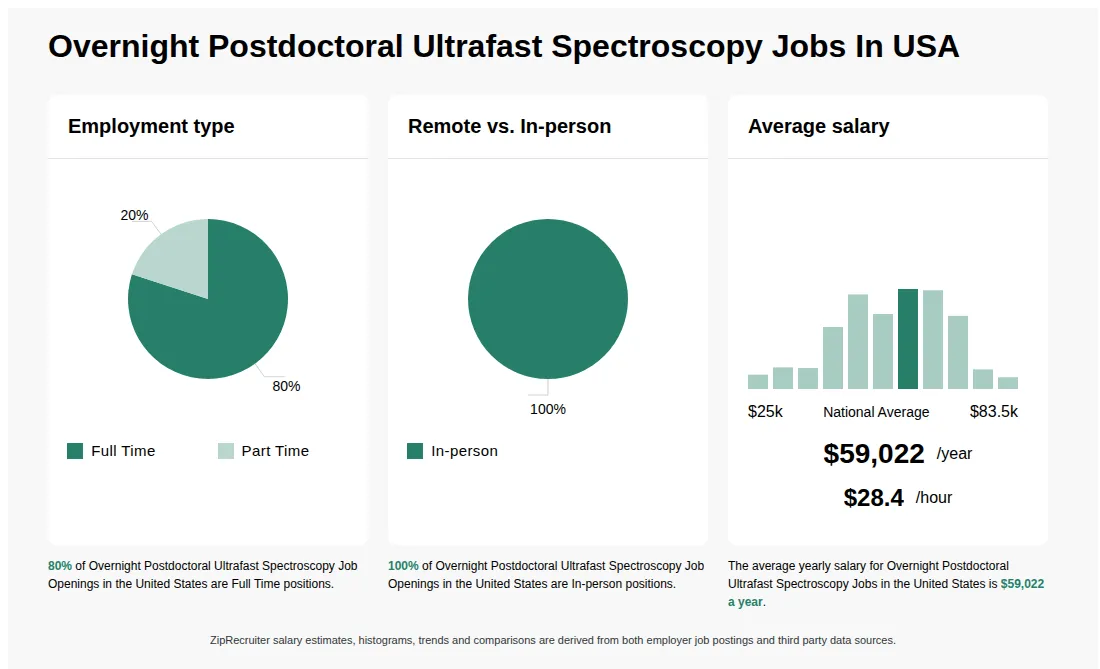
Overnight Postdoctoral Ultrafast Spectroscopy information
See salary details
$25K - $30.3K
2% of jobs
$30.3K - $35.6K
3% of jobs
$35.6K - $41K
3% of jobs
$41K - $46.3K
11% of jobs
$48.1K is the 25th percentile. Wages below this are outliers.
$46.3K - $51.6K
16% of jobs
$51.6K - $56.9K
13% of jobs
The median wage is $57.4K / yr.
$56.9K - $62.2K
17% of jobs
$65.1K is the 75th percentile. Wages above this are outliers.
$62.2K - $67.5K
17% of jobs
$67.5K - $72.9K
13% of jobs
$72.9K - $78.2K
3% of jobs
$78.2K - $83.5K
1% of jobs
$25K
$59K
$83.5K
How much do overnight postdoctoral ultrafast spectroscopy jobs pay per year?
As of Sep 15, 2026, the average yearly pay for overnight postdoctoral ultrafast spectroscopy in the United States is $59,022.00, according to ZipRecruiter salary data. Most workers in this role earn between $49,000.00 and $66,500.00 per year, depending on experience, location, and employer.
What is an overnight postdoctoral ultrafast spectroscopy position?
An Overnight Postdoctoral Ultrafast Spectroscopy position is a research role focusing on ultrafast spectroscopy experiments that take place during nighttime or overnight hours, often due to the scheduling of specialized laboratory equipment or the nature of the experiments. Postdoctoral researchers in this role typically hold a Ph.D. in physics, chemistry, or a related field and work on studying rapid physical or chemical processes using ultrafast lasers and detection systems. The position involves designing and conducting experiments, analyzing data, and sometimes developing new techniques to probe phenomena that occur on femtosecond to picosecond timescales. Working overnight allows for extended or uninterrupted use of expensive equipment and may be necessary in collaborative or shared lab environments. This role is vital in advancing knowledge in fields such as material science, photochemistry, and condensed matter physics.
What are the key skills and qualifications needed to thrive as an overnight postdoctoral ultrafast spectroscopy researcher?
To excel as an Overnight Postdoctoral Ultrafast Spectroscopy researcher, you need a Ph.D. in physics, chemistry, or a related field, with expertise in ultrafast laser systems and time-resolved spectroscopy techniques. Familiarity with advanced instrumentation, data acquisition software (such as LabVIEW or MATLAB), and relevant safety protocols is typically required. Strong analytical thinking, problem-solving abilities, and effective communication skills set outstanding candidates apart, especially when collaborating in multidisciplinary teams. These skills and qualifications are crucial for producing reliable experimental results, troubleshooting complex setups, and advancing cutting-edge research in a demanding laboratory environment.
What are the typical challenges faced by an overnight postdoctoral ultrafast spectroscopy researcher, and how can they be managed?
Overnight Postdoctoral Ultrafast Spectroscopy researchers often face the challenge of maintaining focus and precision during late-night experiments, as ultrafast laser systems require careful calibration and constant monitoring. Managing fatigue and ensuring safety are crucial, so effective time management and clear communication with daytime team members are essential. Collaborating with colleagues for shift handovers and sharing experiment logs helps maintain continuity and data integrity. Additionally, adapting to the unique rhythm of overnight work can take time, but building a supportive routine and leveraging institutional resources can make the transition smoother.
More about Overnight Postdoctoral Ultrafast Spectroscopy jobs
What cities are hiring for Overnight Postdoctoral Ultrafast Spectroscopy jobs?
Cities with the most Overnight Postdoctoral Ultrafast Spectroscopy job openings:
What are the most commonly searched types of Postdoctoral Ultrafast Spectroscopy jobs?
The most popular types of Postdoctoral Ultrafast Spectroscopy jobs are:
What states have the most Overnight Postdoctoral Ultrafast Spectroscopy jobs?
States with the most job openings for Overnight Postdoctoral Ultrafast Spectroscopy jobs include:
What job categories do people searching Overnight Postdoctoral Ultrafast Spectroscopy jobs look for?
The top searched job categories for Overnight Postdoctoral Ultrafast Spectroscopy jobs are:
- Freelance Postdoctoral Ultrafast Spectroscopy
- Full Time Postdoctoral Ultrafast Spectroscopy
- Postdoctoral Ultrafast Spectroscopy
- Temp Inorganic Chemistry Postdoctoral
- Particle Physicist
- Independent Contractor Cyclotron
- Theoretical Physics Postdoctoral
- Postdoctoral Plasma Physics Spectroscopy
- Postdoctoral Position Nanomaterial Chemistry
- Electrochemistry Postdoctoral

Postdoctoral Appointee - Ultrafast Chemical Dynamics, Onsite
Livermore, CA • On-site
Sandia
• Marketing • 11 - 50 employees11 - 50 employees
Full-time
Medical, Retirement, PTO
Posted 29 days ago
Key responsibilities
Operate high-power femtosecond lasers and design, build, and optimize optical and vacuum systems.
Perform ultrafast core-level spectroscopy using a high-harmonic generation source of femtosecond soft X-ray pulses.
Acquire, analyze, and interpret time-resolved experimental data in collaboration with theorists and other experimentalists.
Job description
About Sandia
Sandia National Laboratories is the nation's premier science and engineering lab for national security and technology innovation, with teams of specialists focused on cutting-edge work in a broad array of areas. Some of the main reasons we love our jobs:
World-changing technologies. Life-changing careers. Learn more about Sandia at: http://www.sandia.gov
*These benefits vary by job classification.
What Your Job Will Be Like
We are seeking a motivated experimental postdoctoral appointee to join the Ultrafast Chemical Dynamics Laboratory led by Dr. Krupa Ramasesha. The scientific focus of this appointment is to understand how coupled electronic and structural dynamics shape early photochemical events, including bond dissociation, conformational evolution, and charge transfer, in complex molecular systems. The postdoctoral appointee will apply advanced time-resolved methods to probe electronic excited-state dynamics, with an emphasis on ultrafast core-level spectroscopy enabled by an in-house table-top high-harmonic generation source of femtosecond extreme ultraviolet and soft X-ray pulses. The position also offers opportunities to help develop and participate in user-facility campaigns using ultrafast electron diffraction and free-electron lasers. Working closely with theorists and experimentalists, the successful candidate will interpret time-resolved measurements by connecting experimental observables to coupled electronic and nuclear dynamics.
This position provides an opportunity to develop deep expertise in excited-state molecular dynamics and cutting-edge time-resolved measurements, while building advanced technical skills in ultrafast lasers, nonlinear optics, XUV/soft X-ray spectroscopy, optical systems, and vacuum instrumentation.
On any given day, the postdoc may be called on to:
The postdoctoral appointee is expected to publish research in peer-reviewed scientific journals, present at national and international conferences, and contribute to a collaborative research environment.
Due to the nature of the work, the selected applicant must be able to work onsite.
Qualifications We Require
Qualifications We Require
Qualifications We Desire
Qualifications We Desire
About Our Team
The Gas Phase Chemical Physics Department is part of Sandia's Combustion Research Facility (CRF) in Livermore, California, where over 100 scientists, engineers, and technologists conduct basic and applied research to improve our nation's capabilities in gas-phase chemical physics. Under the principal sponsorship of the Department of Energy's Office of Basic Energy Sciences, the Gas Phase Chemical Physics Department conducts fundamental experimental, theoretical, and modeling research to develop a foundational understanding of the complex chemical reactions that occur either directly in the gas phase or influenced by it. Research areas include chemical dynamics and spectroscopy, advanced diagnostics, ultrafast physics and chemistry, chemical kinetics, multi-phase chemical physics, high-pressure combustion, and gas-surface interactions.
Posting Duration
This posting will be open for application submissions for a minimum of three (3) calendar days, including the 'posting date'. Sandia reserves the right to extend the posting date at any time.
Security Clearance
This position does not currently require a Department of Energy (DOE) security clearance.
Sandia will conduct a pre-employment drug test and background review that includes checks of personal references, credit, law enforcement records, and employment/education verifications. Furthermore, employees in New Mexico need to pass a U.S. Air Force background screen for access to Kirtland Air Force Base. Substance abuse or illegal drug use, falsification of information, criminal activity, serious misconduct or other indicators of untrustworthiness can cause access to be denied or terminated, resulting in the inability to perform the duties assigned and subsequent termination of employment. Under federal law, citizens and agents of the People's Republic of China, the Islamic Republic of Iran, the Democratic People's Republic of North Korea, and the Russian Federation are generally prohibited from accessing Sandia National Laboratories. Accordingly, such individuals will not be considered for employment unless they are also a citizen of the United States.
If hired without a clearance and it subsequently becomes necessary to obtain and maintain one for the position, or you bid on positions that require a clearance, a pre-processing background review may be conducted prior to a required federal background investigation. Applicants for a DOE security clearance need to be U.S. citizens. If you hold more than one citizenship (i.e., of the U.S. and another country), your ability to obtain a security clearance may be impacted.
Members of the workforce (MOWs) hired at Sandia who require uncleared access for greater than 179 days during their employment, are required to go through the Uncleared Personal Identity Verification (UPIV) process. Access includes physical and/or cyber (logical) access, as well as remote access to any NNSA information technology (IT) systems. UPIV requirements are not applicable to individuals who require a DOE personnel security clearance for the performance of their SNL employment or to foreign nationals. The UPIV process will include the completion of a USAccess Enrollment, SF-85 (Questionnaire for Non-Sensitive Positions) and OF-306 (Declaration of for Federal Employment). An unfavorable UPIV determination will result in immediate retrieval of the SNL issued badge, removal of cyber (logical) access and/or removal from SNL subcontract. All MOWs may appeal the unfavorable UPIV determination to DOE/NNSA immediately. If the appeal is unsuccessful, the MOW may try to go through the UPIV process one year after the decision date.
EEO
All qualified applicants will receive consideration for employment without regard to race, color, religion, sex, sexual orientation, gender identity, national origin, age, disability, or veteran status and any other protected class under state or federal law.
NNSA Requirements for MedPEDs
If you have a Medical Portable Electronic Device (MedPED), such as a pacemaker, defibrillator, drug-releasing pump, hearing aids, or diagnostic equipment and other equipment for measuring, monitoring, and recording body functions such as heartbeat and brain waves, if employed by Sandia National Laboratories you may be required to comply with NNSA security requirements for MedPEDs.
If you have a MedPED and you are selected for an on-site interview at Sandia National Laboratories, there may be additional steps necessary to ensure compliance with NNSA security requirements prior to the interview date.
Position Information
This postdoctoral position is a temporary position for up to one year, which may be renewed at Sandia's discretion up to five additional years. The PhD must have been conferred within five years prior to employment.
Individuals in postdoctoral positions may bid on regular Sandia positions as internal candidates, and in some cases may be converted to regular career positions during their term if warranted by ongoing operational needs, continuing availability of funds, and satisfactory job performance.
Sandia National Laboratories is the nation's premier science and engineering lab for national security and technology innovation, with teams of specialists focused on cutting-edge work in a broad array of areas. Some of the main reasons we love our jobs:
- Challenging work with amazing impact that contributes to security, peace, and freedom worldwide
- Extraordinary co-workers
- Some of the best tools, equipment, and research facilities in the world
- Career advancement and enrichment opportunities
- Flexible work arrangements for many positions include 9/80 (work 80 hours every two weeks, with every other Friday off) and 4/10 (work 4 ten-hour days each week) compressed workweeks, part-time work, and telecommuting (a mix of onsite work and working from home)
- Generous vacation, strong medical and other benefits, competitive 401k, learning opportunities, relocation assistance and amenities aimed at creating a solid work/life balance*
World-changing technologies. Life-changing careers. Learn more about Sandia at: http://www.sandia.gov
*These benefits vary by job classification.
What Your Job Will Be Like
We are seeking a motivated experimental postdoctoral appointee to join the Ultrafast Chemical Dynamics Laboratory led by Dr. Krupa Ramasesha. The scientific focus of this appointment is to understand how coupled electronic and structural dynamics shape early photochemical events, including bond dissociation, conformational evolution, and charge transfer, in complex molecular systems. The postdoctoral appointee will apply advanced time-resolved methods to probe electronic excited-state dynamics, with an emphasis on ultrafast core-level spectroscopy enabled by an in-house table-top high-harmonic generation source of femtosecond extreme ultraviolet and soft X-ray pulses. The position also offers opportunities to help develop and participate in user-facility campaigns using ultrafast electron diffraction and free-electron lasers. Working closely with theorists and experimentalists, the successful candidate will interpret time-resolved measurements by connecting experimental observables to coupled electronic and nuclear dynamics.
This position provides an opportunity to develop deep expertise in excited-state molecular dynamics and cutting-edge time-resolved measurements, while building advanced technical skills in ultrafast lasers, nonlinear optics, XUV/soft X-ray spectroscopy, optical systems, and vacuum instrumentation.
On any given day, the postdoc may be called on to:
- Operate high-power femtosecond lasers, and design, build, and optimize optical and vacuum systems.
- Perform ultrafast core-level spectroscopy using a high-harmonic generation source of femtosecond soft X-ray pulses.
- Acquire, analyze, and interpret time-resolved experimental data in collaboration with theorists and other experimentalists.
- Contribute to the development of user proposals and participate in experiments at ultrafast electron diffraction and free-electron laser user facilities.
- Document research findings in peer-reviewed publications.
The postdoctoral appointee is expected to publish research in peer-reviewed scientific journals, present at national and international conferences, and contribute to a collaborative research environment.
Due to the nature of the work, the selected applicant must be able to work onsite.
Qualifications We Require
Qualifications We Require
- Ph.D. in chemistry, physics, or other related fields
- Significant experience with femtosecond amplified laser systems, nonlinear optics, and instrumentation
Qualifications We Desire
Qualifications We Desire
- Strong background in ultrafast spectroscopy and excited-state dynamics
- Experience with high-harmonic generation of XUV/soft X-ray pulses
- Excellent verbal and written communication skills, including the ability to prepare peer-reviewed publications, evidenced by a strong publication record
- Demonstrated ability to address complex problems creatively
- Ability to work effectively both independently and as part of a collaborative team
- Experience with MATLAB, LabVIEW, Python, and related software
About Our Team
The Gas Phase Chemical Physics Department is part of Sandia's Combustion Research Facility (CRF) in Livermore, California, where over 100 scientists, engineers, and technologists conduct basic and applied research to improve our nation's capabilities in gas-phase chemical physics. Under the principal sponsorship of the Department of Energy's Office of Basic Energy Sciences, the Gas Phase Chemical Physics Department conducts fundamental experimental, theoretical, and modeling research to develop a foundational understanding of the complex chemical reactions that occur either directly in the gas phase or influenced by it. Research areas include chemical dynamics and spectroscopy, advanced diagnostics, ultrafast physics and chemistry, chemical kinetics, multi-phase chemical physics, high-pressure combustion, and gas-surface interactions.
Posting Duration
This posting will be open for application submissions for a minimum of three (3) calendar days, including the 'posting date'. Sandia reserves the right to extend the posting date at any time.
Security Clearance
This position does not currently require a Department of Energy (DOE) security clearance.
Sandia will conduct a pre-employment drug test and background review that includes checks of personal references, credit, law enforcement records, and employment/education verifications. Furthermore, employees in New Mexico need to pass a U.S. Air Force background screen for access to Kirtland Air Force Base. Substance abuse or illegal drug use, falsification of information, criminal activity, serious misconduct or other indicators of untrustworthiness can cause access to be denied or terminated, resulting in the inability to perform the duties assigned and subsequent termination of employment. Under federal law, citizens and agents of the People's Republic of China, the Islamic Republic of Iran, the Democratic People's Republic of North Korea, and the Russian Federation are generally prohibited from accessing Sandia National Laboratories. Accordingly, such individuals will not be considered for employment unless they are also a citizen of the United States.
If hired without a clearance and it subsequently becomes necessary to obtain and maintain one for the position, or you bid on positions that require a clearance, a pre-processing background review may be conducted prior to a required federal background investigation. Applicants for a DOE security clearance need to be U.S. citizens. If you hold more than one citizenship (i.e., of the U.S. and another country), your ability to obtain a security clearance may be impacted.
Members of the workforce (MOWs) hired at Sandia who require uncleared access for greater than 179 days during their employment, are required to go through the Uncleared Personal Identity Verification (UPIV) process. Access includes physical and/or cyber (logical) access, as well as remote access to any NNSA information technology (IT) systems. UPIV requirements are not applicable to individuals who require a DOE personnel security clearance for the performance of their SNL employment or to foreign nationals. The UPIV process will include the completion of a USAccess Enrollment, SF-85 (Questionnaire for Non-Sensitive Positions) and OF-306 (Declaration of for Federal Employment). An unfavorable UPIV determination will result in immediate retrieval of the SNL issued badge, removal of cyber (logical) access and/or removal from SNL subcontract. All MOWs may appeal the unfavorable UPIV determination to DOE/NNSA immediately. If the appeal is unsuccessful, the MOW may try to go through the UPIV process one year after the decision date.
EEO
All qualified applicants will receive consideration for employment without regard to race, color, religion, sex, sexual orientation, gender identity, national origin, age, disability, or veteran status and any other protected class under state or federal law.
NNSA Requirements for MedPEDs
If you have a Medical Portable Electronic Device (MedPED), such as a pacemaker, defibrillator, drug-releasing pump, hearing aids, or diagnostic equipment and other equipment for measuring, monitoring, and recording body functions such as heartbeat and brain waves, if employed by Sandia National Laboratories you may be required to comply with NNSA security requirements for MedPEDs.
If you have a MedPED and you are selected for an on-site interview at Sandia National Laboratories, there may be additional steps necessary to ensure compliance with NNSA security requirements prior to the interview date.
Position Information
This postdoctoral position is a temporary position for up to one year, which may be renewed at Sandia's discretion up to five additional years. The PhD must have been conferred within five years prior to employment.
Individuals in postdoctoral positions may bid on regular Sandia positions as internal candidates, and in some cases may be converted to regular career positions during their term if warranted by ongoing operational needs, continuing availability of funds, and satisfactory job performance.

About Sandia
Sourced by ZipRecruiter
Industry
Marketing
Company size
11 - 50 Employees
Headquarters location
Colorado Springs, CO, US
Year founded
1999