Ophthalmic Technician
$18 - $28/hr
OPHTHALMIC TECHNICIAN Ophthalmic Technician Duties: acquire medical history, administer tests, operate and maintain testing equipment, direct patients during various exams and assist with more ...
$18 - $28/hr
OPHTHALMIC TECHNICIAN Ophthalmic Technician Duties: acquire medical history, administer tests, operate and maintain testing equipment, direct patients during various exams and assist with more ...
$18 - $28/hr
OPHTHALMIC TECHNICIAN Ophthalmic Technician Duties: acquire medical history, administer tests, operate and maintain testing equipment, direct patients during various exams and assist with more ...
Somersworth, NH · On-site
$18 - $28/hr
OPHTHALMIC TECHNICIAN Ophthalmic Technician Duties: acquire medical history, administer tests, operate and maintain testing equipment, direct patients during various exams and assist with more ...
Quick apply
Somersworth, NH · On-site
$18 - $28/hr
OPHTHALMIC TECHNICIAN Ophthalmic Technician Duties: acquire medical history, administer tests, operate and maintain testing equipment, direct patients during various exams and assist with more ...
Somersworth, NH · On-site
$18.75 - $25.25/hr
OPHTHALMIC TECHNICIAN Ophthalmic Technician Duties: acquire medical history, administer tests, operate and maintain testing equipment, direct patients during various exams and assist with more ...
Somersworth, NH · On-site
$18.75 - $25.25/hr
OPHTHALMIC TECHNICIAN Ophthalmic Technician Duties: acquire medical history, administer tests, operate and maintain testing equipment, direct patients during various exams and assist with more ...
Portsmouth, NH · On-site
$18 - $28/hr
In this role, you'll be working closely with our patients, other technicians and providers to gather patient information, operate ophthalmic equipment, perform preliminary tests and ensure that each ...
Quick apply
Portsmouth, NH · On-site
$18 - $28/hr
In this role, you'll be working closely with our patients, other technicians and providers to gather patient information, operate ophthalmic equipment, perform preliminary tests and ensure that each ...
$18 - $28/hr
Description In this role, you'll be working closely with our patients, other technicians and providers to gather patient information, operate ophthalmic equipment, perform preliminary tests and ...
$18 - $28/hr
Description In this role, you'll be working closely with our patients, other technicians and providers to gather patient information, operate ophthalmic equipment, perform preliminary tests and ...
Portsmouth, NH · On-site
$18 - $28/hr
Bonus points if you have experience as an ophthalmic technician and are eager to continue growing your skills in this field. We are also VERY open to candidates without prior experience. So, if you ...
Portsmouth, NH · On-site
$18 - $28/hr
Bonus points if you have experience as an ophthalmic technician and are eager to continue growing your skills in this field. We are also VERY open to candidates without prior experience. So, if you ...
Fairfield, CT · On-site
$23 - $29/hr
As an Ophthalmic Technician, you will be responsible for conducting the initial assessment of a patient, including listening to their complaints or concerns, obtaining a relevant medical history, and ...
Quick apply
Fairfield, CT · On-site
$23 - $29/hr
As an Ophthalmic Technician, you will be responsible for conducting the initial assessment of a patient, including listening to their complaints or concerns, obtaining a relevant medical history, and ...
San Antonio, TX · On-site
$18 - $26/hr
Job Posting TitleOphthalmic Technician Ophthalmic Technician Responsibilities: - Perform preliminary eye examinations and diagnostic tests under the supervision of an ophthalmologist. - Record ...
Quick apply
San Antonio, TX · On-site
$18 - $26/hr
Job Posting TitleOphthalmic Technician Ophthalmic Technician Responsibilities: - Perform preliminary eye examinations and diagnostic tests under the supervision of an ophthalmologist. - Record ...
$23 - $29/hr
As an Ophthalmic Technician, you will be responsible for conducting the initial assessment of a patient, including listening to their complaints or concerns, obtaining a relevant medical history, and ...
Quick apply
$23 - $29/hr
As an Ophthalmic Technician, you will be responsible for conducting the initial assessment of a patient, including listening to their complaints or concerns, obtaining a relevant medical history, and ...
Hinesville, GA · On-site
$17.25 - $23.25/hr
Ophthalmic Technician Location: Hinesville, GA Status: Full-Time We are seeking a skilled and detail-oriented Ophthalmic Technician to join our team! As an Ophthalmic Technician, you will be ...
New
Hinesville, GA · On-site
$17.25 - $23.25/hr
Ophthalmic Technician Location: Hinesville, GA Status: Full-Time We are seeking a skilled and detail-oriented Ophthalmic Technician to join our team! As an Ophthalmic Technician, you will be ...
New
Elbert, CO · On-site
$20/hr
A respected ophthalmology practice in Colorado Springs is seeking a skilled Ophthalmic Technician to join their clinical team. This is a great opportunity for candidates who enjoy working in a fast ...
Elbert, CO · On-site
$20/hr
A respected ophthalmology practice in Colorado Springs is seeking a skilled Ophthalmic Technician to join their clinical team. This is a great opportunity for candidates who enjoy working in a fast ...
Colorado Springs, CO · On-site
$20/hr
A respected ophthalmology practice in Colorado Springs is seeking a skilled Ophthalmic Technician to join their clinical team. This is a great opportunity for candidates who enjoy working in a fast ...
Colorado Springs, CO · On-site
$20/hr
A respected ophthalmology practice in Colorado Springs is seeking a skilled Ophthalmic Technician to join their clinical team. This is a great opportunity for candidates who enjoy working in a fast ...
Paterson, NJ · On-site
$23 - $28/hr
Proven experience as an Ophthalmic Technician. * Knowledge of medical office procedures. * Ability to perform indirect activities, administrative tasks and any other assigned duties that contribute ...
Paterson, NJ · On-site
$23 - $28/hr
Proven experience as an Ophthalmic Technician. * Knowledge of medical office procedures. * Ability to perform indirect activities, administrative tasks and any other assigned duties that contribute ...
Forest Hills, NY · On-site
$22 - $28/hr
Experienced Ophthalmic Technician / Scribe Location: Forest Hills, New York This position is for experienced ophthalmic technicians only. Applications without prior ophthalmology or optometry ...
Quick apply
Forest Hills, NY · On-site
$22 - $28/hr
Experienced Ophthalmic Technician / Scribe Location: Forest Hills, New York This position is for experienced ophthalmic technicians only. Applications without prior ophthalmology or optometry ...
Jackson, TN · On-site
$15.75 - $21.25/hr
Ophthalmic Technician, UncertifiedLocation: Jackson, TN, 38305Skills: Ophthalmic Technician-Full Time We are seeking an Ophthalmic Technician to join our team. The successful candidate will be ...
New
Jackson, TN · On-site
$15.75 - $21.25/hr
Ophthalmic Technician, UncertifiedLocation: Jackson, TN, 38305Skills: Ophthalmic Technician-Full Time We are seeking an Ophthalmic Technician to join our team. The successful candidate will be ...
New
Lebanon, NH · On-site
$2.4K/wk
Ophthalmic Technician Training Program Completion Required * Ophthalmic Technician Certification Required, if applicable * Minimum 1 Year of Ophthalmic Technician Experience Preferred * BLS ...
Lebanon, NH · On-site
$2.4K/wk
Ophthalmic Technician Training Program Completion Required * Ophthalmic Technician Certification Required, if applicable * Minimum 1 Year of Ophthalmic Technician Experience Preferred * BLS ...
Fairfield, CT · On-site
$23 - $29/hr
As an Ophthalmic Technician, you will be responsible for conducting the initial assessment of a patient, including listening to their complaints or concerns, obtaining a relevant medical history, and ...
Quick apply
Fairfield, CT · On-site
$23 - $29/hr
As an Ophthalmic Technician, you will be responsible for conducting the initial assessment of a patient, including listening to their complaints or concerns, obtaining a relevant medical history, and ...
Hinesville, GA · On-site
$17.25 - $23.25/hr
Ophthalmic Technician Location: Hinesville, GA Status: Full-Time We are seeking a skilled and detail-oriented Ophthalmic Technician to join our team! As an Ophthalmic Technician, you will be ...
New
Quick apply
Hinesville, GA · On-site
$17.25 - $23.25/hr
Ophthalmic Technician Location: Hinesville, GA Status: Full-Time We are seeking a skilled and detail-oriented Ophthalmic Technician to join our team! As an Ophthalmic Technician, you will be ...
New
Waltham, MA · On-site
$23 - $28/hr
Then come join our team as an Ophthalmic Technician. Position Summary Under the direct supervision of the department supervisor, the Ophthalmic Technician I plays a crucial role in providing ...
Quick apply
Waltham, MA · On-site
$23 - $28/hr
Then come join our team as an Ophthalmic Technician. Position Summary Under the direct supervision of the department supervisor, the Ophthalmic Technician I plays a crucial role in providing ...
Colorado Springs, CO · On-site
$20/hr
A respected ophthalmology practice in Colorado Springs is seeking a skilled Ophthalmic Technician to join their clinical team. This is a great opportunity for candidates who enjoy working in a fast ...
Colorado Springs, CO · On-site
$20/hr
A respected ophthalmology practice in Colorado Springs is seeking a skilled Ophthalmic Technician to join their clinical team. This is a great opportunity for candidates who enjoy working in a fast ...
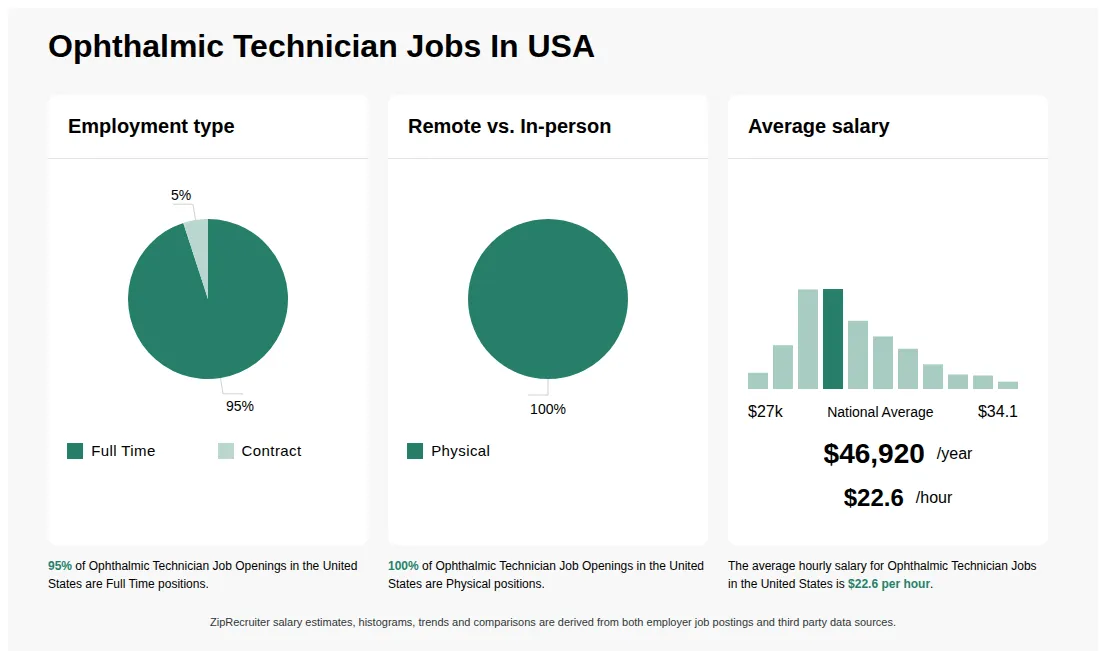
$12.98 - $14.90
3% of jobs
$14.90 - $16.83
9% of jobs
$17.96 is the 25th percentile. Wages below this are outliers.
$16.83 - $18.75
21% of jobs
The median wage is $20.24 / hr.
$18.75 - $20.67
21% of jobs
$20.67 - $22.60
15% of jobs
$23.61 is the 75th percentile. Wages above this are outliers.
$22.60 - $24.52
11% of jobs
$24.52 - $26.44
8% of jobs
$26.44 - $28.37
5% of jobs
$28.37 - $30.29
3% of jobs
$30.29 - $32.21
2% of jobs
$32.21 - $34.13
1% of jobs
$12
$22
$34
Ophthalmic technicians work alongside ophthalmologists (eye doctors) to provide eye-related clinical care for patients who come in for routine eye exams or particular eye disorders. Ophthalmic technicians take patient medical histories, perform a variety of vision and diagnostic tests, and educate patients about procedures, medications, and home care. In addition to assisting with patient procedures, some ophthalmic technicians also perform office management duties such as scheduling patient appointments.
| Aspect | Ophthalmic Technician | Optician |
|---|---|---|
| Credentials | Certification (COA, COT), high school diploma or equivalent | Certification (ABC), high school diploma or equivalent |
| Work Environment | Eye clinics, hospitals, ophthalmology offices | Optical stores, eyewear retail |
| Job Focus | Assisting ophthalmologists, performing diagnostic tests | Fitting and dispensing eyewear, customer service |
Ophthalmic Technicians and Opticians both work in eye care but have different roles. Ophthalmic Technicians assist ophthalmologists with diagnostics and patient exams, requiring specific certifications. Opticians focus on fitting and selling eyewear, often working in retail settings. Understanding these differences helps clarify career paths and job expectations in the eye care industry.
Cities with the most Ophthalmic Technician job openings:
The most popular types of Ophthalmic Technician jobs are:
The top employers for Ophthalmic Technician jobs are:
States with the most job openings for Ophthalmic Technician jobs include:
The top searched job categories for Ophthalmic Technician jobs are:
For Ophthalmic Technician jobs, the most frequently searched job titles are:

$18 - $28/hr
Full-time
Retirement
Re-posted 2 days ago
Description
Job Summary:
Eyesight Ophthalmic Services (www.EyesightNH.com) is the Seacoast's premiere optometric and ophthalmic eye care practice. We are featuring growth opportunities as we fill several openings for Ophthalmic Technicians. These positions are available at our various office locations in Kittery Maine, Portsmouth, Exeter and Somersworth New Hampshire.
OPHTHALMIC TECHNICIAN
Ophthalmic Technician Duties: acquire medical history, administer tests, operate and maintain testing equipment, direct patients during various exams and assist with more complex tests (i.e. refractions), coordinate follow-up care, order / maintain clinic supplies and assist with educating patients on pre and post-operative care and instructions. Experience in the medical field is preferred but not necessary.
THE IDEAL CANDIDATE:
Personality for these positions are 99% of the job. Seeking personable, intelligent and positive professionals who enjoy working with people. This role involves face to face, phone and written contact with patients, so good written and verbal skills are essential. This is not a job. This is a career filled with fun and hard working staff who sincerely enjoy their job. This is an MD owned private eye care practice with over 100 employees, 8 Ophthalmologists (MD's) and 6 optometrists (OD's). Good starting salary and benefit package including 401(k) and short term disability.
Our offices are currently open Monday - Friday 8:00am to 5:00pm. Each office is open 1 evening until 6:00 pm per week. Ophthalmic Technicians have set hours and usually work out of one main office in Kittery, Portsmouth, Exeter or Somersworth. Candidates should have flexibility to work some evening shifts if necessary and be able to travel to other offices during the week to cover shifts if necessary.
Hours are 8:00am to 5:00pm (based on the needs of patients) and possibly one evening per week 9:00am to 6:00pm.
Job Type: Full-time
Requirements
Minimum Requirements (education and experience):
Preferred:
Work Conditions:
Physical Requirements:

Sourced by ZipRecruiter
51 - 200 Employees
Portsmouth, NH, US
1983


