
Nuro has raised over $2B in capital from Uber, NVIDIA, Google, Softbank, Fidelity, T. Rowe Price, and other leading investors. About the Role As a software engineering intern, you will work closely ...
Nuro has raised over $2B in capital from Uber, NVIDIA, Google, Softbank, Fidelity, T. Rowe Price, and other leading investors. About the Role As a software engineering intern, you will work closely ...
Nuro has raised over $2B in capital from Uber, NVIDIA, Google, Softbank, Fidelity, T. Rowe Price, and other leading investors. About the Role As a software engineering intern, you will work closely ...
Nuro has raised over $2B in capital from Uber, NVIDIA, Google, Softbank, Fidelity, T. Rowe Price, and other leading investors. About the Role As a software engineering intern, you will work closely ...
Nuro has raised over $2B in capital from Uber, NVIDIA, Google, Softbank, Fidelity, T. Rowe Price, and other leading investors. About the Role As a software engineering intern, you will work closely ...
Quick apply
Nuro has raised over $2B in capital from Uber, NVIDIA, Google, Softbank, Fidelity, T. Rowe Price, and other leading investors. About the Role As a software engineering intern, you will work closely ...
AI Developer Intern
San Jose, CA · On-site
$45 - $65/hr
Utilize and fine-tune open-source models from Meta, Google, Deepseek, and Nvidia to optimize AI ... Proficiency in programming languages such as Python, Java, R. * Strong understanding of machine ...
AI Developer Intern
San Jose, CA · On-site
$45 - $65/hr
Utilize and fine-tune open-source models from Meta, Google, Deepseek, and Nvidia to optimize AI ... Proficiency in programming languages such as Python, Java, R. * Strong understanding of machine ...

Technical Project Manager, Intern
Chatsworth, CA · On-site
$20 - $35/hr
About Machina Labs Engineering moves at software speed. Manufacturing doesn't. Yet. Machina Labs is ... Backed by Lockheed Martin, Toyota, and NVIDIA, we're building the manufacturing infrastructure that ...
Technical Project Manager, Intern
Chatsworth, CA · On-site
$20 - $35/hr
About Machina Labs Engineering moves at software speed. Manufacturing doesn't. Yet. Machina Labs is ... Backed by Lockheed Martin, Toyota, and NVIDIA, we're building the manufacturing infrastructure that ...

Build systems to automate performance profiling and analysis using tools like NVIDIA Nsight and the ... Systems Programming: Strong proficiency in C++ and a solid understanding of memory management ...
Build systems to automate performance profiling and analysis using tools like NVIDIA Nsight and the ... Systems Programming: Strong proficiency in C++ and a solid understanding of memory management ...
Machine Learning Infrastructure Engineer Intern
Santa Clara, CA · On-site
$19 - $65/hr
Build systems to automate performance profiling and analysis using tools like NVIDIA Nsight and the ... Systems Programming: Strong proficiency in C++ and a solid understanding of memory management ...
Machine Learning Infrastructure Engineer Intern
Santa Clara, CA · On-site
$19 - $65/hr
Build systems to automate performance profiling and analysis using tools like NVIDIA Nsight and the ... Systems Programming: Strong proficiency in C++ and a solid understanding of memory management ...
Speech Research Intern-2
$45/hr
You'll move ideas from prototype to practical demos, working with scientists and engineers to ... Distributed training/serving (FSDP/DeepSpeed), and experience with ESPnet, SpeechBrain, or NVIDIA ...
Speech Research Intern-2
$45/hr
You'll move ideas from prototype to practical demos, working with scientists and engineers to ... Distributed training/serving (FSDP/DeepSpeed), and experience with ESPnet, SpeechBrain, or NVIDIA ...
Vehicle Reliability, Intern
$19.75 - $25.75/hr
Nuro has raised over $2B in capital from Uber, NVIDIA, Google, Softbank, Fidelity, T. Rowe Price ... Our team partners closely with design engineering, integration, test operations, manufacturing, and ...
Quick apply
Vehicle Reliability, Intern
$19.75 - $25.75/hr
Nuro has raised over $2B in capital from Uber, NVIDIA, Google, Softbank, Fidelity, T. Rowe Price ... Our team partners closely with design engineering, integration, test operations, manufacturing, and ...

Direct AI/ML engineering experience * Familiar with AI research conferences Salary Range ... NVIDIA, Pegatron, Supermicro, Wistron, Wiwynn, Gradient Ventures, Mercato Partners, SVB, 1517, and ...
Direct AI/ML engineering experience * Familiar with AI research conferences Salary Range ... NVIDIA, Pegatron, Supermicro, Wistron, Wiwynn, Gradient Ventures, Mercato Partners, SVB, 1517, and ...
Vehicle Reliability, Intern
$19.75 - $25.75/hr
Nuro has raised over $2B in capital from Uber, NVIDIA, Google, Softbank, Fidelity, T. Rowe Price ... Our team partners closely with design engineering, integration, test operations, manufacturing, and ...
Vehicle Reliability, Intern
$19.75 - $25.75/hr
Nuro has raised over $2B in capital from Uber, NVIDIA, Google, Softbank, Fidelity, T. Rowe Price ... Our team partners closely with design engineering, integration, test operations, manufacturing, and ...
Vehicle Reliability, Intern
Mountain View, CA · On-site
$19.75 - $25.75/hr
Nuro has raised over $2B in capital from Uber, NVIDIA, Google, Softbank, Fidelity, T. Rowe Price ... Our team partners closely with design engineering, integration, test operations, manufacturing, and ...
Vehicle Reliability, Intern
Mountain View, CA · On-site
$19.75 - $25.75/hr
Nuro has raised over $2B in capital from Uber, NVIDIA, Google, Softbank, Fidelity, T. Rowe Price ... Our team partners closely with design engineering, integration, test operations, manufacturing, and ...
As a research intern, you will work closely with FieldAI researchers and engineers to explore novel ... NVIDIA, Amazon, Tesla Autopilot, Cruise Self-Driving, Zoox, Toyota Research Institute, and SpaceX ...
As a research intern, you will work closely with FieldAI researchers and engineers to explore novel ... NVIDIA, Amazon, Tesla Autopilot, Cruise Self-Driving, Zoox, Toyota Research Institute, and SpaceX ...
Robotics Research Intern, Robot Learning (Summer 2026) | PhD Internship
Pittsburgh, PA · On-site
$50 - $53/hr
As a research intern, you will work closely with FieldAI researchers and engineers to explore novel ... NVIDIA, Amazon, Tesla Autopilot, Cruise Self-Driving, Zoox, Toyota Research Institute, and SpaceX ...
Robotics Research Intern, Robot Learning (Summer 2026) | PhD Internship
Pittsburgh, PA · On-site
$50 - $53/hr
As a research intern, you will work closely with FieldAI researchers and engineers to explore novel ... NVIDIA, Amazon, Tesla Autopilot, Cruise Self-Driving, Zoox, Toyota Research Institute, and SpaceX ...
Staff Technical Recruiter
San Mateo, CA · On-site
Backed by leading investors such as a16z, NVIDIA (via NVentures) and Radical Ventures, we are ... Design and run our intern and new graduate hiring programs, including university partnerships ...
Staff Technical Recruiter
San Mateo, CA · On-site
Backed by leading investors such as a16z, NVIDIA (via NVentures) and Radical Ventures, we are ... Design and run our intern and new graduate hiring programs, including university partnerships ...
1.53 Robotics Research Internship, Humanoid Manipulation (Summer 2026) | PhD Internship
Boston, MA · On-site
$40 - $60/hr
... intern, you will work at the intersection of robotics research and applied engineering ... NVIDIA, Amazon, Tesla Autopilot, Cruise, Zoox, Toyota Research Institute, and SpaceX. Our R&D ...
1.53 Robotics Research Internship, Humanoid Manipulation (Summer 2026) | PhD Internship
Boston, MA · On-site
$40 - $60/hr
... intern, you will work at the intersection of robotics research and applied engineering ... NVIDIA, Amazon, Tesla Autopilot, Cruise, Zoox, Toyota Research Institute, and SpaceX. Our R&D ...
1.53 Robotics Research Internship, Humanoid Manipulation (Summer 2026) | PhD Internship
Boston, MA · On-site
$40 - $60/hr
... intern, you will work at the intersection of robotics research and applied engineering ... NVIDIA, Amazon, Tesla Autopilot, Cruise, Zoox, Toyota Research Institute, and SpaceX. Our R&D ...
1.53 Robotics Research Internship, Humanoid Manipulation (Summer 2026) | PhD Internship
Boston, MA · On-site
$40 - $60/hr
... intern, you will work at the intersection of robotics research and applied engineering ... NVIDIA, Amazon, Tesla Autopilot, Cruise, Zoox, Toyota Research Institute, and SpaceX. Our R&D ...
This is a technical, hands-on role that sits at the intersection of Network Engineering, Data ... Hands-on experience configuring Arista (EOS), Juniper (Junos), and NVIDIA/Mellanox platforms in a ...
Quick apply
This is a technical, hands-on role that sits at the intersection of Network Engineering, Data ... Hands-on experience configuring Arista (EOS), Juniper (Junos), and NVIDIA/Mellanox platforms in a ...
Familiarity with embedded or automotive compute platforms (e.g., NVIDIA Orin, Drive) and their power/thermal constraints. * Previous experience in the autonomous driving or robotics industry.
Familiarity with embedded or automotive compute platforms (e.g., NVIDIA Orin, Drive) and their power/thermal constraints. * Previous experience in the autonomous driving or robotics industry.
Familiarity with embedded or automotive compute platforms (e.g., NVIDIA Orin, Drive) and their power/thermal constraints. * Previous experience in the autonomous driving or robotics industry.
Familiarity with embedded or automotive compute platforms (e.g., NVIDIA Orin, Drive) and their power/thermal constraints. * Previous experience in the autonomous driving or robotics industry.
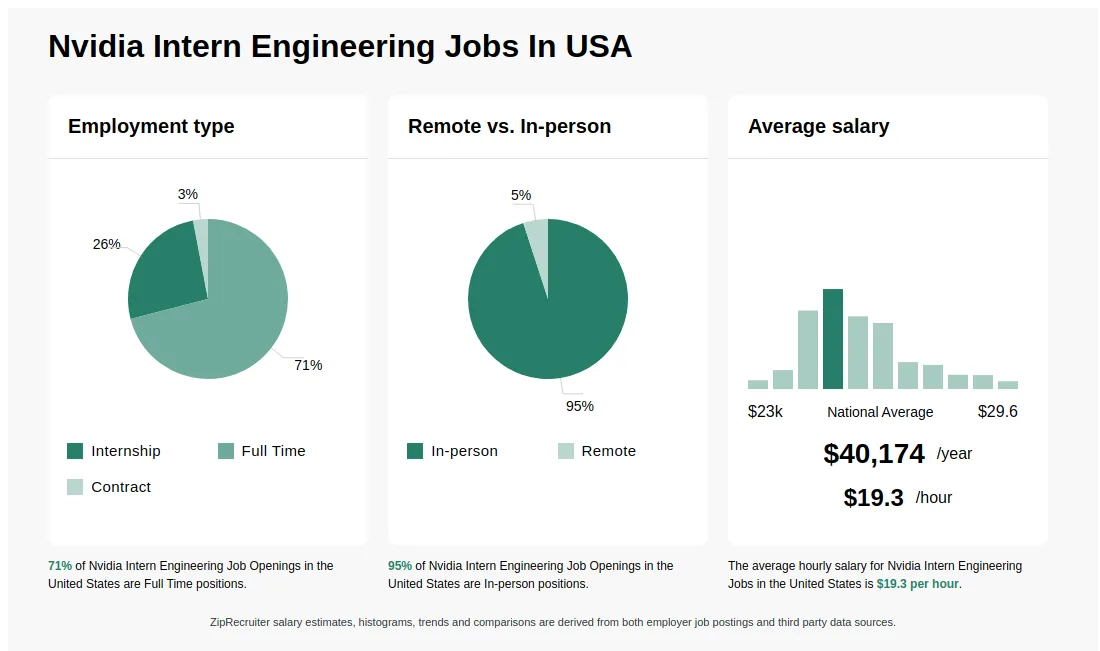
Nvidia Intern Engineering information
See salary details
$11.06 - $12.74
2% of jobs
$12.74 - $14.42
4% of jobs
$16.11 is the 25th percentile. Wages below this are outliers.
$14.42 - $16.11
19% of jobs
$16.11 - $17.79
24% of jobs
The median wage is $17.89 / hr.
$17.79 - $19.47
17% of jobs
$20.48 is the 75th percentile. Wages above this are outliers.
$19.47 - $21.15
16% of jobs
$21.15 - $22.84
6% of jobs
$22.84 - $24.52
5% of jobs
$24.52 - $26.20
3% of jobs
$26.20 - $27.88
3% of jobs
$27.88 - $29.57
1% of jobs
$11
$19
$29
How much do nvidia intern engineering jobs pay per hour?
As of Jun 19, 2026, the average hourly pay for nvidia intern engineering in the United States is $19.31, according to ZipRecruiter salary data. Most workers in this role earn between $16.11 and $20.91 per hour, depending on experience, location, and employer.
What does an Nvidia Engineering Intern do?
An Nvidia Engineering Intern works on real-world projects alongside experienced engineers, contributing to the development of cutting-edge technologies in areas like graphics, AI, and hardware design. Interns may participate in tasks such as coding, debugging, testing, and research, depending on their specific team. The internship is designed to provide hands-on experience, mentorship, and insights into Nvidia’s innovative culture, helping students build valuable technical and professional skills for their future careers.
What types of projects and technologies do Nvidia Engineering Interns typically work on, and how do these experiences contribute to professional development?
As an Nvidia Engineering Intern, you can expect to be involved in hands-on projects that may span areas like GPU architecture, AI research, software development, or hardware validation. Interns often collaborate with experienced engineers, contributing to real-world solutions in fields such as deep learning, computer graphics, and autonomous systems. This exposure helps interns develop technical expertise, teamwork skills, and industry insights, all of which are valuable for future full-time opportunities in high-tech environments.
What are the key skills and qualifications needed to thrive as an Nvidia Engineering Intern, and why are they important?
To thrive as an Nvidia Engineering Intern, you need a solid background in computer science or electrical engineering, strong programming skills (often in C++, Python, or CUDA), and academic coursework or projects related to hardware or software development. Familiarity with development tools, source control systems like Git, and knowledge of GPU architecture or deep learning frameworks is highly valuable. Initiative, teamwork, and effective problem-solving abilities help interns stand out by contributing meaningfully to collaborative projects. These skills and qualities are crucial for adapting quickly to technical challenges and making impactful contributions in a fast-paced, innovation-driven environment.
Job description
Who We Are
Nuro believes self-driving vehicles are the most immediate and profound opportunity for AI to drive positive change in the physical world. Safer streets, more time for what matters, and easier access to the world around us, that's why we're building a universal autonomy platform: self-driving for all roads and all rides.
Founded in 2016, Nuro is a physical AI company developing Level 4 autonomous driving technology for a wide range of vehicles, use cases, and markets. Powered by the Nuro Driver™, our universal autonomy platform enables the global mobility ecosystem to deploy autonomy at scale, from robotaxis and logistics fleets to personal vehicles.
With years of real-world deployment experience and a flexible, partner-led business model, Nuro is working toward a future where millions of autonomous vehicles powered by our technology help make everyday life safer, easier, and more connected.
Nuro has raised over $2B in capital from Uber, NVIDIA, Google, Softbank, Fidelity, T. Rowe Price, and other leading investors.
About the Role
As a software engineering intern, you will work closely with leading experts in the field of machine learning, robotics, and software. Depending on your skill sets and areas of interest, you will work on some or all of the following: Data Platform, Onboard Systems, ML Infrastructure, Simulation, or Technical Infrastructure teams.
About the Work
Depending on your skill set and areas of interest you will work on some or all of the following:
About You
You have deep expertise and prior experience in some or many of the following areas:
At Nuro, we celebrate differences and are committed to a diverse workplace that fosters inclusion and psychological safety for all employees. Nuro is proud to be an equal opportunity employer and expressly prohibits any form of workplace discrimination based on race, color, religion, gender, sexual orientation, gender identity or expression, national origin, age, genetic information, disability, veteran status, or any other legally protected characteristics.
Nuro believes self-driving vehicles are the most immediate and profound opportunity for AI to drive positive change in the physical world. Safer streets, more time for what matters, and easier access to the world around us, that's why we're building a universal autonomy platform: self-driving for all roads and all rides.
Founded in 2016, Nuro is a physical AI company developing Level 4 autonomous driving technology for a wide range of vehicles, use cases, and markets. Powered by the Nuro Driver™, our universal autonomy platform enables the global mobility ecosystem to deploy autonomy at scale, from robotaxis and logistics fleets to personal vehicles.
With years of real-world deployment experience and a flexible, partner-led business model, Nuro is working toward a future where millions of autonomous vehicles powered by our technology help make everyday life safer, easier, and more connected.
Nuro has raised over $2B in capital from Uber, NVIDIA, Google, Softbank, Fidelity, T. Rowe Price, and other leading investors.
About the Role
As a software engineering intern, you will work closely with leading experts in the field of machine learning, robotics, and software. Depending on your skill sets and areas of interest, you will work on some or all of the following: Data Platform, Onboard Systems, ML Infrastructure, Simulation, or Technical Infrastructure teams.
About the Work
Depending on your skill set and areas of interest you will work on some or all of the following:
- Data Platform: The Data Platform serves as a comprehensive management system for Nuro AI Driver's data, labels, and metrics, facilitating seamless access functionality. The team focuses on data annotation across various domains, including 2D/3D perception, mapping, behavior trajectory, and language/text. It also handles data ingestion and mining, employing methods such as heuristics and embedding search. Additionally, the platform supports the autonomy evaluation infrastructure by providing detailed introspection.
- Onboard Systems: Our onboard system team's software engineers provide a reliable and high-performance platform that allows our autonomy teams to integrate their autonomy software and algorithms that work across various self-driving platforms. This work requires close collaboration with our software teams, hardware teams, and systems/safety team to make sure new software and hardware work together safely and reliably and resolve onboard error and performance problems.
- ML Infrastructure: The ML Infra team is the accelerator to our ML-first autonomy strategy. This team provides solutions to empower machine learning development in Nuro and optimize on-cloud training and onboard inference. Our solutions include a distributed training platform, ML compiler, model components libraries, e.t.c. The team provides opportunities for infra engineers to work fully embedded in ML teams to build cutting edge deep learning technologies.
- Simulation: The Simulation team builds the simulator that allows us to develop and test our autonomous driving technology in a virtual setting. We work on the core simulator and simulation frameworks, sensor simulation, scenario generation, and solutions that combine real-world data with synthetic techniques to push the boundaries of what can be simulated, collaborating closely with teams across Autonomy and AI Platform to allow us to simulate realistically and reliably at scale.
- Technical Infrastructure: this group owns few fundamental services for entire engineering organizations: generic compute platform to host mission-critical workflows such as data processing and simulation, storage management service which manages hundreds of PB of data, cloud infrastructure serves as IaaC which provisions and maintains all cloud resources, engineering productivity provides tools such as build and CI/CD to make engineering work more efficient.
About You
You have deep expertise and prior experience in some or many of the following areas:
- You are a current BS or MS candidate in Computer Science, Electrical Engineering, Robotics, or a related field graduating in December 2026 or later
- You have experience in one or more of the following areas: backend API design, applications development, large-scale distributed systems; data storage and processing systems; advanced algorithms using C++ and Python; machine learning, multithreading; x86 architecture; and software performance tuning and optimization, robotics software frameworks, different compute modalities (CPU, GPU, FPGA) etc.
- You have strong problem solving and programming skills.
At Nuro, we celebrate differences and are committed to a diverse workplace that fosters inclusion and psychological safety for all employees. Nuro is proud to be an equal opportunity employer and expressly prohibits any form of workplace discrimination based on race, color, religion, gender, sexual orientation, gender identity or expression, national origin, age, genetic information, disability, veteran status, or any other legally protected characteristics.

About nuro
Sourced by ZipRecruiter
Industry
Motor vehicle manufacturing
Company size
11 - 50 Employees
Headquarters location
Mountain View, CA, US
Year founded
2016