Responsibilities: • Support implementation and compliance activities for arms control treaties ... CWC) - Nuclear Non-Proliferation Treaty (NPT) • Experience with compliance reporting systems ...
Responsibilities: • Support implementation and compliance activities for arms control treaties ... CWC) - Nuclear Non-Proliferation Treaty (NPT) • Experience with compliance reporting systems ...
Responsibilities * Support implementation and compliance activities for arms control treaties ... Nuclear Non-Proliferation Treaty (NPT) * Experience with compliance reporting systems including ...
Responsibilities * Support implementation and compliance activities for arms control treaties ... Nuclear Non-Proliferation Treaty (NPT) * Experience with compliance reporting systems including ...
International Nuclear Safeguards Engagement - Program Analyst
Alexandria, VA · On-site
$110K - $150K/yr
... Arms Control Office. Supporting U.S. national security objectives and the Treaty on the Non-Proliferation of Nuclear Weapons (NPT), the incumbent manages a diverse portfolio of global safeguards and ...
Quick apply
International Nuclear Safeguards Engagement - Program Analyst
Alexandria, VA · On-site
$110K - $150K/yr
... Arms Control Office. Supporting U.S. national security objectives and the Treaty on the Non-Proliferation of Nuclear Weapons (NPT), the incumbent manages a diverse portfolio of global safeguards and ...
Coordinate support across strategic deterrence, CWMD, NC3, arms control, and IAMD mission areas ... Experience supporting nuclear enterprise or strategic deterrence missions
Coordinate support across strategic deterrence, CWMD, NC3, arms control, and IAMD mission areas ... Experience supporting nuclear enterprise or strategic deterrence missions
... arms control, and IAMD mission areas • Provide executive-level briefings and status reports • ... nuclear enterprise or strategic deterrence missions
... arms control, and IAMD mission areas • Provide executive-level briefings and status reports • ... nuclear enterprise or strategic deterrence missions

XLab Nuclear Program Lead
Chicago, IL · On-site
Prior work experience in nuclear-risk research, arms control, nuclear policy, national security policy, or a closely related field. * Experience planning and running high-profile convenings ...
XLab Nuclear Program Lead
Chicago, IL · On-site
Prior work experience in nuclear-risk research, arms control, nuclear policy, national security policy, or a closely related field. * Experience planning and running high-profile convenings ...
Coordinate support across strategic deterrence, CWMD, NC3, arms control, and IAMD mission areas ... Experience supporting nuclear enterprise or strategic deterrence missions
Coordinate support across strategic deterrence, CWMD, NC3, arms control, and IAMD mission areas ... Experience supporting nuclear enterprise or strategic deterrence missions
Prior work experience in nuclear-risk research, arms control, nuclear policy, national security policy, or a closely related field. * Experience planning and running high-profile convenings ...
Prior work experience in nuclear-risk research, arms control, nuclear policy, national security policy, or a closely related field. * Experience planning and running high-profile convenings ...

Program Analyst
Washington, DC · On-site
$87K - $107K/yr
Conduct coordination with other offices within the Office of Nonproliferation and Arms Control ... nuclear security, emergency response training/management, and mission and program support. MELE ...
Quick apply
Program Analyst
Washington, DC · On-site
$87K - $107K/yr
Conduct coordination with other offices within the Office of Nonproliferation and Arms Control ... nuclear security, emergency response training/management, and mission and program support. MELE ...
Research and Program Associate, Nuclear Information Project
Washington, DC · On-site
$62K - $68K/yr
Knowledge of core issues related to nuclear weapons, non-proliferation, arms control, and disarmament. * The ability to travel to support research, policy, or programmatic goals. * Competency with ...
Quick apply
Research and Program Associate, Nuclear Information Project
Washington, DC · On-site
$62K - $68K/yr
Knowledge of core issues related to nuclear weapons, non-proliferation, arms control, and disarmament. * The ability to travel to support research, policy, or programmatic goals. * Competency with ...
Research and Program Associate, Nuclear Information Project
Washington, DC · On-site
$62K - $68K/yr
Knowledge of core issues related to nuclear weapons, non-proliferation, arms control, and disarmament. * The ability to travel to support research, policy, or programmatic goals. * Competency with ...
Research and Program Associate, Nuclear Information Project
Washington, DC · On-site
$62K - $68K/yr
Knowledge of core issues related to nuclear weapons, non-proliferation, arms control, and disarmament. * The ability to travel to support research, policy, or programmatic goals. * Competency with ...
Nuclear Medicine Technologist Location: Not specified Assignment Duration: This is a 13-week ... Ensure quality control of imaging equipment. * Maintain accurate patient records and documentation.
Nuclear Medicine Technologist Location: Not specified Assignment Duration: This is a 13-week ... Ensure quality control of imaging equipment. * Maintain accurate patient records and documentation.

Foreign Affairs Officer
Washington, DC · On-site
$143K/yr
These positions are located in the Bureau of Arms Control and Nonproliferation; Office of Nuclear Energy, Safety, and Security (ACN/NESS). ACN/NESS is responsible for policy development, negotiation ...
Foreign Affairs Officer
Washington, DC · On-site
$143K/yr
These positions are located in the Bureau of Arms Control and Nonproliferation; Office of Nuclear Energy, Safety, and Security (ACN/NESS). ACN/NESS is responsible for policy development, negotiation ...
Maintain imaging equipment and ensure quality control. * Document and report findings accurately and timely. Required Experience / Certifications / Licensure * Current state licensure as a Nuclear ...
Maintain imaging equipment and ensure quality control. * Document and report findings accurately and timely. Required Experience / Certifications / Licensure * Current state licensure as a Nuclear ...

... preparation, quality control, dispensing, dose calibration, administration, and disposal of ... and arms; stoop, kneel, crouch or crawl; and push or pull. Must regularly lift and/or move up to ...
... preparation, quality control, dispensing, dose calibration, administration, and disposal of ... and arms; stoop, kneel, crouch or crawl; and push or pull. Must regularly lift and/or move up to ...
Nuclear Medicine Technologist Location: Rochester, NY Assignment Duration: This is a 13-week ... Perform daily quality control and maintain radio pharmacy operations while adhering to NYSDOH ...
Nuclear Medicine Technologist Location: Rochester, NY Assignment Duration: This is a 13-week ... Perform daily quality control and maintain radio pharmacy operations while adhering to NYSDOH ...
Nuclear Medicine Technologist
Columbus, IN · On-site
$37.68/hr
... preparation, quality control, dispensing, dose calibration, administration, and disposal of ... and arms; stoop, kneel, crouch or crawl; and push or pull. Must regularly lift and/or move up to ...
Nuclear Medicine Technologist
Columbus, IN · On-site
$37.68/hr
... preparation, quality control, dispensing, dose calibration, administration, and disposal of ... and arms; stoop, kneel, crouch or crawl; and push or pull. Must regularly lift and/or move up to ...
Nuclear Medicine Technologist
Columbus, IN · On-site
$37.68/hr
... preparation, quality control, dispensing, dose calibration, administration, and disposal of ... and arms; stoop, kneel, crouch or crawl; and push or pull. Must regularly lift and/or move up to ...
Nuclear Medicine Technologist
Columbus, IN · On-site
$37.68/hr
... preparation, quality control, dispensing, dose calibration, administration, and disposal of ... and arms; stoop, kneel, crouch or crawl; and push or pull. Must regularly lift and/or move up to ...
... preparation, quality control, dispensing, dose calibration, administration, and disposal of ... and arms; stoop, kneel, crouch or crawl; and push or pull. Must regularly lift and/or move up to ...
... preparation, quality control, dispensing, dose calibration, administration, and disposal of ... and arms; stoop, kneel, crouch or crawl; and push or pull. Must regularly lift and/or move up to ...

Nuclear Weapons SME
Washington, DC · On-site +1
... control, gained through government, defense, intelligence, or national laboratory experience ... arms; talk and hear. Most positions require ability to work on desktop or laptop computer for ...
Nuclear Weapons SME
Washington, DC · On-site +1
... control, gained through government, defense, intelligence, or national laboratory experience ... arms; talk and hear. Most positions require ability to work on desktop or laptop computer for ...
Nuclear Arms Control information
See salary details
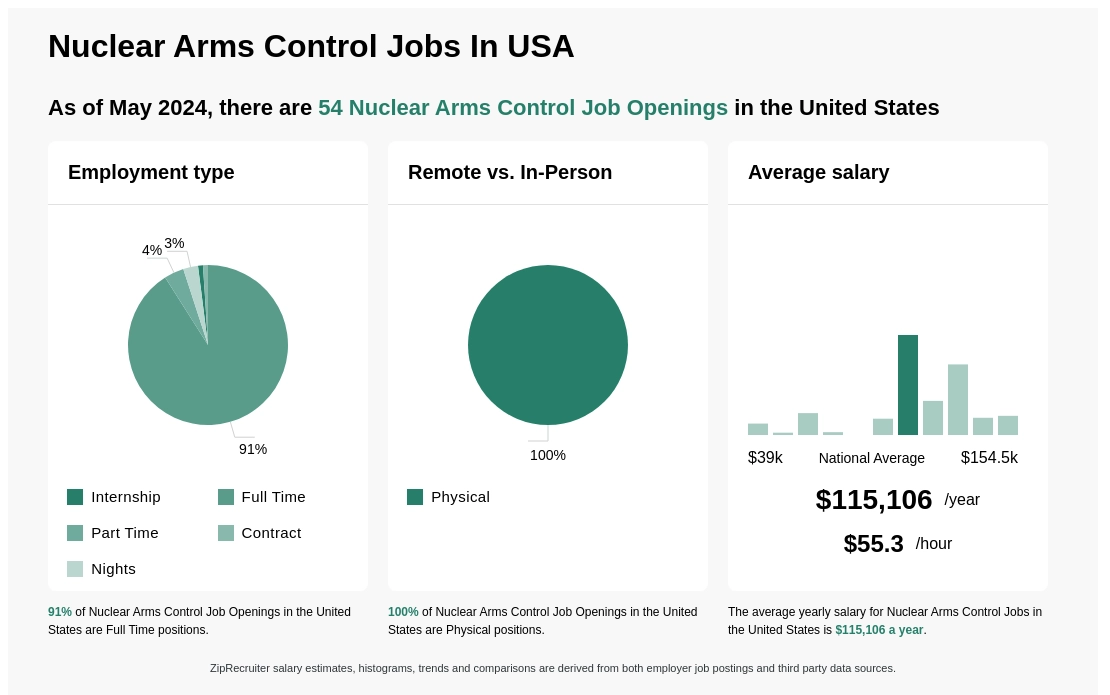
$39K - $49.5K
3% of jobs
$49.5K - $60K
0% of jobs
$60K - $70.5K
8% of jobs
$70.5K - $81K
0% of jobs
$81K - $91.5K
0% of jobs
$91.5K - $102K
5% of jobs
$104.6K is the 25th percentile. Wages below this are outliers.
$102K - $112.5K
35% of jobs
$112.5K - $123K
12% of jobs
$127.9K is the 75th percentile. Wages above this are outliers.
$123K - $133.5K
25% of jobs
$133.5K - $144K
5% of jobs
$144K - $154.5K
6% of jobs
$39K
$115.1K
$154.5K
How much do nuclear arms control jobs pay per year?
As of Jun 8, 2026, the average yearly pay for nuclear arms control in the United States is $115,106.00, according to ZipRecruiter salary data. Most workers in this role earn between $109,500.00 and $131,000.00 per year, depending on experience, location, and employer.
What is nuclear arms control?
Nuclear arms control refers to international agreements and diplomatic efforts aimed at limiting the development, testing, production, deployment, and stockpiling of nuclear weapons. The goal is to reduce the risk of nuclear conflict and promote global security and stability. Arms control treaties, such as the Treaty on the Non-Proliferation of Nuclear Weapons (NPT) and the New START Treaty, are examples of such efforts. These agreements typically include verification measures, mutual inspections, and caps on the number and types of nuclear weapons countries may possess.
What is the difference between Nuclear Arms Control vs Nuclear Policy Analyst?
| Aspect | Nuclear Arms Control | Nuclear Policy Analyst |
|---|---|---|
| Required Credentials | Advanced degrees in international relations, security studies, or related fields; security clearances | Degrees in political science, international relations, or policy; often security clearance |
| Work Environment | Government agencies, international organizations, think tanks | Government departments, research institutions, think tanks |
| Industry Usage | Focuses on treaties, disarmament, verification | Analyzes policies, develops strategies, advises on nuclear issues |
While both roles involve nuclear issues, Nuclear Arms Control primarily focuses on treaty implementation and disarmament efforts, whereas Nuclear Policy Analysts analyze and develop policies related to nuclear security and strategy. Both careers require similar educational backgrounds and often work within government or research settings, but their core responsibilities differ in scope and focus.
What are some common challenges faced by professionals working in nuclear arms control, and how can they be addressed?
Professionals in nuclear arms control often encounter challenges such as navigating complex international treaties, staying updated on evolving technologies, and managing sensitive diplomatic negotiations. Addressing these challenges requires strong analytical skills, a deep understanding of global security issues, and the ability to work collaboratively with multidisciplinary teams, including scientists, diplomats, and policymakers. Continuous education, attending international conferences, and engaging in cross-sector networking can also help professionals stay informed and effective in their roles.
What are the key skills and qualifications needed to thrive in Nuclear Arms Control, and why are they important?
To thrive in Nuclear Arms Control, you need a strong background in international relations, political science, or security studies, often supported by an advanced degree and knowledge of nonproliferation treaties. Familiarity with technical verification tools, treaty monitoring systems, and data analysis software is typically required. Exceptional analytical thinking, negotiation skills, and cross-cultural communication abilities help professionals excel in sensitive diplomatic environments. These skills and qualities are vital for ensuring global security, fostering international cooperation, and effectively implementing arms control agreements.

International Treaties & Agreements SME - 1919 with Security Clearance
Strategic Technology Institute Inc (STi)Washington, DC
Other
Posted 17 days ago
Job description
International Treaties & Agreements SME
Location: Washington, DC / CONUS & OCONUS Support
Clearance: Active TS/SCI Required
*Contingent on Contract Award Overview:
STi is seeking an International Treaties & Agreements SME to support DAF/A10 strategic deterrence and arms control missions. The selected candidate will provide subject matter expertise supporting treaty implementation, compliance, policy analysis, inspections, and interagency coordination. Responsibilities:
• Support implementation and compliance activities for arms control treaties
• Analyze treaty impacts on Air Force operations and modernization programs
• Develop policy recommendations, white papers, briefings, and reports
• Support inspections, exercises, and treaty readiness activities
• Coordinate with MAJCOMs, DoD, Joint Staff, and interagency stakeholders
• Provide analytical support for proposed and in-force treaties Required Qualifications:
• Demonstrated expertise with treaties such as: - New START - Chemical Weapons Convention (CWC) - Nuclear Non-Proliferation Treaty (NPT)
• Experience with compliance reporting systems including ACES
• Experience supporting treaty inspections and verification activities
• Strong policy analysis and strategic planning background Preferred Qualifications:
• Prior arms control or strategic deterrence experience
• Experience supporting Air Force or interagency treaty programs
Location: Washington, DC / CONUS & OCONUS Support
Clearance: Active TS/SCI Required
*Contingent on Contract Award Overview:
STi is seeking an International Treaties & Agreements SME to support DAF/A10 strategic deterrence and arms control missions. The selected candidate will provide subject matter expertise supporting treaty implementation, compliance, policy analysis, inspections, and interagency coordination. Responsibilities:
• Support implementation and compliance activities for arms control treaties
• Analyze treaty impacts on Air Force operations and modernization programs
• Develop policy recommendations, white papers, briefings, and reports
• Support inspections, exercises, and treaty readiness activities
• Coordinate with MAJCOMs, DoD, Joint Staff, and interagency stakeholders
• Provide analytical support for proposed and in-force treaties Required Qualifications:
• Demonstrated expertise with treaties such as: - New START - Chemical Weapons Convention (CWC) - Nuclear Non-Proliferation Treaty (NPT)
• Experience with compliance reporting systems including ACES
• Experience supporting treaty inspections and verification activities
• Strong policy analysis and strategic planning background Preferred Qualifications:
• Prior arms control or strategic deterrence experience
• Experience supporting Air Force or interagency treaty programs

About STRATEGIC TECHNOLOGY INSTITUTE
Sourced by ZipRecruiter
Industry
Aerospace product and parts manufacturing
Company size
51 - 200 Employees
Headquarters location
Rockville, MD, US
Year founded
1985