1

Nasa Systems Engineer Jobs (NOW HIRING)

Job Summary We are seeking a highly motivated and detail-oriented Systems Analyst to support engineering and technology programs at NASA's Marshall Space Flight Center. The ideal candidate will work ...

Aerospace Cybersecurity Engineer Systems Engineer IV NASA Glenn Research Center Brook Park, Ohio HX5 is an award-winning provider of engineering, research and development, and technical services to ...

Systems Engineer

San Diego, CA · On-site

$90K - $120K/yr

Familiarity with INCOSE and NASA Systems Engineering Handbook. * Competent in a programming/scripting language for use in automating data processing, test execution, reporting, and other related ...

Familiarity with NASA Systems Engineering policies and procedures. * Familiarity with aerospace vehicles and system design. * Experience with defining and managing interfaces, interface requirements ...

Familiarity with NASA Systems Engineering policies and procedures. * Familiarity with aerospace vehicle and system design. * Experience with defining and managing interfaces, interface requirements ...

Showing results 21-40

Nasa Systems Engineer information

See salary details

$53.5K

$127.2K

$167K

How much do nasa systems engineer jobs pay per year?

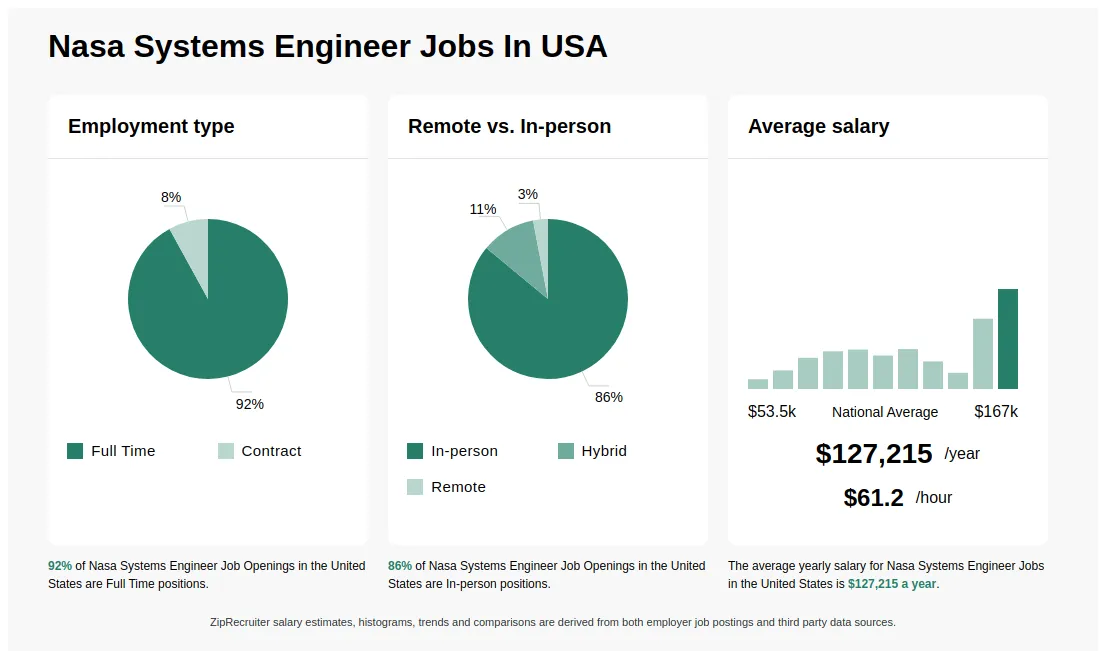
As of Sep 12, 2026, the average yearly pay for nasa systems engineer in the United States is $127,215.00, according to ZipRecruiter salary data. Most workers in this role earn between $98,000.00 and $157,000.00 per year, depending on experience, location, and employer.

What does a NASA Systems Engineer do?

A NASA Systems Engineer designs, develops, and integrates complex systems used in space missions, satellites, and aerospace technology. They ensure different components work together by managing requirements, testing, risk assessment, and troubleshooting. Their role involves collaboration with scientists, engineers, and mission planners to achieve mission objectives. Systems Engineers also address challenges like reliability, safety, and performance in extreme space environments.

What are the key skills and qualifications needed to thrive as a NASA Systems Engineer?

To thrive as a NASA Systems Engineer, you need a strong background in systems engineering principles, aerospace or mechanical engineering, and typically a relevant bachelor's or master's degree. Familiarity with engineering tools like MATLAB, DOORS, SysML, and experience in requirements management and systems integration are often required, along with certifications such as INCOSE CSEP being beneficial. Exceptional problem-solving, collaboration, and communication skills are vital for working on interdisciplinary teams and addressing complex technical challenges. These skills and qualifications ensure seamless design, integration, and operation of high-stakes aerospace systems fundamental to NASA's mission success.

What does a typical day look like for a NASA Systems Engineer?

A typical day for a NASA Systems Engineer involves coordinating with multidisciplinary teams to define requirements, troubleshoot technical issues, and ensure all system components function together seamlessly. You may participate in design reviews, manage documentation, analyze test data, and provide input during integration and verification activities. The role often includes balancing competing technical constraints and collaborating closely with project managers, scientists, and other engineering specialists. This dynamic environment requires adaptability and effective communication, making each day both challenging and rewarding.

Does NASA hire systems engineers?

Yes, NASA hires systems engineers to develop, integrate, and manage complex aerospace systems. These roles often require a background in engineering, proficiency with systems modeling tools, and security clearances. Systems engineers at NASA work on projects related to space exploration, satellite technology, and mission operations.
More about Nasa Systems Engineer jobs

What cities are hiring for Nasa Systems Engineer jobs?

Cities with the most Nasa Systems Engineer job openings:

What are the most commonly searched types of Nasa Systems Engineer jobs?

The most popular types of Nasa Systems Engineer jobs are:

What states have the most Nasa Systems Engineer jobs?

States with the most job openings for Nasa Systems Engineer jobs include:

What are popular job titles related to Nasa Systems Engineer jobs?

For Nasa Systems Engineer jobs, the most frequently searched job titles are:

Infographic showing various Nasa Systems Engineer job openings in the United States as of September 2026, with employment types broken down into 1% Internship, 1% As Needed, 84% Full Time, 10% Part Time, 3% Contract, and 1% Nights. Highlights an 86% Physical, 2% Hybrid, and 12% Remote job distribution, with an average salary of $127,215 per year, or $61.2 per hour.

Senior Staff Crew Systems Engineer - Crew Systems IPT Lead

Arvada, CO • On-site

Lunar Outpost
Aerospace Product and Parts Manufacturing • 11 - 50 employees

$107K - $146K/yr

Full-time

Medical, Dental, Vision, Retirement, PTO

Re-posted 5 days ago


Job description

Are you passionate about shaping the future of humanity's presence in space? Lunar Outpost, an industry leader in space robotics and planetary vehicles, invites you to join our team! Lunar Outpost is dedicated to creating a permanent presence in space, while also driving positive impacts here on Earth. We are currently seeking a Senior Staff Crew Systems Engineer - Crew Systems IPT to contribute to our mission in a dynamic startup environment. As Crew Systems IPT Lead, this role would lead the development and integration of human-facing systems for a NASA Class A human spaceflight program. This position combines work at the forefront of commercial spaceflight with excellence in human spaceflight through delivery of a safe, reliable, and capable system for the lunar surface. As the Crew Systems IPT Lead, you will oversee a cross-functional team responsible for the end-to-end design, integration, and delivery of crew accommodations and interfaces. You will collaborate closely with human spaceflight stakeholders from NASA and the commercial industry, Lunar Dawn engineering teams across multiple disciplines, and subcontractors/suppliers to ensure that the LTVS solution meets rigorous human-rating and certification requirements.


Take the #NextLeap with Lunar Outpost and work on the Pegasus LTV, which will carry NASA astronauts farther than they've ever been before on the lunar surface!  


 Key Responsibilities: 

  • Serve as the technical and programmatic leader for the Crew Systems Integrated Product Team, accountable for performance, cost, and schedule
  • Lead the development of Crew System hardware and software, including (but not limited to): displays and controls, seating and restraints, lighting, stowage, ingress/egress systems, and human-machine interfaces 
  • Collaborate closely and extensively with human spaceflight customers at NASA, across numerous human-related offices, to ensure a satisfactory Crew Systems solution 
  • Ensure compliance with all applicable NASA Class-A requirements, including human systems integration, safety, and certification standards 
  • Contribute to the definition and management of requirements, interfaces, and verification plans across internal and external stakeholders
  • Coordinate technical work across mechanical, electrical, software, thermal, safety, and systems engineering disciplines
  • Own the integration and validation of crew systems through design reviews, ground testing, and flight readiness milestones (e.g., CDR, FRR)
  • Support the development and delivery of training, procedures, and flight products related to crew system usage
  • Champion a culture of safety, innovation, and mission success 


Required Qualifications: 

  • Bachelor’s degree in aerospace, industrial, biomedical, or related fields of engineering or science 
  • Minimum of 11 years of experience in aerospace systems development, including 5+ years in technical leadership roles 
  • Demonstrated experience developing and integrating complex, human-rated systems 
  • Strong leadership, project management, and communication skills 
  • Familiarity with NASA systems engineering processes and human spaceflight certification requirements 
  • Able to simultaneously govern multiple, disparate tasks 
  • Able to operate under notable pressure within tight timelines 
  • Self-motivated, focused, and driven to meet critical deadlines 
  • Excellent organization and time management skills 
  • Excellent written and oral communication skills 
  • U.S. Person  


Preferred Qualifications: 

  • Master’s degree in an engineering or management discipline 
  • Experience supporting ISS, Artemis, Commercial Crew, or similar Class A human spaceflight programs 
  • Working knowledge of NASA-STD-3001 Vol 1 & 2, JSC 20793, or related human systems standards 
  • Experience with MBSE tools (e.g., Cameo, SysML) and digital engineering workflows 
  • Experience working in a fast-paced, agile environment with a startup or commercial aerospace culture 
  • PMP, INCOSE CSEP, or equivalent certification 


Compensation & Benefits: Compensation level and base salary are competitively structured and thoughtfully determined based on factors such as relevant skills, experience, education, and the scope of the role.

  • Comprehensive health coverage: Medical, dental, and vision benefits, with 70% of premiums covered by the employer
  • Paid time off: Three (3) weeks per year of vacation
  • Retirement plan: Up to 4% employer match on 401(k) contributions
  • Paid holidays: 11 company-recognized holidays
  • Parental leave
  • Educational reimbursement opportunities to support company objectives, continued learning, and career development

Lunar Outpost Inc. is an equal opportunity employer. Lunar Outpost Inc. does not discriminate on the basis of race, color, religion, sex (including pregnancy, sexual orientation, and gender identity), national origin, ethnicity, age, disability, veteran status, genetic information, or any other characteristic protected by applicable law. All employees, including executives and human resources personnel, are expected to conduct themselves with professionalism and treat others with dignity and respect in accordance with this policy.