1

Nasa Chemistry Jobs (NOW HIRING)

Program Manager

Lancaster, CA · On-site

$100 - $125/hr

NASA-STD-6016 / NASA-STD-5008 * Experience in cleanroom operations (ISO Class 5-8 environments) * Background in materials, surface chemistry, or contamination engineering Equal Employment Opportunity ...

$80 - $100/hr

AMA supports NASA Armstrong Flight Research Center (AFRC) on a variety of cutting edge and high ... Chemistry, or Physics) or Technology (Electronics Technology, Computer Science, Human Factors ...

New

Showing results 21-40

Nasa Chemistry information

See salary details

$17

$30

$52

How much do nasa chemistry jobs pay per hour?

As of Sep 7, 2026, the average hourly pay for nasa chemistry in the United States is $30.99, according to ZipRecruiter salary data. Most workers in this role earn between $24.04 and $35.58 per hour, depending on experience, location, and employer.

What is a NASA chemistry?

A NASA Chemistry job involves applying chemical principles to space exploration, materials science, and planetary research. Chemists at NASA work on developing new materials for spacecraft, analyzing extraterrestrial samples, studying chemical processes in space, and supporting life support systems. They collaborate with engineers, physicists, and biologists to solve challenges related to space travel and planetary exploration. Their work can involve laboratory research, computational modeling, and field studies to enhance our understanding of chemistry in space environments.

What are the typical responsibilities of a chemist working at NASA?

As a chemist at NASA, your responsibilities may include conducting laboratory experiments to analyze materials for spacecraft, supporting research in astrobiology and planetary science, and developing new chemical processes relevant to space exploration. You will often collaborate with engineers, biologists, and physicists to design and interpret experiments that support mission objectives. Daily activities can range from preparing samples and maintaining analytical equipment to presenting findings at meetings or conferences. This multidisciplinary work environment provides unique opportunities to contribute to groundbreaking projects and fosters both professional growth and continuous learning.

What are the key skills and qualifications needed to thrive in the NASA chemistry position, and why are they important?

To excel in a NASA Chemistry role, candidates typically need a strong background in chemistry, analytical techniques, laboratory research, and a relevant degree such as a BS, MS, or PhD in chemistry or a related field. Experience with advanced instrumentation (such as mass spectrometers or gas chromatographs), knowledge of laboratory safety protocols, and familiarity with data analysis software are often required. Strong problem-solving skills, attention to detail, collaboration, and effective communication are vital soft skills in interdisciplinary STEM environments. These skills and qualities are essential to ensure high-quality research, innovation, and safe, accurate results within NASA's complex scientific projects.


Can you get into NASA with a chemistry degree?

NASA employs chemists in roles related to materials science, chemical analysis, and environmental testing. A chemistry degree combined with laboratory skills, research experience, and often additional training or security clearances can improve chances of employment at NASA in scientific or engineering positions.

Does NASA hire chemists?

Yes, NASA hires chemists for roles involving research in space science, materials, and chemical analysis. These positions often require a background in chemistry, laboratory skills, and sometimes security clearances, with opportunities available through federal job portals and NASA's career website.
More about Nasa Chemistry jobs

What cities are hiring for Nasa Chemistry jobs?

Cities with the most Nasa Chemistry job openings:

What are the most commonly searched types of Nasa Chemistry jobs?

The most popular types of Nasa Chemistry jobs are:

What states have the most Nasa Chemistry jobs?

States with the most job openings for Nasa Chemistry jobs include:

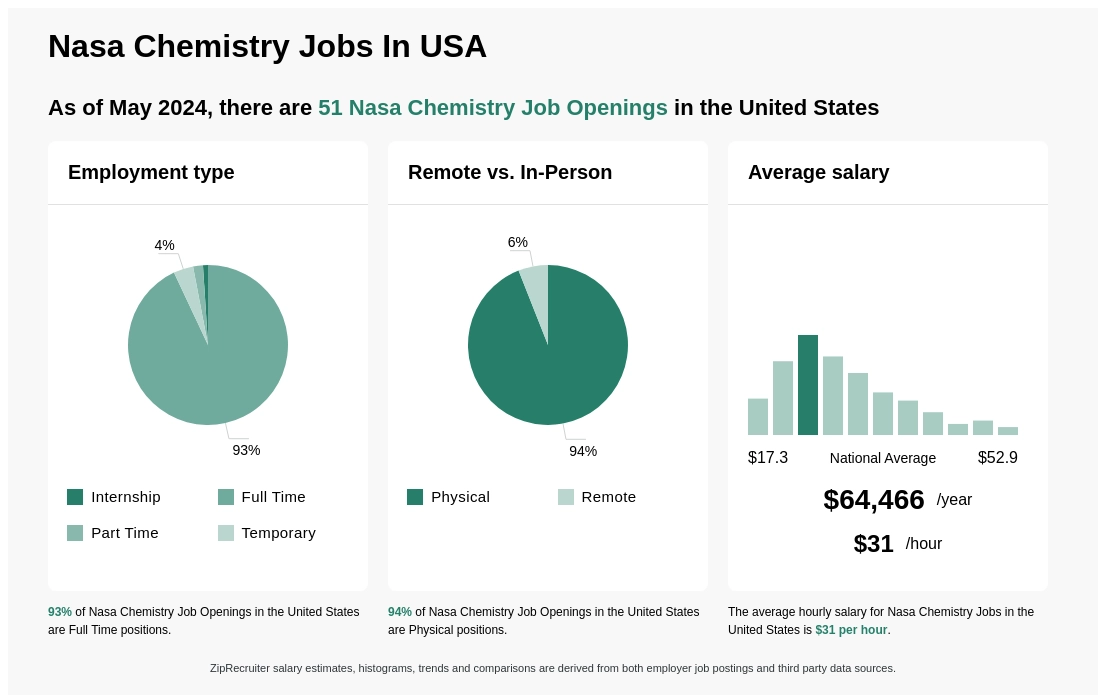
Infographic showing various Nasa Chemistry job openings in the United States as of August 2026, with employment types broken down into 100% Full Time. Highlights an 100% In-person job distribution, with an average salary of $64,466 per year, or $31 per hour.

$125K/yr

Full-time

Posted 7 days ago


Job description

As Regional Restoration Project Manager within NASA's Office of Strategic Infrastructure, you will lead environmental restoration efforts across multiple NASA Centers. You'll provide technical leadership, guide regulatory strategies, and oversee cleanup projects addressing diverse contaminants and remediation challenges. In this role, you'll help protect NASA's infrastructure, and promote environmental stewardship and mission readiness while shaping restoration priorities across the Agency.Qualifications:Specialized experience is experience that has equipped you with the particular ability, skill, and knowledge to successfully perform the duties of this position and is typically in or related to this line of work.
To qualify for GS-14, you must have one year of directly related specialized experience equivalent to the GS-13 level:
  • Managing complex environmental restoration or remediation projects involving contaminated sites, hazardous substances, or hazardous waste;
  • Applying federal and state environmental laws and regulations, such as the Comprehensive Environmental Response, Compensation, and Liability Act of 1980 (CERCLA) or Resource Conservation and Recovery Act of 1976 (RCRA), to develop and implement cleanup strategies and ensure regulatory compliance;
  • Providing technical leadership and coordinating with regulatory agencies and multiple stakeholders to resolve complex restoration issues, manage project risks, and achieve cleanup or compliance milestones.

Your resume must include a clear and detailed narrative description, in your own words, of how you meet the required specialized experience. Experience statements copied from a position description, vacancy announcement or other reference material constitutes plagiarism and may result in disqualification and losing consideration for the job.
Please visit https://www.nasa.gov/careers/how-to-apply/#Artificial-Intelligence to review NASA's guidance on the use of artificial intelligent (AI) or AI-assisted tools during the application process.Education:Basic Requirement:
You must have successfully completed a full 4-year course of study in an accredited college or university leading to a bachelor's or higher degree that included a major in engineering. To be acceptable, the program must: (1) lead to a bachelor's degree in a school of engineering with at least one program accredited by ABET; or (2) include differential and integral calculus and courses (more advanced than first-year physics and chemistry) in five of the following seven areas of engineering science or physics: (a) statics, dynamics; (b) strength of materials (stress-strain relationships); (c) fluid mechanics, hydraulics; (d) thermodynamics; (e) electrical fields and circuits; (f) nature and properties of materials (relating particle and aggregate structure to properties); and (g) any other comparable area of fundamental engineering science or physics, such as optics, heat transfer, soil mechanics, or electronics
OR
Have a combination of education and experience: college-level education, training, and/or technical experience that furnished (1) a thorough knowledge of the physical and mathematical sciences underlying engineering, and (2) a good understanding, both theoretical and practical, of the engineering sciences and techniques and their applications to one of the branches of engineering.
The adequacy of such background must be demonstrated by one of the following:
  1. Professional registration or licensure -- Current registration as an Engineer Intern (EI), Engineer in Training (EIT), or licensure as a Professional Engineer (PE) by any State, the District of Columbia, Guam, or Puerto Rico. Absent other means of qualifying under this standard, those individuals who achieved such registration by means other than written test (e.g., State grandfather or eminence provisions) are eligible only for positions that are within or closely related to the specialty field of their registration. For example, an individual who attains registration through a State Board's eminence provision as a manufacturing engineer typically would be rated eligible only for manufacturing engineering positions.
  2. Written Test -- Evidence of having successfully passed the Fundamentals of Engineering (FE) examination or any other written test required for professional.
  3. Specified academic courses -- Successful completion of at least 60 semester hours of courses in the physical, mathematical, and engineering sciences and that included the courses specified in the basic requirements.
  4. Related curriculum -- Successful completion of a curriculum leading to a bachelor's degree in an appropriate scientific field, e.g., engineering technology, physics, chemistry, architecture, computer science, mathematics, hydrology, or geology, may be accepted in lieu of a bachelor's degree in engineering, provided you have had at least 1 year of professional engineering experience acquired under professional engineering supervision and guidance. Ordinarily there should be either an established plan of intensive training to develop professional engineering competence, or several years of prior professional engineering-type experience. (The above examples of related curricula are not all inclusive.)

U.S. degrees must have been awarded from colleges or universities that are accredited by recognized accrediting organizations. For a list of schools that meet this criteria, go to http://ope.ed.gov/accreditation/.
If you are using education completed in foreign colleges or universities to meet the qualification requirements, you must show that the education credentials have been evaluated by a private organization that specializes in interpretation of foreign education programs. These education credentials must be deemed equivalent to that gained in an accredited U.S. education program; or full credit has been given for the courses at a U.S. accredited college or university. For further information, visit: https://sites.ed.gov/international/recognition-of-foreign-qualifications/.
All degrees must have been received in the year of, or any year subsequent to the original date of accreditation.Employment Type: OTHER