1

Microsoft Quantum Computing Jobs (NOW HIRING)

Test Engineer About Us Quantum Computing Inc. (QCi) (Nasdaq: QUBT) is an innovative, integrated ... A good working knowledge of Microsoft SQL Server, Python, LabView, and other test software ...

EHS Director About Us Quantum Computing Inc. (QCi) (Nasdaq: QUBT) is an innovative, integrated ... Proficiency with Microsoft Office Suite and EHS management software Preferred Qualifications * 2-3 ...

Showing results 41-60

Microsoft Quantum Computing information

See salary details

$12

$21

$30

How much do microsoft quantum computing jobs pay per hour?

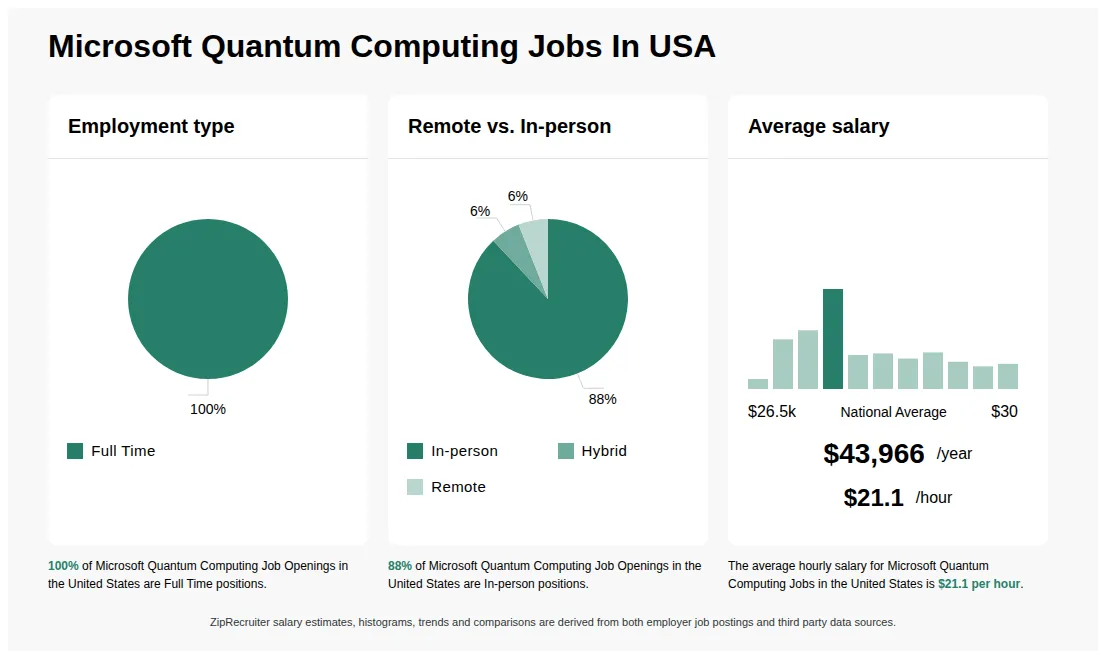
As of Aug 12, 2026, the average hourly pay for microsoft quantum computing in the United States is $21.14, according to ZipRecruiter salary data. Most workers in this role earn between $17.31 and $25.00 per hour, depending on experience, location, and employer.

What are some common challenges faced by professionals working in Microsoft Quantum Computing, and how can new hires prepare for them?

Professionals in Microsoft Quantum Computing often encounter challenges such as staying current with rapidly evolving quantum algorithms, integrating quantum solutions with classical computing systems, and collaborating across multidisciplinary teams. New hires can prepare by developing strong foundational knowledge in both quantum theory and software development, as well as honing communication skills to effectively work with physicists, engineers, and software developers. Being proactive in continuous learning and seeking mentorship within the team can also help overcome the steep learning curve and foster successful collaboration.

What is the difference between Microsoft Quantum Computing vs Quantum Software Engineer?

AspectMicrosoft Quantum ComputingQuantum Software Engineer
Required CredentialsAdvanced degrees in physics, computer science, or related fields; knowledge of quantum mechanics and programming languages like Q#Degree in computer science, software engineering, or related fields; programming skills in Python, C++, and quantum SDKs
Work EnvironmentResearch labs, tech companies, and academia focusing on quantum hardware and software developmentTech companies, startups, or research institutions developing quantum algorithms and applications
Employer & Industry UsagePrimarily in tech giants like Microsoft, IBM, Google, and academiaIn tech firms, startups, and research organizations working on quantum software solutions

Microsoft Quantum Computing focuses on developing quantum hardware and software platforms, requiring deep knowledge of quantum physics and specialized programming. Quantum Software Engineers design and implement quantum algorithms, often using similar programming languages and tools. Both roles overlap in skills and industry but differ in their primary focus—hardware versus software development.

What is a Microsoft Quantum Computing engineer?

A Microsoft Quantum Computing engineer is a professional who develops and implements quantum algorithms, software, and hardware solutions using Microsoft's quantum computing platforms, such as Azure Quantum. They work on advancing the field of quantum computing by designing new quantum circuits, optimizing existing algorithms, and collaborating with researchers and developers. These engineers often use languages like Q# and work with both theoretical and practical aspects of quantum computing to solve complex problems that are challenging for classical computers.

What are the key skills and qualifications needed to thrive in Microsoft Quantum Computing roles?

To thrive in Microsoft Quantum Computing, you need a strong background in quantum physics, computer science, and mathematics, often supported by an advanced degree in a related field. Familiarity with quantum programming languages like Q#, experience with quantum development kits, and knowledge of cloud platforms such as Azure Quantum are commonly required. Strong analytical thinking, problem-solving ability, and collaborative communication set top candidates apart. These skills are vital to advancing quantum research, developing innovative solutions, and contributing effectively to multidisciplinary teams within this cutting-edge field.
More about Microsoft Quantum Computing jobs
What cities are hiring for Microsoft Quantum Computing jobs? Cities with the most Microsoft Quantum Computing job openings:
What states have the most Microsoft Quantum Computing jobs? States with the most job openings for Microsoft Quantum Computing jobs include:
Infographic showing various Microsoft Quantum Computing job openings in the United States as of August 2026, with employment types broken down into 89% Full Time, 7% Part Time, 1% Temporary, and 3% Contract. Highlights an 90% Physical, 4% Hybrid, and 6% Remote job distribution, with an average salary of $43,966 per year, or $21.1 per hour.

Cryptographic Agility & Post-Quantum (PQC) Engineer

State Street Global Advisors

Berwyn, PA

$120K - $202K/yr

Full-time

Medical, Dental, Vision, Life, Retirement, PTO

Posted 14 days ago


Job description

Who We Are Looking For

State Street is seeking a Cryptographic Agility & Post-Quantum (PQC) Engineer to help shape and deliver the firm's enterprise cryptographic modernization strategy. This role is ideal for a cybersecurity professional with a strong foundation in cryptography, encryption technologies, and security engineering who is passionate about preparing the organization for emerging cryptographic threats, including the impact of quantum computing.

The successful candidate will partner across cybersecurity, architecture, engineering, infrastructure, and application teams to establish and operationalize a formal cryptographic agility capability. You will help ensure the organization can efficiently identify cryptographic dependencies, evaluate emerging standards, and execute controlled transitions to new cryptographic algorithms while maintaining security, compliance, and business continuity.

What You Will Be Responsible For

As a Cryptographic Agility & PQC Engineer, you will:

  • Mature the enterprise Cryptographic Agility program, enabling the organization to respond effectively to evolving cryptographic risks and industry standards.
  • Develop and maintain an inventory of cryptographic assets, dependencies, algorithms, protocols, certificates, keys, and related technologies across applications, platforms, and infrastructure.
  • Identify systems utilizing vulnerable, deprecated, or legacy cryptographic algorithms and define remediation and migration strategies.
  • Evaluate emerging post-quantum cryptography (PQC) standards and technologies, with a focus on NIST-approved cryptographic algorithms and industry best practices.
  • Define approved cryptographic migration paths, transition frameworks, and implementation guidance for application and platform teams.
  • Partner with enterprise architecture, platform engineering, application development, PKI, and infrastructure teams to assess cryptographic readiness and capabilities.
  • Pilot and validate PQC-enabled technologies, services, and solutions to support future enterprise adoption.
  • Develop standards, procedures, and technical guidance supporting cryptographic agility and quantum readiness initiatives.
  • Monitor changes in the cryptographic landscape, including advancements in quantum computing, regulatory expectations, and industry standards.
  • Produce metrics, dashboards, and executive reporting to track cryptographic risk, migration progress, and PQC readiness across the enterprise.
  • Contribute to strategic security initiatives focused on strengthening the organization's long-term cryptographic resilience.

What We Value

  • Understanding of modern cryptographic concepts, encryption technologies, PKI, certificate management, and key management systems.
  • Experience assessing security risks and translating technical findings into actionable remediation plans.
  • Ability to collaborate effectively across diverse technology and business teams to drive enterprise-wide initiatives.
  • Strong analytical and problem-solving skills with a structured approach to complex technical challenges.
  • Curiosity and a desire to stay current with advancements in cybersecurity, cryptography, and quantum computing.
  • Excellent written and verbal communication skills, including the ability to present technical concepts to both technical and non-technical audiences.
  • A proactive mindset focused on continuous improvement, operational excellence, and risk reduction.
  • Experience working within highly regulated financial services or other complex enterprise environments is a plus.

Education & Preferred Qualifications

Required Qualifications

  • Bachelor's degree in Computer Science, Cybersecurity, Information Technology, Engineering, Mathematics, or a related discipline, or equivalent work experience.
  • 5+ years of experience in cybersecurity, security engineering, encryption, PKI, key management, infrastructure security, or a related field.
  • Working knowledge of cryptographic algorithms, protocols, and security controls used in enterprise environments.
  • Experience with enterprise operating systems, cloud platforms, and distributed application architectures.
  • Familiarity with cloud platforms such as AWS, Microsoft Azure, OCI, or Google Cloud Platform.
  • Exposure to post-quantum cryptography concepts, cryptographic inventory/discovery tools, or cryptographic risk assessments.
  • Experience supporting security compliance frameworks, cybersecurity standards, and audit activities.
  • Experience developing scripts or automation solutions using languages such as Python, PowerShell, Bash, Java, C#, or Go.
  • Experience with infrastructure-as-code and automation frameworks such as Terraform, Ansible, Jenkins, Harness, or similar CI/CD platforms.
  • Industry certifications such as CISSP, Certified Encryption Specialist (ECES), or similar certifications are desirable.

Salary Range:

$120,000 - $202,500 Annual

The range quoted above applies to the role in the primary location specified. If the candidate would ultimately work outside of the primary location above, the applicable range could differ.

Employees are eligible to participate in State Street's comprehensive benefits program, which includes: our retirement savings plan (401K) with company match; insurance coverage including basic life, medical, dental, vision, long-term disability, and other optional additional coverages; paid-time off including vacation, sick leave, short term disability, and family care responsibilities; access to our Employee Assistance Program; incentive compensation including eligibility for annual performance-based awards (excluding certain sales roles subject to sales incentive plans); and, eligibility for certain tax advantaged savings plans.

For a full overview, visit https://hrportal.ehr.com/statestreet/Home.

About State Street

Across the globe, institutional investors rely on us to help them manage risk, respond to challenges, and drive performance and profitability. We keep our clients at the heart of everything we do, and smart, engaged employees are essential to our continued success.

We are committed to fostering an environment where every employee feels valued and empowered to reach their full potential. As an essential partner in our shared success, you'll benefit from inclusive development opportunities, flexible work-life support, paid volunteer days, and vibrant employee networks that keep you connected to what matters most. Join us in shaping the future.

As an Equal Opportunity Employer, we consider all qualified applicants for all positions without regard to race, creed, color, religion, national origin, ancestry, ethnicity, age, disability, genetic information, sex, sexual orientation, gender identity or expression, citizenship, marital status, domestic partnership or civil union status, familial status, military and veteran status, and other characteristics protected by applicable law.

Discover more information on jobs at StateStreet.com/careers

Read our CEO Statement

Job Application Disclosure:

It is unlawful in Massachusetts to require or administer a lie detector test as a condition of employment or continued employment. An employer who violates this law shall be subject to criminal penalties and civil liability.