1

Microsoft Quantum Computing Jobs (NOW HIRING)

Quantum Engineer - Readout

Redmond, WA · On-site

$133K - $219K/yr

Overview Microsoft Quantum is building a topological measurement-based quantum computer to unlock a completely new landscape of computing possibilities. In this measurement-based architecture, qubit ...

Senior EE - Systems Operations Engineer

Redmond, WA · On-site

$117K - $160K/yr

Microsoft Quantum will change the world of computing and help solve some of humankind's currently unsolvable problems. For more information about our team, visit We are seeking a Senior EE- Systems ...

Microsoft Quantum will change the world of computing and help solve some of humankind's currently unsolvable problems. For more information about our team, visit . Microsoft's mission is to empower ...

Showing results 21-40

Microsoft Quantum Computing information

See salary details

$12

$21

$30

How much do microsoft quantum computing jobs pay per hour?

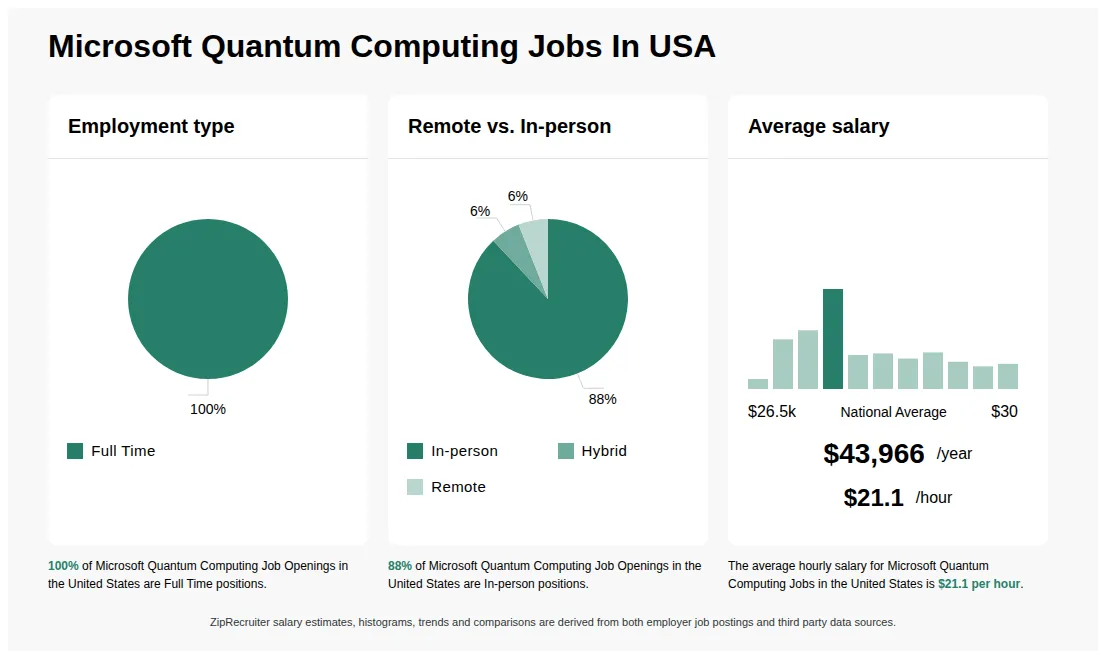
As of Sep 6, 2026, the average hourly pay for microsoft quantum computing in the United States is $21.14, according to ZipRecruiter salary data. Most workers in this role earn between $17.31 and $25.00 per hour, depending on experience, location, and employer.

What is a Microsoft Quantum Computing engineer?

A Microsoft Quantum Computing engineer is a professional who develops and implements quantum algorithms, software, and hardware solutions using Microsoft's quantum computing platforms, such as Azure Quantum. They work on advancing the field of quantum computing by designing new quantum circuits, optimizing existing algorithms, and collaborating with researchers and developers. These engineers often use languages like Q# and work with both theoretical and practical aspects of quantum computing to solve complex problems that are challenging for classical computers.

What are the key skills and qualifications needed to thrive in Microsoft Quantum Computing roles?

To thrive in Microsoft Quantum Computing, you need a strong background in quantum physics, computer science, and mathematics, often supported by an advanced degree in a related field. Familiarity with quantum programming languages like Q#, experience with quantum development kits, and knowledge of cloud platforms such as Azure Quantum are commonly required. Strong analytical thinking, problem-solving ability, and collaborative communication set top candidates apart. These skills are vital to advancing quantum research, developing innovative solutions, and contributing effectively to multidisciplinary teams within this cutting-edge field.

What are some common challenges faced by professionals working in Microsoft Quantum Computing, and how can new hires prepare for them?

Professionals in Microsoft Quantum Computing often encounter challenges such as staying current with rapidly evolving quantum algorithms, integrating quantum solutions with classical computing systems, and collaborating across multidisciplinary teams. New hires can prepare by developing strong foundational knowledge in both quantum theory and software development, as well as honing communication skills to effectively work with physicists, engineers, and software developers. Being proactive in continuous learning and seeking mentorship within the team can also help overcome the steep learning curve and foster successful collaboration.

What is the difference between Microsoft Quantum Computing vs Quantum Software Engineer?

AspectMicrosoft Quantum ComputingQuantum Software Engineer
Required CredentialsAdvanced degrees in physics, computer science, or related fields; knowledge of quantum mechanics and programming languages like Q#Degree in computer science, software engineering, or related fields; programming skills in Python, C++, and quantum SDKs
Work EnvironmentResearch labs, tech companies, and academia focusing on quantum hardware and software developmentTech companies, startups, or research institutions developing quantum algorithms and applications
Employer & Industry UsagePrimarily in tech giants like Microsoft, IBM, Google, and academiaIn tech firms, startups, and research organizations working on quantum software solutions

Microsoft Quantum Computing focuses on developing quantum hardware and software platforms, requiring deep knowledge of quantum physics and specialized programming. Quantum Software Engineers design and implement quantum algorithms, often using similar programming languages and tools. Both roles overlap in skills and industry but differ in their primary focus—hardware versus software development.


Are Microsoft Quantum Computing jobs in high demand?

Microsoft Quantum Computing jobs are in growing demand as the industry advances, with roles focusing on quantum algorithms, hardware development, and research. These positions often require specialized skills in quantum mechanics, programming languages like Q#, and experience with quantum hardware or software development. The field is expanding as companies invest in quantum technology, leading to increased job opportunities for qualified professionals.

Does quantum computing pay well?

Quantum computing professionals, including those working in research, software development, and hardware engineering, tend to earn high salaries due to the specialized skills required. Salaries can vary based on experience, education, and location, but generally, roles in quantum computing are well-compensated compared to many other tech fields. Advanced knowledge of quantum algorithms, programming languages like Qiskit, and a strong background in physics or computer science can lead to higher pay.
More about Microsoft Quantum Computing jobs

What cities are hiring for Microsoft Quantum Computing jobs?

Cities with the most Microsoft Quantum Computing job openings:

What states have the most Microsoft Quantum Computing jobs?

States with the most job openings for Microsoft Quantum Computing jobs include:

Infographic showing various Microsoft Quantum Computing job openings in the United States as of August 2026, with employment types broken down into 90% Full Time, 7% Part Time, 1% Temporary, and 2% Contract. Highlights an 87% Physical, 4% Hybrid, and 9% Remote job distribution, with an average salary of $43,966 per year, or $21.1 per hour.

Quantum Systems Software Development Engineer II

Microsoft

Redmond, WA • On-site

$193K - $229K/yr

Full-time

Posted 17 days ago


Key responsibilities

  • Design, implement, and maintain software used to control and interface with scientific and experimental instruments.

  • Develop and maintain Python-based APIs, libraries, and tools used by experimentalists and automation workflows, and contribute supporting components in systems-level languages as needed.

  • Collaborate closely with hardware, firmware, and system software engineers during instrument bring-up, integration, and debugging.


Microsoft rating

8.6

Company rating: 8.6 out of 10

Based on 134 frontline employees who took The Breakroom Quiz

69th of 247 rated software companies


Job description

Overview
Microsoft is the world's center of expertise on topological quantum computing. We are building a scaled, fault-tolerant quantum computer grounded in topological qubits and integrated end-to-end with the Azure Quantum software stack.
As a Quantum Systems Software Development Engineer II in our Quantum Systems organization, you will contribute to the development of software systems used to control, configure, and interface with scientific instruments that operate and measure advanced quantum hardware. This role focuses on building reliable, well-structured software components primarily in Python, with supporting systems-level development in languages such as C/C++ that communicate with networked, FPGA- and SoC-based devices using both standardized and proprietary protocols.
Our work sits at the intersection of hardware, software, and physics. You will work closely with experienced software engineers, quantum experimentalists, and hardware partners to help turn evolving research systems into robust, repeatable, and observable instrument platforms, while learning how complex hardware-software systems are developed, tested, and operated.
At Microsoft Quantum, our mission is to empower science and scientists to solve the world's hardest problems by realizing advanced computing platforms at the intersection of high-performance computing, artificial intelligence, and quantum information technology.
Learn more at: https://www.microsoft.com/en-us/quantum
If you enjoy working on real-world systems at the hardware-software boundary, learning from cross-disciplinary teams, and using modern tools (including AI) to improve engineering productivity, we'd love to talk.
Responsibilities
  • Design, implement, and maintain software used to control and interface with scientific and experimental instruments, including custom control, readout, and related hardware subsystems.

  • Develop and maintain Python-based APIs, libraries, and tools used by experimentalists and automation workflows, while contributing supporting components in systems-level languages as needed.

  • Translate hardware capabilities, communication protocols, and system constraints into clean, well-factored software abstractions with clear ownership boundaries.

  • Develop software for instruments that communicate over proprietary, non-VISA protocols, while also supporting standardized interfaces (e.g., VISA/SCPI) where applicable.

  • Apply software quality practices to ensure instrument-control software is reliable, testable, and maintainable, including unit testing, debugging, and validation.

  • Collaborate closely with hardware, firmware, and system software engineers during instrument bring-up, integration, and debugging.

  • Contribute to shared libraries, patterns, and frameworks related to instrument control to improve consistency and long-term maintainability.

  • Embody our Culture and Values

Qualifications
Required Qualifications
  • Master's Degree in Computer Science, Software Engineering, Mathematics, Physics, Physical Sciences, or related field AND 1+ year(s) software industry experience, including research and/or development of commercial software, compilers, scientific computing applications, or multi-component systems
    • OR Bachelor's Degree in Computer Science, Software Engineering, Mathematics, Physics, Physical Sciences, or related field AND 2+ years software industry experience, including research and/or development of commercial software, compilers, scientific computing applications, or multi-component systems
    • OR equivalent experience.

  • 2+ years programming experience in related programming languages.

  • 1+ year(s) experience in a collaborative environment.
  • This position requires verification of citizenship or other protected status to meet legal requirements of the role. If the role requires US citizenship, as indicated in the job description, a valid US passport must be provided to verify your citizenship. If the role requires US Person status, as indicated in the job description, US citizens must provide a valid US passport for verification while lawful permanent residents, refugees, and asylees may complete this verification using green cards or other status documents, as applicable.

Additional or Preferred Qualifications
  • Strong proficiency in Python and at least one systems-level programming language (C, C++, C#, or Rust), including designing maintainable, extensible software using sound object-oriented and modular design principles, and the ability to work effectively across language boundaries.

  • Demonstrated ability to design, implement, and deliver software at the feature or component level, working from defined requirements and collaborating with partners to clarify scope, constraints, and tradeoffs.

  • Experience developing software that interfaces with hardware or network-connected external systems, such as scientific instruments, embedded systems, or custom services, including working with both standardized (e.g., VISA/SCPI) and proprietary communication protocols.

  • Ability to apply software quality and verification practices, including unit testing, debugging, validation, and (where applicable) CI/CD or hardware-in-the-loop testing, to ensure correctness and reliability.

  • Experience developing instrument control, measurement, or experimental automation software, including familiarity with data acquisition systems, measurement pipelines, and associated metadata or data workflows.

  • Experience designing or contributing to APIs or Python bindings layered over systems-level code.

  • Background in physics, quantum computing, or other applied scientific or engineering domains.

Other Requirements
  • Ability to meet Microsoft, customer, and/or government security screening requirements is required for this role, including:
    • Microsoft Cloud Background Check (upon hire and every two years thereafter)
    • Citizenship and Citizenship Verification: This role may require access to export-controlled information under applicable regulations (e.g., ITAR, EAR). Eligibility will be assessed in accordance with legal requirements.
    • Ability to leverage AI tools to drive innovation and efficiency (e.g., performance modeling and analysis, research gathering, day to day task automation).
    • Familiarity with designing and building AI agents/copilots that assist with design, development, experiment setup, log triage, report generation, specification generation, and knowledge retrieval (e.g. instrument manuals, design docs).

Microsoft is an equal opportunity employer. We celebrate diversity and are committed to creating an inclusive environment for all employees.
#Quantum #QuantumCareers #MDQCareers
Quantum Software Engineering IC3 - The typical base pay range for this role across the U.S. is USD $102,100 - $202,200 per year. There is a different range applicable to specific work locations, within the San Francisco Bay area and New York City metropolitan area, and the base pay range for this role in those locations is USD $133,800 - $219,200 per year.
Certain roles may be eligible for benefits and other compensation. Find additional benefits and pay information here:
https://careers.microsoft.com/us/en/us-corporate-pay
This position will be open for a minimum of 5 days, with applications accepted on an ongoing basis until the position is filled.
Microsoft is an equal opportunity employer. All qualified applicants will receive consideration for employment without regard to age, ancestry, citizenship, color, family or medical care leave, gender identity or expression, genetic information, immigration status, marital status, medical condition, national origin, physical or mental disability, political affiliation, protected veteran or military status, race, ethnicity, religion, sex (including pregnancy), sexual orientation, or any other characteristic protected by applicable local laws, regulations and ordinances. If you need assistance with religious accommodations and/or a reasonable accommodation due to a disability during the application process, read more about requesting accommodations.

What Microsoft employees say

Pay

Benefits

Hours and flexibility

Workplace

Get the full story on Breakroom


Microsoft logo

About Microsoft

Sourced by ZipRecruiter

Our infrastructure is comprised of a large global portfolio of more than 100 datacenters and 1 million servers. Our foundation is built upon and managed by a team of subject matter experts working to support services for more than 1 billion customers and 20 million businesses in over 90 countries worldwide. With environmental sustainability and optimization at the forefront of our datacenter design and operations, we continue to grow and evolve as we meet the ever-changing business demands that hold Microsoft as a world-class cloud provider.

Industry

Computer and computer peripheral equipment and software wholesalers

Company size

10,000+ Employees

Headquarters location

Redmond, WA, US

Year founded

1975

Social media