1

Medical Equipment Calibration Jobs (NOW HIRING)

Calibration Technician

Milpitas, CA ยท On-site

$25 - $34.25/hr

Paid Time-off, Paid Sick Leave, Special PTO for family events, 100% employer-paid medical, dental ... Operate and thoroughly maintain master calibration equipment, including oscilloscopes, spectrum ...

Home Medical Equipment Tech

Noblesville, IN

$16.25 - $21.25/hr

The Home Medical Equipment Tech triages rental home respiratory equipment and performs required repairs, calibration, and recertification in accordance with manufacturer specifications and Lincare ...

next page

Showing results 1-20

Medical Equipment Calibration information

See salary details

$21

$37

$65

How much do medical equipment calibration jobs pay per hour?

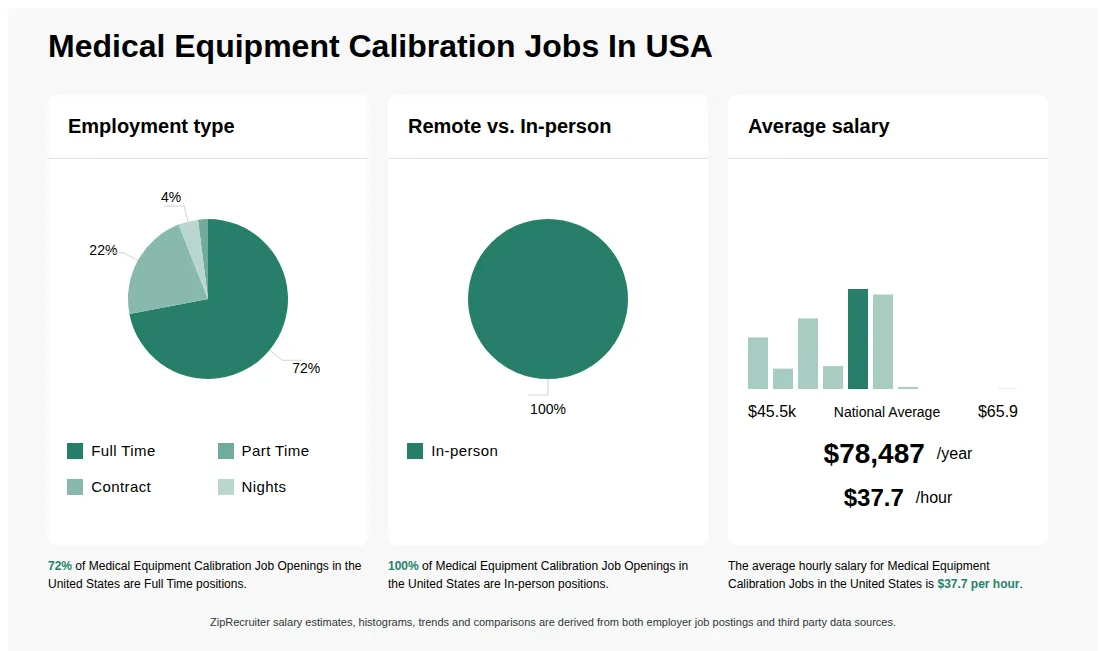
As of Aug 6, 2026, the average hourly pay for medical equipment calibration in the United States is $37.73, according to ZipRecruiter salary data. Most workers in this role earn between $31.25 and $42.31 per hour, depending on experience, location, and employer.

What are some common challenges faced by professionals in medical equipment calibration, and how can they be managed?

Professionals in medical equipment calibration often encounter challenges such as keeping up with constantly evolving technology, managing a diverse inventory of equipment, and ensuring compliance with strict regulatory standards. Staying organized and maintaining detailed records is crucial for tracking calibration schedules and performance. Continuous training and collaboration with healthcare staff and equipment manufacturers also help address technical complexities and keep calibration practices up to date.

How to become a medical equipment calibration specialist?

To become a medical equipment calibration specialist, individuals typically need a background in biomedical engineering, electronics, or a related field, along with training in medical device calibration procedures. Certification from organizations such as the International Certification Commission (ICC) or the American Society for Clinical Engineering (ASHE) can enhance job prospects. Experience with diagnostic and therapeutic equipment, attention to detail, and knowledge of safety standards are also important for this role.

What is the difference between Medical Equipment Calibration vs Medical Equipment Maintenance?

AspectMedical Equipment CalibrationMedical Equipment Maintenance
CertificationsTechnician certifications in calibration and medical devicesTechnician certifications in maintenance and repair
Work EnvironmentHospitals, clinics, calibration labsHospitals, clinics, service centers
Job FocusEnsuring measurement accuracy of medical devicesPreventive and corrective repairs of medical equipment
Industry UsageUsed for compliance and safety standardsUsed for operational reliability and longevity

Medical Equipment Calibration focuses on verifying and adjusting the accuracy of medical devices to meet safety standards, while Medical Equipment Maintenance involves routine repairs and servicing to ensure equipment functions properly over time. Both roles are essential for patient safety and equipment reliability in healthcare settings.


What are the key skills and qualifications needed to thrive as a medical equipment calibration technician?

To thrive as a Medical Equipment Calibration Technician, you need a solid background in electronics, engineering principles, and a relevant associate degree or technical certification. Familiarity with calibration tools, diagnostic software, and regulatory standards such as ISO 17025 is typically required. Attention to detail, problem-solving abilities, and strong communication skills help you ensure accuracy and compliance while working with healthcare teams. These competencies are vital to guarantee medical devices function correctly, supporting patient safety and regulatory adherence.

What is medical equipment calibration?

Medical equipment calibration is the process of adjusting and verifying medical devices to ensure their measurements are accurate and meet specified standards. Calibration technicians use specialized tools and follow manufacturer guidelines, often requiring certification, to maintain device reliability and patient safety.
More about Medical Equipment Calibration jobs
What cities are hiring for Medical Equipment Calibration jobs? Cities with the most Medical Equipment Calibration job openings:
What states have the most Medical Equipment Calibration jobs? States with the most job openings for Medical Equipment Calibration jobs include:
What job categories do people searching Medical Equipment Calibration jobs look for? The top searched job categories for Medical Equipment Calibration jobs are:
Infographic showing various Medical Equipment Calibration job openings in the United States as of August 2026, with employment types broken down into 1% As Needed, 78% Full Time, 15% Part Time, and 6% Contract. Highlights an 91% Physical, 1% Hybrid, and 8% Remote job distribution, with an average salary of $78,487 per year, or $37.7 per hour.

Equipment Calibration Technician / Pharma Manufacturing

Pioneer Data

Groton, CT โ€ข On-site

$22 - $29.75/hr

Contractor

Re-posted 6 days ago


Job description

Position Details:
Our client, a world-leading Pharmaceutical Company in Groton, CT is currently looking for an Equipment Calibration Technician to join their expanding team.
Job Title: Equipment Calibration Technician / Pharma Manufacturing 
Duration: 12 months contract, extendable up to 48 months
Location: Groton, CT

Note:
The client has the right-to-hire you as a permanent employee at any time during or after the end of the contract.
You may participate in the company group medical insurance plan
Job Description:
Notes
Location: Connecticut (100% onsite; occasional work-from-home only for online training)
Assignment Length: 12 months (strong likelihood of extension and possible conversion to FTE)
 
Shifts:
Primarily 1st shift, must be flexible for occasional: 2nd shift
Overtime
Weekend work (based on manufacturing schedules and urgent repairs)

Note: Client provides a 10% shift differential for 2nd shift / off-hours. 
Contractors should be open to split shifts (e.g., 8 hours day + 2–4 hours 2nd shift).
 
Top Priority: Mechanical Aptitude (Non-Negotiable)
This role is not experience-heavy. 
Candidates DO need:
Strong hands-on mechanical ability
Comfort working with tools, equipment, and physical tasks
Willingness to learn and be trained
Excellent examples of strong profiles:
Trade school graduates
Manufacturing certificate holders
Automotive, facilities, or retail maintenance backgrounds
Candidates who work on cars, equipment, machinery, or home projects as a hobby
Entry-level candidates with strong mechanical curiosity and motivation

“Nice to Have”
GMP or regulated manufacturing environment
Electrical experience (especially basic wiring knowledge)
Calibration experience
Preventive Maintenance (PM) or corrective maintenance background
Exposure to control systems (e.g., DeltaV – only a bonus)

Physical Requirements
Ability to lift up to 50 lbs occasionally
Physical work is not daily; occurs mainly during equipment replacement (pumps, tanks, etc.)
Lifts and hoists are typically available

Work Environment & Team
Small, tight-knit maintenance team (collaborative but independent once trained)
Daily work is primarily within manufacturing

Regular interaction with:
Manufacturing operators
Other county/plant maintenance teams
After training, techs run jobs independently but with team support nearby
 
What you will achieve and how:
Under minimal supervision, and working within documented operational procedures, maintain facility cGMP mechanical equipment. Lead complex mechanical repairs, perform instrument calibrations, and lock out tag outs supporting facility project upgrades or routine maintenance.
Initiate, complete and close on-demand and scheduled work orders.
Participate in training other technicians on new equipment and upgrades.
Assists Operational Staff with problem solving and equipment troubleshooting.
Participate in department meetings and safety meetings as required. Be committed to continually improving skills through participation in educational opportunities, whether offered as on the job, within or outside the facility, to increase knowledge base.
May be asked to work on a flexible schedule to meet the department needs in the facility when required.
Basic Qualifications:
High School Diploma with 2+ years of experience in equipment, electrical and/or instrumentation maintenance, computer skills, and familiarity with GMP fundamentals.
Strong organization skills, and attention to detail
Demonstrated capability to support others within a matrix development team
Excellent written and verbal communication skills
Strong computer skills in Microsoft Office required, e.g. MS Word, MS Excel
Preferred Qualifications:
Associate degree (Science or technical discipline)
Mechanical aptitude and desire to execute hands on manual labor
Experience with Delta V Production Control System
Experience in a Pharmaceutical cGMP manufacturing environment
Perform calibrations in compliance with site policies and procedures, ensuring traceability to NIST standards.
Conduct preventive and predictive maintenance on production and utility equipment.
Install, specify, and calibrate process instrumentation and laboratory devices.
Troubleshoot and repair instrumentation and automation systems
Read and interpret equipment schematics, logic diagrams, and engineering drawings.
Use calibration tools and equipment safely and effectively.
Maintain accurate documentation of calibration and maintenance activities
Physical Requirements:
Able to lift more than 50 lbs, be amenable to wearing personal protective equipment and working in the vicinity of hazardous materials.
Non-Standard Work Schedule, Travel, or Environment Requirements:
Candidate must be able and willing to work outside of standard day shift hours and on weekends as necessary.
Other Job Details:
Work Location Assignment: On Premise
On Premise colleagues work in a Client site because it’s needed to get their job done.
They may have flexibility to work remotely from time to time, but they are primarily on-site.