1

Mechanical Utility Engineer Jobs (NOW HIRING)

Inspect and repair all mechanical equipment including, but not limited to: appliances, HVAC, ... Display advanced knowledge of engineering computer programs related to preventative maintenance ...

Facilities Mechanical Engineer (System Owner)**At Wolfspeed, we do amazing things in a human way.We ... Ensure utility systems consistently meet manufacturing requirements for capacity, quality ...

Mechanical Engineer III (Utilities & HVAC) Job Summary Design and implement mechanical systems as part of a broad engineering and architectural team in designing and building food and beverage ...

NY · On-site

Facilities Mechanical Engineer (System Owner)**At Wolfspeed, we do amazing things in a human way.We ... Ensure utility systems consistently meet manufacturing requirements for capacity, quality ...

Bachelor's degree in Mechanical Engineering, Civil Engineering, or a related field. * 5+ years of experience in natural gas distribution engineering or utility infrastructure design. * Professional ...

Bachelor's degree in Mechanical Engineering, Civil Engineering, or a related field. * 5+ years of experience in natural gas distribution engineering or utility infrastructure design. * Professional ...

Showing results 41-60

Mechanical Utility Engineer information

See salary details

$45.5K

$102.9K

$166.5K

How much do mechanical utility engineer jobs pay per year?

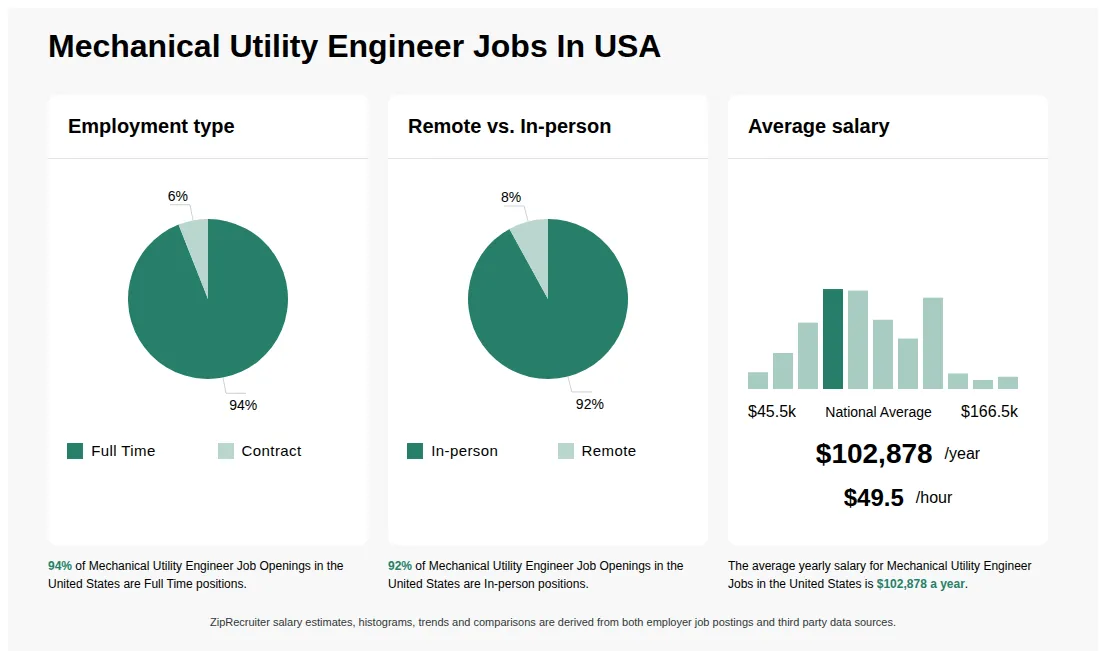
As of Sep 12, 2026, the average yearly pay for mechanical utility engineer in the United States is $102,878.00, according to ZipRecruiter salary data. Most workers in this role earn between $81,500.00 and $126,500.00 per year, depending on experience, location, and employer.

What is a mechanical utility engineer?

Mechanical Utility Engineers are professionals who design, maintain, and manage mechanical systems that support utilities such as water, gas, steam, and HVAC (heating, ventilation, and air conditioning) in buildings and industrial facilities. They ensure that these systems operate efficiently, safely, and in compliance with regulatory standards. Their work often includes overseeing installation, performing inspections, troubleshooting issues, and optimizing system performance to reduce energy consumption and costs.

What are the key skills and qualifications needed to thrive as a mechanical utility engineer?

To thrive as a Mechanical Utility Engineer, you need a strong background in mechanical engineering principles, utility systems, and a relevant engineering degree, often accompanied by a Professional Engineer (PE) license. Familiarity with CAD software, building management systems, and industry standards such as ASHRAE is typically required. Strong problem-solving, project management, and communication skills help you collaborate effectively and address complex operational challenges. These skills ensure reliable utility system design, safe operation, and efficient project delivery in industrial and commercial settings.

What are some common challenges mechanical utility engineers face when working on large-scale infrastructure projects?

Mechanical Utility Engineers often encounter challenges such as coordinating with multiple disciplines (electrical, civil, and environmental engineers) to ensure seamless integration of mechanical systems into broader infrastructure projects. Managing tight deadlines while ensuring compliance with safety and regulatory standards is another frequent challenge. Additionally, adapting to unexpected site conditions or design changes requires strong problem-solving skills and flexibility, as these factors can impact project timelines and budgets.

What is the difference between Mechanical Utility Engineer vs Mechanical Maintenance Engineer?

AspectMechanical Utility EngineerMechanical Maintenance Engineer
CredentialsTypically requires a mechanical engineering degree and relevant certificationsUsually holds a mechanical or industrial engineering degree with maintenance certifications
Work EnvironmentFocuses on utility systems, plant operations, and infrastructurePrimarily involved in equipment repair, troubleshooting, and preventive maintenance
Employer & IndustryCommonly employed in power plants, manufacturing facilities, and large industrial plantsFound in factories, plants, and facilities requiring equipment upkeep

The Mechanical Utility Engineer primarily manages utility systems and plant infrastructure, ensuring efficient operation of systems like HVAC, water, and power. In contrast, the Mechanical Maintenance Engineer concentrates on maintaining and repairing machinery and equipment. Both roles require similar technical skills and certifications but differ in focus and daily responsibilities.

More about Mechanical Utility Engineer jobs

What states have the most Mechanical Utility Engineer jobs?

States with the most job openings for Mechanical Utility Engineer jobs include:

What are popular job titles related to Mechanical Utility Engineer jobs?

For Mechanical Utility Engineer jobs, the most frequently searched job titles are:

Infographic showing various Mechanical Utility Engineer job openings in the United States as of September 2026, with employment types broken down into 70% Full Time, 5% Part Time, and 25% Contract. Highlights an 95% In-person, and 5% Remote job distribution, with an average salary of $102,878 per year, or $49.5 per hour.

Mechanical Engineer IV - Senior Mechanical Engineer

Lenexa, KS • On-site

$98K - $129K/yr

Full-time

Medical, Dental, Vision, Life, Retirement

Posted 21 days ago


Job description

Mechanical Engineer IV : Senior Mechanical Engineer - Life Sciences
Build Your Future with GBA
At GBA, you'll help create the facilities where lifesaving medicines, therapies, and medical innovations are developed and manufactured. Our Life Sciences team partners with leading biopharmaceutical and biotech companies to design highly specialized facilities where complex mechanical systems, regulatory requirements, and manufacturing needs come together. As a Senior Mechanical Engineer, you'll help develop the HVAC, plumbing, and mechanical utility systems that make these facilities possible.
Why This Role Matters
Mechanical systems are critical to the performance of Life Sciences facilities. Your designs will help create environments where temperature, humidity, ventilation, utilities, reliability, and system performance directly support the development and manufacturing of products that improve and save lives. This role gives you the opportunity to apply your technical experience, influence project decisions, build trusted client relationships, and help develop the next generation of engineers.
What You'll Do
  • Lead the design of HVAC, plumbing, and mechanical utility systems for complex biopharmaceutical and biotech manufacturing facilities.
  • Develop mechanical design concepts that respond to client operational requirements, project goals, and budget expectations.
  • Perform engineering calculations, equipment selections, and system evaluations, and review calculations and equipment selections completed by project team members.
  • Evaluate existing mechanical systems and develop retrofit, replacement, and upgrade strategies.
  • Work directly with clients to establish design criteria and communicate technical recommendations.
  • Prepare technical specifications and support compliance with applicable codes, standards, and regulatory requirements.
  • Coordinate closely with architecture, electrical, process engineering, fire protection, commissioning, and other disciplines.
  • Maintain project quality through technical reviews and Quality Assurance/Quality Control.
  • Conduct field investigations and reviews and support construction administration and commissioning activities.
  • Mentor junior engineers and contribute to the continued technical growth of the Life Sciences team.
How You'll Make an Impact
Beyond the technical design itself, your experience will help shape project outcomes, strengthen client relationships, and grow the technical capabilities of the Life Sciences team.
  • Influence critical design decisions. Bring your experience and engineering judgment to decisions that affect facility performance, reliability, constructability, and long-term operation.
  • Build client confidence. Become a trusted technical partner who can understand complex challenges, communicate options clearly, and help clients make informed decisions.
  • Raise the bar for technical excellence. Help strengthen quality, consistency, and thoughtful engineering across our mechanical designs and project teams.
  • Develop the next generation. Share your experience and perspective with developing engineers, helping them grow their technical confidence and capabilities.
  • Contribute to work with a bigger purpose. Help create the facilities where lifesaving medicines, therapies, and medical innovations are developed and manufactured.
What You'll Bring
Education & Experience
  • Bachelor's degree in Mechanical Engineering.
  • Professional Engineer (PE) license in Mechanical Engineering.
  • 7+ years of relevant mechanical engineering experience.
  • Experience designing complex building systems; Life Sciences, biopharmaceutical, biotech, industrial, or other technically complex facility experience is preferred.
Technical Skills & Abilities
  • Strong knowledge of HVAC, plumbing, and mechanical utility system design.
  • Experience performing mechanical design calculations and equipment selections.
  • Ability to evaluate existing systems and develop practical retrofit and upgrade solutions.
  • Proficiency in Revit required; AutoCAD experience is a plus.
  • Strong understanding of applicable building codes, engineering standards, and regulatory requirements.
  • Strong problem-solving skills and sound engineering judgment.
  • Strong written and verbal communication skills with the ability to work effectively with clients and multidisciplinary project teams.
  • Ability to manage multiple priorities while maintaining quality and project deadlines.
  • Collaborative approach and interest in mentoring and developing others.
Why You'll Love Working Here
Every project is an opportunity to contribute to something bigger. At GBA, you'll work alongside architects, engineers, and industry experts to create facilities that allow our clients to develop and manufacture medicines, therapies, and other products that make a meaningful difference in people's lives. You'll tackle technically challenging projects, work directly with clients, collaborate with multidisciplinary teams, and have opportunities to grow both your technical expertise and your career.
  • Medical, dental, and vision insurance
  • Life, accident, and disability coverage
  • 401(k) with company match
  • Employee Assistance Program (EAP) and wellness initiatives
  • Paid company holidays, floating holidays, and flexible time off
  • Training, professional development, and opportunities for career advancement
Travel
Travel may be required based on project needs for client meetings, project-site visits, field investigations, construction support, and commissioning activities.
Physical Requirements
Ability to perform field investigations and site visits as needed. Reasonable accommodations may be made to enable individuals with disabilities to perform the essential functions of the position.
GBA is an Equal Employment Opportunity Employer. We promote diversity in our workforce by including all individuals regardless of age, race, religion, color, sex, national origin, marital status, genetic information, sexual orientation, gender identity, gender expression, disability, veteran status, pregnancy status, or any other status protected by law.