1

Mechanical Utility Engineer Jobs (NOW HIRING)

As a utility engineer, you will provide mechanical or electrical expertise and cost effective solutions for multiple utility facility operating and construction projects that meet budget, quality ...

The Mechanical Engineer will lead mechanical utility design and installation--including chilled water, cooling water, domestic water, compressed air, argon, nitrogen, and hydrogen systems--and ...

Utility Engineer

Melbourne, FL

$85.19K - $140.20K/yr

... developers and consultants. Oversees the maintaining and updating of Utilities Technical ... Mechanical Integrity Testing, and Wellfield and flushing consumptive use permit. Performs plan ...

Senior Mechanical Engineer

Newport News, VA ยท On-site

$94.90K - $125.30K/yr

Act as the owner's engineer, supporting NNS facilities maintenance and assisting the utility ... Citizenship. * Mechanical utility distribution systems and plants. * Knowledge of ASME codes.

Utility Engineer

Melbourne, FL ยท On-site

$85.19K - $140.20K/yr

... developers and consultants. * Oversees the maintaining and updating of Utilities Technical ... and Copper, Mechanical Integrity Testing, and Wellfield and flushing consumptive use permit.

Utility Engineer Work Place Flexibility: Onsite Legal Entity: Entergy Services, LLC Note: This is ... Degrees in engineering technology (typically, Electrical, Mechanical, Civil, Chemical, and ...

Bachelors' degree in Mechanical, Electrical, Facilities Engineering or related engineering ... in utilities systems and troubleshooting Experience coordinating a cross functional team for ...

next page

Showing results 1-20

Mechanical Utility Engineer information

See salary details

$45.5K

$102.9K

$166.5K

How much do mechanical utility engineer jobs pay per year?

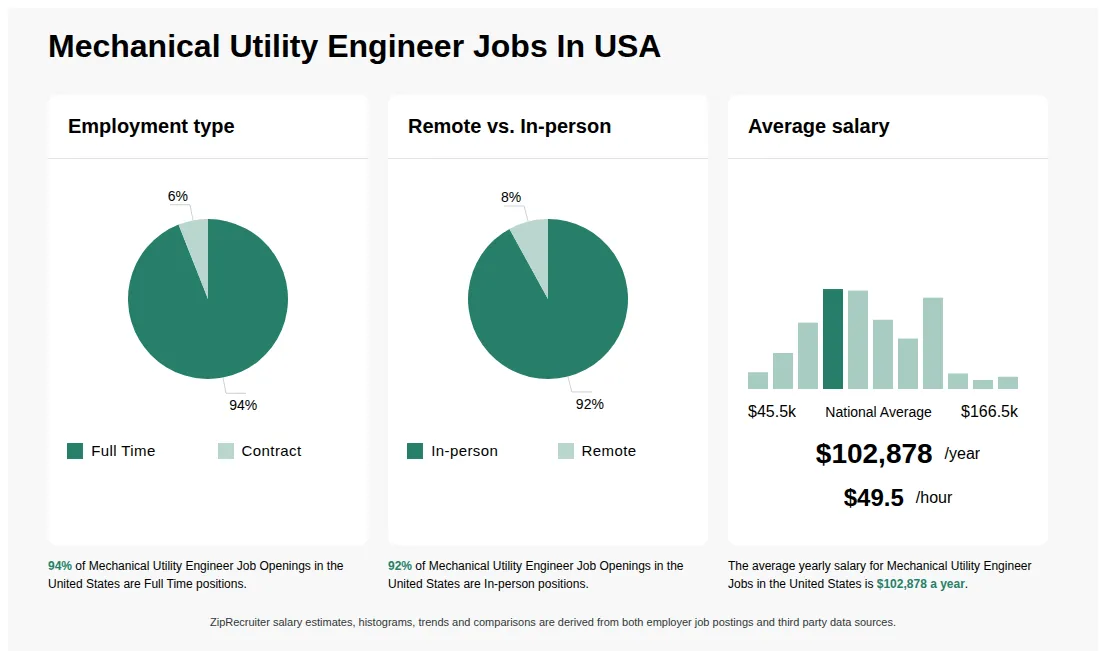
As of May 28, 2026, the average yearly pay for mechanical utility engineer in the United States is $102,878.00, according to ZipRecruiter salary data. Most workers in this role earn between $81,500.00 and $126,500.00 per year, depending on experience, location, and employer.

What are the key skills and qualifications needed to thrive as a Mechanical Utility Engineer, and why are they important?

To thrive as a Mechanical Utility Engineer, you need a strong background in mechanical engineering principles, utility systems, and a relevant engineering degree, often accompanied by a Professional Engineer (PE) license. Familiarity with CAD software, building management systems, and industry standards such as ASHRAE is typically required. Strong problem-solving, project management, and communication skills help you collaborate effectively and address complex operational challenges. These skills ensure reliable utility system design, safe operation, and efficient project delivery in industrial and commercial settings.

What are some common challenges Mechanical Utility Engineers face when working on large-scale infrastructure projects?

Mechanical Utility Engineers often encounter challenges such as coordinating with multiple disciplines (electrical, civil, and environmental engineers) to ensure seamless integration of mechanical systems into broader infrastructure projects. Managing tight deadlines while ensuring compliance with safety and regulatory standards is another frequent challenge. Additionally, adapting to unexpected site conditions or design changes requires strong problem-solving skills and flexibility, as these factors can impact project timelines and budgets.

What are Mechanical Utility Engineers?

Mechanical Utility Engineers are professionals who design, maintain, and manage mechanical systems that support utilities such as water, gas, steam, and HVAC (heating, ventilation, and air conditioning) in buildings and industrial facilities. They ensure that these systems operate efficiently, safely, and in compliance with regulatory standards. Their work often includes overseeing installation, performing inspections, troubleshooting issues, and optimizing system performance to reduce energy consumption and costs.

What is the difference between Mechanical Utility Engineer vs Mechanical Maintenance Engineer?

AspectMechanical Utility EngineerMechanical Maintenance Engineer
CredentialsTypically requires a mechanical engineering degree and relevant certificationsUsually holds a mechanical or industrial engineering degree with maintenance certifications
Work EnvironmentFocuses on utility systems, plant operations, and infrastructurePrimarily involved in equipment repair, troubleshooting, and preventive maintenance
Employer & IndustryCommonly employed in power plants, manufacturing facilities, and large industrial plantsFound in factories, plants, and facilities requiring equipment upkeep

The Mechanical Utility Engineer primarily manages utility systems and plant infrastructure, ensuring efficient operation of systems like HVAC, water, and power. In contrast, the Mechanical Maintenance Engineer concentrates on maintaining and repairing machinery and equipment. Both roles require similar technical skills and certifications but differ in focus and daily responsibilities.

More about Mechanical Utility Engineer jobs
What states have the most Mechanical Utility Engineer jobs? States with the most job openings for Mechanical Utility Engineer jobs include:
Infographic showing various Mechanical Utility Engineer job openings in the United States as of May 2026, with employment types broken down into 87% Full Time, 10% Part Time, and 3% Contract. Highlights an 79% Physical, 13% Hybrid, and 8% Remote job distribution, with an average salary of $102,878 per year, or $49.5 per hour.

Facility Mechanical Utility Engineer (G-Project)

Foxconn Assembly LLC

Houston, TX โ€ข On-site

Full-time

Medical, Dental, Life, Retirement, PTO

Posted 14 days ago


Job description

We are seeking a Facility Mechanical Utility Engineer to plan and implement daily building maintenance and mechanical tasks while ensuring the reliable operation of utility systems. The ideal candidate will monitor and analyze compressed air and water consumption to drive efficiency improvements and support sustainability initiatives in alignment with ISO 50001 standards. This role is also responsible for managing maintenance documentation, tracking system performance, and coordinating with cross-functional teams to support continuous improvement across facility operations.
Key Responsibility
  • Repair and replace building mechanical equipment.
  • Update building mechanical drawings as necessary.
  • Organize inspections, measurements, and manage all documentation related to the building and operations.
  • Actively participate in the operation and development of the ISO50001 standards.
  • Monitor and analyze compressed air and water consumption, to develop and implement efficiency improvement measures.
  • Develop a building inspection system.
  • Supervise the development of the facility technician's work.
  • Plan and implement daily building maintenance, mechanical tasks, and manage related documentation (elaboration and development of regular maintenance instructions, inspection sheets).
  • Organize, implement and provide professional support for regular and preventive maintenance work and inspections of building mechanical equipment.
  • Creative thinking, good communication, and problem-solving skills.

Experience/Education
  • Degree in building engineering, mechanical engineering, or relevant fields.
  • At least 2 years of professional experience in a similar field.

Benefits:
  • 401(k)
  • Dental insurance
  • Health insurance
  • Life insurance
  • Paid holidays
  • Paid time off

Foxconn is an Equal Opportunity Employer and Drug Free Workplace. Qualified applicants will receive consideration for employment without regard to their race, color, religion, national origin, sex, sexual orientation, gender identity, protected veteran status or disability.