1

Machine Learning Chemistry Jobs (NOW HIRING)

... Machine Learning Scientist or Engineer to design, build, and deploy agentic AI systems that ... chemistry, and energy systems. The goal is not to build a generic chatbot, but to create reliable ...

Showing results 21-40

Machine Learning Chemistry information

See salary details

$13

$22

$32

How much do machine learning chemistry jobs pay per hour?

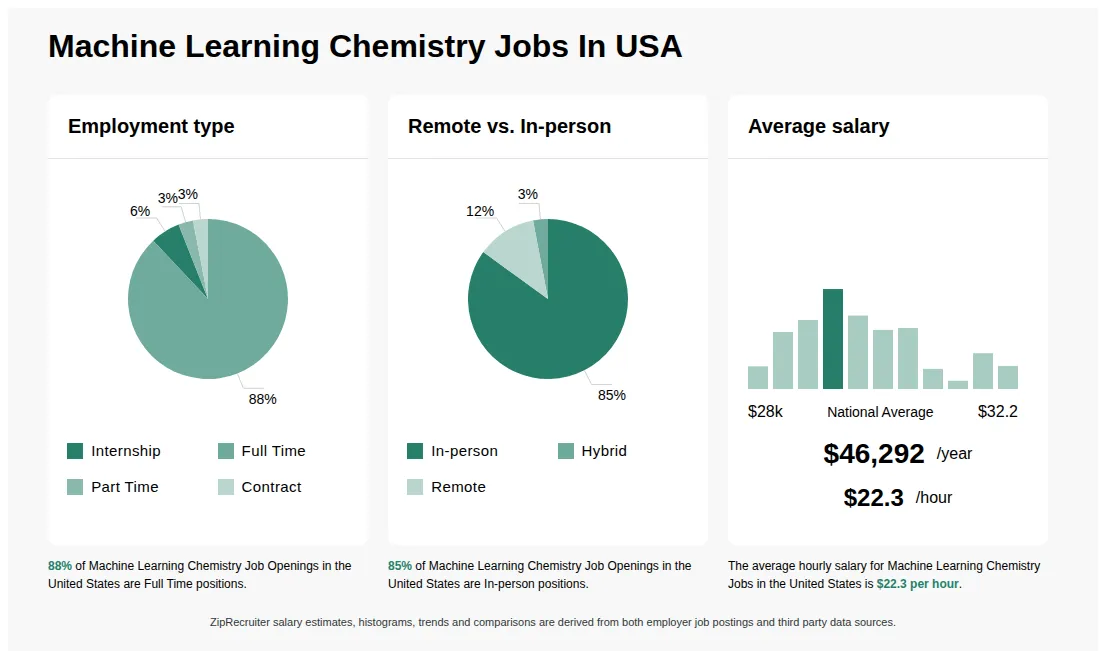
As of Sep 9, 2026, the average hourly pay for machine learning chemistry in the United States is $22.26, according to ZipRecruiter salary data. Most workers in this role earn between $18.27 and $24.52 per hour, depending on experience, location, and employer.

What is a machine learning chemistry?

A Machine Learning Chemistry job involves using artificial intelligence techniques to analyze chemical data, model molecular behaviors, and accelerate discoveries in chemistry-related fields. Professionals in this role develop and apply machine learning algorithms to predict chemical properties, optimize reactions, and assist in drug design, material science, and other applications. They typically work in pharmaceuticals, materials science, or environmental chemistry, collaborating with chemists, data scientists, and engineers to solve complex chemical problems efficiently.

What does a machine learning chemistry do?

Professionals in Machine Learning Chemistry often work on projects such as developing predictive models for chemical property analysis, optimizing molecular structures, or advancing drug discovery through data-driven methods. Daily tasks may include data preprocessing, building and training machine learning models, validating results, and interpreting outcomes in collaboration with experimental chemists. Teamwork is common, with regular interactions between chemistry researchers, data scientists, and software engineers. This structure allows for iterative feedback and ensures that computational models align with practical lab needs. Continuous learning and adaptation are also key, as both the chemistry and machine learning fields are rapidly evolving.

What are the key skills and qualifications needed to thrive in machine learning chemistry?

To thrive in a Machine Learning Chemistry role, you need a solid background in chemistry, expertise in data science and machine learning algorithms, and typically an advanced degree in chemistry, computer science, or a related field. Familiarity with programming languages like Python or R and experience working with cheminformatics tools and machine learning frameworks (such as TensorFlow or scikit-learn) are essential. Strong analytical thinking, problem-solving abilities, and effective communication skills enable professionals to bridge the gap between computational work and experimental research teams. These competencies are crucial for developing innovative solutions in chemical research and ensuring successful collaboration across interdisciplinary teams.

More about Machine Learning Chemistry jobs

What cities are hiring for Machine Learning Chemistry jobs?

Cities with the most Machine Learning Chemistry job openings:

What are the most commonly searched types of Machine Learning Chemistry jobs?

The most popular types of Machine Learning Chemistry jobs are:

What states have the most Machine Learning Chemistry jobs?

States with the most job openings for Machine Learning Chemistry jobs include:

Infographic showing various Machine Learning Chemistry job openings in the United States as of September 2026, with employment types broken down into 1% Internship, 1% As Needed, 74% Full Time, 23% Part Time, and 1% Contract. Highlights an 83% Physical, 2% Hybrid, and 15% Remote job distribution, with an average salary of $46,292 per year, or $22.3 per hour.

Machine Learning Infrastructure Engineer

San Mateo, CA • On-site, Remote

$197K - $233K/yr

Full-time

Medical, Dental, Vision, Life, Retirement, PTO

Re-posted 5 days ago


Key responsibilities

  • Design and improve the in-house workflow orchestration framework, including DAG construction, execution, scheduling, caching, retries, observability, and distributed execution.

  • Build and optimize large-scale preprocessing pipelines for protein structures, chemical datasets, simulations, and machine learning training data.

  • Profile workflows to identify and eliminate bottlenecks, and develop abstractions for lazy execution, incremental computation, and artifact reuse.


Job description

About the Team
At Genesis Molecular AI, we're a tight-knit team of proven deep learning researchers, software engineers, and drug discovery pioneers. Our shared mission is nothing short of revolutionary: to forge the next generation of AI foundation models that unlock new therapies for patients with severe diseases.
We conduct fundamental research at the intersection of machine learning, physics, and computational chemistry, pushing the boundaries of each field.
You will work alongside machine learning researchers, computational scientists, and engineers to build the infrastructure that transforms massive, heterogeneous protein and chemical datasets into reliable, high-performance inputs for our models and drug discovery workflows.
About the Role
We are looking for a Machine Learning Infrastructure Engineer to build the data and orchestration systems that power molecular AI at Genesis. Drug discovery creates unusual infrastructure challenges: our workflows combine computational chemistry, structural biology, machine learning, and large-scale data processing in ways that don't map neatly onto traditional ETL systems. To meet these requirements, we have built our own pipeline orchestration framework-and we want an engineer excited to push it much further.
This role is deliberately split between building the platform and using it. Roughly 50% of your time will be spent designing and improving our in-house orchestration framework: its DAG abstractions, execution engine, scheduling, caching, observability, and developer experience. The other 50% will be spent building and optimizing the protein, chemical, and ML data preprocessing pipelines that run on top of it. You'll work across both layers, finding opportunities to eliminate unnecessary computation, reduce latency, introduce lazy evaluation and caching, and make complex scientific workflows fast, reproducible, and easy for researchers to use.
Your day-to-day work will span:
  • Design and evolve our in-house workflow orchestration framework, including DAG construction and execution, dependency management, scheduling, caching, retries, observability, and distributed execution.
  • Build and optimize large-scale preprocessing pipelines for protein structures, chemical datasets, simulations, and machine learning training data.
  • Profile end-to-end workflows and aggressively eliminate bottlenecks-from redundant I/O and serialization to unnecessary recomputation and poorly parallelized workloads.
  • Develop abstractions for lazy execution, incremental computation, intelligent caching, and artifact reuse so expensive scientific computations happen only when necessary.
  • Partner closely with ML researchers, computational chemists, and scientific software engineers to translate complex research workflows into scalable, reproducible computational pipelines.
  • Improve the developer experience for scientists and engineers authoring pipelines, making sophisticated distributed workflows intuitive to define, debug, monitor, and extend.
  • Make architectural decisions spanning local and distributed execution, storage, compute scheduling, data lineage, and reproducibility.
  • Use lessons from real-world scientific pipelines to continuously improve the orchestration platform itself-and use improvements to the platform to unlock faster, more ambitious scientific workflows.

You are
  • Passionate about DAGs. You naturally think about computation as graphs of dependencies and care deeply about how work is scheduled, parallelized, cached, retried, and recomputed.
  • Impatient about latency. When a pipeline takes hours, your instinct is to understand exactly where the time went and systematically make it faster.
  • An evangelist for lazy execution and caching. You dislike unnecessary work and look for principled ways to avoid recomputation, move less data, and reuse intermediate results.
  • A strong systems engineer. You are comfortable reasoning across APIs, distributed systems, storage, serialization, concurrency, resource scheduling, and performance.
  • Hands-on with data-intensive systems. You have built production pipelines or infrastructure that processes large datasets reliably and efficiently.
  • Comfortable moving between framework and application layers. You're as interested in designing the orchestration primitive as you are in optimizing the pipeline built with it.
  • A pragmatic abstraction builder. You can identify the common pattern hiding underneath many specialized workflows without forcing every scientific problem into an overly generic framework.
  • A strong collaborator with researchers. You can understand an evolving scientific workflow, identify its computational structure, and turn it into robust infrastructure without slowing down experimentation.
  • Energized by unusual problems. You enjoy environments where off-the-shelf infrastructure gets you 80% of the way there-and the interesting work is designing the remaining 20%.

Nice to haves
  • Experience building or operating large-scale ETL, data processing, or workflow systems such as Apache Spark, GCP Dataflow / Apache Beam, Flyte, Dagster, Airflow, Ray, or similar infrastructure.
  • Experience designing workflow engines, schedulers, DAG execution systems, build systems, or other dependency-driven computation frameworks.
  • Experience optimizing large-scale scientific, ML, protein, cheminformatics, or computational biology data pipelines.
  • Familiarity with Kubernetes and containerized compute environments, including deploying and operating distributed workloads across heterogeneous CPU and GPU resources.
  • Familiarity with Terraform or similar infrastructure-as-code tooling for provisioning and managing the underlying cloud, storage, networking, and compute resources that support large-scale pipelines.
  • Experience with cloud object storage, distributed compute environments, and high-performance or GPU-based computing.
  • Experience with content-addressable storage, incremental computation, data lineage, memoization, or cache invalidation at scale.
  • Familiarity with molecular data formats and tools such as RDKit, OpenEye, BioPython, molecular dynamics tooling, or structural biology pipelines.

Compensation, Benefits, and Perks
  • Competitive compensation package that includes salary and equity.
  • Comprehensive health benefits: Medical, Dental, and Vision (covered 100% for the employees).
  • 401(k) plan.
  • Open (unlimited) PTO policy.
  • Free lunches and dinners at our offices.
  • Paid family leave (maternity and paternity).
  • Life and long- and short-term disability insurance.

About Genesis Molecular AI
Genesis Molecular AI is pioneering foundation models for molecular AI to unlock a new era of drug design and development. Our generative and predictive AI platform, GEMS (Genesis Exploration of Molecular Space), integrates AI and physics into industry-leading models to generate and optimize drug molecules, including the breakthrough generative diffusion model Pearl for structure prediction. Genesis is backed by premier AI and life science investors, including a16z, NVIDIA, Rock Springs Capital, Menlo Ventures, T. Rowe Price, Fidelity, and Radical Ventures. Genesis has also signed category-leading AI-pharma deals, the most recent of which was a significant expansion with Incyte (see coverage in Forbes and GEN) with a total potential deal value of several billion dollars.
Genesis is headquartered in San Mateo, CA, with a fully integrated laboratory in San Diego. We are proud to be an inclusive workplace and an Equal Opportunity Employer.