Job Title Quality Manager Collaborate with Innovative 3Mers Around the World Choosing where to ... Travel: May include up to 25% domestic/international Relocation Assistance: Not authorized ...
Job Title Quality Manager Collaborate with Innovative 3Mers Around the World Choosing where to ... Travel: May include up to 25% domestic/international Relocation Assistance: Not authorized ...
Quality Manager Electronics
Maplewood, MN · On-site
Job Title Quality Manager Collaborate with Innovative 3Mers Around the World Choosing where to ... Travel: May include up to 25% domestic/international Relocation Assistance: Not authorized ...
Quality Manager Electronics
Maplewood, MN · On-site
Job Title Quality Manager Collaborate with Innovative 3Mers Around the World Choosing where to ... Travel: May include up to 25% domestic/international Relocation Assistance: Not authorized ...

$165 - $201/hr
Job Title Quality Manager Collaborate with Innovative 3Mers Around the World Choosing where to ... Travel: May include up to 25% domestic/international Relocation Assistance: Not authorized ...
$165 - $201/hr
Job Title Quality Manager Collaborate with Innovative 3Mers Around the World Choosing where to ... Travel: May include up to 25% domestic/international Relocation Assistance: Not authorized ...
Quality Manager Electronics
Maplewood, MN · On-site
$165 - $201/hr
Job Title Quality Manager Collaborate with Innovative 3Mers Around the World Choosing where to ... Travel: May include up to 25% domestic/international Relocation Assistance: Not authorized ...
Quality Manager Electronics
Maplewood, MN · On-site
$165 - $201/hr
Job Title Quality Manager Collaborate with Innovative 3Mers Around the World Choosing where to ... Travel: May include up to 25% domestic/international Relocation Assistance: Not authorized ...
As a Quality Manager , you will have the opportunity to tap into your curiosity and collaborate ... Travel: May include up to 25% domestic/international? Relocation Assistance: Not authorized
As a Quality Manager , you will have the opportunity to tap into your curiosity and collaborate ... Travel: May include up to 25% domestic/international? Relocation Assistance: Not authorized
Quality Manager Electronics
$164K - $201K/yr
Job Title Quality Manager Collaborate with Innovative 3Mers Around the World Choosing where to ... Travel: May include up to 25% domestic/international Relocation Assistance: Not authorized ...
Quality Manager Electronics
$164K - $201K/yr
Job Title Quality Manager Collaborate with Innovative 3Mers Around the World Choosing where to ... Travel: May include up to 25% domestic/international Relocation Assistance: Not authorized ...
Project Quality Manager
Novi, MI · On-site
$95K - $120K/yr
May be responsible for ensuring products meet international quality standards such as ISO 9001 ... Knowledge of quality management systems (ISO 9001 or equivalent) a plus. Preferred Attributes
Quick apply
Project Quality Manager
Novi, MI · On-site
$95K - $120K/yr
May be responsible for ensuring products meet international quality standards such as ISO 9001 ... Knowledge of quality management systems (ISO 9001 or equivalent) a plus. Preferred Attributes

Quality Manager
Evart, MI · On-site
... union contracts and International Quality Standards (ie ISO, IATF, etc.) and all applicable ... Business and management principles involved in strategic planning, resource allocation, human ...
Quality Manager
Evart, MI · On-site
... union contracts and International Quality Standards (ie ISO, IATF, etc.) and all applicable ... Business and management principles involved in strategic planning, resource allocation, human ...

Quality Manager
Seattle, WA · On-site
$180K - $200K/yr
Hill International is seeking a Quality Manager in Seattle, Washington This role will support a major transit infrastructure program. This leadership role is responsible for developing, implementing ...
Quality Manager
Seattle, WA · On-site
$180K - $200K/yr
Hill International is seeking a Quality Manager in Seattle, Washington This role will support a major transit infrastructure program. This leadership role is responsible for developing, implementing ...

Quality Manager Full-Time | Onsite *This position is not eligible for relocation assistance or ... international quality standards. Key Responsibilities * Lead Quality Engineering and Quality ...
Quick apply
Quality Manager Full-Time | Onsite *This position is not eligible for relocation assistance or ... international quality standards. Key Responsibilities * Lead Quality Engineering and Quality ...
As a Quality Manager , you will have the opportunity to tap into your curiosity and collaborate ... Travel: May include up to 25% domestic/international? Relocation Assistance: Not authorized
As a Quality Manager , you will have the opportunity to tap into your curiosity and collaborate ... Travel: May include up to 25% domestic/international? Relocation Assistance: Not authorized
Quality Manager Electronics
Maplewood, MN · On-site
$164K - $201K/yr
Job Title Quality Manager Collaborate with Innovative 3Mers Around the World Choosing where to ... Travel: May include up to 25% domestic/international Relocation Assistance: Not authorized ...
Quality Manager Electronics
Maplewood, MN · On-site
$164K - $201K/yr
Job Title Quality Manager Collaborate with Innovative 3Mers Around the World Choosing where to ... Travel: May include up to 25% domestic/international Relocation Assistance: Not authorized ...
Quality Manager Electronics
Maplewood, MN · On-site
Job Title Quality Manager Collaborate with Innovative 3Mers Around the World Choosing where to ... Travel: May include up to 25% domestic/international Relocation Assistance: Not authorized ...
Quality Manager Electronics
Maplewood, MN · On-site
Job Title Quality Manager Collaborate with Innovative 3Mers Around the World Choosing where to ... Travel: May include up to 25% domestic/international Relocation Assistance: Not authorized ...
Job Title Quality Manager Collaborate with Innovative 3Mers Around the World Choosing where to ... Travel: May include up to 25% domestic/international Relocation Assistance: Not authorized ...
Job Title Quality Manager Collaborate with Innovative 3Mers Around the World Choosing where to ... Travel: May include up to 25% domestic/international Relocation Assistance: Not authorized ...

Quality Supervisor
Coxsackie, NY · On-site
Facilitates compliance procedures for customer and international quality standards. * Maintains ... Confers with other supervisors, managers, and leads across departments to coordinate activities and ...
Quality Supervisor
Coxsackie, NY · On-site
Facilitates compliance procedures for customer and international quality standards. * Maintains ... Confers with other supervisors, managers, and leads across departments to coordinate activities and ...

Be Seen First
Quality Manager
Houston, TX · On-site
$110K - $130K/yr (+ commission)
QUALITY MANAGER MSS International is a UK world leader (Europe, India, Americas) specialist in engineered components and assemblies. MSS harnesses over 50 years of metallurgical expertise and global ...
Quick apply
Be Seen First
Quality Manager
Houston, TX · On-site
$110K - $130K/yr (+ commission)
QUALITY MANAGER MSS International is a UK world leader (Europe, India, Americas) specialist in engineered components and assemblies. MSS harnesses over 50 years of metallurgical expertise and global ...
Facilitates compliance procedures for customer and international quality standards. * Maintains ... Confers with other supervisors, managers, and leads across departments to coordinate activities and ...
Facilitates compliance procedures for customer and international quality standards. * Maintains ... Confers with other supervisors, managers, and leads across departments to coordinate activities and ...

Quality Manager-Syracuse, New York
$113K - $165K/yr
... international quality standard, ISO/IEC 80079 International Standard and EQS. * Act as primary ... Manage resources to enable QA (Quality Assurance) personnel to fulfill their responsibility.
Quality Manager-Syracuse, New York
$113K - $165K/yr
... international quality standard, ISO/IEC 80079 International Standard and EQS. * Act as primary ... Manage resources to enable QA (Quality Assurance) personnel to fulfill their responsibility.
Quality Manager Electronics-Maplewood, Minnesota
$164K - $201K/yr
Job Title Quality Manager Collaborate with Innovative 3Mers Around the World Choosing where to ... Travel: May include up to 25% domestic/international Relocation Assistance: Not authorized ...
Quality Manager Electronics-Maplewood, Minnesota
$164K - $201K/yr
Job Title Quality Manager Collaborate with Innovative 3Mers Around the World Choosing where to ... Travel: May include up to 25% domestic/international Relocation Assistance: Not authorized ...
Quality Manager Electronics-Maplewood, Minnesota
$164K - $201K/yr
Job Title Quality Manager Collaborate with Innovative 3Mers Around the World Choosing where to ... Travel: May include up to 25% domestic/international Relocation Assistance: Not authorized ...
Quality Manager Electronics-Maplewood, Minnesota
$164K - $201K/yr
Job Title Quality Manager Collaborate with Innovative 3Mers Around the World Choosing where to ... Travel: May include up to 25% domestic/international Relocation Assistance: Not authorized ...
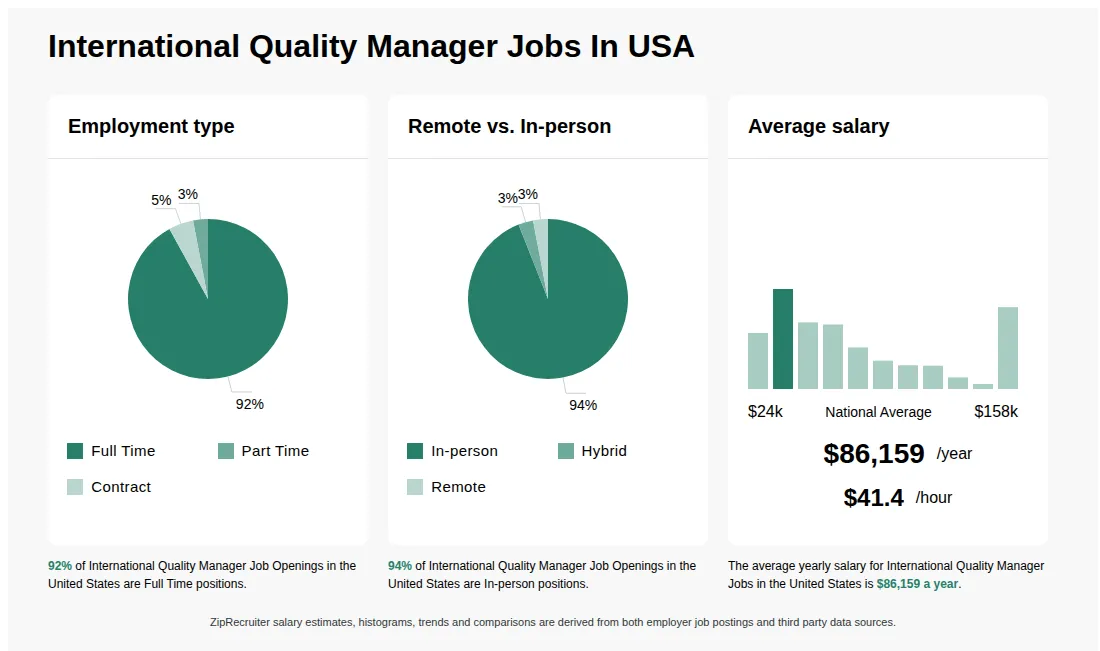
International Quality Manager information
See salary details
$24K - $36.2K
12% of jobs
$44.2K is the 25th percentile. Wages below this are outliers.
$36.2K - $48.4K
20% of jobs
$48.4K - $60.5K
14% of jobs
The median wage is $64.6K / yr.
$60.5K - $72.7K
13% of jobs
$72.7K - $84.9K
9% of jobs
$84.9K - $97.1K
5% of jobs
$104.7K is the 75th percentile. Wages above this are outliers.
$97.1K - $109.3K
4% of jobs
$109.3K - $121.5K
4% of jobs
$121.5K - $133.6K
2% of jobs
$133.6K - $145.8K
0% of jobs
$145.8K - $158K
17% of jobs
$24K
$86.2K
$158K
How much do international quality manager jobs pay per year?
As of Sep 7, 2026, the average yearly pay for international quality manager in the United States is $86,159.00, according to ZipRecruiter salary data. Most workers in this role earn between $44,000.00 and $136,000.00 per year, depending on experience, location, and employer.
What does an international quality manager do?
An International Quality Manager ensures that a company's products or services meet quality standards across global markets. They develop and implement quality control processes, ensure compliance with international regulations, and coordinate with teams across different countries. Their role involves analyzing data, conducting audits, and improving quality systems to enhance customer satisfaction and operational efficiency.
What are the key skills and qualifications needed to thrive as an international quality manager?
To thrive as an International Quality Manager, you need a strong background in quality management systems, process improvement methodologies like Six Sigma or ISO 9001, and often a bachelor's or master's degree in engineering, business, or a related field. Familiarity with tools such as SAP, QMS software, and certifications like CQE (Certified Quality Engineer) or Lead Auditor are typically important. Strong leadership, cross-cultural communication, and problem-solving skills help you excel in managing diverse teams and complex international projects. These competencies are vital for consistently meeting global quality standards, facilitating regulatory compliance, and fostering collaboration across multiple regions.
What are the typical challenges an international quality manager faces when working across global markets?
International Quality Managers often encounter challenges related to navigating different regulatory environments, varying customer expectations, and diverse cultural norms. Managing quality consistency across multiple countries can require close coordination with local teams, suppliers, and partners, as well as the need to adapt processes to fit local requirements without compromising global standards. Successfully balancing these dynamics demands strong communication and project management skills. Overcoming these challenges not only ensures product or service quality but also enhances the company's reputation and competitiveness in global markets.
More about International Quality Manager jobs
What cities are hiring for International Quality Manager jobs?
Cities with the most International Quality Manager job openings:
What states have the most International Quality Manager jobs?
States with the most job openings for International Quality Manager jobs include:
What job categories do people searching International Quality Manager jobs look for?
The top searched job categories for International Quality Manager jobs are:
Full-time
Medical, Dental, Vision, Life, Retirement
This job post has expired 3 days ago. Applications are no longer accepted.
3M rating

7.8
Based on 249 frontline employees who took The Breakroom Quiz
171st of 546 rated manufacturers
Job description
Job Title
Quality Manager
Collaborate with Innovative 3Mers Around the World
Choosing where to start and grow your career has a major impact on your professional and personal life, so it's equally important you know that the company that you choose to work at, and its leaders, will support and guide you. With a wide variety of people, global locations, technologies and products, 3M is a place where you can collaborate with other curious, creative 3Mers.
This position provides an opportunity to transition from other private, public, government or military experience to a 3M career.
The Impact You'll Make in this Role
As a Quality Manager, you will have the opportunity to tap into your curiosity and collaborate with some of the most innovative people around the world. Here, you will make an impact by:
- Consults with leadership team to set medium- to long-term strategic direction and operating plans for a medium to large complex market/product line(s).
- Interprets industry trends, customer requirements, and business objectives to define guidelines/methods for multiple disciplines within the Quality function, such as quality assurance, product quality control, incoming quality control, and customer management
- Initiates and approves projects to continuously improve efficiency and competitiveness.
- Has direct responsibility for functional strategic planning, including establishing and managing budgets for the department in the immediate team.
- Management responsibility usually encompasses one or more quality areas such as quality assurance, product quality control, incoming quality control, customer issue management, and etc.
- Determines priorities, timetables and assigns resources/tasks. Accountable for the activities and results of their functional area.
- Provides direct supervision to the team which include objective setting, performance management, and motivation, as well as training and coaching. Resolves issues and conflicts related to direct reports.
- Creates solutions for complex and multi-faceted problems, which requires ingenuity, creativity, innovation, and strong analytical skills. Problem solving requires thorough understanding of operating unit policies and practices. Applies knowledge of different techniques and practices to achieve desired results.
- Has a significant business impact on the organization due to scope of responsibility and complexity and growth potential of this business.
- Ability to influence cross-functionally to collaborate to common goals.
- Incumbent typically communicates with managers, functional leaders, area/business leaders, and direct subordinates. May interact with key external customers.
- Shares vision and demonstrates company values.
- Providing expert-level Quality functional leadership, guidance, and direction to your team on the Quality Body-of-Knowledge for products within scope.
- Identifying and leading improvement opportunities to proactively ensure compliance to all applicable internal, domestic, and international quality regulations.
- Maintain effective Quality Metric performance and define and execute activities to enhance product quality, reduce process variances, and resolve decreases in performance.
Your Skills and Expertise
To set you up for success in this role from day one, 3M requires (at a minimum) the following qualifications:
- Bachelor's degree or higher (completed and verified prior to start).
- Minimum of five (5) years experience in a quality or manufacturing setting in a private, public, government or military environment.
- Minimum of two (2) years experience in a Quality or Manufacturing leadership position, either direct supervision or by technical team lead role.
Additional qualifications that could help you succeed even further in this role include:
- Master's degree or higher from an accredited institution
- Advanced expertise across multiple quality disciplines, such as quality assurance, product quality control, incoming inspection, Six Sigma, ISO standards, and warranty analysis.
- Experience administering and maintaining ISO 9001 Quality Management Systems.
- Strong project management capabilities, with a track record of leading complex, cross-functional initiatives.
- Exceptional communication and presentation skills, with the ability to effectively engage senior leadership, peers, teams, customers, and regulatory stakeholders.
- Proficiency with corporate systems and digital tools commonly used in Quality functions, along with strong English verbal and written communication skills.
- Experience with Statistical Process Control and other advanced analytical methods used to manage and improve quality performance.
Work Location:
Work location: This role follows an on-site working model, requiring the employee to work at least four days a week at the 3M center in Maplewood, MN.
Travel: May include up to 25% domestic/international
Relocation Assistance: Not authorized
Supporting Your Well-being
3M offers many programs to help you live your best life - both physically and financially. To ensure competitive pay and benefits, 3M regularly benchmarks with other companies that are comparable in size and scope.
Chat with Max
For assistance with searching through our current job openings or for more information about all things 3M, visit Max, our virtual recruiting assistant on 3M.com/careers.
Applicable to US Applicants Only: The expected compensation range for this position is $164,612 - $201,193, which includes base pay plus variable incentive pay, if eligible. This range represents a good faith estimate for this position. The specific compensation offered to a candidate may vary based on factors including, but not limited to, the candidate's relevant knowledge, training, skills, work location, and/or experience. In addition, this position may be eligible for a range of benefits (e.g., Medical, Dental & Vision, Health Savings Accounts, Health Care & Dependent Care Flexible Spending Accounts, Disability Benefits, Life Insurance, Voluntary Benefits, Paid Absences and Retirement Benefits, etc.). Additional information is available at: https://www.3m.com/3M/en_US/careers-us/working-at-3m/benefits/.
All US-based 3M full time employees will need to sign an employee agreement as a condition of employment with 3M. This agreement lays out key terms on using 3M Confidential Information and Trade Secrets. It also has provisions discussing conflicts of interest and how inventions are assigned. Employees that are Job Grade 7 or equivalent and above may also have obligations to not compete against 3M or solicit its employees or customers, both during their employment, and for a period after they leave 3M.
Learn more about 3M's creative solutions to the world's problems at www.3M.com or on Instagram, Facebook, and LinkedIn @3M.
Responsibilities of this position include that corporate policies, procedures and security standards are complied with while performing assigned duties.
Safety is a core value at 3M. All employees are expected to contribute to a strong Environmental Health and Safety (EHS) culture by following safety policies, identifying hazards, and engaging in continuous improvement.
Pay & Benefits Overview: https://www.3m.com/3M/en_US/careers-us/working-at-3m/benefits/
3M does not discriminate in hiring or employment on the basis of race, color, sex, national origin, religion, age, disability, veteran status, or any other characteristic protected by applicable law.
Please note: your application may not be considered if you do not provide your education and work history, either by: 1) uploading a resume, or 2) entering the information into the application fields directly.
3M Global Terms of Use and Privacy Statement
Carefully read these Terms of Use before using this website. Your access to and use of this website and application for a job at 3M are conditioned on your acceptance and compliance with these terms.
Please click on the following links and select the country where you are applying for employment to review the applicable Terms of Use (link here) and Privacy Policy (link here). Before submitting your application, you will be asked to confirm your agreement with the terms.

About 3M
Sourced by ZipRecruiter
Industry
Coal, metals and minerals mining
Company size
10,000+ Employees
Headquarters location
Saint Pau, MN, US
Year founded
1902