
"Job Summary The Infection Control Coordinator coordinates, implements and evaluates the organization's infection prevention and control program. Reports to: Market Director of Infection Prevention ...
"Job Summary The Infection Control Coordinator coordinates, implements and evaluates the organization's infection prevention and control program. Reports to: Market Director of Infection Prevention ...
"Job Summary The Infection Control Coordinator coordinates, implements and evaluates the organization's infection prevention and control program. Reports to: Market Director of Infection Prevention ...
"Job Summary The Infection Control Coordinator coordinates, implements and evaluates the organization's infection prevention and control program. Reports to: Market Director of Infection Prevention ...
Infection Preventionist, RN
Raleigh, NC · On-site
EOE Licensure Certified in Infection Control Required Education Bachelor's Degree Required Bachelor's Degree Medical Laboratory Technology Preferred Bachelor's Degree Science Preferred Bachelor ...
Infection Preventionist, RN
Raleigh, NC · On-site
EOE Licensure Certified in Infection Control Required Education Bachelor's Degree Required Bachelor's Degree Medical Laboratory Technology Preferred Bachelor's Degree Science Preferred Bachelor ...

Nursing Supervisor
Lillington, NC · On-site
Facilitates staff education and inservices in the areas of safety, infection control, OSHA, TB control and performance improvement. Conducts and reviews annual CPR verifications; * Participates in ...
Quick apply
Nursing Supervisor
Lillington, NC · On-site
Facilitates staff education and inservices in the areas of safety, infection control, OSHA, TB control and performance improvement. Conducts and reviews annual CPR verifications; * Participates in ...
Nursing Supervisor
Lillington, NC · On-site
Facilitates staff education and inservices in the areas of safety, infection control, OSHA, TB control and performance improvement. Conducts and reviews annual CPR verifications; * Participates in ...
Nursing Supervisor
Lillington, NC · On-site
Facilitates staff education and inservices in the areas of safety, infection control, OSHA, TB control and performance improvement. Conducts and reviews annual CPR verifications; * Participates in ...

Dental Assistant II
Apex, NC · On-site
$22 - $25/hr
Infection Control: Strictly follow sterilization and disinfection protocols. * Appointment Scheduling: Help manage and confirm patient appointments. * Collaboration: Work closely with the dental team ...
Dental Assistant II
Apex, NC · On-site
$22 - $25/hr
Infection Control: Strictly follow sterilization and disinfection protocols. * Appointment Scheduling: Help manage and confirm patient appointments. * Collaboration: Work closely with the dental team ...
Dental Assistant II
Rolesville, NC · On-site
$20 - $26/hr
Infection Control: Strictly follow sterilization and disinfection protocols. * Appointment Scheduling: Help manage and confirm patient appointments. * Collaboration: Work closely with the dental team ...
Dental Assistant II
Rolesville, NC · On-site
$20 - $26/hr
Infection Control: Strictly follow sterilization and disinfection protocols. * Appointment Scheduling: Help manage and confirm patient appointments. * Collaboration: Work closely with the dental team ...
Dental Assistant II
Holly Springs, NC · On-site
$25 - $30/hr
Infection Control: Strictly follow sterilization and disinfection protocols. * Appointment Scheduling: Help manage and confirm patient appointments. * Collaboration: Work closely with the dental team ...
Dental Assistant II
Holly Springs, NC · On-site
$25 - $30/hr
Infection Control: Strictly follow sterilization and disinfection protocols. * Appointment Scheduling: Help manage and confirm patient appointments. * Collaboration: Work closely with the dental team ...
Dental Assistant II
Apex, NC · On-site
$25 - $30/hr
Infection Control: Strictly follow sterilization and disinfection protocols. * Appointment Scheduling: Help manage and confirm patient appointments. * Collaboration: Work closely with the dental team ...
Dental Assistant II
Apex, NC · On-site
$25 - $30/hr
Infection Control: Strictly follow sterilization and disinfection protocols. * Appointment Scheduling: Help manage and confirm patient appointments. * Collaboration: Work closely with the dental team ...
Dental Assistant II
Fuquay Varina, NC · On-site
$18 - $24/hr
Infection Control: Strictly follow sterilization and disinfection protocols. * Appointment Scheduling: Help manage and confirm patient appointments. * Collaboration: Work closely with the dental team ...
Dental Assistant II
Fuquay Varina, NC · On-site
$18 - $24/hr
Infection Control: Strictly follow sterilization and disinfection protocols. * Appointment Scheduling: Help manage and confirm patient appointments. * Collaboration: Work closely with the dental team ...

Maintains infection control measures as necessary. * Adheres to all regulations pertaining to cleanliness, infection control, and Standard/Universal Precautions. * Assists with research related to ...
Maintains infection control measures as necessary. * Adheres to all regulations pertaining to cleanliness, infection control, and Standard/Universal Precautions. * Assists with research related to ...
Maintains infection control measures as necessary. * Adheres to all regulations pertaining to cleanliness, infection control, and Standard/Universal Precautions. * Assists with research related to ...
Maintains infection control measures as necessary. * Adheres to all regulations pertaining to cleanliness, infection control, and Standard/Universal Precautions. * Assists with research related to ...
Maintains infection control measures as necessary. * Adheres to all regulations pertaining to cleanliness, infection control, and Standard/Universal Precautions. * Assists with research related to ...
Maintains infection control measures as necessary. * Adheres to all regulations pertaining to cleanliness, infection control, and Standard/Universal Precautions. * Assists with research related to ...
Maintains infection control measures as necessary. * Adheres to all regulations pertaining to cleanliness, infection control, and Standard/Universal Precautions. * Assists with research related to ...
Maintains infection control measures as necessary. * Adheres to all regulations pertaining to cleanliness, infection control, and Standard/Universal Precautions. * Assists with research related to ...
Maintains infection control measures as necessary. * Adheres to all regulations pertaining to cleanliness, infection control, and Standard/Universal Precautions. * Assists with research related to ...
Maintains infection control measures as necessary. * Adheres to all regulations pertaining to cleanliness, infection control, and Standard/Universal Precautions. * Assists with research related to ...
Maintains infection control measures as necessary. * Adheres to all regulations pertaining to cleanliness, infection control, and Standard/Universal Precautions. * Assists with research related to ...
Maintains infection control measures as necessary. * Adheres to all regulations pertaining to cleanliness, infection control, and Standard/Universal Precautions. * Assists with research related to ...
Dental Assistant II
Garner, NC · On-site
$24 - $28/hr
Infection Control: Strictly follow sterilization and disinfection protocols. * Appointment Scheduling: Help manage and confirm patient appointments. * Collaboration: Work closely with the dental team ...
Dental Assistant II
Garner, NC · On-site
$24 - $28/hr
Infection Control: Strictly follow sterilization and disinfection protocols. * Appointment Scheduling: Help manage and confirm patient appointments. * Collaboration: Work closely with the dental team ...
Maintains infection control measures as necessary. * Adheres to all regulations pertaining to cleanliness, infection control, and Standard/Universal Precautions. * Assists with research related to ...
Maintains infection control measures as necessary. * Adheres to all regulations pertaining to cleanliness, infection control, and Standard/Universal Precautions. * Assists with research related to ...
Maintains infection control measures as necessary. * Adheres to all regulations pertaining to cleanliness, infection control, and Standard/Universal Precautions. * Assists with research related to ...
Maintains infection control measures as necessary. * Adheres to all regulations pertaining to cleanliness, infection control, and Standard/Universal Precautions. * Assists with research related to ...
Maintains infection control measures as necessary. * Adheres to all regulations pertaining to cleanliness, infection control, and Standard/Universal Precautions. * Assists with research related to ...
Maintains infection control measures as necessary. * Adheres to all regulations pertaining to cleanliness, infection control, and Standard/Universal Precautions. * Assists with research related to ...
Infection Control information
See Raleigh, NC salary details
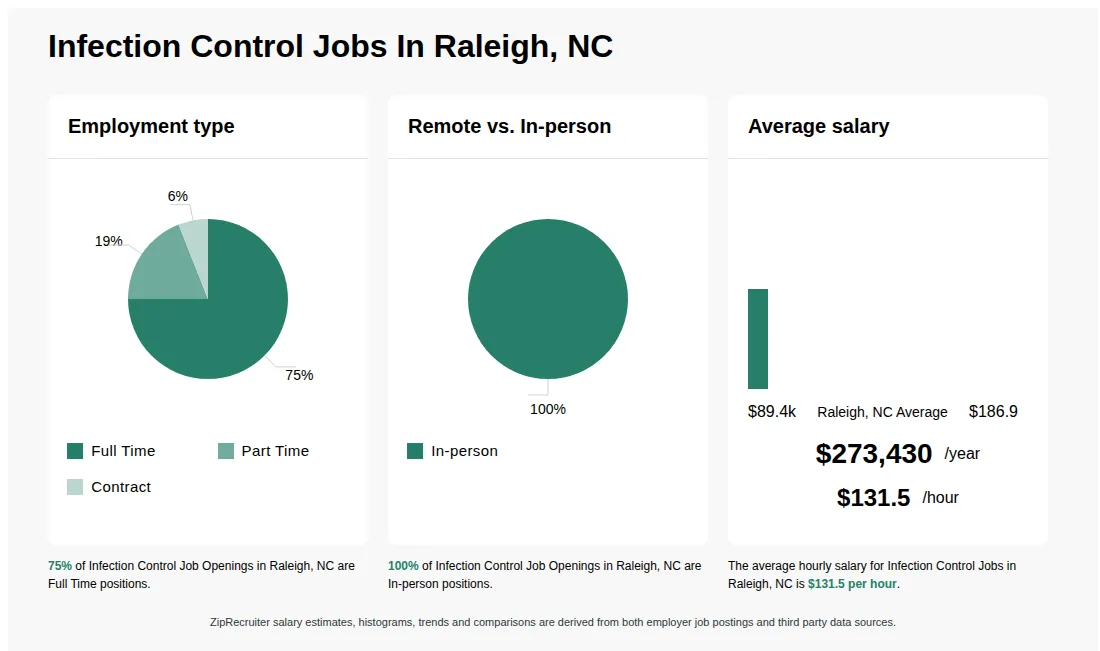
$46.27 is the 25th percentile. Wages below this are outliers.
$43 - $56.08
100% of jobs
$56.08 - $69.17
0% of jobs
$69.17 - $82.25
0% of jobs
$82.25 - $95.34
0% of jobs
$95.34 - $108.42
0% of jobs
$108.42 - $121.51
0% of jobs
$121.51 - $134.60
0% of jobs
$134.60 - $147.68
0% of jobs
$147.68 - $160.77
0% of jobs
$160.77 - $173.85
0% of jobs
$173.85 - $186.94
0% of jobs
$42
$131
$186
How much do infection control jobs pay per hour?
As of Jun 11, 2026, the average hourly pay for infection control in Raleigh, NC is $131.46, according to ZipRecruiter salary data. Most workers in this role earn between $48.37 and $186.92 per hour, depending on experience, location, and employer.
What Are the Qualifications to Get a Job in Infection Control?
The qualifications that you need to get a career in infection control include specialized education, healthcare knowledge, and investigative and planning skills. If your responsibilities involve directly treating patients, you need at least an associate degree in nursing and a nursing license. Since these positions require advanced knowledge of infectious diseases and the associated dangers, employers prefer nurses and practitioners with extensive experience in infectious disease treatment and at least a bachelor’s degree in nursing. Infectious disease coordinators may need a degree in public health in addition to or instead of a master’s degree.
What is the difference between Infection Control vs Medical Assistant?
| Aspect | Infection Control | Medical Assistant |
|---|---|---|
| Certifications | Certified in Infection Control (CIC), OSHA training | Certified Medical Assistant (CMA), CPR certification |
| Work Environment | Hospitals, clinics, public health settings | Doctor's offices, outpatient clinics, hospitals |
| Job Focus | Preventing and managing infections, compliance with health standards | Assisting with patient care, administrative tasks, clinical support |
Infection Control specialists focus on preventing and managing infections within healthcare settings, requiring specific certifications like CIC. Medical Assistants support clinical and administrative tasks in healthcare facilities. While both roles work in healthcare environments, Infection Control professionals concentrate on infection prevention, whereas Medical Assistants provide direct patient care and support.
Can I be an infection preventionist without a nursing degree?
Infection preventionists typically have backgrounds in healthcare, such as nursing, public health, or microbiology, and often hold certifications like the Certification in Infection Control (CIC). While a nursing degree is common, it is not always required if the individual has relevant education, experience, and certification in infection control practices.
What are some common challenges faced by professionals in Infection Control roles, and how can they be addressed?
Infection Control professionals often face challenges such as ensuring staff compliance with protocols, keeping up with evolving regulations, and managing outbreaks swiftly. Navigating resistance to change and promoting a culture of safety can require strong communication and education skills. Successful Infection Control specialists frequently collaborate with multidisciplinary teams, provide ongoing training, and stay updated through continuing education to effectively address these challenges.
What are the key skills and qualifications needed to thrive as an Infection Control professional, and why are they important?
To thrive as an Infection Control professional, you need a background in microbiology or nursing, knowledge of infection prevention protocols, and usually a relevant certification such as CIC (Certification in Infection Control). Familiarity with epidemiological surveillance systems, data analysis tools, and regulatory guidelines like those from the CDC or WHO is essential. Strong communication, attention to detail, and analytical thinking are standout soft skills in this position. These abilities are vital to effectively prevent and manage healthcare-associated infections, ensuring patient safety and regulatory compliance.
What is the career path for infection control?
The career path for infection control professionals typically begins with a relevant degree such as a nursing, public health, or microbiology degree. Entry-level roles include infection control practitioner or specialist, with advancement to senior infection control coordinator, manager, or director roles often requiring additional experience, certifications like CIC (Certified in Infection Control), and leadership skills. Opportunities exist in healthcare facilities, public health agencies, and industry, with increasing responsibility and specialization over time.
Is infection prevention a good career?
Infection control is a vital healthcare role focused on preventing the spread of infections through protocols, training, and monitoring. It often requires certifications such as CIC and involves working in healthcare settings, laboratories, or public health agencies, offering stable employment and opportunities for advancement.
How much do infection preventionists make?
Infection preventionists typically earn an average annual salary of around $70,000 to $85,000, depending on experience, certification, and work setting. Salaries can vary based on location, with higher wages often found in larger healthcare facilities and regions with higher living costs. Certification as a Certified in Infection Control (CIC) can also influence earning potential.
What is infection control?
Infection control refers to the policies and procedures used to minimize the risk of spreading infections, particularly in hospitals and healthcare settings. Infection control professionals work to prevent and manage the transmission of infectious diseases among patients, healthcare workers, and visitors. This includes implementing hygiene practices, sterilization protocols, and monitoring outbreaks. Effective infection control helps ensure patient safety and protects public health.
More about Infection Control jobs
What are the most commonly searched types of Infection Control jobs in Raleigh, NC? The most popular types of Infection Control jobs in Raleigh, NC are:
What are popular job titles related to Infection Control jobs in Raleigh, NC? For Infection Control jobs in Raleigh, NC, the most frequently searched job titles are:
What job categories do people searching Infection Control jobs in Raleigh, NC look for? The top searched job categories for Infection Control jobs in Raleigh, NC are:
What cities near Raleigh, NC are hiring for Infection Control jobs? Cities near Raleigh, NC with the most Infection Control job openings:
LifePoint Health rating

5.9
Based on 258 frontline employees who took The Breakroom Quiz
749th of 870 rated healthcare providers
Job description
"Job Summary
The Infection Control Coordinator coordinates, implements and evaluates the organization's infection prevention and control program.
Reports to: Market Director of Infection Prevention
FLSA: NonExempt
Job Requirements
Minimum Education
Associate's Degree Nursing (ADN) Required or
Associates of Science Degree in Clinical Laboratory Technology or Medical Laboratory Technician.
Bachelor's Degree Nursing (BSN) Preferred or
Bachelors of Science Degree in Clinical Laboratory Technology or Medical Laboratory Technician.
Required Skills
Licenses:
Registered Nurse or MLT/MT (ASCP) or MLT/MT (AMT) or MLT/MT (HEW) or CLT (NCA)
Requires critical thinking skills, decisive judgment and the ability to work with minimal supervision. Must be able to work in a stressful environment and take appropriate action.
Essential Functions
Coordinates the development and evaluation of the organization's infection prevention and control strategies, policies, and planning.
Collects and performs statistical analysis, interpretation and dissemination of healthcare acquired infection data, including risk assessment, surveillance priorities, and outcomes analysis.
Develops and implements departmental goals, plans, and standards consistent with the clinical, administrative, legal, and ethical requirements/objectives of the organization.
Monitors local, state and federal regulations and ensures compliance with accrediting and regulatory agencies' standards and requirements.
Integrates evidence-based practices into operations and clinical protocols. Assists with the development of educational resources and initiatives.
Monitors research and developments in the field of infection prevention and control to identify best practices.
Functional Demands
Populations Served
Adolescent (13 and Young Adult (17 to Middle Adult (30 years to Older Adult (>60 years)
Protected Health Information
Type of Protected Information Accessed:
Demographic
Clinical
Complete Medical Record
Bloodborne Pathogens Exposure
While performing this job, occupational exposure is present for all employees
Physical Requirements - Physical Dexterity and Effort: Rarely Bending/Stooping occasionally
Climbing rarely
Keyboard Data Entry frequently
Kneeling occasionally
Lifting/Moving Patients rarely
Reaching occasionally
Repetitive Foot/Leg Movements rarely
Repetitive Hand/Arm Movements frequently
Running rarely
Sitting frequently
Squatting occasionally
Standing frequently
Walking frequently
Pushing / Pulling: 0-25 lbs. occasionally
Pushing / Pulling: 26-75 lbs. occasionally
Pushing/Pulling: over 75 lbs. occasionally
Lifting/Carrying (non-patient) : 0-25 lbs. occasionally
Lifting/Carrying (non-patient) : 26-75 lbs. rarely
Lifting/Carrying (non-patient) : over 75 lbs. rarely
Visual Acuity, Hearing and Speaking: Rarely Audible Speech frequently
Hearing Acuity frequently
Smelling Acuity rarely
Taste Discrimination rarely
Vision: Depth Perception frequently
Vision: Distinguish Color frequently
Vision: Seeing Far frequently
Vision: Seeing Near frequently
Biological: Rarely Biohazardous waste/ hazards occasionally
Blood and/or bodily fluids occasionally
Communicable diseases/pathogens occasionally
Chemical: Rarely Asbestos or lead rarely
Cytotoxic Chemicals rarely
Dust rarely
Hazardous Chemicals rarely
Gases/Vapors/Fumes occasionally
Hazardous Medication rarely
Latex rarely"
"Job Summary
The Infection Control Coordinator coordinates, implements and evaluates the organization's infection prevention and control program.
Reports to: Market Director of Infection Prevention
FLSA: NonExempt
Job Requirements
Minimum Education
Associate's Degree Nursing (ADN) Required or
Associates of Science Degree in Clinical Laboratory Technology or Medical Laboratory Technician.
Bachelor's Degree Nursing (BSN) Preferred or
Bachelors of Science Degree in Clinical Laboratory Technology or Medical Laboratory Technician.
Required Skills
Licenses:
Registered Nurse or MLT/MT (ASCP) or MLT/MT (AMT) or MLT/MT (HEW) or CLT (NCA)
Requires critical thinking skills, decisive judgment and the ability to work with minimal supervision. Must be able to work in a stressful environment and take appropriate action.
Essential Functions
Coordinates the development and evaluation of the organization's infection prevention and control strategies, policies, and planning.
Collects and performs statistical analysis, interpretation and dissemination of healthcare acquired infection data, including risk assessment, surveillance priorities, and outcomes analysis.
Develops and implements departmental goals, plans, and standards consistent with the clinical, administrative, legal, and ethical requirements/objectives of the organization.
Monitors local, state and federal regulations and ensures compliance with accrediting and regulatory agencies' standards and requirements.
Integrates evidence-based practices into operations and clinical protocols. Assists with the development of educational resources and initiatives.
Monitors research and developments in the field of infection prevention and control to identify best practices.
Functional Demands
Populations Served
Adolescent (13 and Young Adult (17 to Middle Adult (30 years to Older Adult (>60 years)
Protected Health Information
Type of Protected Information Accessed:
Demographic
Clinical
Complete Medical Record
Bloodborne Pathogens Exposure
While performing this job, occupational exposure is present for all employees
Physical Requirements - Physical Dexterity and Effort: Rarely Bending/Stooping occasionally
Climbing rarely
Keyboard Data Entry frequently
Kneeling occasionally
Lifting/Moving Patients rarely
Reaching occasionally
Repetitive Foot/Leg Movements rarely
Repetitive Hand/Arm Movements frequently
Running rarely
Sitting frequently
Squatting occasionally
Standing frequently
Walking frequently
Pushing / Pulling: 0-25 lbs. occasionally
Pushing / Pulling: 26-75 lbs. occasionally
Pushing/Pulling: over 75 lbs. occasionally
Lifting/Carrying (non-patient) : 0-25 lbs. occasionally
Lifting/Carrying (non-patient) : 26-75 lbs. rarely
Lifting/Carrying (non-patient) : over 75 lbs. rarely
Visual Acuity, Hearing and Speaking: Rarely Audible Speech frequently
Hearing Acuity frequently
Smelling Acuity rarely
Taste Discrimination rarely
Vision: Depth Perception frequently
Vision: Distinguish Color frequently
Vision: Seeing Far frequently
Vision: Seeing Near frequently
Biological: Rarely Biohazardous waste/ hazards occasionally
Blood and/or bodily fluids occasionally
Communicable diseases/pathogens occasionally
Chemical: Rarely Asbestos or lead rarely
Cytotoxic Chemicals rarely
Dust rarely
Hazardous Chemicals rarely
Gases/Vapors/Fumes occasionally
Hazardous Medication rarely
Latex rarely"
What LifePoint Health employees say
Pay
Benefits
Hours and flexibility
Workplace
Get the full story on Breakroom

About LifePoint Health
Sourced by ZipRecruiter
Lifepoint Health serves patients, clinicians, communities and partners across the healthcare continuum. Our diversified healthcare delivery network extends from coast to coast, consisting of community hospitals, rehabilitation and behavioral health hospitals, and additional sites of care.
Industry
Health care and social assistance
Company size
10,000+ Employees
Headquarters location
Brentwood, TN, US
Year founded
1999