TECHNICAL ASSOCIATE I , LANGER LAB, Koch Institute (KI) for Integrative Cancer Research (multiple ... rat, etc.), in-vivo imaging and collection of animal samples/specimen, including blood and/or ...
TECHNICAL ASSOCIATE I , LANGER LAB, Koch Institute (KI) for Integrative Cancer Research (multiple ... rat, etc.), in-vivo imaging and collection of animal samples/specimen, including blood and/or ...

Research Scientist I
Milwaukee, WI · On-site
RGD is the dedicated NIH-funded knowledgebase for the laboratory rat, along with human and several ... Mentor graduate students and contribute to training and scientific development within the lab ...
Research Scientist I
Milwaukee, WI · On-site
RGD is the dedicated NIH-funded knowledgebase for the laboratory rat, along with human and several ... Mentor graduate students and contribute to training and scientific development within the lab ...
Research Scientist I
Milwaukee, WI · On-site
RGD is the dedicated NIH-funded knowledgebase for the laboratory rat, along with human and several ... Mentor graduate students and contribute to training and scientific development within the lab ...
Research Scientist I
Milwaukee, WI · On-site
RGD is the dedicated NIH-funded knowledgebase for the laboratory rat, along with human and several ... Mentor graduate students and contribute to training and scientific development within the lab ...

Research Services Professional
Aurora, CO · On-site
$18.25 - $25.25/hr
Prepare lab for daily operations, including stocking materials, equipment, safety, cleanliness, and ... Prepare and process rat samples, including blood and tissue collection. * Conduct ocular ...
Research Services Professional
Aurora, CO · On-site
$18.25 - $25.25/hr
Prepare lab for daily operations, including stocking materials, equipment, safety, cleanliness, and ... Prepare and process rat samples, including blood and tissue collection. * Conduct ocular ...
Research Services Professional
$18.25 - $25.25/hr
Prepare lab for daily operations, including stocking materials, equipment, safety, cleanliness, and ... Prepare and process rat samples, including blood and tissue collection. * Conduct ocular ...
Research Services Professional
$18.25 - $25.25/hr
Prepare lab for daily operations, including stocking materials, equipment, safety, cleanliness, and ... Prepare and process rat samples, including blood and tissue collection. * Conduct ocular ...

Research Technician
Atlanta, GA · On-site
$17.25 - $23.75/hr
... human samples. * o Maintaining rat colony and isolating rat cortical neurons. * o Conducting and ... Manages day-to-day laboratory activities including organizing and cleaning lab and supplies ...
Research Technician
Atlanta, GA · On-site
$17.25 - $23.75/hr
... human samples. * o Maintaining rat colony and isolating rat cortical neurons. * o Conducting and ... Manages day-to-day laboratory activities including organizing and cleaning lab and supplies ...
Research Technician
Atlanta, GA · On-site
$17 - $23.25/hr
... human samples. * o Maintaining rat colony and isolating rat cortical neurons. * o Conducting and ... Manages day-to-day laboratory activities including organizing and cleaning lab and supplies ...
Research Technician
Atlanta, GA · On-site
$17 - $23.25/hr
... human samples. * o Maintaining rat colony and isolating rat cortical neurons. * o Conducting and ... Manages day-to-day laboratory activities including organizing and cleaning lab and supplies ...

Postdoctoral Research Associate, Department of Child Health (College of Medicine - Phoenix)
Phoenix, AZ · On-site
$50 - $70/hr
The lab studies the molecular and immunological mechanisms underlying pulmonary arterial ... Using mouse and rat models and human cell-based systems, the research investigates RAB7 deficiency ...
Postdoctoral Research Associate, Department of Child Health (College of Medicine - Phoenix)
Phoenix, AZ · On-site
$50 - $70/hr
The lab studies the molecular and immunological mechanisms underlying pulmonary arterial ... Using mouse and rat models and human cell-based systems, the research investigates RAB7 deficiency ...

The successful candidate will lead a research project dedicated to identifying the abnormal neuronal circuits, cell biological and molecular mechanisms in mouse, rat, and human models of rare copy ...
The successful candidate will lead a research project dedicated to identifying the abnormal neuronal circuits, cell biological and molecular mechanisms in mouse, rat, and human models of rare copy ...
Postdoctoral Research Associate, Department of Child Health (College of Medicine - Phoenix)
Phoenix, AZ · On-site
The lab studies the molecular and immunological mechanisms underlying pulmonary arterial ... Using mouse and rat models of pulmonary vascular disease and human cell-based systems, this ...
Postdoctoral Research Associate, Department of Child Health (College of Medicine - Phoenix)
Phoenix, AZ · On-site
The lab studies the molecular and immunological mechanisms underlying pulmonary arterial ... Using mouse and rat models of pulmonary vascular disease and human cell-based systems, this ...

Sr Research Associate 2, In Vivo for Biology Research
Petaluma, CA · On-site
$97K - $146K/yr
... human disease. Perform in vivo lab experiments including but not limited to dosing (ip, iv, sc, po ... Demonstrated ability in rodent handling (mouse, rat) and experience with PK/PD studies and ...
Quick apply
Sr Research Associate 2, In Vivo for Biology Research
Petaluma, CA · On-site
$97K - $146K/yr
... human disease. Perform in vivo lab experiments including but not limited to dosing (ip, iv, sc, po ... Demonstrated ability in rodent handling (mouse, rat) and experience with PK/PD studies and ...

Staff Scientist
Beaverton, OR · On-site
... rat, mouse, human and monkey cells and viruses. * Oversees all hESC/HPC experiments including mentoring and training all lab personal for the following procedures: hESC culture and maintenance ...
Staff Scientist
Beaverton, OR · On-site
... rat, mouse, human and monkey cells and viruses. * Oversees all hESC/HPC experiments including mentoring and training all lab personal for the following procedures: hESC culture and maintenance ...
Staff Scientist
Beaverton, OR · On-site
$90 - $130/hr
... rat, mouse, human and monkey cells and viruses. * Oversees all hESC/HPC experiments including mentoring and training all lab personal for the following procedures: hESC culture and maintenance ...
Staff Scientist
Beaverton, OR · On-site
$90 - $130/hr
... rat, mouse, human and monkey cells and viruses. * Oversees all hESC/HPC experiments including mentoring and training all lab personal for the following procedures: hESC culture and maintenance ...
Staff Scientist
Beaverton, OR · On-site
... rat, mouse, human and monkey cells and viruses. * Oversees all hESC/HPC experiments including mentoring and training all lab personal for the following procedures: hESC culture and maintenance ...
Staff Scientist
Beaverton, OR · On-site
... rat, mouse, human and monkey cells and viruses. * Oversees all hESC/HPC experiments including mentoring and training all lab personal for the following procedures: hESC culture and maintenance ...
Staff Scientist
Beaverton, OR · On-site
... rat, mouse, human and monkey cells and viruses. * Oversees all hESC/HPC experiments including mentoring and training all lab personal for the following procedures: hESC culture and maintenance ...
Staff Scientist
Beaverton, OR · On-site
... rat, mouse, human and monkey cells and viruses. * Oversees all hESC/HPC experiments including mentoring and training all lab personal for the following procedures: hESC culture and maintenance ...
Staff Scientist
Beaverton, OR · On-site
$90 - $130/hr
... rat, mouse, human and monkey cells and viruses. * Oversees all hESC/HPC experiments including mentoring and training all lab personal for the following procedures: hESC culture and maintenance ...
Staff Scientist
Beaverton, OR · On-site
$90 - $130/hr
... rat, mouse, human and monkey cells and viruses. * Oversees all hESC/HPC experiments including mentoring and training all lab personal for the following procedures: hESC culture and maintenance ...
Staff Scientist
Beaverton, OR · On-site
$86K - $144K/yr
... rat, mouse, human and monkey cells and viruses. * Oversees all hESC/HPC experiments including mentoring and training all lab personal for the following procedures: hESC culture and maintenance ...
Staff Scientist
Beaverton, OR · On-site
$86K - $144K/yr
... rat, mouse, human and monkey cells and viruses. * Oversees all hESC/HPC experiments including mentoring and training all lab personal for the following procedures: hESC culture and maintenance ...
Staff Scientist
Beaverton, OR · On-site
... rat, mouse, human and monkey cells and viruses. * Oversees all hESC/HPC experiments including mentoring and training all lab personal for the following procedures: hESC culture and maintenance ...
Staff Scientist
Beaverton, OR · On-site
... rat, mouse, human and monkey cells and viruses. * Oversees all hESC/HPC experiments including mentoring and training all lab personal for the following procedures: hESC culture and maintenance ...

Student Assistant
Newark, NJ · On-site
$15.92/hr
Maintain mouse and rat colony (for ex, genotyping, breeding, weaning). * Understands and adheres to ... Lab environment. * Moderate Noise. Special Conditions Posting Details Posting Number 26ST1662 ...
Student Assistant
Newark, NJ · On-site
$15.92/hr
Maintain mouse and rat colony (for ex, genotyping, breeding, weaning). * Understands and adheres to ... Lab environment. * Moderate Noise. Special Conditions Posting Details Posting Number 26ST1662 ...
Human Lab Rat information
See salary details
$10.34 - $12.11
0% of jobs
$12.11 - $13.88
2% of jobs
$13.88 - $15.65
12% of jobs
$16.84 is the 25th percentile. Wages below this are outliers.
$15.65 - $17.42
17% of jobs
$17.42 - $19.19
18% of jobs
The median wage is $19.35 / hr.
$19.19 - $20.96
17% of jobs
$22.45 is the 75th percentile. Wages above this are outliers.
$20.96 - $22.73
12% of jobs
$22.73 - $24.50
9% of jobs
$24.50 - $26.27
7% of jobs
$26.27 - $28.04
4% of jobs
$28.04 - $29.81
2% of jobs
$10
$20
$29
How much do human lab rat jobs pay per hour?
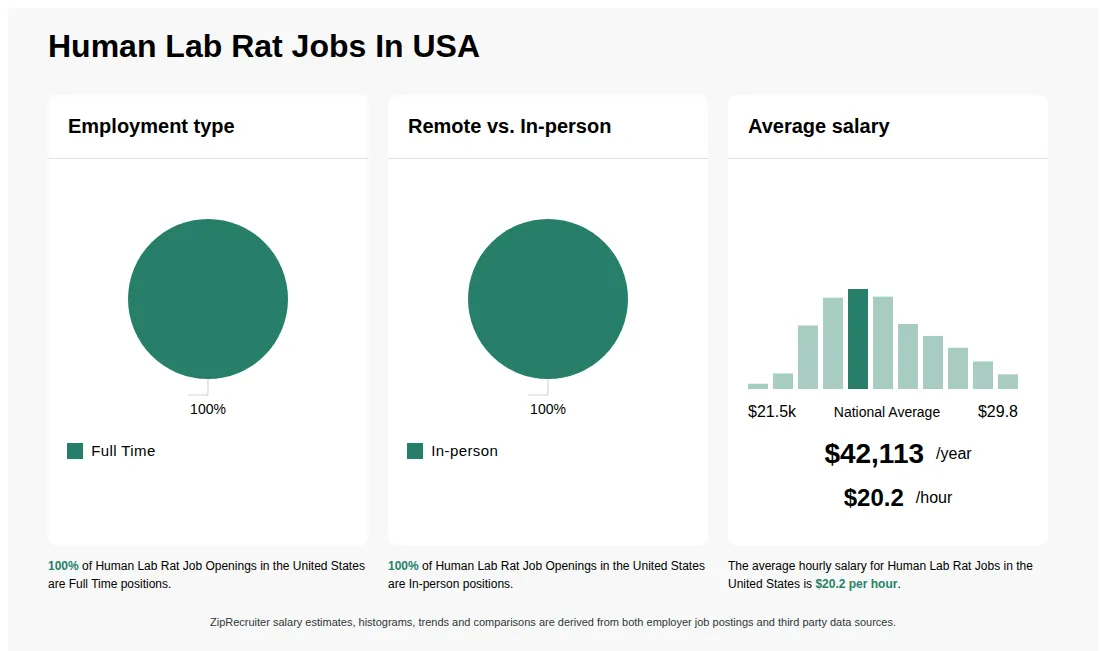
As of Sep 6, 2026, the average hourly pay for human lab rat in the United States is $20.25, according to ZipRecruiter salary data. Most workers in this role earn between $16.59 and $23.08 per hour, depending on experience, location, and employer.
What is a human lab rat?
A Human Lab Rat job typically involves participating in clinical trials or medical studies as a test subject. Volunteers may be asked to take experimental medications, undergo medical procedures, or participate in psychological or behavioral studies. These roles help researchers gather data on the safety and effectiveness of new treatments. Compensation varies based on study length and complexity, and participants must meet eligibility requirements. Risks and benefits are explained before enrollment through an informed consent process.
What should I expect during the typical day as a human lab rat?
As a Human Lab Rat, or clinical trial participant, your daily activities will depend on the specific study, but often include scheduled health assessments, following research protocols such as taking medications or following special diets, and reporting your symptoms or experiences to research staff. You may need to stay at the testing facility for observation or visit periodically for check-ups and data collection. Research staff will guide you through each step, and you will typically be compensated for your time and efforts. Participation can require patience and flexibility, but it's also a chance to contribute to important medical advancements while working closely with a supportive team.
What are the key skills and qualifications needed to thrive as a human lab rat?
To thrive as a Human Lab Rat (clinical trial participant), you need good physical health, attention to detail, and the ability to carefully follow study protocols, with basic literacy and in some cases specific health or age qualifications required. Participants may interact with monitoring devices, complete digital questionnaires, and adhere to medical or dietary regimens as directed by study staff. Reliability, patience, and clear communication are important soft skills, as is a willingness to report symptoms or changes consistently. These skills ensure both participant safety and the integrity of clinical research data, which are critical for successful trials.
More about Human Lab Rat jobs
What cities are hiring for Human Lab Rat jobs?
Cities with the most Human Lab Rat job openings:
What are the most commonly searched types of Human Lab Rat jobs?
The most popular types of Human Lab Rat jobs are:
What states have the most Human Lab Rat jobs?
States with the most job openings for Human Lab Rat jobs include:
What job categories do people searching Human Lab Rat jobs look for?
The top searched job categories for Human Lab Rat jobs are:

Full-time
Re-posted 9 days ago
Job description
TECHNICAL ASSOCIATE I, LANGER LAB, Koch Institute (KI) for Integrative Cancer Research (multiple openings), to join the Jaklenec Group and support our interdisciplinary and dynamic team with the development of injectable drug delivery systems for vaccines and small molecule therapeutics; contribute to a diverse range of therapeutic areas; be responsible for end-to-end fabrication of drug or vaccine delivery materials using semiconductor industry manufacturing techniques and surgical-level dexterity; administration of intradermal, subcutaneous, intramuscular, and intraperitoneal injections in animal models (mice, rat, etc.), in-vivo imaging and collection of animal samples/specimen, including blood and/or tissues, for quantitative or qualitative analysis, conducting in-vitro release kinetics and biological assays (e.g., ELISA), designing and executing experiments for formulation, development, optimization, characterization of drug delivery systems using analytical techniques/instruments [dynamic light scattering (DLS), transmission electron microscopy (TEM), and nuclear magnetic resonance (NMR), and maintenance of various types of cell lines.

About MIT Human Resources
Sourced by ZipRecruiter
Our mission is to advance a vibrant and diverse work community where individuals and groups thrive and contribute to MIT's excellence. We offer Support, Services, and Programs to enhance your work life. We're here to help. MIT is committed to helping employees achieve a healthy balance between their careers and the full lives they lead off-campus. Explore all of MIT's Work & Life resources, including MyLife Services, which provides 24/7 access to a network of experts available to help with life’s challenges.
Industry
Human resource programs administration
Company size
1 - 10 Employees
Headquarters location
Cambridge, MA, US
Year founded
2014