1

Home Automation Jobs (NOW HIRING)

Smart Home Technician

Tampa, FL · On-site

$20 - $26/hr

If you're someone who gets excited about working with the latest AV tech and building jaw-dropping home automation systems, we want YOU! As our Smart Home Technician, you'll be at the heart of ...

Be Seen First

Electrician

Vero Beach, FL · On-site

$22 - $30.25/hr

Comet is a THREE time CONTROL4 Home Automation Dealer of the Year Award Winner. We are a second generation family owned business celebrating our 50th by delivering quality installations and service ...

Salary: Based on Experience 4.0 PROFESSIONAL 4.1 High school diploma or GED. 4.2 Preferably 1-3 years of experience in network Installations, video surveillance installations, home automation ...

We install premium smart home systems, including lighting, shades, A/V, networking, and smart home automation, for some of the most spectacular homes in America. We're growing, and we need a Smart ...

We install premium smart home systems, including lighting, shades, A/V, networking, and smart home automation, for some of the most spectacular homes in America. We're growing, and we need a Smart ...

We install premium smart home systems, including lighting, shades, A/V, networking, and smart home automation, for some of the most spectacular homes in America. We're growing, and we need a Smart ...

Smart Home Technician

Naples, FL · On-site

$25 - $35/hr

We install premium smart home systems, including lighting, shades, A/V, networking, and smart home automation, for some of the most spectacular homes in America. We're growing, and we need a Smart ...

next page

Showing results 1-20

Home Automation information

See salary details

$31K

$116.6K

$169.5K

How much do home automation jobs pay per year?

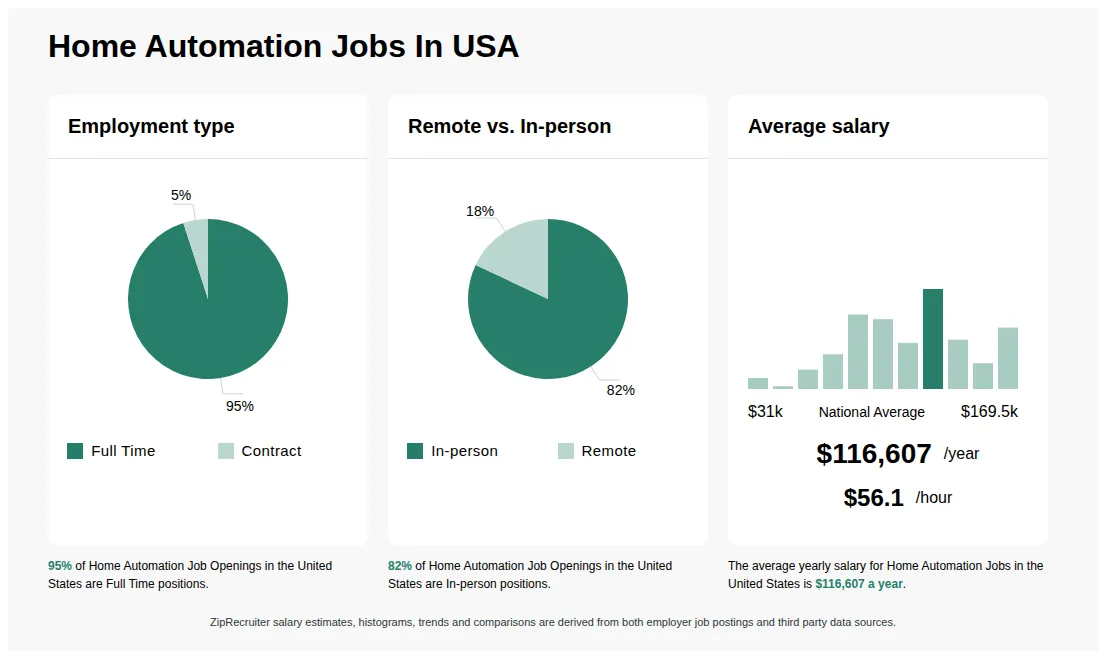
As of Jun 15, 2026, the average yearly pay for home automation in the United States is $116,607.00, according to ZipRecruiter salary data. Most workers in this role earn between $91,500.00 and $139,000.00 per year, depending on experience, location, and employer.

What are some common challenges faced by professionals working in home automation, and how can they be addressed?

Professionals in home automation often encounter challenges such as integrating devices from different manufacturers, ensuring network security, and keeping up with rapidly evolving technology. To address these issues, it's important to stay updated on industry standards and certifications, collaborate closely with manufacturers, and invest in ongoing training. Additionally, clear communication with clients about their needs and the limitations of certain products can help set realistic expectations and lead to more successful project outcomes.

What job makes $10,000 a month without a degree?

In home automation, roles such as experienced installers, system designers, or project managers can earn around $10,000 per month through specialized skills, certifications, and successful project management. These positions often require technical knowledge, hands-on experience, and the ability to manage multiple projects independently.

What Are Home Automation Jobs?

Home automation jobs involve the installation, customization, and repair of residential home control and security systems. Your duties include working with smart home equipment that allows people to control heating and cooling, lighting, and other features, as well as monitor security within their home. Smart home technology can also collect data and adjust automatically. Your responsibilities include connecting the systems to an internet network, testing the network and automation equipment to ensure effectiveness, and showing the homeowner how to use their new systems. You may work for a company that sells a specific product or an IT service that can connect multiple systems.

What is a home automation job?

A home automation job involves designing, installing, and maintaining systems that control home functions such as lighting, security, climate, and entertainment. Professionals in this field often work with smart devices, networking, and programming, requiring technical skills and knowledge of automation platforms. The role may include troubleshooting and providing customer support for integrated home systems.

What are the key skills and qualifications needed to thrive as a Home Automation Specialist, and why are they important?

To thrive as a Home Automation Specialist, you need a strong background in electrical systems, networking, and smart home technology, typically supported by technical certifications or relevant experience. Familiarity with platforms like Control4, Crestron, or KNX, and proficiency in using configuration and diagnostic software are commonly required. Strong problem-solving skills, attention to detail, and effective communication are important soft skills for collaborating with clients and resolving technical issues. These abilities ensure reliable installation, seamless integration, and high customer satisfaction in smart home projects.

What 5 jobs will survive AI?

Home automation jobs such as automation technicians, system integrators, and smart device installers are likely to persist because they require hands-on skills, troubleshooting, and customer interaction that are difficult for AI to replicate. Roles involving complex problem-solving, creative design, and personalized service are also expected to remain in demand. Additionally, jobs requiring physical presence and manual dexterity, like maintenance and installation, will continue to be essential in the industry.

What is the difference between Home Automation vs Home Automation Technician?

AspectHome AutomationHome Automation Technician
CredentialsKnowledge of smart devices, networking, and basic programmingCertifications in smart home systems, networking, and installation
Work EnvironmentDesigning, planning, and overseeing automation systemsInstalling, configuring, and troubleshooting smart home devices
Employer & IndustryTech companies, custom integrators, or self-employedHome automation service providers, installation companies
Search & Comparison IntentUnderstanding automation concepts and career optionsLearning about installation roles and required skills

While Home Automation involves designing and planning smart home systems, Home Automation Technicians focus on installing and maintaining these systems. Both roles require knowledge of smart devices and networking, but technicians typically hold specific certifications and work directly on device setup. Understanding these differences helps clarify career paths and job expectations in the smart home industry.

What are home automation specialists?

Home automation specialists are professionals who design, install, and maintain smart home systems that control lighting, climate, security, entertainment, and other home functions. They integrate various devices and technologies to create a seamless, automated living environment. These specialists work with products like smart thermostats, security cameras, and voice assistants, ensuring that all components work together efficiently for convenience and energy savings.

Is home automation in demand?

Home automation is in high demand as consumers seek smart home systems for convenience, security, and energy efficiency. This growth drives employment opportunities for home automation specialists skilled in installing, programming, and maintaining smart devices and systems. The industry is expected to continue expanding with advancements in IoT technology and increasing adoption of connected home solutions.
What cities are hiring for Home Automation jobs? Cities with the most Home Automation job openings:
What are the most commonly searched types of Home Automation jobs? The most popular types of Home Automation jobs are:
What states have the most Home Automation jobs? States with the most job openings for Home Automation jobs include:
What job categories do people searching Home Automation jobs look for? The top searched job categories for Home Automation jobs are:
Infographic showing various Home Automation job openings in the United States as of June 2026, with employment types broken down into 29% Full Time, and 71% Part Time. Highlights an 87% Physical, 1% Hybrid, and 12% Remote job distribution, with an average salary of $116,607 per year, or $56.1 per hour.

Home Automation Installer / Systems Integrator

ProSource

Austin, TX • On-site

$23 - $35/hr

Full-time

Medical, Retirement, PTO

Posted 21 days ago


Job description

We are a large Central Austin Home Automation Company with a showroom in Central Austin. We build large projects off of blue prints with extensive designs to include, audio, video, lighting control, led lighting, outdoor lighting, security, surveillance, access control for doors and gates, Lutron shades, etc.
We are looking for an individual who wants to become a pro at all of this. The candidate MUST have knowledge of low voltage systems and know how to use hand tools well. Role initially includes cutting in speakers, running some cable, installing led lighting, hanging TVs, potentially building racks, installing cameras and potentially security systems, etc. We are not looking for a pro necessarily, but someone who works hard and clean with general knowledge and a desire to learn more. We have pros and are willing to train the right person.
We provide a van, tools, vacation, retirement, and health insurance. Pay can range from $23 per hour to $34 per hour, depending on the level of experience and ability to produce. Our company has a great vibe and showroom. Our staff has been with us for years and we have been in business since 2005. If you want to build cool projects with cool people text me at 512-799 2379 and we can start a conversation.
Compensation: $23.00 - $35.00 per hour
Smart Home Integration offers a tremendous growth opportunity for a variety of skill sets including sales, technician, project management, operations and more
According to CEDIA, the global trade association for the home technology industry, the most recent 2021 Integrated Home Market Analysis reports the estimated value of the integrated home market at $20.1B. Categories experiencing the most growth include lighting, motorized shades, lighting control, and networking. Smart Home Integrators offer careers in sales, operations, marketing, project management, finance, merchandising, purchasing, technical trades, and customer service. If you're seeking to make an impact from the start of your career, spark impressive change, learn new or innovative skills, and most importantly, gain success in a field that rewards ambitious hard workers, a Smart Home Integration opportunity is for you!
Benefits of working in Smart Home Integration
Opportunity for Growth
If you want a responsible and engaging position in a fun environment, why not choose the Smart Home Integration sector. With the proper training and career road map, you can write your own ticket!
Gain In-Demand Skills
As consumers focus on improving and connecting their lives at home, growth in the smart home sector is booming.