1

Helitack Crew Jobs (NOW HIRING)

Unit Fire Chief

Phoenix, AZ · On-site

$112K/yr

At least one full fire season working in a primary wildland firefighting role (e.g., Engine Crew, Fire Effects Crew, Prescribed Fire/Fuels Crew, Hand Crew, Helitack Crew, Hotshot Crew, Smokejumper ...

Unit Fire Chief

Boise, ID · On-site

$112K/yr

At least one full fire season working in a primary wildland firefighting role (e.g., Engine Crew, Fire Effects Crew, Prescribed Fire/Fuels Crew, Hand Crew, Helitack Crew, Hotshot Crew, Smokejumper ...

Unit Fire Chief

Gallup, NM · On-site

$112K/yr

At least one full fire season working in a primary wildland firefighting role (e.g., Engine Crew, Fire Effects Crew, Prescribed Fire/Fuels Crew, Hand Crew, Helitack Crew, Hotshot Crew, Smokejumper ...

next page

Showing results 1-20

Helitack Crew information

See salary details

$10

$21

$32

How much do helitack crew jobs pay per hour?

As of Jul 9, 2026, the average hourly pay for helitack crew in the United States is $21.28, according to ZipRecruiter salary data. Most workers in this role earn between $16.83 and $24.76 per hour, depending on experience, location, and employer.

What are some common challenges faced by helitack crew members during wildfire response operations?

Helitack crew members often face challenges such as rapidly changing fire conditions, working in remote and rugged terrain, and coordinating closely with air and ground teams under stressful circumstances. The job requires quick decision-making, physical endurance, and adaptability, as plans may change at a moment’s notice due to weather or fire behavior. Effective communication and teamwork are essential, as crews must work safely and efficiently alongside pilots, ground firefighters, and incident command staff.

How much do helitack crews make?

Helitack crews typically earn between $15 and $25 per hour, with annual salaries ranging from approximately $30,000 to $50,000 depending on experience, location, and agency. Many crews work seasonally and require firefighting certifications and physical fitness tests.

Is 27 too late to be a firefighter?

For a Helitack Crew member, age 27 is generally not too late to start a firefighting career, as many departments accept recruits in their late 20s and beyond. Physical fitness, relevant training, and certifications like wildland fire qualifications are important factors. Experience in outdoor work or emergency response can also be beneficial for entry into the role.

What are helitack crews?

Helitack crews are specialized teams of wildland firefighters who are deployed to fight fires using helicopters. Their primary role is to respond quickly to wildfires in remote or hard-to-reach areas by being transported via helicopter, often rappelling down or landing near the fire. Once on the ground, helitack crews suppress fires by constructing fire lines, clearing vegetation, and sometimes coordinating aerial water drops. They are highly trained in both firefighting and helicopter operations, ensuring efficient and rapid wildfire response. Helitack crews play a crucial role in the early stages of wildfire suppression and in preventing small fires from becoming large, destructive events.

What are the key skills and qualifications needed to thrive as a Helitack Crew member, and why are they important?

To thrive as a Helitack Crew member, you need strong physical fitness, wildfire suppression knowledge, and specialized wildland firefighting training, often supported by certifications like S-130/S-190. Familiarity with helicopters, personal protective equipment (PPE), and fire communication systems is crucial. Teamwork, situational awareness, and the ability to stay calm under pressure are vital soft skills. These skills ensure safe, efficient wildfire response and the ability to adapt quickly to dynamic, high-risk environments.

How to get on a helitack crew?

To join a helitack crew, applicants typically need to have firefighting experience, physical fitness, and often hold certifications such as Wildland Firefighter or Basic Firefighter training. Many crews require completion of specialized training in helicopter safety, aerial firefighting techniques, and working in remote environments, with some positions requiring a valid driver's license and the ability to work long, irregular hours.

What does a helitack crew do?

A helitack crew is a team responsible for fighting wildfires using helicopters to access remote or difficult terrain. They perform tasks such as initial attack, fire suppression, and logistical support, often requiring specialized training and safety certifications. The crew operates in challenging environments and may work long hours during fire season.

What is the difference between Helitack Crew vs Firefighter?

AspectHelitack CrewFirefighter
CertificationsWildland Firefighter Type 2, Helicopter SafetyFirefighter I & II, EMT
Work EnvironmentHelicopter-based, remote wildland areasUrban, suburban, wildland
Employer & IndustryFederal, state agencies, forestry servicesFire departments, emergency services

Helitack Crews specialize in rapid response using helicopters to access wildland fires, often working in remote areas. Firefighters work in various environments, including urban and wildland settings, with broader emergency response roles. While both roles require wildland firefighting certifications, Helitack Crews focus on aerial operations, whereas firefighters may work on ground-based fire suppression.

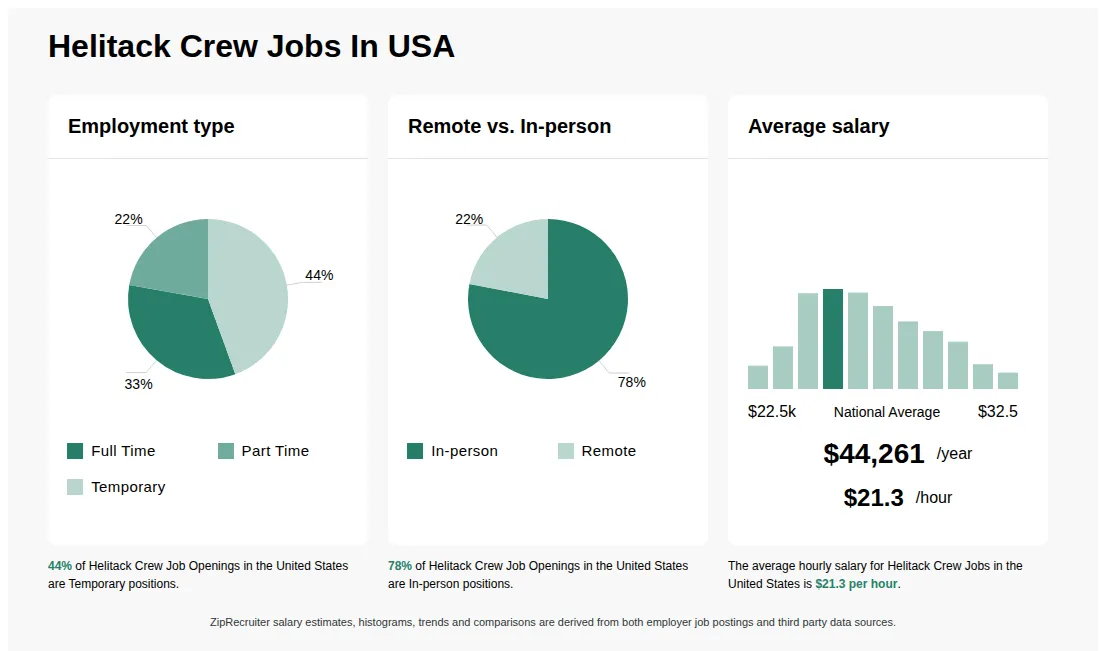
More about Helitack Crew jobs
Infographic showing various Helitack Crew job openings in the United States as of July 2026, with employment types broken down into 79% Full Time, 20% Part Time, and 1% Nights. Highlights an 100% Physical job distribution, with an average salary of $44,261 per year, or $21.3 per hour.

Wildland Firefighter (Fuels Management) - Direct Hire Authority

IBC Opportunities | U.S. Department of the Interior

Boise, ID • On-site

$112K/yr

Other

Posted 13 days ago


Job description

This is a Direct-Hire advertisement. Veterans preference is not applicable to this advertisement. Learn more about this authority at: Direct Hire Authority

These Wildland Firefighter (Fuels Management) positions are with the US Wildland Fire Service, GW-0456-13 working in the following location(s):

  • Boise, Idaho
Qualifications:

Basic Qualification Requirements:

Applicants must have documented prior primary firefighting experience, with substantial service defined as either:

  • At least one full fire season working in a primary wildland firefighting role (e.g., Engine Crew, Fire Effects Crew, Prescribed Fire/Fuels Crew, Hand Crew, Helitack Crew, Hotshot Crew, Smokejumper, Wildland Fire Modules or Fire Suppression Crews, etc.) with a federal, state, tribal, local, or private-sector organization;
    - OR -
  • At least 14-days of on-the-ground fireline experience (cumulative or consecutive).

Prior primary wildland fire experience must be clearly documented in your resume.
Note: an IQCS Master Record or equivalent document will not be used to determine or calculate prior primary wildland fire experience eligibility for this requirement.

Credit will be given for all appropriate qualifying experience. Please be sure to include this information in your resume. No assumptions will be made about your experience.
In addition to the requirements described above, you must possess the Minimum Qualification requirements listed below.
Minimum Qualification GW-0456-13

At least one year of specialized experience equivalent to the GW-12 level, or higher, in the Federal service, or equivalent, which includes all of the following: Examples of specialized experience include: Develops, evaluates, and implements wildland fire and fuels management policies, procedures, and program guidance affecting multiple organizational units, ensuring compliance with Departmental, Bureau, and interagency requirements. Serves as a technical authority on hazardous fuels management, providing expert guidance to field, tribal, state, and regional leadership on complex fuels planning, risk reduction strategies, and program implementation. Leads program reviews, assessments, and audits of wildland fire and fuels management operations; analyzes findings, identifies deficiencies, and develops corrective actions to improve program effectiveness and policy compliance. Coordinates the development, review, and approval of Fire Management Plans, fuels treatment strategies, and long-range program plans, ensuring alignment with land management objectives, environmental requirements, and national fire management policies. Represents the organization on interagency committees, workgroups, and planning teams, negotiating solutions to complex fuels management issues and developing standards, policies, and operational guidance across multiple jurisdictions. Analyzes program performance, accomplishments, funding requirements, and resource allocation needs to support fuels management budgeting, strategic planning, workforce development, and achievement of fire management objectives.

Experience refers to paid and unpaid experience, including volunteer work done through National Service programs (e.g., Peace Corps, AmeriCorps) and other organizations (e.g., professional; philanthropic; religious; spiritual; community, student, social). Volunteer work helps build critical competencies, knowledge, and skills and can provide valuable training and experience that translates directly to paid employment. You will receive credit for all qualifying experience, including volunteer experience.

*Applicants must meet all minimum qualification requirements for the position of interest by the closing date of the Job Announcement.

Secondary Firefighter Retirement Coverage - Applicants for this secondary administrative fire fighter position under the provisions of 5 U.S.C. 8336 (c) (CSRS) and 5 U.S.C. 8412 (d), must possess knowledge of the principles, methods, and techniques of wildland firefighting as demonstrated by direct wildland firefighting experience. In order to receive credit, you must provide a written description of your experience in wildland firefighting. Education without hands-on wildland firefighting experience does not meet this requirement. Periods of wildland firefighting experience, gained through militia and rural fire departments, can also be credited. Wildland fire is defined as any non-structure fire that occurs in the wildland. Two distinct types of wildland fire have been defined and include wildfire and prescribed fires as follows: Wildfire: Unplanned ignitions or prescribed fires that are declared wildfires. Prescribed Fires: Planned ignitions. This description includes only fire line experience on a Prescribed Fire; it does not include experience in the planning stages. Prescribed fire experience must be supplemented by fire suppression experience in order to be creditable as previous wildland firefighting experience.

Physical Demands: The work is primarily sedentary, however, some physical exertion related to site visitations and fire line assignments is required. Walking on rough, uneven terrain, long periods of standing, and exposure to extreme heat, smoke, and temperatures is required.
Working Conditions: Work is normally performed in an office setting. During the wildland fire season, field work may involve high risk exposure to potentially dangerous situating or stress. The above work environment involves occasional exposure to moderate risks and discomforts which usually
require protective equipment to be worn. A range of safety and other precautions are required. Exposure to risks such as wildfire, heat, smoke, falling rocks and trees, etc., are a part of the job during wildland fire season. Work may require flying in small fixed-wing and rotary-wing aircraft.
Incumbent will adhere to all safety rules and regulating as prescribed in manuals/supplements or by the designated Safety Officer.
Only experience and education obtained by 07/10/2026 will be considered.

Education:IMPORTANT - PLEASE NOTE: There is no qualifying education for the 0456 series at this grade level.Employment Type: OTHER