1

Helitack Crew Jobs (NOW HIRING)

Showing results 21-40

Helitack Crew information

See salary details

$10

$21

$32

How much do helitack crew jobs pay per hour?

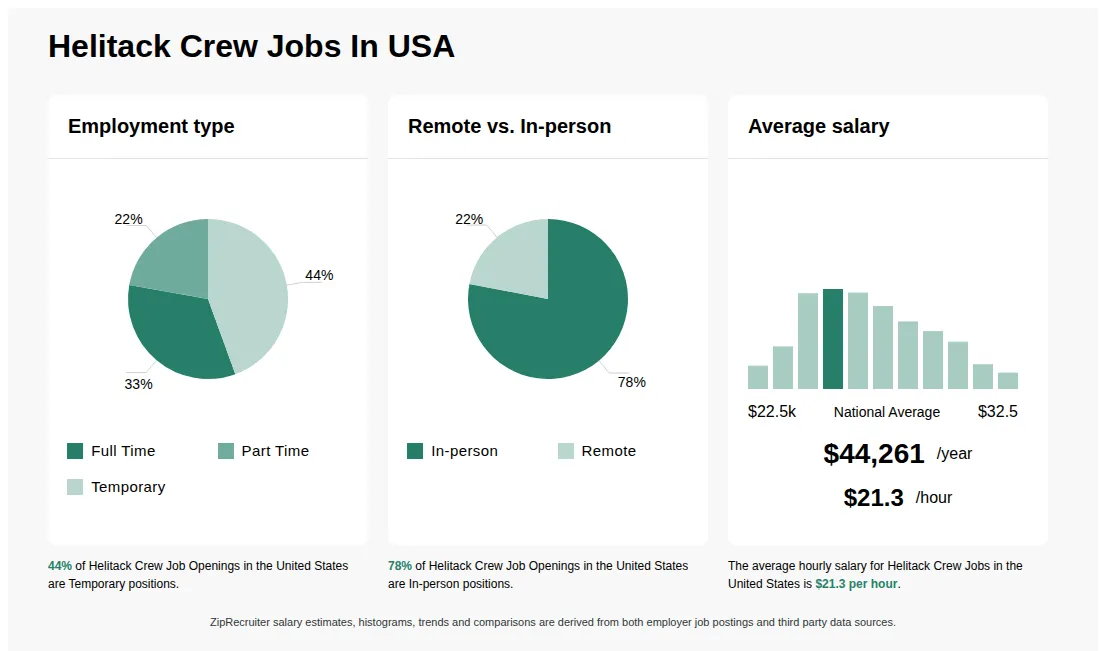
As of Sep 9, 2026, the average hourly pay for helitack crew in the United States is $21.28, according to ZipRecruiter salary data. Most workers in this role earn between $16.83 and $24.76 per hour, depending on experience, location, and employer.

What is a helitack crew?

Helitack crews are specialized teams of wildland firefighters who are deployed to fight fires using helicopters. Their primary role is to respond quickly to wildfires in remote or hard-to-reach areas by being transported via helicopter, often rappelling down or landing near the fire. Once on the ground, helitack crews suppress fires by constructing fire lines, clearing vegetation, and sometimes coordinating aerial water drops. They are highly trained in both firefighting and helicopter operations, ensuring efficient and rapid wildfire response. Helitack crews play a crucial role in the early stages of wildfire suppression and in preventing small fires from becoming large, destructive events.

What skills and qualifications are needed to thrive as a helitack crew member?

To thrive as a Helitack Crew member, you need strong physical fitness, wildfire suppression knowledge, and specialized wildland firefighting training, often supported by certifications like S-130/S-190. Familiarity with helicopters, personal protective equipment (PPE), and fire communication systems is crucial. Teamwork, situational awareness, and the ability to stay calm under pressure are vital soft skills. These skills ensure safe, efficient wildfire response and the ability to adapt quickly to dynamic, high-risk environments.

What are common challenges faced by helitack crew members during wildfire response operations?

Helitack crew members often face challenges such as rapidly changing fire conditions, working in remote and rugged terrain, and coordinating closely with air and ground teams under stressful circumstances. The job requires quick decision-making, physical endurance, and adaptability, as plans may change at a moment’s notice due to weather or fire behavior. Effective communication and teamwork are essential, as crews must work safely and efficiently alongside pilots, ground firefighters, and incident command staff.

What is the difference between Helitack Crew vs Firefighter?

AspectHelitack CrewFirefighter
CertificationsWildland Firefighter Type 2, Helicopter SafetyFirefighter I & II, EMT
Work EnvironmentHelicopter-based, remote wildland areasUrban, suburban, wildland
Employer & IndustryFederal, state agencies, forestry servicesFire departments, emergency services

Helitack Crews specialize in rapid response using helicopters to access wildland fires, often working in remote areas. Firefighters work in various environments, including urban and wildland settings, with broader emergency response roles. While both roles require wildland firefighting certifications, Helitack Crews focus on aerial operations, whereas firefighters may work on ground-based fire suppression.

How much does a helitack crew make?

A helitack crew member's salary typically ranges from $15 to $25 per hour, depending on experience, location, and agency. Firefighters in these crews often require specialized training and certifications, and they work in challenging environments during wildfire seasons.

How to get on a helitack crew?

To join a helitack crew, applicants typically need to have wildfire suppression experience, physical fitness, and often hold certifications such as Basic Wildland Firefighter or Advanced Firefighter. Applying through federal or state fire agencies and completing required training programs increases chances of selection, as crews look for team players with relevant skills and certifications.

Is it hard to get on a helitack crew?

Getting on a helitack crew is competitive and typically requires prior firefighting experience, physical fitness, and relevant certifications such as S-130 and S-190. Applicants often need to demonstrate strong teamwork skills and the ability to work in remote, high-pressure environments.
More about Helitack Crew jobs

What are popular job titles related to Helitack Crew jobs?

For Helitack Crew jobs, the most frequently searched job titles are:

Infographic showing various Helitack Crew job openings in the United States as of September 2026, with employment types broken down into 1% As Needed, 76% Full Time, 22% Part Time, and 1% Nights. Highlights an 99% Physical, and 1% Remote job distribution, with an average salary of $44,261 per year, or $21.3 per hour.

Wildland Firefighter (Smokejumper)

West Yellowstone, MT • On-site

$52K/yr

Full-time

Retirement

Re-posted 9 days ago


Job description

This position is located at a USDA Forest Service Unit..
The purpose of these positions is to serve as an experienced smokejumper, performing parachute jumps, and a variety of wildland fire suppression duties.
See ADDITIONAL INFORMATION section for the specific contact information.Qualifications:In order to qualify, you must meet the eligibility and qualifications requirements as defined below by the closing date of the announcement. For more information on the qualifications for this position, visit the Office of Personnel Management's General Schedule Qualification Standards.
Your application and resume must clearly show that you possess the experience requirements. Transcripts must be provided for qualifications based on education. Provide course descriptions as necessary.
Specialized Experience Requirement:
For the GW-05: Applicants must have one year of specialized experience equivalent to at least the next lower grade level (GW-04) in the Federal Service; OR Successful completion of a 4-year course of study in an accredited college or university with major study in Fire Science, Fire Training, Fire Technology or other related fields of study OR a combination of education and experience. The education must have been obtained in an accredited college or university.
Examples of specialized experience may include: Loaded helicopter cargo and completing manifests of crews and equipment; Patrolled areas of controlled fires to mop-up by searching out and extinguishing any remaining burning material; Served on a specialty crew (hotshot, helitack, engines, etc.) to suppress the full range of difficult and complex fires; and Operated specialized fire suppression equipment such as portable pumps or drip torches.
For the GW-06: Applicants must have one year of specialized experience equivalent to at least the next lower grade level (GW-05) in the Federal Service. Examples of specialized experience may include: Performed parachute jumps under many conditions while executing landings on rough terrain, open areas, mountain slopes, and/or timber; Suppressed the full range of difficult and complex wildland fire using common and proven basic techniques; and Served as a Squad boss on a Fire Crew, Helitack Crew, Pump Crew or served as Crew Boss, Fire Boss, or Sector Boss.
Smokejumper duties present unusual hazards and require that personnel be in excellent physical condition and possess a high degree of emotional stability and mental alertness. The health of individuals must be such that they have the capacity to meet demands for performance in the position and for human reliability. Before entrance on duty, and periodically during employment, smokejumpers must undergo a medical exam, physical conditioning, and an adeptness test. Failure to meet any of the required standards will be considered disqualifying for employment or a basis of termination.
See Medical Requirements for Smokejumper Positions.
During the training period, incumbents are continually evaluated on their ability to demonstrate a high level of proficiency in various aspects of parachute jumping and smokejumper-related tasks, including aircraft exit procedures, parachute landing falls, parachute maneuvering, timber let-down procedures, parachute and cargo retrieving, tree climbing, and chainsaw and hand tool use. Incumbents who cannot perform up to the required standards of proficiency will be terminated from the smokejumper program.
Smokejumpers must perform safely and efficiently in extreme temperatures and weather conditions, often with severe smoke and dust. Terrain may be extremely steep, uneven, rocky, and covered with thick tangled vegetation. Conditions riding in aircraft may be hot, cramped, and extremely turbulent, which may promote airsickness. The hazardous nature of the work requires that protective clothing (jump suit, helmet, boots, gloves, fire resistant clothing, etc.) be worn and protective equipment, including fire shelters, be carried.
Primary firefighter positions include the following age requirements: Under age 37 -OR- less than age 37 after subtracting the months of Permanent Federal Service worked in a primary or secondary firefighter/law enforcement position -OR- a veteran preference eligible, older than age 37 and is requesting a waiver to the maximum age requirement -OR-currently occupy a permanent position with primary fire fighter retirement coverage.
For those who do not currently occupy a permanent Federal position covered under primary fire fighter retirement, you must be under age 37; less than age 37 after subtracting the months of Permanent Federal Service in a primary or secondary firefighter/law enforcement position; or a veteran preference eligible, older than age 37 and requesting a waiver to the requirement.
Experience refers to paid and unpaid experience, including volunteer work done through National Service programs (e.g., Peace Corps, AmeriCorps) and other organizations (e.g., professional; philanthropic; religious; spiritual; community, student, social). Volunteer work helps build critical competencies, knowledge, and skills and can provide valuable training and experience that translates directly to paid employment. You will receive credit for all qualifying experience, including volunteer experience.
FIREFIGHTER RETIREMENT COVERAGE: This is a primary/rigorous position covered under the special retirement provisions of 5 USC 8336(c) for the Civil Service Retirement System and of 5 USC 8412(d) for the Federal Employees Retirement System.
WORK CAPACITY TEST (WCT) for Wildland Firefighters: This position participates in wildland firefighting activities. Based on the type of work performed, TAKING and PASSING the WCT at the ARDUOUS level is a condition of employment.
To receive consideration for this position, you must provide updated required documents and meet all qualification requirements by the closing date of this announcement.Education:
See Qualifications Section for educational requirements.
Employment Type: OTHER