full stack .NET Developer
Charlotte, NC · On-site
We are looking for full stack .net/c#/nosql developers to join Real Time Communication Team as we move from being a tech-enabled service to a tech product hub. * We are looking for passionate and ...
Charlotte, NC · On-site
We are looking for full stack .net/c#/nosql developers to join Real Time Communication Team as we move from being a tech-enabled service to a tech product hub. * We are looking for passionate and ...
Charlotte, NC · On-site
We are looking for full stack .net/c#/nosql developers to join Real Time Communication Team as we move from being a tech-enabled service to a tech product hub. * We are looking for passionate and ...
Mandeville, LA · On-site
We are seeking a highly skilled and experienced Full Stack .NET Developer to join our dynamic team. The ideal candidate will be a creative innovator with strong communication skills and a dedication ...
Mandeville, LA · On-site
We are seeking a highly skilled and experienced Full Stack .NET Developer to join our dynamic team. The ideal candidate will be a creative innovator with strong communication skills and a dedication ...
Jersey City, NJ · On-site
Full Stack .Net Developer Location: Jersey City, NJ- hybrid Interview: ONSITE INTERVIEW is a must Must Haves: .NET CORE C# Angular 12+ Description: .Net Developer will be responsible for ...
Quick apply
Jersey City, NJ · On-site
Full Stack .Net Developer Location: Jersey City, NJ- hybrid Interview: ONSITE INTERVIEW is a must Must Haves: .NET CORE C# Angular 12+ Description: .Net Developer will be responsible for ...
Irving, TX · On-site +1
$65 - $67/hr
Full Stack .Net Developer Location: Fremont, CA (Day 1 onsite) About the Role: Our Client is looking for a software developer for its current and next generations of business applications and systems.
Irving, TX · On-site +1
$65 - $67/hr
Full Stack .Net Developer Location: Fremont, CA (Day 1 onsite) About the Role: Our Client is looking for a software developer for its current and next generations of business applications and systems.
Senior Full Stack Developer (.NET/React) Location: Onsite; Omaha, Nebraska Employment Type: Contract; 12+ months seeking a Senior Full Stack .NET Developer to build and support modern web ...
Quick apply
Senior Full Stack Developer (.NET/React) Location: Onsite; Omaha, Nebraska Employment Type: Contract; 12+ months seeking a Senior Full Stack .NET Developer to build and support modern web ...
Senior Full Stack .NET Developer Location: Fremont, CA (Onsite) Company Overview: Glint Tech Solutions is a women-owned, global IT staffing and recruiting firm serving enterprise clients across the ...
Senior Full Stack .NET Developer Location: Fremont, CA (Onsite) Company Overview: Glint Tech Solutions is a women-owned, global IT staffing and recruiting firm serving enterprise clients across the ...
Neevsys is currently seeking An experienced full-stack .NET developer to build and support the program's portal(s) end to end -- the Angular or React front end and the .NET backend, backed by ...
Neevsys is currently seeking An experienced full-stack .NET developer to build and support the program's portal(s) end to end -- the Angular or React front end and the .NET backend, backed by ...
New York, NY · On-site
$70 - $74/hr
Lighthouse Technology Services is partnering with our client to fill their Full Stack .NET Developer position! This is a 9-18 month contract and will be hybrid in Buffalo, New York. This role will be ...
New York, NY · On-site
$70 - $74/hr
Lighthouse Technology Services is partnering with our client to fill their Full Stack .NET Developer position! This is a 9-18 month contract and will be hybrid in Buffalo, New York. This role will be ...
Livingston, NJ · On-site
Full Stack .Net Developer Location: Livingston, NJ Duration: Full Time Mandatory Skills - Microsoft MVC framework, SQL server 2012- T-sql, ssis/ssrs Skills: Team Lead / Senior Developer will be ...
Livingston, NJ · On-site
Full Stack .Net Developer Location: Livingston, NJ Duration: Full Time Mandatory Skills - Microsoft MVC framework, SQL server 2012- T-sql, ssis/ssrs Skills: Team Lead / Senior Developer will be ...
$100K - $120K/yr
Full Stack .NET Developer Location: Rockville, MD (On-site 2 days per week required) Clearance: Public Trust Clearance Salary: $100,000.00 - $120,000.00 Annually The anticipated salary range for this ...
$100K - $120K/yr
Full Stack .NET Developer Location: Rockville, MD (On-site 2 days per week required) Clearance: Public Trust Clearance Salary: $100,000.00 - $120,000.00 Annually The anticipated salary range for this ...
We are seeking a highly skilled and experienced Full Stack .NET Developer to join our dynamic team. The ideal candidate will be a creative innovator with strong communication skills and a dedication ...
We are seeking a highly skilled and experienced Full Stack .NET Developer to join our dynamic team. The ideal candidate will be a creative innovator with strong communication skills and a dedication ...
Charlotte, NC · On-site
We are seeking a highly skilled and experienced Full Stack .NET Developer to join our dynamic team. The ideal candidate will be a creative innovator with strong communication skills and a dedication ...
Charlotte, NC · On-site
We are seeking a highly skilled and experienced Full Stack .NET Developer to join our dynamic team. The ideal candidate will be a creative innovator with strong communication skills and a dedication ...
Washington, DC · On-site
We are seeking a highly skilled and experienced Full Stack .NET Developer to join our dynamic team. The ideal candidate will be a creative innovator with strong communication skills and a dedication ...
Washington, DC · On-site
We are seeking a highly skilled and experienced Full Stack .NET Developer to join our dynamic team. The ideal candidate will be a creative innovator with strong communication skills and a dedication ...
Houston, TX · On-site
We are seeking a highly skilled and experienced Full Stack .NET Developer to join our dynamic team. The ideal candidate will be a creative innovator with strong communication skills and a dedication ...
Houston, TX · On-site
We are seeking a highly skilled and experienced Full Stack .NET Developer to join our dynamic team. The ideal candidate will be a creative innovator with strong communication skills and a dedication ...
Bellingham, WA · On-site
They are seeking a Full Stack .Net Developer to utilize ASP.Net, MVC, and current web development technologies to integrate major business systems and contribute to multiple projects.
Bellingham, WA · On-site
They are seeking a Full Stack .Net Developer to utilize ASP.Net, MVC, and current web development technologies to integrate major business systems and contribute to multiple projects.
Manhattan, NY · On-site
$120K - $150K/yr
The Full-Stack .NET Developer is the hands-on builder on the modernization team. You will take legacy batch programs and, working from documented business requirements, replace them with modern ...
Manhattan, NY · On-site
$120K - $150K/yr
The Full-Stack .NET Developer is the hands-on builder on the modernization team. You will take legacy batch programs and, working from documented business requirements, replace them with modern ...
We are seeking a highly skilled and experienced Full Stack .NET Developer to join our dynamic team. The ideal candidate will be a creative innovator with strong communication skills and a dedication ...
We are seeking a highly skilled and experienced Full Stack .NET Developer to join our dynamic team. The ideal candidate will be a creative innovator with strong communication skills and a dedication ...
Full Stack .Net Developer Location: Livingston, NJ Duration: Full Time Mandatory Skills - Microsoft MVC framework, SQL server 2012- T-sql, ssis/ssrs Skills: · Team Lead / Senior Developer will be ...
Full Stack .Net Developer Location: Livingston, NJ Duration: Full Time Mandatory Skills - Microsoft MVC framework, SQL server 2012- T-sql, ssis/ssrs Skills: · Team Lead / Senior Developer will be ...
Rockville, MD · On-site
$100K - $120K/yr
Full Stack .NET Developer Location: Rockville, MD (On-site 2 days per week required) Clearance: Public Trust Clearance Salary: $100,000.00 - $120,000.00 Annually The anticipated salary range for this ...
Rockville, MD · On-site
$100K - $120K/yr
Full Stack .NET Developer Location: Rockville, MD (On-site 2 days per week required) Clearance: Public Trust Clearance Salary: $100,000.00 - $120,000.00 Annually The anticipated salary range for this ...
Addison, TX · On-site
Georgia IT, Inc. is seeking a Full-Stack .NET Developer for a long-term contract position in North Dallas. The role involves working on backend, middle tier, and front-end requirements for enterprise ...
Addison, TX · On-site
Georgia IT, Inc. is seeking a Full-Stack .NET Developer for a long-term contract position in North Dallas. The role involves working on backend, middle tier, and front-end requirements for enterprise ...
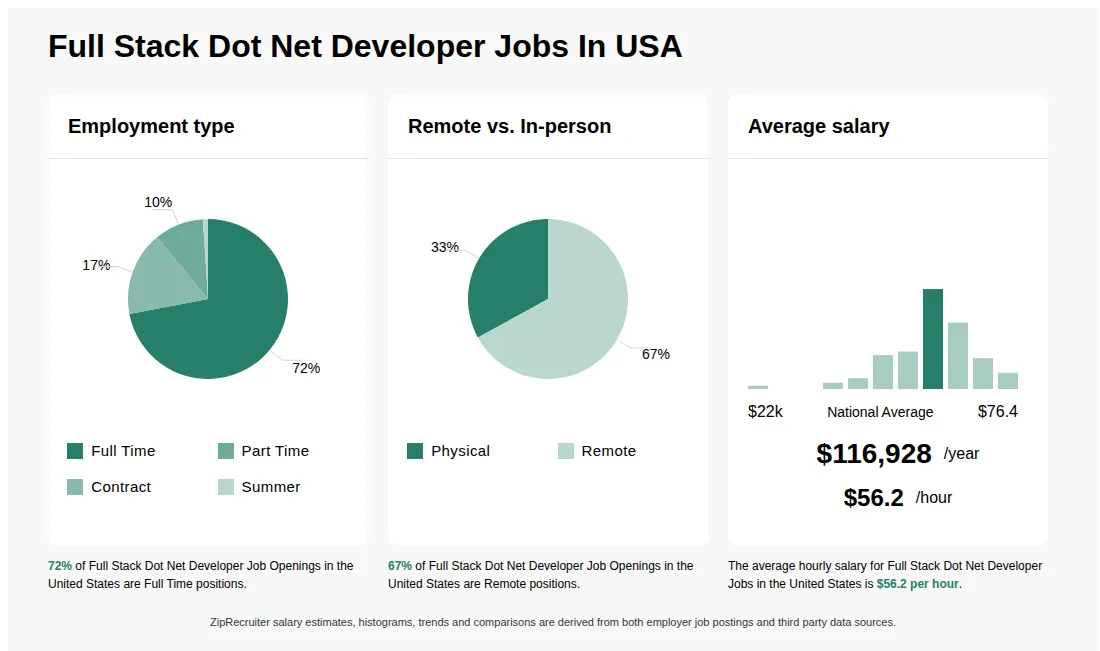
$10.58 - $16.56
1% of jobs
$16.56 - $22.55
0% of jobs
$22.55 - $28.54
0% of jobs
$28.54 - $34.53
2% of jobs
$34.53 - $40.52
3% of jobs
$40.52 - $46.50
11% of jobs
$50.12 is the 25th percentile. Wages below this are outliers.
$46.50 - $52.49
12% of jobs
The median wage is $56.14 / hr.
$52.49 - $58.48
33% of jobs
$61.83 is the 75th percentile. Wages above this are outliers.
$58.48 - $64.47
22% of jobs
$64.47 - $70.45
10% of jobs
$70.45 - $76.44
5% of jobs
$10
$56
$76
| Aspect | Full Stack Dot Net Developer | Front End Developer |
|---|---|---|
| Required Skills | Proficiency in C#, ASP.NET, SQL, JavaScript, HTML, CSS | Expertise in HTML, CSS, JavaScript, frameworks like React or Angular |
| Work Environment | Develops both server-side and client-side applications, often in enterprise settings | Focuses on user interface and experience, primarily front-end design and development |
| Common Usage | Used in full-stack development teams within .NET-based projects | Used in UI/UX teams, web design, and front-end development projects |
While both roles involve web development, a Full Stack Dot Net Developer handles both backend and frontend tasks using .NET technologies, whereas a Front End Developer specializes in creating engaging user interfaces and experiences. The full stack role requires knowledge of server-side programming, databases, and client-side scripting, making it broader in scope.
Cities with the most Full Stack Dot Net Developer job openings:
The most popular types of Full Stack Dot Net Developer jobs are:
States with the most job openings for Full Stack Dot Net Developer jobs include:
For Full Stack Dot Net Developer jobs, the most frequently searched job titles are:
Charlotte, NC • On-site
Full-time
This job post has expired today. Applications are no longer accepted.