1

Freight Conductor Jobs (NOW HIRING)

As a Freight Conductor, you'll play an important role in the safe and efficient movement of freight trains. You'll work with train crews to move and position railcars, build and break down trains ...

New

A Freight Conductor's primary responsibility is to safely coordinate train crews on a freight train, place rail cars to facilitate loading and unloading, and makeup/breakdown trains in a rail yard ...

A Freight Conductor's primary responsibility is to safely coordinate train crews on a freight train, place rail cars to facilitate loading and unloading, and makeup/breakdown trains in a rail yard ...

A Freight Conductor's primary responsibility is to safely coordinate train crews on a freight train, place rail cars to facilitate loading and unloading, and makeup/breakdown trains in a rail yard ...

A Freight Conductor's primary responsibility is to safely coordinate train crews on a freight train, place rail cars to facilitate loading and unloading, and makeup/breakdown trains in a rail yard ...

next page

Showing results 1-20

Freight Conductor information

See salary details

$27

$32

$37

How much do freight conductor jobs pay per hour?

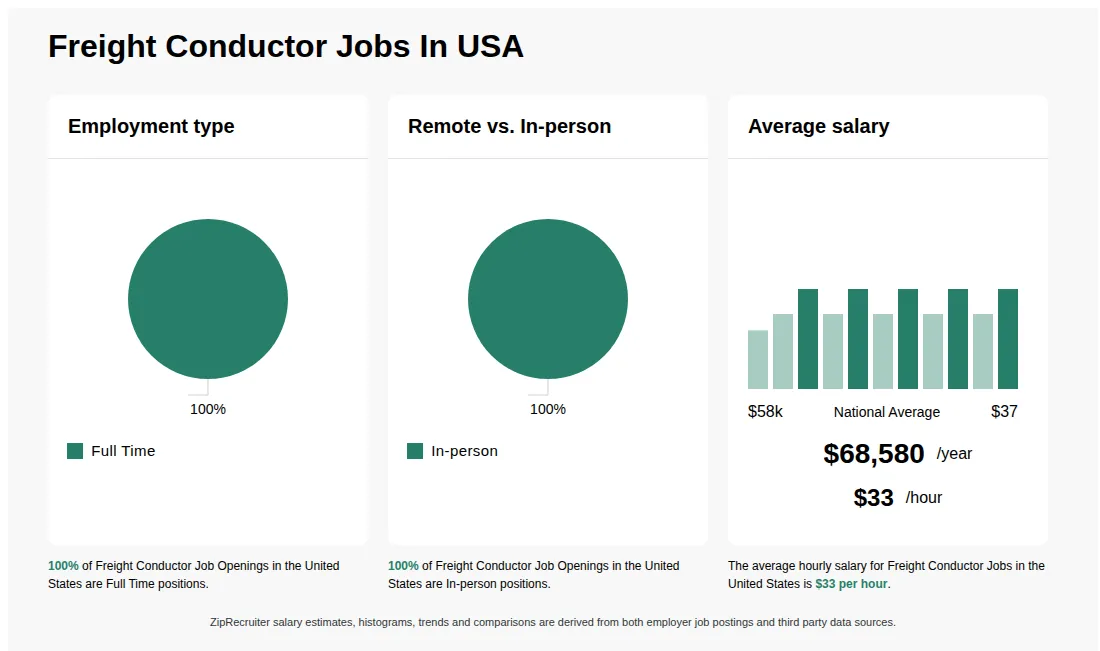
As of Aug 25, 2026, the average hourly pay for freight conductor in the United States is $32.97, according to ZipRecruiter salary data. Most workers in this role earn between $30.53 and $35.34 per hour, depending on experience, location, and employer.

What is a freight conductor?

Freight Conductors are railroad employees responsible for coordinating and overseeing the movement of freight trains. Their duties include managing railcars, ensuring correct cargo loading and unloading, communicating with engineers and dispatchers, and ensuring safety regulations are followed. They play a crucial role in making sure that goods are delivered efficiently and safely across the rail network. Freight Conductors often work irregular hours and must be prepared for outdoor work in various weather conditions.

What are some typical challenges freight conductors face while coordinating train operations?

Freight Conductors often encounter challenges such as managing tight schedules, adapting to unexpected delays (like weather or track issues), and ensuring clear communication between engineers, yard crews, and dispatchers. The role requires quick problem-solving and attention to detail to safely direct the movement of trains and handle cargo documentation. Additionally, conductors must remain vigilant for safety hazards and be prepared for physically demanding tasks during long or irregular shifts.

What are the key skills and qualifications needed to thrive as a freight conductor, and why are they important?

To thrive as a Freight Conductor, you need strong knowledge of train operations, safety regulations, and logistics, usually supported by a high school diploma and completion of railroad training programs. Familiarity with electronic dispatch systems, radio communication equipment, and safety inspection tools is typically required. Attention to detail, problem-solving skills, and effective communication are crucial soft skills for coordinating train movements and ensuring safety. These skills and qualifications are critical to maintaining efficient, safe, and timely rail operations.

What is the difference between Freight Conductor vs Rail Yard Clerk?

AspectFreight ConductorRail Yard Clerk
CredentialsHigh school diploma, safety training, railroad certificationsHigh school diploma, clerical skills, railroad certifications
Work EnvironmentOn trains, in rail yards, outdoorsIn rail yards, offices, indoors
Job DutiesSupervises train operations, ensures cargo safety, communicates with crewManages yard operations, schedules, and documentation

Freight Conductors and Rail Yard Clerks both work within the railroad industry, but Freight Conductors focus on train supervision and cargo safety on the move, while Rail Yard Clerks handle yard operations and administrative tasks. Both roles require railroad certifications and involve working in rail yard environments, but their daily responsibilities differ significantly.

Do freight conductors make a lot of money?

Freight conductors typically earn a median annual salary of around $70,000, with experienced workers and those in certain regions earning higher wages. Their compensation can include benefits such as health insurance and retirement plans, and the job often requires working irregular hours and safety certifications.

How hard is it to become a freight conductor?

Becoming a freight conductor typically requires a high school diploma or equivalent, on-the-job training, and passing a background check. Candidates often need to learn safety procedures, operate communication tools, and may need to obtain certification such as a freight conductor license, with some positions requiring prior experience in rail or transportation industries.

What cities are hiring for Freight Conductor jobs?

Cities with the most Freight Conductor job openings:

Who are the top companies hiring for Freight Conductor jobs?

The top employers for Freight Conductor jobs are:

What states have the most Freight Conductor jobs?

States with the most job openings for Freight Conductor jobs include:

What are popular job titles related to Freight Conductor jobs?

For Freight Conductor jobs, the most frequently searched job titles are:

Infographic showing various Freight Conductor job openings in the United States as of August 2026, with employment types broken down into 1% As Needed, 91% Full Time, 7% Part Time, and 1% Contract. Highlights an 100% Physical job distribution, with an average salary of $68,580 per year, or $33 per hour.

Freight Conductor

Natchez, MS โ€ข On-site

A&K Railroad Materials Inc
Manufacturingย โ€ขย 201 - 500 employees

Full-time

Posted 3 days ago

New


Job description

Description:

Looking for a career that keeps you moving, offers specialized training, and gives you the opportunity to build a future in the railroad industry? Natchez Railway is looking for dependable, safety-focused individuals to join our team as Conductors.


As a Freight Conductor, you'll play an important role in the safe and efficient movement of freight trains. You'll work with train crews to move and position railcars, build and break down trains, inspect equipment, operate switches, communicate with railroad personnel and customers, and help ensure railcars are safely placed where they need to be.


What You'll Do
  • Coordinate with train crews, yardmasters, dispatchers, and customers to safely move and position railcars
  • Inspect railcars and equipment before departure
  • Couple and uncouple railcars, operate switches, and assist with minor railcar repairs
  • Communicate by radio and telephone and accurately follow work orders, bulletins, and operating instructions
  • Follow all railroad safety rules and Federal Railroad Administration (FRA) regulations
  • Assist with track crew activities, equipment inspections, and general railroad maintenance as needed
  • Work as an Employee in Charge (EIC) to supervise track crews when assigned
Requirements:

What We're Looking For

You don't need extensive railroad experience to get started. We're looking for people who are dependable, safety-minded, physically capable, and willing to learn.


Required:

  • 18 years of age or older
  • High school diploma or GED
  • At least 1 year of related work experience
  • Ability to read and understand written instructions, operating rules, safety procedures, and regulatory information
  • Strong verbal and written communication skills

Experience in construction, farming, heavy equipment, industrial work, or other outdoor environments is a plus.


Training & Career Growth

Your railroad career starts with a 6-week Conductor training program that includes classroom instruction, computer-based learning, hands-on simulations, and physical training.


New hires must successfully complete the program and achieve an 85% or higher score on the final examination and qualifying trip to obtain their Conductor qualification. Successful Conductors will then be required to advance toward becoming a Locomotive Engineer.


Know What You're Signing Up For

This is a physically demanding, safety-sensitive outdoor position. Conductors may work nonstandard schedules, overtime, weekends, and holidays as operational needs require.


You must be comfortable working in varying weather conditions, climbing on and around rail equipment, walking long distances over uneven terrain, working in confined or awkward spaces, and frequently lifting up to 80 pounds.


Employees must meet applicable FRA hearing and color-vision requirements, complete required safety training and assessments, and participate in federally required random drug and alcohol testing.


If you're dependable, safety-focused, and ready to build a specialized career in the railroad industry, apply today!