1

Field Botany Jobs in California (NOW HIRING)

Plant Variety Protection Intern

Woodland, CA ยท On-site

$22.75 - $47.75/hr

Maintain accurate records of field observations and measurements; Follow established protocols and ... Currently pursuing a Bachelor's Degree with an emphasis in Agriculture, Botany, Biology, or ...

Maintain accurate records of field observations and measurements; Follow established protocols and ... Currently pursuing a Bachelor's Degree with an emphasis in Agriculture, Botany, Biology, or ...

Plant Variety Protection Intern

Woodland, CA ยท On-site

$22.75 - $47.75/hr

... field trials at the Woodland site. The role focuses on collecting critical data from plant ... Currently pursuing a Bachelor's Degree with an emphasis in Agriculture, Botany, Biology, or ...

Ability to travel to field sites and walk long distances may be required on occasion Education * Bachelor's or Master's degree in biology, botany, wildlife management, ecology, environmental biology ...

Ability to travel to field sites and walk long distances may be required on occasion Education * Bachelor's or Master's degree in biology, botany, wildlife management, ecology, environmental biology ...

Ability to travel to field sites and walk long distances may be required on occasion Education * Bachelor's or Master's degree in biology, botany, wildlife management, ecology, environmental biology ...

Ability to travel to field sites and walk long distances may be required on occasion Education * Bachelor's or Master's degree in biology, botany, wildlife management, ecology, environmental biology ...

Showing results 41-60

Field Botany information

See California salary details

$11

$22

$42

How much do field botany jobs pay per hour?

As of Sep 7, 2026, the average hourly pay for field botany in California is $22.94, according to ZipRecruiter salary data. Most workers in this role earn between $16.71 and $27.54 per hour, depending on experience, location, and employer.

What is field botany?

Field botany is the scientific study of plants in their natural environments. Field botanists observe, identify, and document various plant species, often conducting research on plant ecology, distribution, and interactions with other organisms. Their work is crucial for understanding ecosystems, conserving biodiversity, and informing environmental management. Field botany typically involves outdoor fieldwork, using tools like plant guides, GPS units, and sampling equipment.

What are some common challenges faced by field botanists during fieldwork, and how can they be addressed?

Field botanists often encounter challenges such as unpredictable weather conditions, difficult terrain, and limited access to remote locations. These factors can make data collection and specimen gathering physically demanding and sometimes hazardous. To address these challenges, field botanists prepare thoroughly by researching field sites, carrying appropriate gear, and developing contingency plans for emergencies. Collaboration with local guides or researchers is also common, as it helps ensure safety and improves the efficiency of field studies.

What are the key skills and qualifications needed to thrive as a field botanist, and why are they important?

To thrive as a Field Botanist, you need expertise in plant identification, ecology, and data collection, often supported by a degree in botany, ecology, or a related field. Familiarity with GPS devices, mapping software, and statistical analysis tools is typically required, and certifications in field safety or herbarium techniques can be beneficial. Excellent observational skills, attention to detail, and effective communication are crucial for documenting findings and collaborating with research teams. These skills ensure accurate data collection, safe and efficient fieldwork, and meaningful scientific contributions to environmental research and conservation.

Are field botanists in high demand?

Field botanists are in moderate demand, especially in environmental consulting, conservation, and research sectors. Employment opportunities often depend on regional ecological projects, government funding, and the ability to identify and document plant species using skills like GIS and plant identification tools.

What careers are there in field botany?

Careers in field botany include roles such as botanical field technician, plant ecologist, conservation scientist, and botanical researcher. These positions often require skills in plant identification, data collection, and environmental analysis, and may involve working outdoors in various ecosystems. Opportunities can be found in government agencies, environmental consulting firms, botanical gardens, and research institutions.

What jobs come from field botany?

Field botany leads to careers such as botanical researcher, plant ecologist, conservation scientist, environmental consultant, and botanical surveyor. These roles often involve fieldwork, plant identification, data collection, and environmental analysis, requiring knowledge of plant taxonomy and field skills.

What are the most commonly searched types of Field Botany jobs in California?

The most popular types of Field Botany jobs in California are:

What cities in California are hiring for Field Botany jobs?

Cities in California with the most Field Botany job openings:
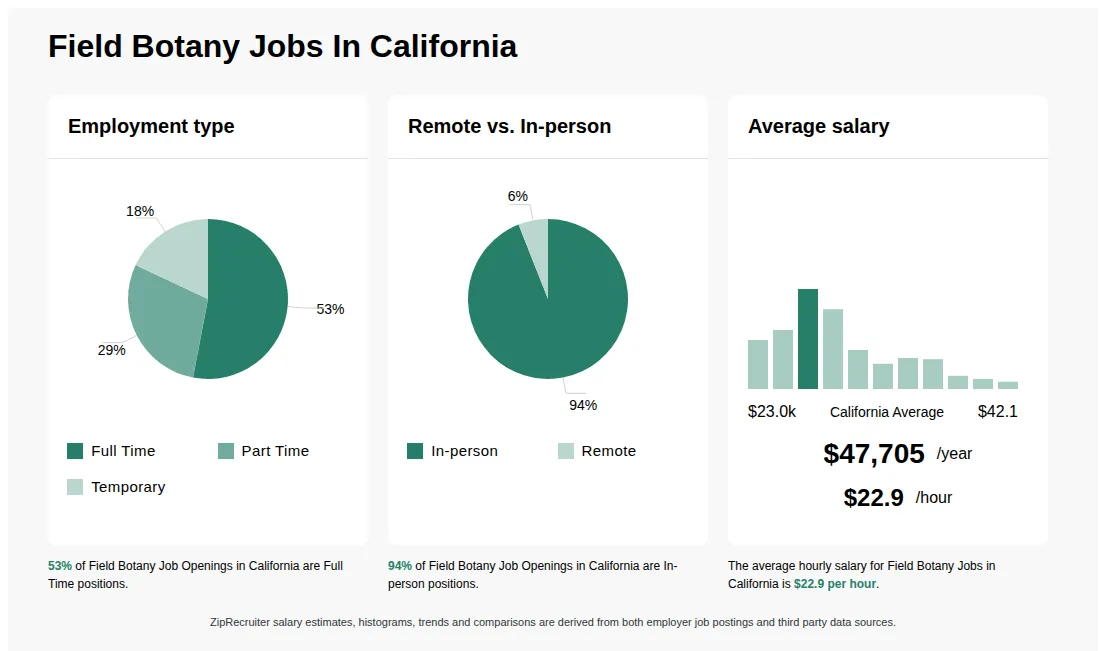
Infographic showing various Field Botany job openings in California as of August 2026, with employment types broken down into 47% Full Time, 33% Part Time, and 20% Temporary. Highlights an 93% In-person, and 7% Remote job distribution, with an average salary of $47,705 per year, or $22.9 per hour.

Senior Environmental Biologist / Project Manager - Wetland Delineator

Dudek Habitat Restoration

Riverside, CA โ€ข On-site

$125 - $150/hr

Other

Re-posted 2 days ago


Key responsibilities

  • Plan and lead aquatic resource delineations and collect detailed field data in remote locations and various weather conditions.

  • Prepare and oversee reports, permit application documents, and scopes of work related to aquatic resources and environmental compliance.

  • Manage technical projects from start to finish, support and mentor project teams, and represent the company in agency meetings and public hearings.


Job description

Overview

Location(s): Southern California Practice/Department: Biological Work Environment: Hybrid Compensation: $100,000-150,000/annually*

Dudekโ€™s journey began in 1980 with a vision to serve Southern Californiaโ€™s water and wastewater agencies. Today, we are a 100% employeeโ€‘owned firm supporting clients nationwide and delivering projects that improve and protect the built and natural environments of communities throughout the United States.

Position Overview

Who You Are

As an employeeโ€‘owner you embrace accountability, work safely, and collaborate while thinking resourcefully and independently. Like all Dudekians, you are curious and solutionโ€‘oriented, with the ability to adapt quickly to changes and approach challenges with a spirit of innovation.

How Youโ€™ll Make an Impact

Dudek is currently seeking a fullโ€‘time seniorโ€‘level Biologist to join our biological resources team. The successful candidate will help grow Dudekโ€™s biological resources practice with a focus on aquatic resource delineations and permitting and work collaboratively with other Dudek staff based throughout our California offices. This position will necessitate both inโ€‘office and fieldโ€‘based work and can be located out of any of our California offices.

Duties and Responsibilities

  • Plan and lead aquatic resource delineations;
  • Plan and lead collection of detailed field data, work in remote field locations, hike steep slopes over uneven terrain, and work full days in all types of weather;
  • Prepare and oversee preparation of reports summarizing methodology, field survey results and recommendations;
  • Prepare and oversee preparation of Aquatic Resources Delineation Reports;
  • Prepare and oversee preparation of documents supporting environmental permit applications and CEQA/NEPA aquatic resources evaluations;
  • Prepare scopes of work and cost estimates for aquatic resources delineation work;
  • Manage technical projects from inception to completion, ensuring timely and efficient delivery;
  • Lead, mentor, and support project teams with the goal of maximizing performance and efficiency in the field and with report writing;
  • Mentor and train junior staff in collaboration with other senior staff;
  • Participate in the development of guides and training materials;
  • Represent Dudek and clients in agency meetings and public hearings as a subject matter expert for aquatic resource delineations and permitting;
  • Track and keep abreast of regulatory and delineation protocol changes to ensure compliance with the latest requirements.

Minimum Qualifications

  • Bachelorโ€™s degree in biology, ecology, botany, environmental science or related natural resources field;
  • A minimum of 12 yearsโ€™ experience preparing and focusing solely on aquatic delineations and identifying wetland mapping boundaries using the 1987 US Army Corps of Engineers Wetland Delineation Manual and Regional Supplements;
  • Expert-level knowledge of state and federal statutes, regulations, and permitting requirements relating to the Federal Clean Water Act, California Porterโ€‘Cologne Water Quality Control Act, and California Fish and Game Code;
  • Expert-level knowledge of California aquatic resource types and systems; including disturbed and difficult sites in diverse environments (deserts, coasts, mountains, etc.);
  • Knowledge and applied experience with soil science;
  • Demonstrated experience with management of projects involving complex biological/aquatic resource impact analyses and mitigation planning;
  • Strong written and oral communication skills;
  • Expert-level experience with GPS technologies (e.g., ESRI FieldMaps) for mapping aquatic resources;
  • Willingness to travel throughout California for work, including overnight stays in hotels;
  • Must possess a valid driverโ€™s license and have active personal automobile liability insurance by first day of employment.

Preferred Qualifications

  • Masterโ€™s degree in biology, ecology, botany, environmental science or related natural resources field;
  • Leadership and strong ability to work in a collaborative environment;
  • Regarded as an expert in the field and sought out as an instructor and presenter by outside parties;
  • Understanding of delineation process for twoโ€‘parameter wetlands per California Coastal Commission;
  • Strong customer service emphasis and solutionโ€‘oriented project delivery approach;
  • Conscientious and detailโ€‘oriented with demonstrated accuracy and attention to detail;
  • Exercises good judgment and demonstrates sound decisionโ€‘making skills.

Compensation: $100,000-150,000/annually*

*Final agreedโ€‘upon compensation will be based on a variety of factors including, but not limited to, an individualโ€™s related experience, education, certifications, skills, and work location. Successful candidates must pass a preโ€‘employment drug test and background check prior to beginning employment.

Working Conditions

  • This job operates in a remote or officeโ€‘based environment and this role routinely uses standard office equipment such as computers, phones, printers, etc.;
  • This job requires occasional project site visits, based out outdoors which can include excessive noise, uneven walking surfaces, extreme weather, and moving vehicles and equipment.

Physical Requirements

The physical demands described here are representative of those that must be met to successfully perform the essential functions of the job. This job requires the following:

  • Working on a computer, sitting, or standing for long periods of time in an office or remote office setting.
  • Employees must be capable of bending, squatting, climbing ladders, and lifting up to 35 lbs. unassisted; 50 lbs in a team lift (two or more employees).
  • This job requires attending meetings, both in person and virtually as well as speaking on the phone with government agency representatives, members of the public, and others. Speaking, hearing and listening are required.
  • Specific vision abilities required by this job include close vision, distance vision, color vision, peripheral vision, depth perception, and ability to adjust focus. Outdoor activity may involve walking/trekking in uneven terrain over long distances in extreme weather conditions for extended periods of time.
Equal Employment Opportunity

Dudek is committed to creating a workplace where all employees, regardless of their background, feel valued, respected, and have equal opportunities to succeed. We believe that a diverse and inclusive workforce is essential to our business success, and we are dedicated to fostering a culture where everyone can thrive. We are committed to fair and equitable processes, based on merit, free from any discrimination.

Dudek is genuinely committed to equal employment opportunities within our company and on our project teams. Dudek is also committed to compliance with all applicable laws providing equal employment opportunities. This commitment applies to all persons involved in Dudekโ€™s operations and prohibits unlawful discrimination by any employee of Dudek, including supervisors and coworkers. Equal employment opportunities will be extended to all persons (including those with disability and veteran status) in all aspects of the employment relationship, including recruitment, hiring, training, promotion, transfer, compensation, benefits, discipline, layoff, recall, and termination. Any employee who violates this policy and Dudekโ€™s commitment to equal employment opportunities will be subject to disciplinary action.

Dudek is a U.S.-based employer. All positions are based in the United States and require U.S. work authorization.

#J-18808-Ljbffr