1

Fbi Biologist Jobs (NOW HIRING)

Must hold or be eligible for a Virginia teaching license with an endorsement in Biology. Applicants ... Federal Bureau of Investigation (FBI) Criminal History Investigation * State Police Criminal ...

Must hold or be eligible for a Virginia teaching license with an endorsement in Biology. Applicants ... Federal Bureau of Investigation (FBI) Criminal History Investigation * State Police Criminal ...

Elbarbary's lab combines basic RNA biology and translational musculoskeletal research (relevant ... PA State Police Criminal Background Check, PA Child Abuse History Clearance Form, and Federal (FBI ...

Examines, documents, characterizes, and tests biological evidence submitted for criminal and ... FBI Quality Assurance Standards for Forensic DNA Testing Successfully completes training ...

Examines, documents, characterizes, and tests biological evidence submitted for criminal and ... FBI Quality Assurance Standards for Forensic DNA Testing Successfully completes training ...

Works with biological families, when appropriate, to facilitate the goals of an individual service ... Provide a valid PA child abuse clearance, FBI check, and criminal background check. * Knowledge of ...

New

Showing results 21-40

Fbi Biologist information

See salary details

$37K

$89.4K

$138K

How much do fbi biologist jobs pay per year?

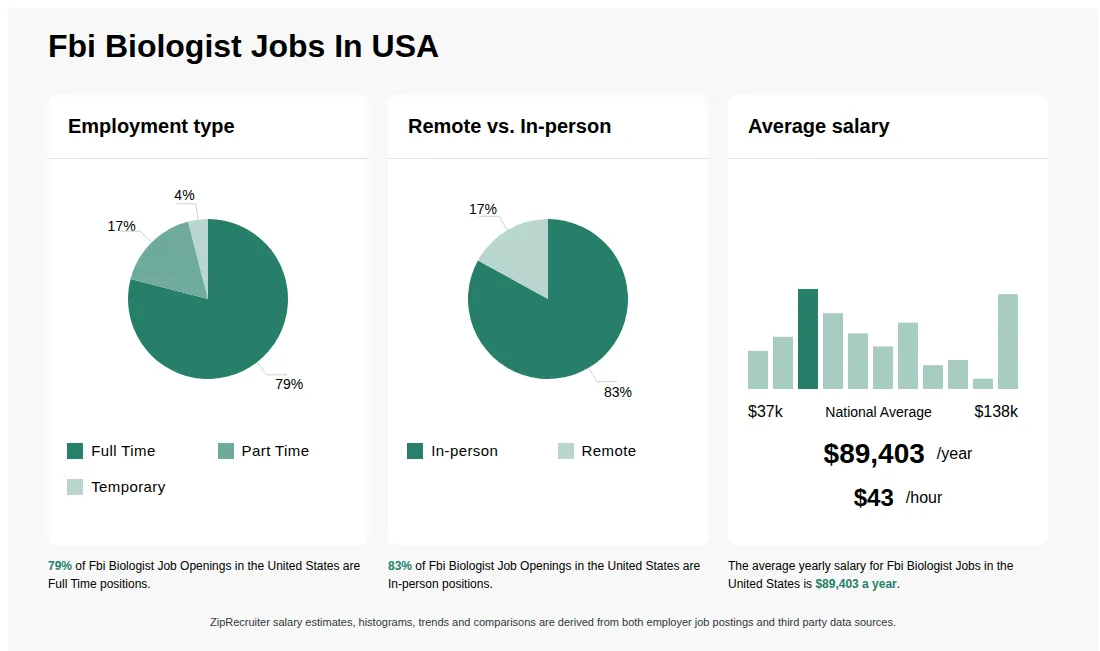
As of Aug 16, 2026, the average yearly pay for fbi biologist in the United States is $89,403.00, according to ZipRecruiter salary data. Most workers in this role earn between $59,500.00 and $121,000.00 per year, depending on experience, location, and employer.

Does the FBI hire biologists?

Yes, the FBI hires biologists as special agents or forensic specialists to work on biological evidence analysis, crime scene investigations, and forensic science. Candidates typically need a background in biology, relevant certifications, and must pass FBI training and background checks.

What are the key skills and qualifications needed to thrive as an FBI biologist?

To thrive as an FBI Biologist, you need a strong background in biology, forensic science, or a related field, typically supported by at least a bachelor’s or master’s degree in a biological science. Expertise in laboratory techniques, DNA analysis, and the use of specialized forensic software and laboratory instrumentation is crucial, with certifications such as those from the American Board of Criminalistics being advantageous. Excellent analytical thinking, attention to detail, teamwork, and strong written and verbal communication skills make someone stand out in this position. These competencies are vital for ensuring the accuracy, reliability, and clarity of forensic evidence used in federal investigations.

What is an FBI biologist?

An FBI Biologist is a specialized scientist who analyzes biological evidence in criminal investigations. They work in forensic laboratories, examining DNA, body fluids, and other biological materials to help identify suspects and victims. These professionals may also testify in court as expert witnesses and support national security efforts. FBI Biologists typically have degrees in biology, forensic science, or related fields and receive extensive training in forensic techniques.

What does an FBI biologist do?

FBI Biologists routinely analyze biological evidence, such as DNA, in support of federal investigations and criminal cases. Their daily tasks often include processing samples, interpreting laboratory data, preparing detailed reports, and maintaining meticulous records in a secure laboratory environment. Collaborating closely with forensic examiners, agents, and attorneys is integral, particularly when explaining scientific findings or preparing testimony for court. This role demands consistently high accuracy and the ability to follow strict protocols, making attention to detail and excellent teamwork essential. Biologists may also participate in ongoing training to stay current with technological advancements and evolving forensic methods.

More about Fbi Biologist jobs

What cities are hiring for Fbi Biologist jobs?

Cities with the most Fbi Biologist job openings:

What are the most commonly searched types of Fbi Biologist jobs?

The most popular types of Fbi Biologist jobs are:

What states have the most Fbi Biologist jobs?

States with the most job openings for Fbi Biologist jobs include:

Infographic showing various Fbi Biologist job openings in the United States as of August 2026, with employment types broken down into 2% As Needed, 71% Full Time, 23% Part Time, 1% Temporary, and 3% Contract. Highlights an 97% Physical, 1% Hybrid, and 2% Remote job distribution, with an average salary of $89,403 per year, or $43 per hour.

Computational Data Scientist II

University of Pittsburgh

Pittsburgh, PA • On-site

Full-time

Posted 26 days ago


Job description

The Bioinformatics Core within the Division of Health Informatics at UPMC Children's Hospital of Pittsburgh is seeking a computational biologist or data scientist to develop and apply machine learning and deep learning methods for omics-driven biomedical research. This individual will work closely with faculty and collaborators across multiple pediatric research programs to support biologically grounded, translationally relevant research. Equivalent relevant work experience may be substituted for degree requirement. This position is located at UPMC Children's Hospital of Pittsburgh in Lawrenceville. PA Child Abuse History Clearance, PA State Police Criminal Record Check, and FBI Criminal Record Check will be required prior to the start of employment. Also, a current TB test will be required as a condition of employment. EEO/AA/M/F/Vets/Disabled.
Minimum Qualifications
Applicants should have an MS or PhD in computational biology, bioinformatics, computer science, statistics, data science, biomedical informatics, or a related quantitative field.
The successful candidate should have strong programming skills in Python and/or R, with experience using libraries such as PyTorch, TensorFlow, scikit-learn, or comparable tools. Experience in applying computational or statistical modeling to biomedical or biological datasets is expected.
Prior experience working with single-cell, spatial omics, or related high-dimensional omics datasets is highly desirable. Candidates should be strong critical thinkers who can translate ideas into completed analyses, models, or tools; manage contributions across multiple collaborative research projects; work independently and as part of multidisciplinary teams; and demonstrate strong oral and written communication skills.
Preferred qualifications include:
• Demonstrated experience designing and implementing models for high-dimensional biological data, beyond routine application of existing analysis pipelines.
• Hands-on experience with graph neural networks or perturbation modeling.
• Experience integrating omics data with clinical data sources such as electronic health records (EHR).
• Evidence of independent technical contribution, such as first-author or co-author publications, preprints, conference presentations, open-source software, deployed tools, analytical pipelines, or a relevant project portfolio.