1

Exercise Science Jobs in Houston, TX (NOW HIRING)

Bachelor's degree in Exercise Physiology, Exercise Science, Kinesiology, Physiology, or a related field. * Approximately 5-10 years of progressively responsible experience in clinical exercise ...

Bachelor's degree in Exercise Physiology, Exercise Science, Kinesiology, Physiology, or a related field. * Approximately 5-10 years of progressively responsible experience in clinical exercise ...

Bachelor's degree in physiology, kinesiology, exercise science, or a related field, plus approximately 5 years of relevant experience; or an equivalent combination of graduate education and ...

Personal Trainer

Humble, TX · On-site

$30 - $40/hr

Bachelors Degree in Exercise Science or equivalent * Masters Degree in Exercise Science or equivalent * NSCA Certified Strength & Conditioning Specialist (CSCS) * USAW Level One Sport Performance ...

Personal Trainer

Humble, TX · On-site

$30 - $40/hr

Bachelor's Degree in Exercise Science or equivalent * Master's Degree in Exercise Science or equivalent * NSCA Certified Strength & Conditioning Specialist (CSCS) * USAW Level One Sport Performance ...

next page

Showing results 1-20

Exercise Science information

See Houston, TX salary details

$12

$27

$45

How much do exercise science jobs pay per hour?

As of Jul 13, 2026, the average hourly pay for exercise science in Houston, TX is $27.08, according to ZipRecruiter salary data. Most workers in this role earn between $19.76 and $32.36 per hour, depending on experience, location, and employer.

What are exercise science professionals?

Exercise science professionals are experts who study how physical activity, exercise, and sports impact the human body. They use their knowledge to help individuals improve their fitness, performance, and overall health. These professionals can work in a variety of settings, including fitness centers, rehabilitation facilities, sports organizations, and research institutions. Their roles may involve developing exercise programs, conducting fitness assessments, and educating people on safe and effective physical activity.

What are careers in exercise science?

Careers in exercise science include roles such as exercise physiologists, sports scientists, fitness trainers, and rehabilitation specialists. These professionals analyze physical activity, develop training programs, and often work in gyms, clinics, or research settings, typically requiring knowledge of anatomy, physiology, and certification in relevant fields.

Is exercise science a good degree?

Exercise science is a valuable degree for careers in health, fitness, and rehabilitation, providing knowledge of human physiology, biomechanics, and nutrition. Graduates often pursue certifications like ACSM or NSCA and work in settings such as gyms, clinics, or research labs. The degree offers practical skills for promoting physical activity and wellness.

What can I do with a PE degree?

A degree in Exercise Science can lead to careers such as personal trainer, fitness instructor, physical therapy assistant, sports coach, or strength and conditioning specialist. These roles often require knowledge of anatomy, physiology, and fitness assessment, and may require certifications like CPR or personal trainer credentials.

What are the key skills and qualifications needed to thrive as an Exercise Science professional, and why are they important?

To thrive as an Exercise Science professional, you need a solid background in human physiology, kinesiology, and exercise prescription, typically supported by a bachelor's or master's degree in exercise science or a related field. Familiarity with fitness assessment tools, exercise equipment, and industry certifications such as ACSM or NSCA is often required. Strong interpersonal skills, motivational ability, and clear communication are vital for effectively coaching and supporting clients. These competencies are essential for designing safe, effective programs that improve client health and performance while fostering trust and adherence.

What Are the Qualifications to Get a Job in Exercise Science?

The qualifications that you need to start working in an exercise science career include a degree and skills in your chosen specialty. Most exercise science careers require at least a bachelor’s degree in exercise science or a related field, such as physiology, kinesiology, or physical therapy. Most clinical jobs require a master’s degree or doctoral degree, though you may only need a bachelor’s degree and on-the-job training if you work under the supervision of a licensed doctor or physical therapist.

What jobs can you do as an exercise scientist?

Exercise scientists can work in roles such as fitness trainers, clinical exercise physiologists, sports performance specialists, and research scientists. They often work in gyms, hospitals, sports teams, or research institutions, utilizing skills in exercise testing, program design, and health assessment. Certification and knowledge of human physiology and biomechanics are typically required for these positions.

What are some common career paths for professionals with a background in Exercise Science?

Exercise Science professionals can pursue a variety of career paths depending on their interests and additional certifications. Many work as exercise physiologists, strength and conditioning coaches, wellness coordinators, or personal trainers. Others may find opportunities in clinical settings such as cardiac rehabilitation or corporate wellness programs. Additionally, some choose to further their education and specialize in areas like physical therapy, occupational therapy, or sports nutrition. The field offers diverse options for growth and specialization, often involving collaboration with healthcare providers, athletes, or community groups.
What are the most commonly searched types of Exercise Science jobs in Houston, TX? The most popular types of Exercise Science jobs in Houston, TX are:
What job categories do people searching Exercise Science jobs in Houston, TX look for? The top searched job categories for Exercise Science jobs in Houston, TX are:
What cities near Houston, TX are hiring for Exercise Science jobs? Cities near Houston, TX with the most Exercise Science job openings:
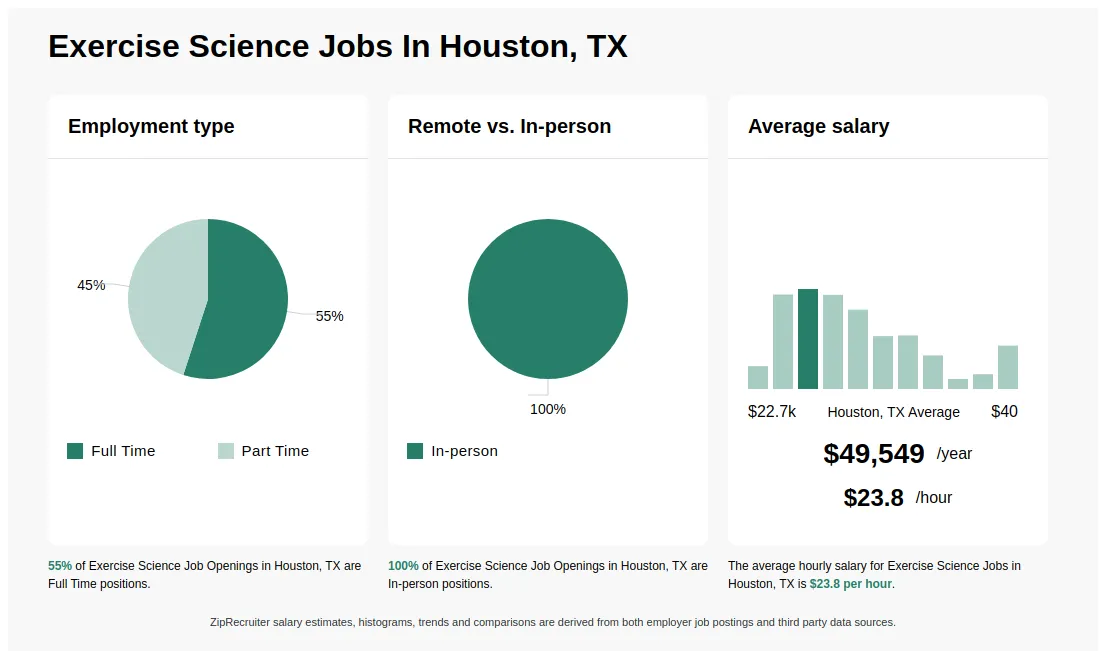
Infographic showing various Exercise Science job openings in Houston, TX as of July 2026, with employment types broken down into 23% Full Time, 72% Part Time, and 5% Contract. Highlights an 100% In-person job distribution, with an average salary of $56,319 per year, or $27.1 per hour.
Clinical Exercise Physiologist

Clinical Exercise Physiologist

JES Tech

Houston, TX • On-site

Full-time

Posted 9 days ago


Job description

Job Type
Full-time
Description
Belong. Connect. Grow.
We are a contract of innovators, thinkers, creators, explorers, volunteers, and dreamers, and we all share one goal: to improve the world responsibly and safely. On the Human Health and Performance Contract, we are at the forefront of safeguarding astronaut health, ensuring human performance, and advancing technologies for human space exploration.
We are seeking a Clinical Exercise Physiologist at the NASA Johnson Space Center (JSC) in Houston, TX to support the Exercise Physiology and Countermeasures (EPC) Laboratory.
What you'll do:
In this role, you will play a key part in supporting the Exercise Physiology and Countermeasures (EPC) team by conducting and coordinating exercise-focused physiological testing to advance human health and performance for exploration missions. You will help transition research into operational use, validate exercise countermeasure systems, and perform human performance assessments across laboratory, analog, and field environments.
This position supports routine operational testing using established protocols in a fast-paced environment. The successful candidate will be comfortable working independently, leading testing activities, and maintaining a high level of professionalism while interacting with research participants, crewmembers, clinicians, engineers, and multidisciplinary teams.
Your primary interfaces will include the NASA Human Health and Performance Directorate, Flight Operations, engineering groups, crewmembers, clinical personnel, research collaborators, and human test subjects.
You will:
  • Lead physiological and performance testing during research studies, training, and analog missions while ensuring participant safety and high-quality data collection.
  • Independently perform setup, calibration, troubleshooting, and real-time monitoring of exercise and physiological testing equipment.
  • Independently conduct graded exercise testing, VO2 max testing, and other physiological performance assessments using continuous ECG and vital sign monitoring.
  • Troubleshoot issues that arise during testing and apply sound judgment to ensure participant safety and data integrity.
  • Coordinate human research studies and engineering evaluations, including participant scheduling, logistics, and collaboration with multidisciplinary teams.
  • Lead testing activities by coordinating participants and guiding team members through established testing protocols to ensure safe, efficient, and consistent execution.
  • Prepare and maintain study documentation, including IRB protocols, test plans, readiness review materials, and progress reports.
  • Design, implement, and maintain data acquisition systems for physiological, metabolic, and performance testing.
  • Support validation and verification of exercise countermeasure hardware, wearable physiological sensors, and human-system interaction technologies.
  • Contribute to the development and refinement of conditioning programs, testing protocols, and performance standards supporting crew health and mission readiness.
  • Ensure compliance with all safety, quality, and regulatory requirements.
  • Complete all assigned training and perform other duties as assigned.

What you bring:
You bring experience independently leading exercise and physiological performance testing with minimal supervision. You are comfortable conducting graded exercise testing with continuous ECG and vital sign monitoring, troubleshooting during testing, and making sound decisions in real time while maintaining participant safety.
You communicate professionally and effectively with research participants, astronauts, clinicians, engineers, and multidisciplinary teams. You are organized, adaptable, and able to balance multiple priorities in a fast-paced operational environment.
Requirements
Minimum Qualifications
  • Bachelor's degree in Exercise Physiology, Exercise Science, Kinesiology, Physiology, or a related field.
  • Approximately 5-10 years of progressively responsible experience in clinical exercise physiology or human performance testing, or an equivalent combination of graduate education and relevant experience.
  • Experience independently conducting graded exercise testing, VO2 max testing, and physiological performance assessments with continuous ECG and vital sign monitoring.
  • Demonstrated ability to independently lead testing activities with minimal supervision.
  • Experience conducting human performance research or clinical exercise testing involving direct interaction with research participants or patients.
  • Strong communication skills with the ability to effectively interact with participants, crewmembers, clinicians, engineers, and multidisciplinary teams.
  • U.S. citizenship or legal permanent residency.

Preferred Qualifications
  • Master's degree in Exercise Physiology, Exercise Science, Kinesiology, Physiology, or a related field.
  • ACSM Certified Clinical Exercise Physiologist (ACSM-CEP) certification preferred. Equivalent hands-on experience independently conducting clinical exercise testing will also be considered.
  • Experience evaluating wearable physiological sensors, exercise devices, or other health monitoring technologies.
  • Experience supporting operational human performance studies or human-system interaction testing in research or operational environments.
  • Familiarity with NASA Human Health & Performance, exercise countermeasure systems, human systems integration, or spaceflight analog environments.

Skills
  • Ability to independently lead exercise testing while maintaining participant safety and data quality.
  • Strong interpersonal skills with the ability to work independently and collaboratively across multiple NASA organizations.
  • Excellent written and verbal communication skills.
  • Strong organizational skills and ability to manage multiple concurrent projects.
  • Sound judgment and problem-solving skills during physiological testing activities.
  • High attention to detail and understanding of human performance assessment.
  • Proficiency with Microsoft Office and standard PC applications.

What to Expect
This position is 100% onsite at NASA Johnson Space Center in Houston, Texas. Occasional travel may be required.