2

Entry Level Welder Jobs in Alaska (NOW HIRING)

Heavy Diesel Technician/Mechanic - Night shift

Juneau, AK

$25.25 - $34.75/hr

  • Medical

  • Dental

  • Vision

  • Life

  • Retirement

  • PTO

This is an entry level position and on-the-job training will be provided. However, formal education ... Basic welding skills. Electrical, hydraulic, engine, A/C and emissions system diagnostics and ...

Heavy Diesel Technician/Mechanic - Night shift

Juneau, AK

$25.25 - $34.75/hr

  • Medical

  • Dental

  • Vision

  • Life

  • Retirement

  • PTO

This is an entry level position and on-the-job training will be provided. However, formal education ... Basic welding skills. Electrical, hydraulic, engine, A/C and emissions system diagnostics and ...

This is an entry-level position with Nordic Calista rigs. This position requires physical strength ... Assists mechanics, electricians, welders, forklift drivers and derrickhands. * Relieves floorhands ...

Entry Level Welder information

See Alaska salary details

$15

$23

$33

How much do entry level welder jobs pay per hour?

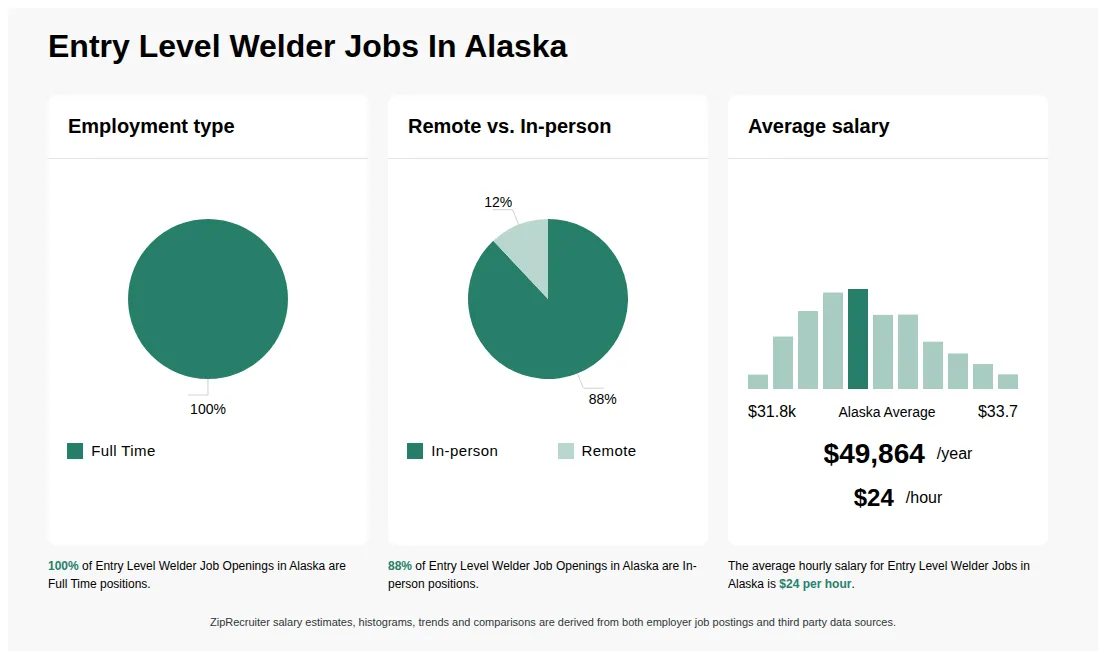
As of Aug 15, 2026, the average hourly pay for entry level welder in Alaska is $23.97, according to ZipRecruiter salary data. Most workers in this role earn between $20.19 and $26.68 per hour, depending on experience, location, and employer.

How much do entry level welders make?

Entry-level welders typically earn between $15 and $20 per hour, with annual salaries ranging from approximately $30,000 to $40,000. Wages can vary based on location, industry, and whether the welder has certifications or specialized skills such as MIG or TIG welding.

How to get a first job as an entry level welder?

To secure an entry-level welder position, obtain a high school diploma or equivalent and complete a welding training program or apprenticeship to develop basic skills. Certifications such as the AWS Certified Welder can improve job prospects, and gaining experience with common tools like MIG or TIG welders is beneficial; applying to local manufacturing, construction, or fabrication companies is a common approach.

What are the key skills and qualifications needed to thrive as an entry level welder?

To thrive as an Entry Level Welder, you need basic welding knowledge, manual dexterity, attention to detail, and often a high school diploma or GED. Familiarity with welding equipment, ability to read blueprints, and certifications like AWS Certified Welder are commonly required. Reliability, willingness to learn, and teamwork are important soft skills that help new welders succeed. These skills and qualities ensure safe, accurate, and efficient work in manufacturing, construction, and repair environments.

What is the difference between Entry Level Welder vs Apprentice Welder?

AspectEntry Level WelderApprentice Welder
CertificationsBasic welding certifications often preferredTypically working towards certifications
Work EnvironmentManufacturing, construction, fabrication shopsOn-the-job training in similar environments
ExperienceMinimal or no prior experience requiredTraining phase, learning skills on the job
Job RolePerforming basic welding tasks under supervisionLearning and assisting with welding tasks

Entry Level Welders are ready to perform basic welding tasks with minimal experience, often holding certifications. Apprentice Welders are in training, gaining hands-on experience under supervision to develop their skills. Both roles are common in manufacturing and construction industries, but apprentices focus on learning and certification attainment.

Can I get an entry level welder job with no experience?

Entry level welder positions often do not require prior experience, but employers typically look for basic skills in welding techniques, knowledge of safety procedures, and the ability to operate welding equipment. Completing a welding training program or obtaining a certification can improve chances of employment, even without previous work experience.

What are some common challenges entry level welders face during their first year on the job?

Entry level welders often encounter challenges such as adapting to different welding techniques, maintaining safety standards, and working efficiently under supervision. Many find it takes time to perfect steady hand movements and to read blueprints or technical drawings accurately. Additionally, adjusting to the physical demands of welding—like standing for long hours or working in confined spaces—can be tough initially. However, with guidance from experienced team members and consistent practice, most new welders overcome these hurdles and become proficient in their roles.

What are the most commonly searched types of Welder jobs in Alaska?

The most popular types of Welder jobs in Alaska are:

What are popular job titles related to Entry Level Welder jobs in Alaska?

For Entry Level Welder jobs in Alaska, the most frequently searched job titles are:

What job categories do people searching Entry Level Welder jobs in Alaska look for?

The top searched job categories for Entry Level Welder jobs in Alaska are:

What cities in Alaska are hiring for Entry Level Welder jobs?

Cities in Alaska with the most Entry Level Welder job openings:

Infographic showing various Entry Level Welder job openings in Alaska as of August 2026, with employment types broken down into 100% Full Time. Highlights an 100% In-person job distribution, with an average salary of $49,864 per year, or $24 per hour.

Heavy Diesel Technician/Mechanic - Night shift

lynden

Juneau, AK

$25.25 - $34.75/hr

Full-time, Other

Medical, Dental, Vision, Life, Retirement, PTO

Posted 24 days ago


Job description

Alaska Marine Trucking is excited to announce the opening of our state-of-the-art heavy equipment shop in Juneau, Alaska. We are seeking talented individuals to join our Team. 

Our mechanics specialize in maintaining some of the largest forklifts in the world. Additionally, we manage a fleet of tractors, including older Kenworth T800’s and newer Kenworth T680’s, as well as over 100 chassis.

This is a full-time position offering family-friendly benefits, a competitive pay package, professional growth opportunities, and ample overtime.

The night shift hours are 3:00pm to 3:00am Monday through Thursday and include a $3.00/hr shift differential.

Currently, our benefit package includes:

Paid time off – start with 17 days paid time off a year (PTO)+ additional extended leave paid time
Paid Holidays– 8 paid holidays a year in addition to PTO

Health Insurance – medical, dental and vision with low employee contributions

Health Insurance for your family– we also contribute to medical, dental and vision for your family.
401(k)– with company match + additional annual retirement contribution.
Tuition Reimbursement
Employee Assistance Program
Life Insurance and AD&D
– we pay at no cost to you.
Long term disability– we pay at no cost to you.
Opportunities for internal promotions/career advancement

Be part of our Team and create big possibilities in your life with a challenging and rewarding career at Alaska Marine Trucking.

SUMMARY:

Provides maintenance on heavy-duty equipment such as lift trucks, tractors, freight moving equipment and product transfer systems.  Also provides maintenance and repair for company facilities at the direction of Maintenance Manager, Service Center Manager and/or Shop Lead.

ESSENTIAL DUTIES AND RESPONSIBILITIES:   

Mechanic I

Perform general preventative maintenance.  This includes fluid changes, greasing equipment and minor component changes.  Shop cleanliness and safe work practices are essential.  This is an entry level position and on-the-job training will be provided.  However, formal education is encouraged.  Mechanic will need to learn a basic skill in our M&R software.  Must be certified on a 4T forklift.

 Mechanic II

All the responsibilities of a Mechanic I.  Ability to perform FHWA inspections.  The ability to assist with more major component swaps like hydraulic pump, engines and transmissions.  Basic welding skills. Electrical, hydraulic, engine, A/C and emissions system diagnostics and repairs diagnostic skills required.  Must have at least a Class A CDL permit.  This position requires at least 1-year Mechanical experience.  Must be willing to travel when needed.  52T forklift certified.

Mechanic III

All the responsibilities of a Mechanic I-II.  Has a Class A CDL with appropriate endorsements.  Ability to perform major component changes alone if needed.  Can work independently as well as take lead on projects.  Can create and receive PO’s in our M&R software system.

 Mechanic IV

All the responsibilities of Mechanic I-III.  Advanced knowledge and skills in electrical, hydraulic, engine, A/C and emissions systems diagnostics and repair.  In depth knowledge of our M&R software system.  Completion of AMT Leadership training is required.

 QUALIFICATIONS:

To perform this job successfully, an individual must possess mechanical inclination and be able to perform each essential duty satisfactorily.  Attendance and timeliness are essential functions of this position; employee customarily works at least 40 hours/week on a planned continuous basis.  The requirements listed below are representative of the knowledge, skill, and/or abilities required.  Reasonable accommodations may be made to enable individuals with disabilities to perform the essential functions.

 EDUCATION AND/OR EXPERIENCE:

High school diploma or equivalent.  Experience in working on heavy duty equipment.  Must have advanced knowledge of hydraulic and DC electrical systems and basic understanding of metal fabrication.  Must be an experienced welder in both MIG and stick processes.  The ability to troubleshoot complex electric over hydraulic systems and the ability to read and understand both electrical and hydraulic schematics is required.  Experience in the transportation industry is preferred.

 LANGUAGE SKILLS:

Ability to read, interpret, and write documents such as bills of ladings, tariffs, delivery receipts, military documents, procedure manuals, employee and safety manuals, and routine reports and correspondence.  Ability to speak effectively and clearly with customers, vendors, managers, and other employees.  Strong communication skills both verbally and in written form.

 MATHEMATICAL SKILLS:

Ability to add, subtract, multiply, and divide in all units of measure, using whole numbers, common fractions, and decimals.  Ability to compute rate, ratio, area, circumference, volume, and percent and to draw and interpret bar graphs.  Ability to apply concepts such as fractions, percentages, ratios and proportions to practical solutions.

 OTHER SKILLS AND ABILITIES:

  • Ability to understand detailed written and oral instructions; ability to prioritize and problem-solve in time/safety-sensitive situations; ability to read and understand wire and hydraulic schematics. 
  • Ability to apply common sense understanding to carry out detailed written or oral instructions, and the ability to prioritize and problem-solve in time/safety-sensitive situations.
  • Ability to organize and follow through to completion projects and tasks assigned or assumed; ability to provide objective and decisive action(s) necessary to resolve any/all issues with minimal disruption to operational performance.
  • Basic computer program skills: Microsoft Windows, Excel, Word, Visio and Outlook.
  • Ability to multi-task in a fast-paced environment.
  • Hazardous materials training.
  • Detail oriented, good interpersonal skills, and organizational skills.
  • Must be flexible to work extended hours and adaptable to change.
  • Must have the ability to work well under pressure.
  • Ability to maintain accurate records and reports in the provided maintenance software.
  • Ability to analyze repair mechanical failures.
  • Must be capable of working with little or no supervision as well as working as part of a team.
  • Must provide own toolbox and sufficient hand tools to perform most assigned duties.

CERTIFICATES, LICENSES, AND REGISTRATIONS:

  • Alaska Commercial Driving License with air brake endorsement.
  • Valid DOT medical card.
  • Forklift Operation Certification.
  • FHWA Inspector Qualification Certification (per 49 CFR § 396.19) and Brake Inspector Qualification Certification (per 49 CFR § 396.25)  

 PHYSICAL DEMANDS:

The physical demands described here are representative of those that must be met by an employee to successfully perform the essential functions of the job; reasonable accommodations may be made to enable individuals with disabilities to perform the essential functions.

  • While performing the duties of this job the employee is regularly required to sit, stand, walk, talk and hear while communicating with customers, drivers and co-workers during the normal course of daily activities; the employee is occasionally required to stoop, kneel, or crouch while inspecting vehicles and other equipment.
  • The employee is regularly required to use hands, arms and fingers to perform the normal duties of the job such as inspecting equipment, entering computer data, manipulate objects, tools, or operate controls.
  • Employee must be able to use eyes, hands and fingers to keyboard, operate phones, fax, radios, and other office machinery.
  • The employee is regularly required to hear, speak, and listen while communicating with telephones, radios and in person with customers and coworkers.
  • The employee must possess close, distance, peripheral and depth perception.
  • The employee is occasionally required to climb or balance and stoop, kneel or crouch around equipment and facilities.
  • Specific vision abilities required by this job include close vision, distance vision, color vision, peripheral vision, depth perception, and ability to adjust focus during the normal course of the job. 
  • The employee must regularly lift and/or move up to 50 pound objects and is occasionally required to lift as much as 100 pound objects.

 WORK ENVIRONMENT:

The work environment characteristics described here are representative of those an employee encounters while performing the essential functions of this job; reasonable accommodations may be made to enable individuals with disabilities to perform the essential functions.

  • While performing the duties of this job, the employee works near moving mechanical parts.  The employee is regularly exposed to fumes, airborne particles, vibration, toxic or caustic chemicals, wet, and/or humid conditions and occasionally works in high, precarious places.
  • The employee occasionally works in an environment with a risk of electric shock.
  • The noise level in the work environment ranges from moderate to moderately loud.
  • The employee is occasionally exposed to outside weather conditions, including incremental Arctic cold conditions and extreme heat and cold.

 COMMENTS:

A post-conditional offer of successfully passing an employment drug test and background investigation are required.