2

Entry Level Software Engineer Jobs in Boston, MA

Our multidisciplinary teams of engineers and scientists work in a collaborative environment that ... Software-defined radio (SDR) platforms and wireless communication systems * Exposure to advanced RF ...

Entry Level RF Engineer

Cambridge, MA · On-site

$62K - $140K/yr

Our multidisciplinary teams of engineers and scientists work in a collaborative environment that ... Software-defined radio (SDR) platforms and wireless communication systems * Exposure to advanced RF ...

... training is available. ** Entry Level Candidates are Encouraged to Apply!!!** General ... Learn and implement technical hardware/software solutions. * Be comfortable with data pattern ...

... training is available. ** Entry Level Candidates are Encouraged to Apply!!!** General ... Learn and implement technical hardware/software solutions. * Be comfortable with data pattern ...

... training is available. ** Entry Level Candidates are Encouraged to Apply!!!** General ... Learn and implement technical hardware/software solutions. * Be comfortable with data pattern ...

Job Overview Skanska is searching for a dynamic Entry-Level VDC Engineer. This is a great ... Internship or relevant experience with 3/D Modeling/ BIM software * Bachelors degree in Engineering ...

next page

Showing results 1-20

Entry Level Software Engineer information

See Boston, MA salary details

$26.1K

$113.9K

$205.3K

How much do entry level software engineer jobs pay per year?

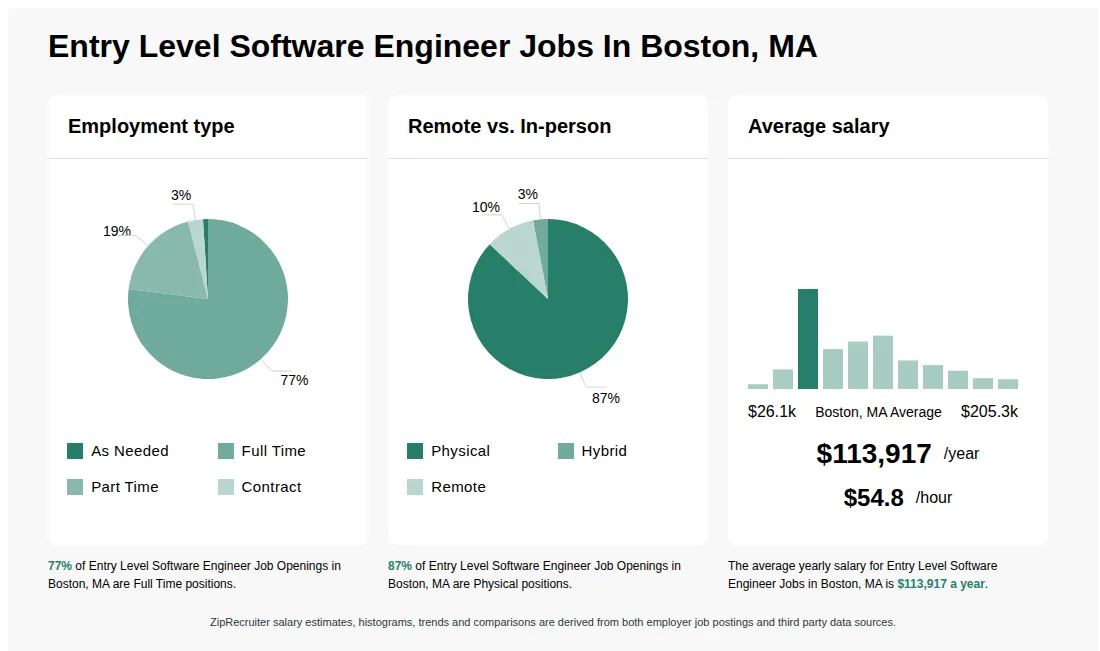
As of Jul 4, 2026, the average yearly pay for entry level software engineer in Boston, MA is $113,917.00, according to ZipRecruiter salary data. Most workers in this role earn between $70,600.00 and $130,400.00 per year, depending on experience, location, and employer.

Will AI replace developers in 2026?

Entry level software engineers will continue to play a vital role in software development, as AI tools are designed to assist rather than fully replace human programmers. Developing skills in coding, problem-solving, and understanding AI integration will remain valuable in the evolving tech environment.

What is the difference between Entry Level Software Engineer vs Software Developer?

AspectEntry Level Software EngineerSoftware Developer
Required CredentialsBachelor's in CS or related field; some internshipsBachelor's in CS or related; coding experience
Work EnvironmentTeam-based, collaborative projects, entry-level tasksProject-focused, coding, debugging, and implementation
Employer & Industry UsageTech companies, startups, IT departmentsSoftware firms, tech startups, enterprise IT
Common Search & ComparisonYesYes

Entry Level Software Engineers and Software Developers often share similar educational backgrounds and work environments. The main difference lies in their roles: engineers may focus more on designing systems and architecture, while developers typically concentrate on coding and implementation. Both roles are essential in tech industries and often overlap in job functions, but understanding these distinctions helps job seekers target the right positions.

What engineer makes $500,000 a year?

Highly experienced software engineers, especially those in senior or specialized roles such as machine learning engineers or software architects at large tech companies, can earn $500,000 or more annually. These roles often require advanced skills, extensive experience, and sometimes stock options or bonuses as part of compensation packages.

How to get a job as a software engineer with no experience?

Entry-level software engineer positions often require demonstrating programming skills through personal projects, internships, or coding bootcamps. Building a strong portfolio, learning relevant tools like Git and languages such as Python or Java, and obtaining certifications can improve chances of securing an entry-level role without prior work experience.

What types of projects do entry level software engineers typically work on, and how do they collaborate with other team members?

Entry level software engineers often start by working on smaller features, bug fixes, or assisting with testing and documentation within larger projects. They usually collaborate closely with senior engineers, product managers, and QA teams through code reviews, daily stand-ups, and pair programming sessions. This structure helps new engineers learn best practices, understand the codebase, and gradually take on more complex assignments. Effective communication and a willingness to learn are key to success in these collaborative environments.

What does an entry level software engineer do?

An entry level software engineer is responsible for assisting in the design, development, testing, and maintenance of software applications. They typically work under the guidance of more experienced engineers and may write code, debug programs, and participate in code reviews. The role often involves learning company-specific tools and workflows, collaborating with team members, and continuously improving technical skills. Entry level software engineers are expected to adapt quickly, communicate effectively, and contribute to the team's overall goals.

What are the key skills and qualifications needed to thrive as an Entry Level Software Engineer, and why are they important?

To thrive as an Entry Level Software Engineer, you need a solid understanding of programming languages (such as Java, Python, or C++), computer science fundamentals, and often a relevant bachelor’s degree. Familiarity with version control systems like Git, development frameworks, and basic software development tools is typically expected. Strong problem-solving abilities, eagerness to learn, and effective collaboration are standout soft skills in this role. These skills are crucial for building reliable software, adapting to evolving technologies, and contributing productively to team projects.

What Does an Entry Level Software Engineer Do?

An Entry-Level Software Engineer, also called a Junior Engineer, works with a team of mid-level and senior engineers to develop, test, and maintain software applications and programs. The job duties of Junior Software Engineers typically include relatively simple routine tasks, such as debugging, testing, and code documentation. These tasks hone a Junior Engineer’s skills and familiarize them with the company’s code base. As Software Engineers gain more years of experience, they work on more complex development projects.

Is it true that AI will replace software engineers?

AI is unlikely to fully replace entry-level software engineers, as human skills such as problem-solving, creativity, and understanding complex requirements remain essential. AI tools can assist with coding and automation, but software engineering involves tasks that require critical thinking and collaboration. Developing proficiency in programming languages and understanding AI capabilities can enhance job performance and adaptability in the field.
What are the most commonly searched types of Software Engineer jobs in Boston, MA? The most popular types of Software Engineer jobs in Boston, MA are:
What job categories do people searching Entry Level Software Engineer jobs in Boston, MA look for? The top searched job categories for Entry Level Software Engineer jobs in Boston, MA are:
What cities near Boston, MA are hiring for Entry Level Software Engineer jobs? Cities near Boston, MA with the most Entry Level Software Engineer job openings:
Data Scientist/Engineer - Junior (Remote)

Data Scientist/Engineer - Junior (Remote)

SynergisticIT

Boston, MA • On-site

Other

Posted 14 days ago


Job description

Your Degree Was Only the Beginning — Now It’s Time to Get Hired - Get Hired with a Process which Works ! A CS degree gives you a foundation, but employers want more — they want proof you can apply your knowledge in real‑world scenarios. SynergisticIT helps you bridge that gap.

You’ll build industry‑level projects, sharpen your interview skills, and gain hands‑on experience in the technologies companies are hiring for right now. The program also markets your profile directly to Fortune 500 clients ,giving you visibility beyond what a degree alone can provide. If you want to turn your education into a real job offer, Synergisticit is the next step you need.

If you’re getting interviews but not offers, you’re closer than you think—yet that final gap can feel brutal. Many candidates spend months learning frameworks and finishing courses, only to freeze during technical screens, system questions, or behavioral rounds. The result is painful: “almost hired” over and over again, while the confidence drops.

The truth is that interviewing is its own skill, and Colleges don’t teach it. They teach how to code—but not how to think out loud, structure answers, debug in real time, defend trade-offs, and communicate like an engineer. Since 2010, SynergisticIT has helped candidates land full-time roles with many major employers.

The best way to understand this: you can be smart and still fail interviews if you don’t know what the interview is truly measuring. Interviews rarely test “can you write code at home.” They test: Can you solve problems under constraints and time pressure? Can you communicate your approach clearly?

Can you handle edge cases and complexity? Can you explain trade-offs and design choices? Can you show job-ready project depth, not just toy examples?

SynergisticIT focuses on roles such as entry-level software programmers, Java full stack developers, Python/Java developers, Data Analysts, Data Engineers, Data Scientists, and Machine Learning Engineers. The focus areas include Java / Full Stack / DevOps and Data tracks like Data Engineering, Data Analytics/BI, ML/AI, because those are the roles employers continue to hire for. If your pattern is “I reach interviews but don’t clear them,” you likely need three upgrades: Stronger project narratives (what you built, why it matters, how it works) Stronger technical foundations (DSA, OOP, APIs, SQL, pipeline design) Mock interview reps (realistic simulation, feedback, improvement loops) Many jobseekers underestimate how much hiring is about clarity.

You don’t need to be perfect—you need to show you can think, collaborate, and deliver. That’s why guided mock interviews and structured interview coaching can be a game-changer. Ideal candidates for this version include: Candidates who get interviews but repeatedly fall short Jobseekers stuck in “screen round limbo” Developers who panic during live coding Candidates who can build projects but struggle to explain them Professionals who haven’t interviewed in years and feel rusty Career changers who fear “I’m behind CS grads” (often untrue with support) If you’re tired of failing interviews and want a structured plan to convert interviews into offers, start here: please read our blogs Why do Tech Companies not Hire recent Computer Science Graduates | https://www.synergisticit.com/why-tech-companies-dont-hire-recent-cs-graduates/ Technical Skills or Experience?

| Which one is important to get a Job? | https://www.synergisticit.com/tech-skill-or-experience-which-one-is-more-important-for-a-jobseeker/ Please check below links: Event videos (OCW, JavaOne, Gartner): https://fast.wistia.com/embed/channel/k4mlq69ekl USA Today feature Discover JOPP: https://www.synergisticit.com/jopp/ Contact: https://www.synergisticit.com/contact-us/ Because getting hired isn’t about trying harder—it’s about preparing smarter, practicing correctly, and having the right guidance. Please note: Resume databases are shared with clients and interested clients will reach out directly if they find a qualified candidate for their req.

Resume submissions may be shared with our JOPP team database also. Please unsubscribe if contacted or if you don’t want to be contacted please don’t submit your resume.