3

Entry Level Remote Ai Trainer Jobs (NOW HIRING)

Be Seen First

APPLY HERE: & utm_source=zip_recruiter We are looking for fluent Korean speakers to participate in remote AI training projects. Tasks may include reviewing AI-generated content, evaluating responses ...

Be Seen First

APPLY HERE: & utm_source=zip_recruiter We are looking for fluent Korean speakers to participate in remote AI training projects. Tasks may include reviewing AI-generated content, evaluating responses ...

Join our team as a Remote AI Trainer Prompt Writer and play a vital role in shaping the future of AI from the comfort of your own home. No particular qualifications or prior experience are required ...

Be Seen First

APPLY HERE: & utm_source=zip_recruiter We are looking for fluent Korean speakers to participate in remote AI training projects. Tasks may include reviewing AI-generated content, evaluating responses ...

next page

Showing results 1-20

Entry Level Remote Ai Trainer information

See salary details

$13

$24

$36

How much do entry level remote ai trainer jobs pay per hour?

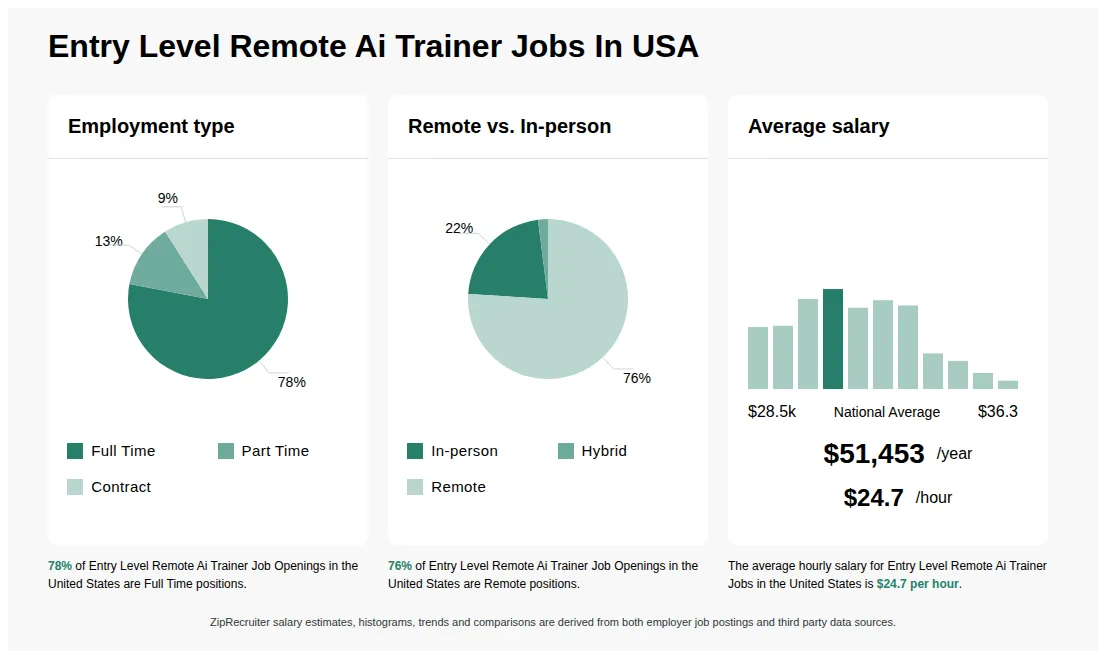
As of Jul 26, 2026, the average hourly pay for entry level remote ai trainer in the United States is $24.74, according to ZipRecruiter salary data. Most workers in this role earn between $18.75 and $26.44 per hour, depending on experience, location, and employer.

What is the difference between Entry Level Remote Ai Trainer vs Data Annotator?

AspectEntry Level Remote Ai TrainerData Annotator
CredentialsHigh school diploma or equivalent; basic understanding of AI conceptsHigh school diploma or equivalent; attention to detail
Work EnvironmentRemote, collaborative with AI teamsRemote or on-site, focused on labeling data
Industry UsageAI development, machine learning projectsData preparation for AI and ML models
Search & Comparison IntentOften compared for entry-level AI rolesRelated but more focused on data labeling tasks

While both roles are entry-level and often remote, Entry Level Remote Ai Trainers focus on training AI models by providing feedback and refining algorithms, whereas Data Annotators primarily label and prepare data for AI systems. Understanding these distinctions helps job seekers identify the right role based on their skills and career goals.

What is an Entry Level Remote AI Trainer?

An Entry Level Remote AI Trainer is a professional who helps improve artificial intelligence systems by providing feedback, labeling data, and evaluating AI outputs, often from a remote location. These roles typically require individuals to review content, assess the accuracy of AI-generated responses, or annotate data sets to help machine learning models learn and perform better. No advanced technical background is usually necessary, making it ideal for those starting their careers in AI or data-related fields. Training is often provided, and tasks can range from simple text analysis to more complex problem-solving depending on the employer.

What are the key skills and qualifications needed to thrive as an Entry Level Remote AI Trainer, and why are they important?

To thrive as an Entry Level Remote AI Trainer, you typically need strong written communication, critical thinking, and a basic understanding of technology, often supported by a bachelor's degree or equivalent experience. Familiarity with annotation platforms, collaboration tools, and sometimes foundational knowledge of AI concepts or data labeling systems is beneficial. Attention to detail, adaptability, and the ability to work independently are crucial soft skills for excelling in this role. These skills ensure high-quality data contributions, effective remote collaboration, and the reliable training of AI models.

Can I work remotely as an AI trainer?

Yes, entry-level AI trainers can often work remotely, as the role primarily involves data annotation, model testing, and providing feedback through online platforms. Strong communication skills and familiarity with AI tools or annotation software are typically required, and remote work arrangements are common in this field.

Can I become an AI trainer with no experience?

Entry level AI trainer roles often do not require prior experience, as training programs may provide on-the-job learning and basic skills in data annotation, machine learning concepts, and tools like Python or annotation platforms. Having strong communication skills and attention to detail can help you succeed, and some roles may require a relevant certification or background in related fields such as computer science or linguistics.

How can I get a job as an AI trainer?

To get a job as an AI trainer, develop skills in machine learning, data annotation, and natural language processing. Gaining experience with data labeling tools and understanding AI model training processes can improve your chances, and some roles may require a background in computer science or related fields.

What are some common challenges faced by Entry Level Remote AI Trainers, and how can they be addressed?

Entry Level Remote AI Trainers often encounter challenges such as understanding complex annotation guidelines, maintaining consistency in labeling, and managing communication across distributed teams. To address these issues, it's helpful to actively participate in training sessions, ask clarifying questions when guidelines are unclear, and leverage collaboration tools like Slack or project management platforms to stay connected with teammates and supervisors. Regular feedback sessions and quality checks also support continual improvement and help ensure high annotation accuracy.

How much do remote AI trainers make?

Remote AI trainers typically earn between $15 and $25 per hour, depending on experience, skills, and the complexity of the tasks. Entry-level positions may start at the lower end of this range, while more experienced trainers or those with specialized knowledge can earn higher wages. Compensation often includes flexible schedules and opportunities to work with machine learning tools and datasets.
More about Entry Level Remote Ai Trainer jobs
What cities are hiring for Entry Level Remote Ai Trainer jobs? Cities with the most Entry Level Remote Ai Trainer job openings:
What are the most commonly searched types of Remote Ai Trainer jobs? The most popular types of Remote Ai Trainer jobs are:
What states have the most Entry Level Remote Ai Trainer jobs? States with the most job openings for Entry Level Remote Ai Trainer jobs include:
Infographic showing various Entry Level Remote Ai Trainer job openings in the United States as of July 2026, with employment types broken down into 73% Full Time, 24% Part Time, and 3% Contract. Highlights an 65% Physical, 3% Hybrid, and 32% Remote job distribution, with an average salary of $51,453 per year, or $24.7 per hour.
Korean AI Task Contributor, Part-Time Remote

Korean AI Task Contributor, Part-Time Remote

Total AI

OR • Remote

$31 - $35/hr

Part-time

Posted 11 days ago

Be Seen First

After you apply to this job, you can share why you’re interested to jump to the top of the candidate list.


Job description

APPLY HERE:
https://totaltask.ai/projects/f73f5ed0efc8cebe?lang=ko&utm_source=zip_recruiter
We are looking for fluent Korean speakers to participate in remote AI training projects. Tasks may include reviewing AI-generated content, evaluating responses, labeling data, completing language-based assignments, and helping improve AI systems.

Requirements:

  • Fluent or native-level Korean
  • Strong attention to detail
  • Reliable internet connection and computer access
  • Ability to follow written instructions
  • Previous AI or data-labeling experience is helpful but not required

This is flexible, remote, project-based work. Task availability and compensation may vary by project, and all details will be shown before you begin.
APPLY HERE:
https://totaltask.ai/projects/f73f5ed0efc8cebe?lang=ko&utm_source=zip_recruiter

Company Description

Total AI is a technology company focused on building high-quality, human-generated datasets that support AI training, evaluation, and research.
Our projects may include voice recordings, language-based tasks, content review, data labeling, and response evaluation. This work helps AI systems better understand different languages, accents, communication styles, and real-world situations. We work with contributors from diverse backgrounds and provide clear instructions for every project.