2

Entry Level Machine Learning Engineer Jobs (NOW HIRING)

Machine Learning Engineer I

Seattle, WA · On-site

$100K - $150K/yr

About the Role We are looking for a motivated, entry-level Machine Learning Engineer to help build, train, and deploy ML models that power our Marketing AI and AI Sales Agent products. This role is ...

next page

Showing results 1-20

Entry Level Machine Learning Engineer information

See salary details

$30K

$69.4K

$118K

How much do entry level machine learning engineer jobs pay per year?

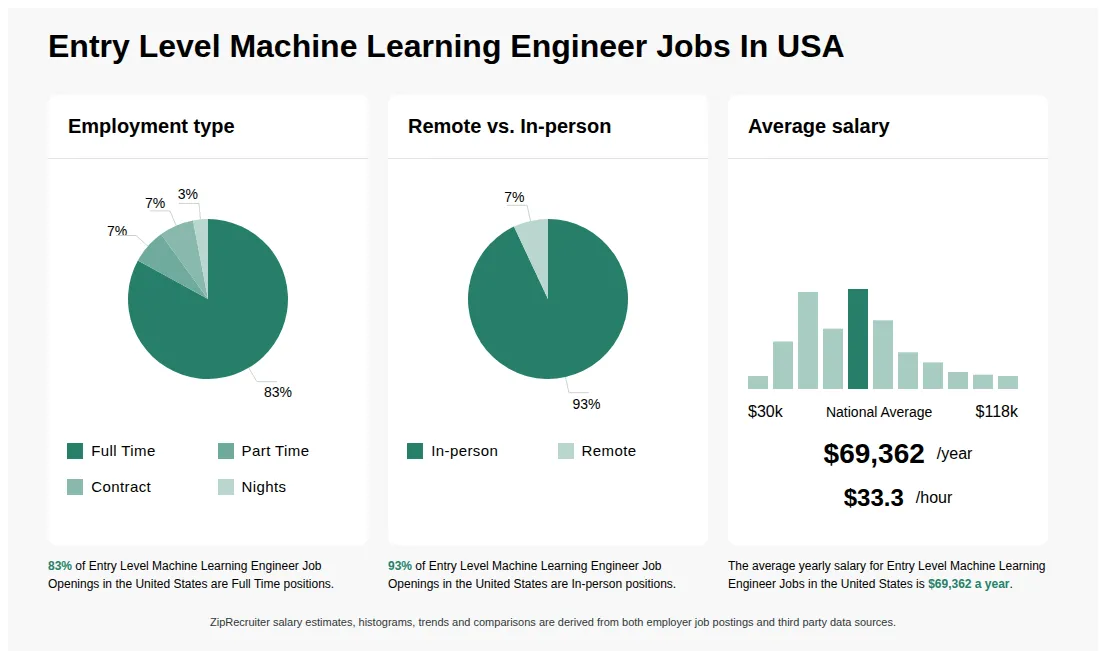
As of Jun 23, 2026, the average yearly pay for entry level machine learning engineer in the United States is $69,362.00, according to ZipRecruiter salary data. Most workers in this role earn between $51,500.00 and $78,500.00 per year, depending on experience, location, and employer.

What are the key skills and qualifications needed to thrive in the Entry Level Machine Learning Engineer position, and why are they important?

To thrive as an Entry Level Machine Learning Engineer, you need a solid understanding of machine learning algorithms, programming languages like Python, and a degree in computer science, engineering, or a related field. Familiarity with tools such as TensorFlow, PyTorch, scikit-learn, and version control systems like Git is highly valuable, and completing online courses or certifications can further demonstrate your skills. Strong analytical thinking, attention to detail, and effective communication are important soft skills in this role. These abilities are essential because they enable you to build accurate models, work collaboratively with teams, and communicate insights to stakeholders.

What are some typical projects or tasks an Entry Level Machine Learning Engineer might work on?

As an Entry Level Machine Learning Engineer, you’ll often work on tasks such as data preprocessing, feature engineering, and assisting in training and evaluating models under the guidance of senior engineers or data scientists. You may help develop prototypes, automate data collection pipelines, and collaborate with software engineers to integrate machine learning solutions into products. Working in this role typically involves frequent collaboration in a team environment, participating in code reviews, and learning best practices for scalable model deployment. These foundational experiences are designed to build your technical expertise and set the stage for future growth within the field.

What is an Entry Level Machine Learning Engineer job?

An Entry Level Machine Learning Engineer is responsible for developing, testing, and deploying machine learning models under the guidance of senior engineers. They work with datasets, implement algorithms, and optimize model performance. Their role often involves data preprocessing, feature engineering, and collaborating with data scientists and software engineers. Strong programming skills in Python, knowledge of ML frameworks like TensorFlow or PyTorch, and an understanding of statistics and algorithms are essential. This position serves as a foundation for building expertise in artificial intelligence and data-driven decision-making.

More about Entry Level Machine Learning Engineer jobs
What cities are hiring for Entry Level Machine Learning Engineer jobs? Cities with the most Entry Level Machine Learning Engineer job openings:
What are the most commonly searched types of Machine Learning Engineer jobs? The most popular types of Machine Learning Engineer jobs are:
What states have the most Entry Level Machine Learning Engineer jobs? States with the most job openings for Entry Level Machine Learning Engineer jobs include:
Infographic showing various Entry Level Machine Learning Engineer job openings in the United States as of June 2026, with employment types broken down into 14% Internship, 72% Full Time, 7% Part Time, and 7% Temporary. Highlights an 93% In-person, and 7% Remote job distribution, with an average salary of $69,362 per year, or $33.3 per hour.
Entry Level Machine Learning Engineer

Entry Level Machine Learning Engineer

Frederick Community College

Rockville, MD • On-site

Other

This job post has expired 1 day ago. Applications are no longer accepted.


Job description

Entry Level Machine Learning Engineer

Temple Allen Industries is at the forefront of bringing AI and Machine Learning to industrial processes for high-value assets in aerospace, marine, wind power, and transportation markets. We are currently expanding our award-winning line of Smart Automation EMMA™ systems which promise to dramatically reshape surface preparation and the robotics, machine learning, and human augmentation landscape.

Position: Entry Level Machine Learning Engineer

We are seeking a highly skilled Machine Learning Engineer to join our dynamic team and lead projects within the Machine Learning Program. In this role, you will be responsible for completing projects associated with the training, deployment, optimization, and advancement of machine learning models that are currently running, or will be run, on the SA EMMA systems.

You should be interested in the full scope of the machine learning pipeline, including data collection, annotation, simulation, training, deployment, testing, benchmarking, and model optimization. Your passion for robotics will help fuel your work in improving the EMMA robotic solution. You should be excited to show off your work, teach peers about it, and uplift your team's skills by sharing your expertise.

You should also want to be part of the design process and be excited to participate in discussions with designers, engineers, and managers to understand the system holistically and implement machine learning solutions that bring real value to the artisan and the enterprise.

This role will expose you to complex and rewarding technical challenges, as well as real-world engineering and machine learning experience. You will work with a team of engineers and developers to meet the requirements of the overall EMMA system and the Machine Learning Program. Along the course of the project, mentorship and guidance will be provided to help you grow and advance your skills on both the technical and managerial fronts.

You will need to be organized, systematic, and self-driven to lead projects, successfully deliver machine learning solutions that achieve system-level performance and functional specifications, and participate in discussions coordinating the Machine Learning Program's long-term vision and objectives with other programs and major projects.

In this role, you will work on major projects that create and advance the machine learning approach used to continually improve cutting-edge robotic systems that push the boundaries of technology.

Requirements

  • Bachelor's or Master's degree in Machine Learning, Robotics, Computer Science, Computer Engineering, Electrical Engineering, or a related field.
  • Strong proficiency in modern C++ programming.
  • Previous experience in computer vision, machine learning, robotics, or real-time perception systems.
  • Previous experience training, testing, validating, and deploying machine learning models.
  • Experience with ROS and ROS2.
  • Experience with neural networks, CNNs, semantic segmentation, instance segmentation, object detection, and classification models.
  • Strong understanding of machine learning model architectures, including how layers, feature extractors, heads, parameters, and model size impact accuracy, latency, memory usage, and inference performance.
  • Experience analyzing model architecture to identify opportunities for optimization, simplification, pruning, quantization, layer reduction, or architecture tuning.
  • Ability to optimize models for faster inference on real-time robotic systems while maintaining acceptable accuracy, reliability, and system-level performance.
  • Familiarity with model optimization and deployment tools such as TensorRT, ONNX, TorchScript, OpenVINO, or similar frameworks.
  • Ability to implement and run machine learning models in real-time systems, edge devices, embedded systems, GPUs, or robotics platforms.
  • Experience benchmarking model performance using metrics such as inference time, FPS, latency, memory usage, GPU utilization, CPU utilization, and accuracy.
  • Experience using NVIDIA Isaac Sim or similar robotics simulation platforms for developing, testing, and validating robotic perception systems.
  • Familiarity with creating and configuring simulated robotic environments, including lighting, camera placement, sensor models, textures, object behaviors, aircraft geometry, and environmental conditions.
  • Experience generating synthetic image datasets from simulated environments to support machine learning model training, validation, and testing.
  • Experience creating or using RGB images, depth images, segmentation masks, annotation outputs, and other simulated sensor data for model development.
  • Familiarity with domain randomization techniques to improve model robustness across different lighting conditions, surface finishes, camera angles, environments, and real-world operating scenarios.
  • Experience comparing simulated data performance against real-world data and identifying gaps between simulation and deployment environments.
  • Exposure to cloud-based machine learning workflows, including training, testing, evaluating, and deploying models using platforms such as AWS, Azure, or Google Cloud.
  • Experience using cloud services such as AWS EC2, S3, Lambda, SageMaker, or similar tools for data storage, training pipelines, automation, and deployment.
  • Ability to manage large-scale datasets in cloud environments, including organizing, versioning, transferring, securing, and retrieving training data.
  • Familiarity with distributed training, GPU-based cloud instances, containerized machine learning workflows, and scalable model training pipelines.
  • Experience using Docker or similar containerization tools to support repeatable training, testing, and deployment environments.
  • Experience with data handling libraries and dataset preprocessing workflows.
  • Exposure to GPU programming, such as CUDA, is preferred.
  • Proficient in software development best practices, including version control systems, testing frameworks, code reviews, documentation, and maintainable software design.
  • Ability to create project deadlines, remain self-driven to meet those deadlines, and think critically about the long-term goals of the program.
  • Ability to coordinate technical work across programs and projects while aligning machine learning efforts with broader system objectives.
  • Ability to hold team members accountable and delegate project work efficiently.
  • Excellent problem-solving skills and strong attention to detail.
  • Eagerness to receive and implement direct feedback from the customer.
  • Strong written and verbal communication skills.
  • Ability to demonstrate strong time management skills.
  • Ability to work effectively in a collaborative team environment.
  • Ability to efficiently communicate and renegotiate requirements based on ongoing scopes of work.

Responsibilities

  • Lead and participate in system design discussions to generate performance and functional specifications for machine learning projects.
  • Research different machine learning models, understand their inputs, outputs, architectures, and limitations, and determine how they can be utilized for specific EMMA system tasks.
  • Train, test, validate, optimize, and deploy machine learning models for use on EMMA robotic systems.
  • Analyze existing machine learning model architectures to understand performance bottlenecks and identify opportunities for optimization.
  • Modify, simplify, or remove unnecessary model layers to improve inference speed while preserving required accuracy and reliability.
  • Apply model optimization techniques such as pruning, quantization, layer reduction, architecture tuning, knowledge distillation, and conversion to optimized runtime formats.
  • Convert trained models into deployment-ready formats such as ONNX, TensorRT, TorchScript, OpenVINO, or other runtime-optimized formats.
  • Benchmark models before and after optimization to validate improvements in inference speed, memory usage, GPU utilization, CPU utilization, and real-time system performance.
  • Evaluate tradeoffs between model size, accuracy, latency, compute requirements, hardware constraints, and deployment performance.
  • Work with robotics and software engineers to ensure optimized models meet the timing and performance requirements of the EMMA system.
  • Generate datasets and annotation requirements for future models, and lead junior engineers performing annotations.
  • Record desired camera and sensor data from EMMA systems to use for model training, validation, and testing.
  • Perform data manipulation tasks including labeling, cleaning, removing outliers, organizing metadata, and splitting data into training, validation, and test datasets.
  • Design and implement data collection pipelines for individual client sites.
  • Work with the network engineer to set up databases and cloud-connected storage systems to store, organize, and sort machine learning data.
  • Develop and maintain simulated environments in NVIDIA Isaac Sim or similar simulation platforms to support machine learning model training, validation, and testing.
  • Create realistic and domain-randomized simulation scenarios that vary lighting, surface conditions, camera angles, object placement, aircraft geometry, and environmental factors.
  • Generate simulated RGB images, depth images, segmentation masks, and other synthetic datasets to supplement real-world data collected from EMMA systems.
  • Design workflows for converting simulated outputs into usable training datasets with proper labels, annotations, and metadata.
  • Use synthetic and real-world datasets to improve perception tasks such as semantic segmentation, object detection, classification, feature recognition, surface identification, defect detection, and sanding-region identification.
  • Validate machine learning models using both simulated and real-world datasets to evaluate robustness