Crime Scene Specialist
Georgetown, TX · On-site
Crime Scene Investigation and Criminal investigation procedures. * Latent Print Examiner, preferred * Police Department rules and regulations. * Latent print comparison, identification and ...
Georgetown, TX · On-site
Crime Scene Investigation and Criminal investigation procedures. * Latent Print Examiner, preferred * Police Department rules and regulations. * Latent print comparison, identification and ...
Georgetown, TX · On-site
Crime Scene Investigation and Criminal investigation procedures. * Latent Print Examiner, preferred * Police Department rules and regulations. * Latent print comparison, identification and ...
Augusta, GA · On-site
Assist Crime Scene Investigators during criminal investigations of crime scenes that may assist courts with judicial proceedings within the guidelines of the Criminal Code of Georgia, federal ...
Augusta, GA · On-site
Assist Crime Scene Investigators during criminal investigations of crime scenes that may assist courts with judicial proceedings within the guidelines of the Criminal Code of Georgia, federal ...
Rio Rancho, NM · On-site
$49K - $53K/yr
Methods and techniques of crime scene investigations Fingerprinting processes and classification; rules of evidence, police procedures, and photo taking; DNA processing methods and evidence ...
Rio Rancho, NM · On-site
$49K - $53K/yr
Methods and techniques of crime scene investigations Fingerprinting processes and classification; rules of evidence, police procedures, and photo taking; DNA processing methods and evidence ...
This non-sworn position is responsible for performing a variety of tasks and procedures relating to crime scene investigation, documentation, analysis, and sorting of physical evidence for ...
This non-sworn position is responsible for performing a variety of tasks and procedures relating to crime scene investigation, documentation, analysis, and sorting of physical evidence for ...
San Diego, CA · On-site
$26.63 - $28.89/hr
Crime Scene Investigation & Forensics Location: Onsite: San Diego, CA (Spectrum) National University is a veteran-founded, San Diego-based nonprofit. Since 1971, our mission has been to provide ...
San Diego, CA · On-site
$26.63 - $28.89/hr
Crime Scene Investigation & Forensics Location: Onsite: San Diego, CA (Spectrum) National University is a veteran-founded, San Diego-based nonprofit. Since 1971, our mission has been to provide ...
$65K - $108K/yr
Conducts investigations of felonies and misdemeanors committed within Fulton County. Questions ... Performs crime scene processing. Obtains photographs, fingerprints, questions victims, suspects ...
$65K - $108K/yr
Conducts investigations of felonies and misdemeanors committed within Fulton County. Questions ... Performs crime scene processing. Obtains photographs, fingerprints, questions victims, suspects ...
San Diego, CA · On-site
$26.63 - $28.89/hr
Crime Scene Investigation & Forensics Location: Onsite: San Diego, CA (Spectrum) National University is a veteran-founded, San Diego-based nonprofit. Since 1971, our mission has been to provide ...
San Diego, CA · On-site
$26.63 - $28.89/hr
Crime Scene Investigation & Forensics Location: Onsite: San Diego, CA (Spectrum) National University is a veteran-founded, San Diego-based nonprofit. Since 1971, our mission has been to provide ...
Ardmore, OK · On-site
$23.95 - $25.79/hr
Investigate crime scenes at any hour of the day or night, under any weather conditions; survey crime scene and formulate a plan of procedure. Prepare detailed report of investigations, and maintain ...
Ardmore, OK · On-site
$23.95 - $25.79/hr
Investigate crime scenes at any hour of the day or night, under any weather conditions; survey crime scene and formulate a plan of procedure. Prepare detailed report of investigations, and maintain ...
Houston, TX · On-site
$60 - $80/hr
Forensic Investigator - Crime Scene Resources, Inc. Houston, TX Duties and Requirements Duties Duties & Responsibilities: * Responds to death scenes to document, recover and identify human remains ...
Houston, TX · On-site
$60 - $80/hr
Forensic Investigator - Crime Scene Resources, Inc. Houston, TX Duties and Requirements Duties Duties & Responsibilities: * Responds to death scenes to document, recover and identify human remains ...
San Jose, CA · On-site
$98K - $119K/yr
... Crime Scene Analysis; * Examines evidence, evaluates findings and interprets results utilizing ... Assists with field investigations at crime scenes and other locations to search for, collect ...
San Jose, CA · On-site
$98K - $119K/yr
... Crime Scene Analysis; * Examines evidence, evaluates findings and interprets results utilizing ... Assists with field investigations at crime scenes and other locations to search for, collect ...
Proactively analyze and investigate potential threats and complex criminal schemes directed at Wash U; perform and coordinate crime avoidance and prevention training for the campus community; author ...
Proactively analyze and investigate potential threats and complex criminal schemes directed at Wash U; perform and coordinate crime avoidance and prevention training for the campus community; author ...
Saint Louis, MO · On-site
Proactively analyze and investigate potential threats and complex criminal schemes directed at Wash U; perform and coordinate crime avoidance and prevention training for the campus community; author ...
Saint Louis, MO · On-site
Proactively analyze and investigate potential threats and complex criminal schemes directed at Wash U; perform and coordinate crime avoidance and prevention training for the campus community; author ...
Ability to identify, assess, and mitigate risks associated with crime scene investigations, evidence handling, and forensic analysis to minimize errors, contamination, and legal challenges.
Quick apply
Ability to identify, assess, and mitigate risks associated with crime scene investigations, evidence handling, and forensic analysis to minimize errors, contamination, and legal challenges.
New York, NY · On-site
Crime Correspondent / Crime Desk Editor Location: Onsite, Daily Mail US, New York, NY Salary Range ... and in-depth investigations, we deliver a unique editorial blend spanning showbiz, royals ...
New York, NY · On-site
Crime Correspondent / Crime Desk Editor Location: Onsite, Daily Mail US, New York, NY Salary Range ... and in-depth investigations, we deliver a unique editorial blend spanning showbiz, royals ...
Ability to identify, assess, and mitigate risks associated with crime scene investigations, evidence handling, and forensic analysis to minimize errors, contamination, and legal challenges.
Quick apply
Ability to identify, assess, and mitigate risks associated with crime scene investigations, evidence handling, and forensic analysis to minimize errors, contamination, and legal challenges.
New York, NY · On-site
Crime Correspondent / Crime Desk Editor Location: Onsite, Daily Mail US, New York, NY Salary Range ... and in-depth investigations, we deliver a unique editorial blend spanning showbiz, royals ...
New York, NY · On-site
Crime Correspondent / Crime Desk Editor Location: Onsite, Daily Mail US, New York, NY Salary Range ... and in-depth investigations, we deliver a unique editorial blend spanning showbiz, royals ...
The Technical Operations Investigation Contractor is responsible for overseeing, conducting, and documenting investigations related to deviations, nonconformances, and quality events. This role ...
The Technical Operations Investigation Contractor is responsible for overseeing, conducting, and documenting investigations related to deviations, nonconformances, and quality events. This role ...
Anchorage, AK · On-site
Performs crime scene investigation in homicide and other major felony cases. Collects and preserves forensic evidence from crime scenes and autopsies. Submits detailed documentation of all ...
Anchorage, AK · On-site
Performs crime scene investigation in homicide and other major felony cases. Collects and preserves forensic evidence from crime scenes and autopsies. Submits detailed documentation of all ...
Accident Investigator II (260005NM) Description The Department of Industrial Accidents (DIA ... Makes recommendations for criminal charges to be filed against certain employers meeting agency ...
Accident Investigator II (260005NM) Description The Department of Industrial Accidents (DIA ... Makes recommendations for criminal charges to be filed against certain employers meeting agency ...
Crime Scene Investigation (Forensic Science) * Criminal Investigation Responsibilities * Teach assigned undergraduate Criminal Justice courses. * Prepare and deliver course content consistent with ...
Crime Scene Investigation (Forensic Science) * Criminal Investigation Responsibilities * Teach assigned undergraduate Criminal Justice courses. * Prepare and deliver course content consistent with ...
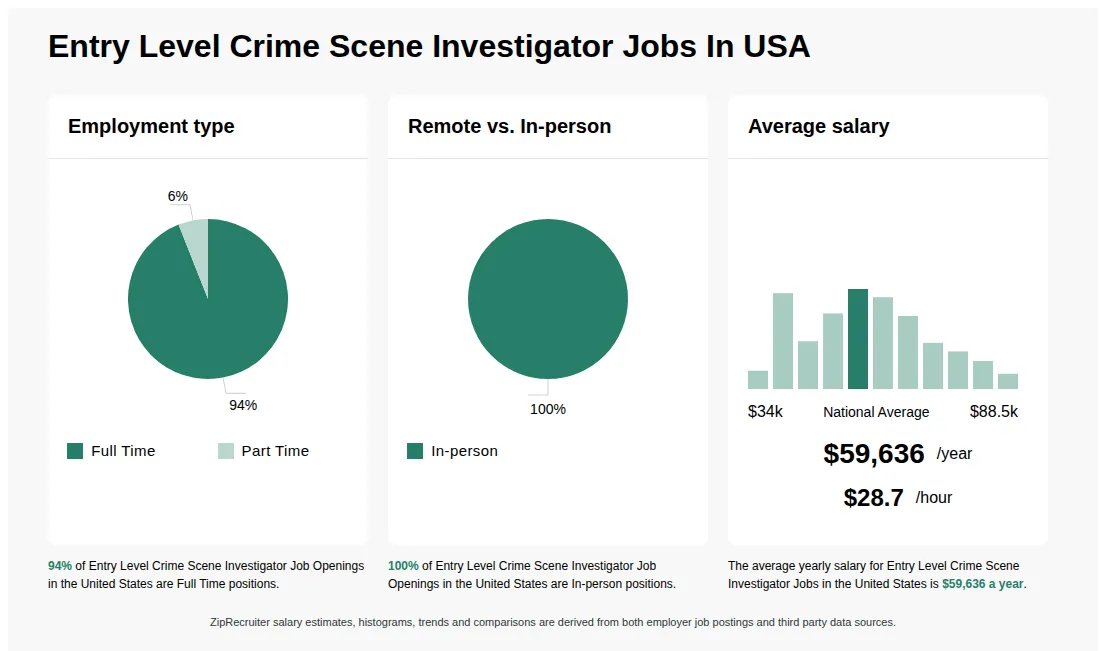
$34K - $39K
2% of jobs
$39K - $43.9K
16% of jobs
$48.5K is the 25th percentile. Wages below this are outliers.
$43.9K - $48.9K
7% of jobs
$48.9K - $53.8K
13% of jobs
The median wage is $57.5K / yr.
$53.8K - $58.8K
16% of jobs
$58.8K - $63.7K
15% of jobs
$66.2K is the 75th percentile. Wages above this are outliers.
$63.7K - $68.7K
12% of jobs
$68.7K - $73.6K
7% of jobs
$73.6K - $78.6K
5% of jobs
$78.6K - $83.5K
4% of jobs
$83.5K - $88.5K
2% of jobs
$34K
$59.6K
$88.5K
An entry-level crime scene investigator (CSI) identifies and collects evidence at a crime scene. In this role, your job is to document everything in the area of suspected criminal activity by taking pictures, recording measurements, and gathering information that may not be captured by images, such as weather conditions. As an entry-level employee, you undergo on-the-job training and work under the supervision of senior crime scene staff members and investigators. You may shadow veteran investigators for a while, observing how they extract and process evidence at the crime scene and back at the office; it is crucial to preserve evidence properly to ensure it does not become tainted.
| Aspect | Entry Level Crime Scene Investigator | Forensic Technician |
|---|---|---|
| Required Credentials | High school diploma or associate's; some roles prefer criminal justice or forensic science degrees | High school diploma; some roles require associate's or bachelor's in forensic science or related fields |
| Work Environment | Crime scenes, outdoor and indoor locations, often in unpredictable conditions | Laboratories, crime labs, or field sites; more controlled environment |
| Employer & Industry Usage | Law enforcement agencies, crime labs, forensic units | Crime labs, forensic laboratories, law enforcement support units |
While both roles support forensic investigations, Entry Level Crime Scene Investigators primarily collect evidence at crime scenes, whereas Forensic Technicians analyze evidence in labs. The roles often overlap in credentials and work environment, but their focus differs—fieldwork versus laboratory analysis.
Cities with the most Entry Level Crime Scene Investigator job openings:
The most popular types of Crime Scene Investigator jobs are:
States with the most job openings for Entry Level Crime Scene Investigator jobs include:
For Entry Level Crime Scene Investigator jobs, the most frequently searched job titles are:
Locates, labels, collects and preserves physical evidence present at crime scenes, traffic fatalities and search warrants. Processes evidence and crime scenes for latent prints. Incumbents in this classification are required to respond to crime scenes based on a rotating on-call schedule, including evenings, weekends, and holidays.
ESSENTIAL FUNCTIONS:Essential functions, as defined under the Americans with Disabilities Act, may include any of the following representative duties, knowledge, and skills. This is not a comprehensive listing of all functions and duties performed by incumbents of this class; employees may be assigned duties which are not listed below; reasonable accommodations will be made as required. The job description does not constitute an employment agreement and is subject to change at any time by the employer. Essential duties and responsibilities may include, but are not limited to, the following:
Education, training and Experience Guidelines
High School Diploma or equivalent. Three (3) years of full-time work experience as a Crime Scene Technician.
One (1) year (30 semester hours) of forensic science, criminal justice or related field, from an accredited college or university OR any equivalent combination of experience and training that provides the required knowledge, skills, and abilities may be substituted for one year of the required experience.
Applicant must be able to pass a background investigation, oral board, polygraph and psychological examination.
Knowledge of:This position will be a Monday through Friday schedule, from 8 a.m. to 5 p.m.
LICENSES AND CERTIFICATION REQUIREMENTS:Standing, sitting, walking, lifting, carrying, pushing, pulling, reaching, handling, fine dexterity, kneeling, crouching, crawling, bending, twisting, climbing, balancing, vision, hearing, talking, use of foot controls.
Exposed to chemicals used in processing evidence and crime scenes. Exposed to body fluids/blood at crime scenes and autopsies. May be subject to exposure to extreme weather conditions, hostile environments, infectious diseases, air and waterborne pathogens. Lifting up to 50 pounds.
Hiring Range: $31.42 - $39.36, hourly.